At a Glance (Architecture of Modern Power)
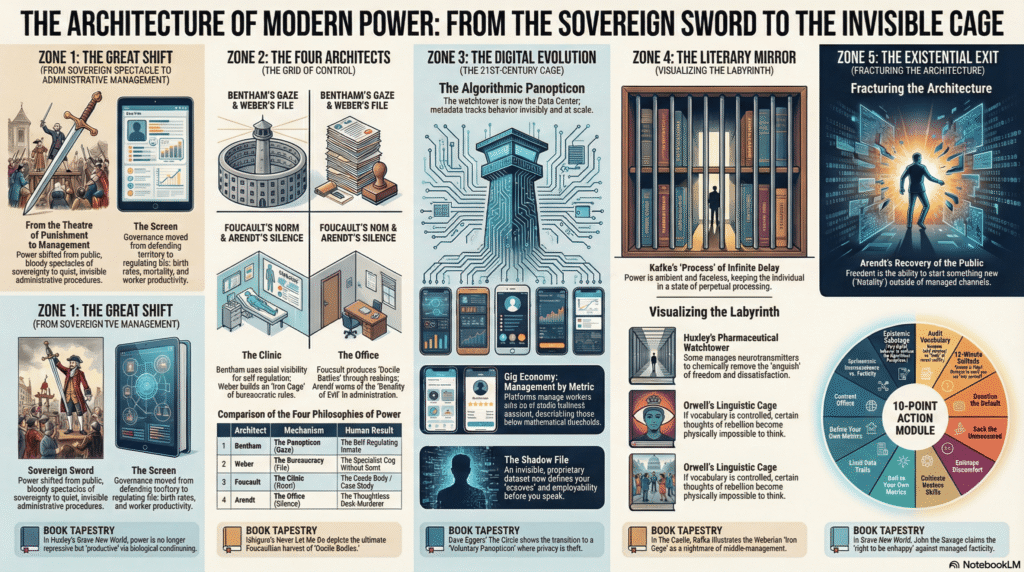
The architecture of Modern Power in the modern age has moved from the theatrical sword of the King to the invisible systems of the Architect. This pillar page explores the structural, psychological, and moral “cages” defined by Bentham, Weber, Foucault, and Arendt—mechanisms that attempt to define our essence through surveillance, bureaucracy, and normalization. By tracing these invisible architectures through the lens of dystopian literature, we uncover the ultimate existential challenge: how to reclaim radical freedom and personal responsibility within a system designed to manage the soul.
I. Introduction: From Sovereignty to System
The Theatre of Punishment: Sovereignty as Spectacle
In 1757, Robert-François Damiens was executed in Paris with ritualistic brutality. His body was drawn and quartered by horses before a massive crowd. This was not merely punishment; it was a theatre. As Michel Foucault demonstrates, in the “Sovereign” era, power was theatrical. The king’s authority was inscribed on the condemned body. Punishment was loud; it bled; it announced itself.1
Contrast this with a modern prison sentence or a digital fine. Gradually, the spectacle of pain has been replaced by administrative procedure. In the current era, power no longer manifests itself through violence; it operates through management.
From Territory to Population
Modern states shifted their attention from territory to population. The object of governance became life itself: birth rates, mortality, and productivity. Foucault called it Biopower. This is Biopower: a form of power concerned with regulated life.2 It “makes live and lets die.”
Invisible Architectures of Essence
Modern power does not primarily tell you what to do; it tells you what you are. You are categorized as employable or redundant, normal or deviant. These categories define our “essence” before we have the chance to exist for ourselves.
II. Bentham: The Physical Architecture (Visibility)
The Utilitarian Goal: The Felicific Calculus
Jeremy Bentham proposed a “felicific calculus” where human actions were variables in a mathematical equation.3 Law became engineering. The Panopticon emerges from this logic: surveillance is not cruelty; it is efficiency.
The Geometry of the Eye: Axial Visibility
The Panopticon’s power lies in geometry: a circular building with a central watchtower. Visibility is axial. The inmate behaves because he might be seen.4 This is Bentham’s silent revolution: Architecture produces morality.
Modern Parallel: The Digital Panopticon
The watchtower is now the data center; the inmate is the user. The digital Panopticon tracks behavior invisibly through metadata. The geometry persists: an asymmetry of knowledge where platforms know the user’s fears, but the user sees only curated outputs.
III. Weber: The Structural Architecture (Rationality)
The Protestant Roots of the Cage: From Salvation to Productivity
In The Protestant Ethic and the Spirit of Capitalism, Weber argues that modern rationalism is the secularized ghost of ascetic Protestantism. We no longer work to prove salvation to God; we work to prove efficiency to the system.5
The Disenchantment of the World (Entzauberung)
Rationalization replaces the “mysterious” with the “calculable.” In a disenchanted world, everything is manageable by administration. We have mastered the means of life while losing sight of its ends.
The Three Pure Types of Authority
Weber identifies three “Ideal Types” of authority:
- Obedience to the “Person” (The Hero).
- Traditional: Obedience to the “Past” (The King).
- Legal-Rational: Obedience to the “Office” (The Bureaucrat). Modernity is the story of Legal-Rationality swallowing the others. Predictability triumphs over myth.
The Bureaucratic Machine: Sine Ira et Studio
The defining characteristic of Weberian architecture is sine ira et studio—“without anger or passion.” The individual exists only as a Functionary.6 This produces the “Specialist without Spirit”—cogs who are good at being cogs but lose the ability to see the “Whole.”
IV. Foucault: The Psychological Architecture (Discipline)
The Micro-Physics of Power: Beyond the State
Power is a strategy operating in the smallest intervals of our lives: seating charts, timetables, and shifts. It doesn’t just “repress”; it “produces” Docile Bodies.7
The Anatomy of the Docile Body
Foucault identifies three primary techniques:
- Art of Distributions: Organizing space (enclosure and partitions).8
- Control of Activity: The Timetable—not a single moment is wasted.9
- Organization of Geneses: The Ranking—creating permanent competition.10
The Normalizing Gaze: The Birth of the Clinic
We became “Cases”11 measured against a Norm.12 If you fall outside the statistical average, the system “cures” you via therapy or re-education to pull you back toward the center of the curve. For example, the creature in Frankenstein is labeled simply as “a monster.” Once that label is attached to him, people no longer see his intelligence, loneliness, or desire for companionship. He is reduced to a category, and because society defines him as something inhuman, he is no longer allowed to live among other people.
The Examination and Confession
The Examination turns the individual into a permanent record (The File). Meanwhile, the Confessional Mode trains us to “tell our truth” to therapists and dating apps, helping the system categorize us more accurately. We become our own inquisitors.
V. Arendt: The Moral Architecture (Obedience)
The Crisis of the “Social”
Modernity collapsed the Private and Public spheres into the Social, where politics is replaced by Administration. We no longer “act”; we “behave.”
The Desk-Murderer: The Banality of Evil
Reporting on Adolf Eichmann, Arendt found not a monster, but a Bureaucrat. Eichmann was “terrifyingly normal,” a man who cared about train schedules, not human souls. Because he was a “small cog” in a chain of command, he felt he had no personal responsibility.13
Sprachregelung: Corrupted Language
The Nazi regime used Language Rules to reorganize reality. Modern “Corporate Speak” (e.g., “right-sizing” instead of “firing”) acts as a Moral Sound-Deadening Wall. You cannot judge what you cannot name.14
The Duty to Think: The Two-in-One
Thinking is the “Silent Dialogue” between me and myself. To Think is to step out of the march of the crowd.15 It is the ability to ask: “Can I live with myself if I do this?”
VI. The Book Tapestry: Architectural Deep Dives
1. Kafka’s The Castle: The Labyrinth
Power is a distance. K. navigates a middle-management nightmare where the “Iron Cage” is made of stolen time and infinite delays.
2. Gogol’s The Overcoat: The Bureaucratic Soul
Akaky Akakievich is so thoroughly defined by his role as a copier that when he loses his coat, he loses his essence.
3. Huxley’s Brave New World: The Fabricated Normal
Huxley’s World State is the ultimate staging ground for Biopower.
- Bokanovsky Process: Industrializing human essence.
- Soma: The pharmaceutical watchtower that manages neurotransmitters to remove “anguish.”
- The Savage: John claims the “right to be unhappy”—asserting Transcendence against Bio-Facticity.
4. Orwell’s Newspeak: The Linguistic Cage
If you control vocabulary, you make certain thoughts physically impossible to think.
- Animal Farm: Beyond a simple allegory of political corruption, Animal Farm serves as a chilling blueprint for how power infiltrates the very language and biology of the governed.
5. Eggers’ The Circle: Performance of Transparency
Mae Holland shows the transition from the Involuntary Panopticon (prison) to the Voluntary Panopticon (social media), where privacy is reframed as theft.
6. Kafka’s The Trial: The Horror of “Process”
Josef K. is arrested by a “Process” with no face. The “Iron Cage” is ambient, located in the rafters of everyday life.
7. Ishiguro’s Never Let Me Go: The Foucaultian Harvest (Apr 5, 2026 Scheduled)
The clones are the ultimate Docile Bodies. They are so normalized that they view their own organ harvest as a natural career path.
VII. Modern Applications: The 21st Century Cage
1. The Algorithmic Panopticon
The tower has been replaced by the Algorithm. Today, our “Shadow File” follows us, determining employability and credit-worthiness invisibly.
2. The Gig Economy: Management by Metric
Platform workers are managed by apps that function sine ira et studio. If your rating falls, you are “deactivated”—the ultimate triumph of Legal-Rational Authority.
3. Remote Work: Collapse of the Public Sphere
We have returned to the “Private Realm” of labor. The “plurality” Arendt prized is replaced by the Echo Chamber.
VIII. Conclusion: The Existential Exit Strategy
The architecture is merely our Facticity. It is the “situation” into which we are thrown.
1. Sartre’s Transcendence
Your data file is real, but consciousness is a “nothingness” that can say, “I am not that.” The exit begins when the bureaucrat realizes they are choosing to play a role.
2. Camus’s Revolt
Revolt is Persistent Lucidity. It is the refusal to let the Digital Panopticon be ambient. When you are aware of the gaze, it loses its power to normalize you.
3. Arendt’s Antidote: Recovery of the Public
Freedom is the ability to “start something new” (Natality). Reclaim the Public Square by engaging in speech and deed with others outside managed channels.
Drawing on Hannah Arendt’s concept of natality, this essay explores how P.D. James’s The Children of Men depicts the terrifying stability of a society governed by exhaustion and bureaucratic procedure.
IX. Action Module: 10 Ways to Fracture the Architecture
- Epistemic Sabotage: Intentionally vary digital behavior.
- Reject the Administrative Alibi: Reclaim the “I” in every decision.
- The 15-Minute Solitude: Engage in the silent dialogue of thought.
- Demand “Inefficiency”: Fracture the Iron Cage with a moment of “Magic.”
- Audit Your Vocabulary: Use language that reveals reality.
- Exercise “Natality”: Start something the system didn’t ask for.
- Embrace the “Abnormal”: Cultivate the parts of your essence that cannot be categorized.
- Reversal of the Medical Gaze: Insist on being a “Subject with a Story.”
- Lucid Consumption: Share data with intention.
- The Sisyphus Smile: Acknowledge the architecture, but refuse to mistake the bars for yourself.
X. Final Synthesis: Master of the Blueprint
Bentham builds the watchtower, Weber the file, Foucault the norm, and Arendt the silence. But a blueprint is not a life. The “Iron Cage” only stays locked as long as the prisoner believes they are a “Functionary.”
You exist first. You define your essence second. And in that gap, the architecture of modern power fails.
Further Reading: Analysis in The Book Tapestry
- The Weberian Labyrinth (The Trial): A descent into the cage where law is everywhere but justice is nowhere.
- The Gaze of Big Brother (1984): The synthesis of Benthamite visibility and Arendtian totalitarianism.
- Docile Essence (Never Let Me Go): How normalization leads to the voluntary sacrifice of the soul.
The Professional Alibi (The Remains of the Day): The quintessential study of “Bad Faith” in a single life.
Notes
- Michel Foucault, Discipline and Punish: The Birth of the Prison, Second Vintage Books edition, trans. Alan Sheridan (Vintage Books, a division of Random House, Inc, 1995), 45–51. ↩︎
- Michel Foucault, Society Must Be Defended: Lectures at the Collège de France, 1975-76, ed. Michael Senellart, trans. Graham Burchell (Picador, 2003), 242–53. ↩︎
- Jeremy Bentham, An Introduction To The Principles Of Morals And Legislation (1907; The Clarendon Press, n.d.), 29–31. ↩︎
- Jeremy Bentham, Panopticon; or, The Inspection House: Containing the Idea of a New Principle … (1791; T. Payne, n.d.), 21–42. ↩︎
- Max Weber, The Protestant Ethic and the Spirit of Capitalism, trans. Talcott Parsons, with University Of California (Charles Scribner’s Sons, 1930), 79–128. ↩︎
- Max Weber, Economy and Society: An Outline of Interpretative Sociology, ed. Guenther Roth and Claus Wittich (University of California press, 1978), 973–1005. ↩︎
- Foucault, Discipline and Punish, 135–73. ↩︎
- Ibid, 141–48. ↩︎
- Ibid, 148–54. ↩︎
- Ibid, 154–60. ↩︎
- Michel Foucault, The Birth of the Clinic, 3rd ed., trans. A. M. Sheridan (Presses Universitaires de France; Routledge, 2012), ix–xxi. ↩︎
- Foucault, Discipline and Punish, 183–84. ↩︎
- Hannah Arendt, Eichmann in Jerusalem: A Report on the Banality of Evil, with Amos Elon (Penguin Books, 2006), 19–26. ↩︎
- Arendt, Eichmann in Jerusalem, 126–36. ↩︎
- Hannah Arendt, The Life of the Mind: One/Thinking, Two/Willing, one-vol.ed, trans. J. B. Leishman and Stephen Spender, A Harvest Book (Hartcourt, 1976), 185–93. ↩︎
Bibliography
Arendt, Hannah. Eichmann in Jerusalem: A Report on the Banality of Evil. With Amos Elon. Penguin Books, 2006.
Arendt, Hannah. The Life of the Mind: One/Thinking, Two/Willing. One-vol.Ed. Translated by J. B. Leishman and Stephen Spender,. A Harvest Book. Hartcourt, 1976.
Bentham, Jeremy. An Introduction To The Principles Of Morals And Legislation. 1907; The Clarendon Press, n.d.
Bentham, Jeremy. Panopticon; or, The Inspection House: Containing the Idea of a New Principle … 1791; T. Payne, n.d.
Foucault, Michel. The Birth of the Clinic. 3rd ed. Translated by A. M. Sheridan. Presses Universitaires de France. Routledge, 2012.
Foucault, Michel. Discipline and Punish: The Birth of the Prison. Second Vintage Books edition. Translated by Alan Sheridan. Vintage Books, a division of Random House, Inc, 1995.
Foucault, Michel. Society Must Be Defended: Lectures at the Collège de France, 1975-76. Edited by Michael Senellart. Translated by Graham Burchell. Picador, 2003.
Weber, Max. Economy and Society: An Outline of Interpretative Sociology. Edited by Guenther Roth and Claus Wittich. University of California press, 1978.Weber, Max. The Protestant Ethic and the Spirit of Capitalism. Translated by Talcott Parsons. With University Of California. Charles Scribner’s Sons, 1930.