There is a podcast posting for the short version of this essay. Please go to the bottom of this page for the podcast link.
At a Glance
In a world where infertility has transformed the state from a political “polis” into an administrative “hospice,” resistance is no longer a matter of grand revolution, but of systemic sabotage. Drawing on Hannah Arendt’s concept of natality, this essay explores how P.D. James’s The Children of Men depicts the terrifying stability of a society governed by exhaustion and bureaucratic procedure. By reframing the arrival of a single child not as a redemptive “fix” but as a radical “possibility,” we uncover a powerful lesson for our own era of demographic anxiety and digital apathy: that freedom depends not on the certainty of a cure, but on the courageous willingness to begin again.
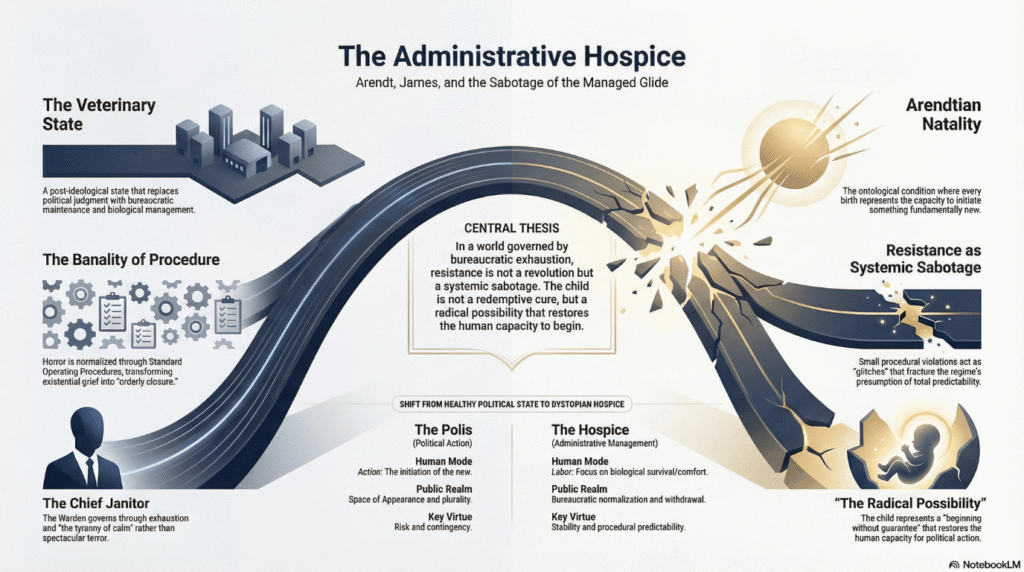
I. Introduction: The Political Autopsy
Infertility in P.D. James’s The Children of Men is not merely a biological catastrophe; it is a political autopsy. James does not depict a civilization collapsing in fire or shattering under the weight of ideological frenzy. England does not descend into spectacular tyranny. Instead, it settles. It stabilizes. It manages. In a world where no child has been born for decades, the response is not panic, but quiet administration.1 The nation does not implode; it slides toward extinction under the weight of procedural supervision.
The Arendtian Anchor: Natality as Ontology
This “glide” marks a crisis deeper than demographic decline. It reveals the sterility of the public realm itself. In the absence of birth, more than the population disappears; the human capacity to begin is extinguished. Hannah Arendt termed this capacity natality—the ontological condition that each human birth represents the arrival of someone fundamentally new, an actor capable of initiating “action” and altering the shared world.2 For Arendt, natality is the bedrock of politics. It is not reproduction as biology, but beginning as a mode of being.
Politics exists because humans are not merely living organisms; they are beings who act. Action, however, requires plurality: the condition in which individuals appear before one another as distinct and irreplaceable actors.3 The public realm—Arendt’s “space of appearance“—is the arena where this plurality becomes visible. It is where speech and deed reveal who someone is, rather than merely what they are.4
Subversion in the Post-Ideological State
In James’s dystopia, infertility is devastating because the conditions for political action have already eroded. Without the arrival of newcomers, the horizon of “the new” collapses. The future is administratively foreclosed. Citizens withdraw from the friction of public engagement into the anesthesia of private endurance. As the space of appearance shrinks, what remains is not ideological fanaticism, but bureaucratic maintenance.
The England of the Warden is therefore not a classical totalitarian regime driven by mass mobilization. It is something colder: a post-ideological administrative state that governs through exhaustion rather than terror. Stability replaces conviction; procedure replaces judgment. Despair is not suppressed—it is normalized.
In such a world, resistance cannot take the form of traditional revolution. There is no fiery uprising, no grand ideological confrontation. Instead, rebellion appears as an interruption. Theo Faron’s transformation is not a rise to heroic spectacle, but a movement toward radical responsibility. His actions—a series of small procedural violations—reinstate contingency into a system built upon predictability.5 In Arendtian terms, he does not overthrow a regime; he reopens the possibility of the political.
The pregnancy at the center of the narrative is not a form of redemption. It does not promise structural repair or historical salvation. Rather, it is something more destabilizing: a beginning without guarantee. It forces the state and its citizens to confront the “unexpected” once again, exposing the fundamental fragility of political life.
The Children of Men offers more than a survival story; it is a meditation on the sabotage of a managed glide toward extinction. Its final gesture is not triumph, but exposure. In that exposure, Arendt’s insight remains decisive: Politics does not promise redemption. It offers only the recurring, fragile possibility of beginning.6
II. Veterinary State: From Polis to Hospice
The Dissolution of the Shared World
If natality is the ontological ground of politics, its disappearance in The Children of Men does not merely threaten extinction; it dissolves the “world” as a shared space of appearance. Hannah Arendt insists that the public realm is not simply a physical square, but a condition in which individuals disclose themselves through speech and action.7 The “world,” in her sense, is the durable web of relationships and institutions that outlasts any single life, providing the stage for plurality. When this world collapses, human beings do not cease to exist, but they cease to act politically.
In James’s England, the public realm has not been violently demolished; it has withered. Citizens have retreated from collective engagement into the private management of comfort. The town square has given way to the sitting room; deliberation has surrendered to distraction. The polis—the site of freedom—becomes indistinguishable from the oikos—the ancient household sphere concerned strictly with necessity and survival. Politics, which requires risk and exposure, is replaced by the maintenance of biological well-being. In a society without children, the future ceases to function as a shared horizon. Without newcomers to inherit the world, the incentive to preserve or renew it erodes into a sterile present.
Hospice Labor: The Reversion to Animal Laborans
This retreat marks a profound shift in the human condition. Arendt distinguishes between labor (cyclical biological processes), work (the production of durable objects), and action (the initiation of the new).8 Action alone is the reality of politics. In the absence of natality, action loses its footing. The population reverts to what Arendt calls animal laborans—beings preoccupied almost exclusively with health, safety, and the rhythmic requirements of bodily life.9
James’s dystopia is saturated with this reversion. Citizens obsess over comfort and quiet, even as their biology fails them. The paradox is devastating: society is organized around the preservation of life precisely when life can no longer reproduce itself. The state’s clinics, inspections, and rituals of euthanasia are not signs of ideological fervor, but of biological management. The state has become veterinary in its orientation, supervising a species in terminal decline. The political question—“What kind of world shall we build?”—is replaced by the administrative mandate: “How shall we manage the remainder?”
The Chief Janitor and the Tyranny of Calm
In this context, the Warden’s authority does not resemble an Orwellian spectacle. He is not a theatrical tyrant demanding love or fear; he is a more subdued, and therefore more stable, figure. He is the Chief Janitor of a dying order. His legitimacy arises from his capacity to provide calm in the face of inevitability. Stability becomes the ultimate virtue; order becomes the only consolation. He does not promise renewal; he promises a smooth descent.
This managerial posture reframes the nature of tyranny. It is not animated by grand ideology or mobilized hatred, but by procedural normalization. Immigration quotas, fertility regulations, and the Quietus ritual are not eruptions of rage, but instruments of containment. The Warden does not seek to ignite passion; he seeks to eliminate disruption. In a society convinced of its own end, this administrative coldness appears as a form of mercy.
Arendt warns that the gravest danger to the public realm is not chaos, but the reduction of politics to administration.10 When action disappears, management fills the void. The Veterinary State emerges not from spectacular violence, but from the quiet collapse of plurality. Authoritarian administration becomes unnecessary to enforce; it simply becomes the most efficient arrangement for a terminal society. The transformation from polis to hospice is complete. Politics, which once revolved around shared beginnings, is reduced to the careful supervision of endings. What remains is not tyranny in its dramatic form, but the tranquil, terrifying management of decline.
III. The Paperwork of Horror: Ritualized Humiliation
The Banality of the Bureau
If the Veterinary State supervises biological decline, it does so not through spectacle, but through procedure. The cruelty in The Children of Men is rarely theatrical; it is administrative. Its force lies not in visible brutality, but in normalization. What would otherwise appear as a profound moral rupture is translated into the neutralizing language of paperwork.
Hannah Arendt’s analysis of Adolf Eichmann provides a disturbing framework for this mechanism. In Eichmann in Jerusalem, Arendt describes the “banality of evil” not as monstrous sadism, but as bureaucratic thoughtlessness—a refusal to judge beyond the confines of regulation.11 The administrator does not perceive himself as a perpetrator; he perceives himself as a functionary. The horror lies in this absence of passion. When cruelty becomes procedural, it ceases to feel like cruelty to those who implement it.
Normalization as Control: The Scheduled End
James’s England operates within this relentless logic. Fertility checks, immigration quotas, and reproductive surveillance are framed not as exceptional violence, but as rational governance. The humiliation of women is couched in the vocabulary of biological necessity. Refugees are processed through categories rather than encountered as persons. Each act of degradation is absorbed into the steady rhythm of administration.12
This translation—from moral shock to Standard Operating Procedure (SOP)—is the state’s central instrument of control. Once horror becomes policy, outrage dissipates. The act no longer appears as a scandal; it appears as compliance. Citizens adjust not because they approve, but because the language of procedure dissolves moral friction. As Arendt observed, modern domination is most effective when responsibility is diffused across a system rather than concentrated in a visible tyrant.13
The Quietus ritual represents the culmination of this transformation. It is not a clandestine extermination, but a curated public ceremony. The state does not suppress despair; it integrates it. Suicide is reframed as civic participation. Rather than denying hopelessness, the regime aestheticizes it with music, order, and collective solemnity. Death is scheduled; the end is curated. The Quietus converts existential grief into orderly closure, transforming what should be the spark of revolution into the final movement of the managed glide.14
The Sojourner as the “Non-Person”
This procedural cruelty extends most starkly to the “Sojourners”—the refugees seeking survival on England’s shores. Here, Arendt’s The Origins of Totalitarianism becomes decisive. She argues that the refugee reveals a terrifying paradox: stripped of citizenship, the stateless person loses the very “right to have rights.” Without a political community, the individual becomes administratively invisible.15
The Sojourners embody this condition. They are the only figures in the novel still striving toward life, still moving toward possibility. Yet, they are treated as surplus matter—detained, transported, or expelled as systemic waste. Their presence disrupts the state’s managed narrative of terminal stability. Because they lack political standing, they cannot “appear” within the public realm. They exist biologically, but they are dead politically.
This exclusion is structural. A regime governing decline cannot tolerate genuine striving, for action threatens predictability. The refugee, seeking continuation, embodies the stubborn persistence of natality. The state responds not with rage, but with classification.
In Arendt’s account, total domination aims to eliminate spontaneity and reduce human beings to predictable specimens.16 In James’s dystopia, spontaneity is not crushed through terror, but absorbed through procedure. Persons become files; suffering becomes logistics; death becomes a timetable. The paperwork of horror thus bridges the Veterinary State to the Saboteur. In a world where humiliation has been normalized, resistance cannot begin as a dramatic insurrection. It must first recover the capacity to judge—to recognize that a procedure is, in fact, an atrocity. Only when the language of administration is interrupted can true action emerge.
IV. The Saboteur: Interrupting the Managed Glide
The Glitch in the Machine
If the Veterinary State governs through exhaustion and procedural normalization, resistance cannot assume the form of spectacle. There is no tyrant demanding theatrical confrontation; there is only a system operating on the inertia of predictability. In such a regime, disruption appears not as revolution, but as error.
Theo Faron’s transformation, therefore, should not be described as a rise to heroism, but as a transition to responsibility. At the novel’s outset, Theo exemplifies the “administrative citizen”: reflective yet detached, conscious yet resigned. He inhabits the managed glide without contesting it, his drift mirroring the very political withdrawal Arendt diagnosed in the modern age. What changes is not his capacity for violence, but his willingness to assume exposure.
Hannah Arendt defines Action as the introduction of the “new” into the world—an initiative that breaks the chain of automatic processes.17 Action is miraculous not because it is supernatural, but because it interrupts necessity. In a bureaucratic order, necessity takes the form of procedure: forms must be filed, checkpoints observed, quotas enforced. The system persists by assuming the infinite repetition of the status quo.
Small Refusals as Seismic Acts
Theo’s resistance unfolds within this grammar of repetition. He forges documents, travels without authorization, and shelters a body that should not exist. None of these gestures is traditionally dramatic; they are administrative violations. Yet, precisely because the regime depends upon total compliance, even minor refusals generate systemic disturbance.
The refusal to participate in the Quietus, the willingness to move outside permitted routes, and the protection of the pregnancy constitute a form of administrative sabotage. Theo does not storm institutions; he destabilizes their assumptions. The state presumes that tomorrow will resemble yesterday, that no child will ever appear, and that no citizen will risk intervention. Extinction is meant to proceed smoothly. Theo’s actions fracture that presumption.
The pregnancy itself intensifies this fracture. It should not exist within the system’s logic. For decades, infertility has structured every policy and every psychological adaptation. The child is not initially a symbol of hope; it is a category error. It cannot be processed according to established precedent. It is, in administrative terms, an anomaly that the machine was never programmed to resolve.
Contingency vs. Predictability
Here, Arendt’s conception of natality becomes concrete. Every birth represents the capacity to begin anew,18 yet such a beginning does not arrive as triumph—it arrives as contingency. The presence of the child forces a choice: either absorb the anomaly into the procedure (turning it into a state asset) or acknowledge the re-emergence of the unpredictable.
Bureaucracy seeks to eliminate contingency, aiming to transform the future into a mere projection of the past. Theo’s protection of the pregnancy refuses that transformation. He denies the state the opportunity to convert birth into a managed asset. In doing so, he does not guarantee renewal; he merely preserves possibility.19
This distinction is decisive. Theo does not overthrow the Veterinary State; he interrupts it. His sabotage reintroduces uncertainty into a polity structured around inevitability. In Arendtian terms, he restores the condition under which “Action” may once again occur.20 The miracle is not the victory, but the unpredictability.
The saboteur thus emerges not as a revolutionary hero, but as a figure of reappearance. Through small refusals, he reclaims agency within a system that had rendered agency obsolete. The managed glide is no longer seamless. A variable has entered the equation. The question that remains is not whether the regime will fall, but whether the “space of appearance” can reopen. That reopening depends not on structural reform, but on the preservation of the unexpected. Theo does not promise redemption; he protects the possibility of beginning.
V. The Ending: The Risk of the Reluctant Foounder
The Founding of a Space
The conclusion of The Children of Men resists catharsis. There is no triumphant uprising, no mass awakening, and no structural dismantling of the Veterinary State. Instead, there is a gesture: Theo Faron takes the Warden’s ring.21 This scene has often been read as a mere succession—a handoff of authority from one ruler to another. Yet, such a reading risks collapsing the novel’s philosophical subtlety into a conventional political transition. Theo’s gesture is not primarily administrative; it is spatial.
To understand its significance, one must return to Arendt’s account of political founding. For Arendt, power is not synonymous with rule. Rather, power arises wherever people act in concert to establish a space in which appearance becomes possible.22 Founding, therefore, does not consist in inheriting an office, but in inaugurating a realm where action may occur. The legitimacy of such a founding derives not from procedural continuity, but from its relation to the “Beginning.”
Theo’s acceptance of the ring does not signal an ambition to manage decline more efficiently. Instead, it marks a recognition that authority must now be oriented toward protection rather than supervision. He assumes the symbol of office not to preserve the administrative order, but to secure the child’s right to “appear” in the world as a distinct political being. In Arendtian terms, he shifts the axis of legitimacy from Stability to Natality.
This shift is fraught with danger. Arendt consistently warned that every founding moment contains a fundamental ambiguity: the same act that opens a space of freedom may solidify into a new form of domination if institutionalized without vigilance.23 Theo’s gesture is precarious. By taking the ring, he risks the repetition of the past—the transformation of a new beginning back into mere administration. Yet, to refuse that responsibility would be to abandon the fragile possibility now embodied in the child.
The Sea as the Boundless Frontier
The novel’s ambiguity is deliberate. It does not celebrate Theo as a triumphant ruler, but presents him as a reluctant witness. His authority derives not from conquest, but from proximity to birth. He stands at the threshold between extinction and contingency, resembling what Arendt calls the “actor” rather than the sovereign—one who initiates a process but cannot control its ultimate outcome.24
The movement toward the sea intensifies this symbolism. The land in James’s dystopia is managed, partitioned, and regulated; it is the terrain of quotas and checkpoints. The sea, by contrast, is unbounded and unpredictable. It resists administration, and it offers no guarantee of survival and no map of assured passage. It is, quite literally, exposure.
For Arendt, “Action” is similarly boundless. Once initiated, it escapes the control of its originator and enters the web of human relationships, where consequences proliferate far beyond the actor’s intention.25 The sea thus mirrors the condition of politics itself: uncertain, contingent, and radically open.
The ending’s refusal of closure is not a narrative deficiency, but a masterpiece of philosophical precision. There is no assurance that the child will inaugurate a renewal of the species.26 There is no promise that Theo’s founding will not ossify into another administrative regime. What exists is only the reintroduction of unpredictability.
The risk of the reluctant founder is therefore twofold: to act is to endanger stability, while to refuse to act is to preserve extinction. Theo chooses the risk. In doing so, he does not redeem the world. He restores its exposure. And exposure, for Arendt, is the necessary condition of freedom.
VI. Contemporary Reflection: Redemption vs. Possibility.
The Redemptive Fantasy
The unsettling force of The Children of Men lies not in its dystopian premise, but in its refusal to console. Contemporary political discourse, by contrast, is saturated with redemptive expectations. Demographic decline is addressed through tax incentives and “optimization.” Institutional fatigue is met with managerial reform. Technological acceleration is framed as something to be stabilized through further innovation. The prevailing instinct is therapeutic: decline must be fixed, systems must be recalibrated, and equilibrium must be restored. This redemptive fantasy operates on the presumption that history can be administratively resolved.
In such a framework, politics is reduced to a matter of technical adjustment. Policy tweaks promise recovery; technology promises efficiency; leadership promises stabilization. The citizen’s role is diminished to mere compliance within a process of improvement. Redemption is externalized; it is expected to arrive through the hands of experts.
The Arendtian Exposure
Hannah Arendt’s political thought resists this managerial orientation. While she does not deny the necessity of institutions, she refuses to treat politics as an engineering problem. For Arendt, the essence of politics lies not in maintenance, but in Beginning.27 A beginning cannot be managed into certainty, nor can it be guaranteed by design. It emerges only when individuals assume responsibility for action without the arrogance of a guaranteed outcome.
The ending of James’s novel embodies this Arendtian exposure. There is no structural reform; there is no triumphal restoration. The birth does not “redeem” the system, nor does it secure demographic recovery. Institutional decay remains, but the birth introduces risk.28 This is precisely what makes the narrative philosophically honest.
Redemption offers consolation, promising that history bends toward repair and that crisis culminates in restoration. Possibility offers no such comfort. It confronts us with the fragility of political life, insisting that renewal depends not upon inevitability, but upon willingness.
The Burden of Agency
In a culture increasingly oriented toward “managed fixes”—toward technological saviorism, algorithmic governance, and procedural optimization—the temptation is to seek security in control. Yet control, when pursued as an end in itself, quietly erodes the space of action. If citizens believe that systems will eventually correct themselves, agency recedes. If decline is framed as either irreversible collapse or guaranteed recovery, personal responsibility dissolves.
Apathy thrives in both extremes. If the redemptive fantasy reassures us that “someone else will fix it,” action becomes unnecessary. If the collapse narrative convinces us that “nothing can be done,” action becomes futile. Both narratives remove the burden of beginning.
Willingness to Begin Again
James’s fragile ending refuses both temptations. The child does not guarantee victory. The sea does not promise safe passage. Theo does not inaugurate a perfect order. What remains is exposure—the re-emergence of unpredictability within a managed world.
Arendt insists that action is boundless and irreversible; once begun, it escapes the control of its initiator.29 This lack of guarantee is not a defect of politics, but its very condition. Freedom consists not in the certainty of success, but in the capacity to initiate despite uncertainty.
If The Children of Men offers a lesson for the present, it is not that demographic crisis must be reversed at any cost, but that political vitality depends upon the preservation of agency. Systems may be necessary, and administration may be inevitable, but when procedural management replaces judgment and stability becomes the highest good, the public realm contracts.Apathy is not overcome by victory; it is interrupted by willingness. To begin again, without assurance of success, is the only antidote to managed decline. The novel’s final gesture does not redeem history. It restores exposure. And in that exposure, political life becomes possible once more.
Podcast:
Notes
- P. D. James, The Children of Men (Knopf Doubleday Publishing Group, 1992), 4–5. ↩︎
- Hannah Arendt et al., The Human Condition, Second edition (The University of Chicago Press, 2018), 8–10. ↩︎
- Ibid, 7–8. ↩︎
- Ibid, 199–200. ↩︎
- Ibid, 175–246. ↩︎
- Ibid, 175–81. ↩︎
- Ibid, 49–58. ↩︎
- Ibid, 7–21. ↩︎
- Ibid, 117–25. ↩︎
- Arendt et al., The Human Condition, 40–45. ↩︎
- Hannah Arendt, Eichmann in Jerusalem: A Report on the Banality of Evil, with Amos Elon (Penguin Books, 2006), 19–26. ↩︎
- James, The Children of Men, 58–60. ↩︎
- Arendt, Eichmann in Jerusalem, 126–36. ↩︎
- James, The Children of Men, 51–80. ↩︎
- Hannah Arendt and Anne Applebaum, The Origins of Totalitarianism (Mariner Book Classics, 2024), 298. ↩︎
- Arendt and Applebaum, The Origins of Totalitarianism, 441. ↩︎
- Arendt et al., The Human Condition, 175–81. ↩︎
- Ibid, 7–21. ↩︎
- James, The Children of Men, 237–39. ↩︎
- Arendt et al., The Human Condition, 185–91. ↩︎
- James, The Children of Men, 239. ↩︎
- Arendt et al., The Human Condition, 198–206. ↩︎
- Ibid, 212–14. ↩︎
- Ibid, 175–81. ↩︎
- Ibid, 189–91. ↩︎
- James, The Children of Men, 239–41. ↩︎
- Arendt et al., The Human Condition, 175–81. ↩︎
- James, The Children of Men, 239–41. ↩︎
- Arendt et al., The Human Condition, 189–91. ↩︎
Bibliography
Arendt, Hannah, Danielle S. Allen, and Margaret Canovan. The Human Condition. Second edition. The University of Chicago Press, 2018.
Arendt, Hannah. Eichmann in Jerusalem: A Report on the Banality of Evil. With Amos Elon. Penguin Books, 2006.
Arendt, Hannah, and Anne Applebaum. The Origins of Totalitarianism. Mariner Book Classics, 2024.
James, P. D. The Children of Men. Knopf Doubleday Publishing Group, 1992.