The Book Tapestry

From the pages to the mind—woven with care.

Menu
  • Home
  • Blog
  • Privacy Policy
  • About Me
Menu

The Soul as the Prison of the Body: The Perfection of Power

Posted on April 5, 2026March 12, 2026 by Sophia Wordsmith

Blog Summary

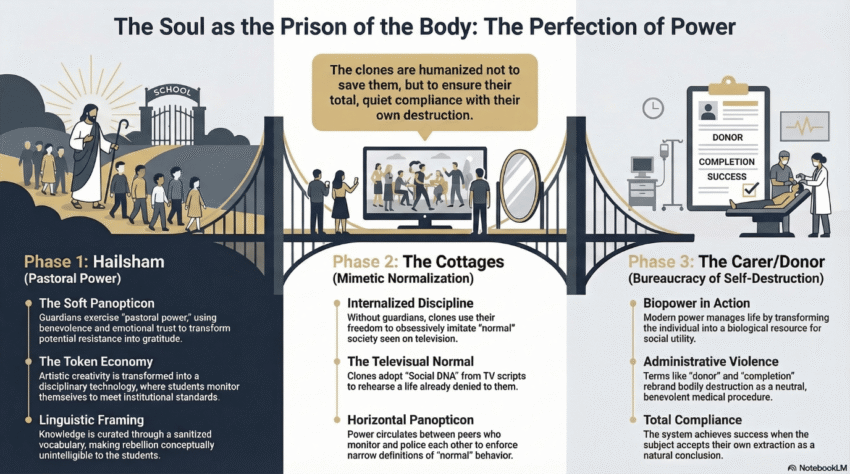
This analysis explores how the world of Never Let Me Go functions as a perfect Foucaultian system, where power is exercised not through horizontal violence, but through the meticulous shaping of the clones’ identities. By examining the transition from the “pastoral” discipline of Hailsham to the bureaucratic self-destruction of the donor phase, the essay reveals how the clones are humanized specifically to ensure their total, quiet compliance. Ultimately, the “completion” of the system is found in Kathy H. herself—a subject who understands her exploitation yet accepts it as the only natural conclusion to her life.

Introduction: The Paradox of the Non-Rebellion

Kazuo Ishiguro’s Never Let Me Go presents one of the most unsettling dystopias in contemporary literature, not for its cruelty, but for its quietude. The novel follows Kathy H., a “student” at the idyllic English boarding school of Hailsham, as she navigates a life designed for a single, terminal biological purpose: the “donation” of her organs to sustain the lives of others.1

Yet, the true horror of Ishiguro’s world is the absence of visible coercion. There are no barbed wire fences, no armed guards, and no dramatic escape attempts. Instead, Kathy and her peers, Tommy and Ruth, walk toward what the system calls “completion” with a haunting resignation.2 This paradox—the lack of rebellion in the face of systemic liquidation—serves as the novel’s central philosophical tension. Traditional dystopian narratives, from 1984 to The Hunger Games, rely on overt violence or constant surveillance. In Ishiguro’s world, however, power is far more architectural. The clones’ compliance is not a product of fear, but of their very constitution. Raised within institutions that curate their desires and limit their vocabularies, they do not revolt because they cannot conceive of a life outside the system that defines them. For the students of Hailsham, the institution is not a prison; it is the horizon.

The Foucaultian Lens: Producing the Docile Body

To understand this phenomenon, we must turn to Michel Foucault’s analysis of disciplinary power. In Discipline and Punish, Foucault argues that modern power does not merely repress individuals; it produces them. Through the meticulous techniques of surveillance, normalization, and repetitive training, institutions create what he famously termed “docile bodies”—subjects that are simultaneously useful to the state and politically obedient.3

When viewed through this lens, Ishiguro’s clones are the ultimate triumph of a refined disciplinary system. Their obedience is a carefully manufactured byproduct of educational structures, moral narratives, and “filtered” knowledge. Hailsham functions as a laboratory of social conditioning where the “discipline” of the institution is so thoroughly internalized that external force becomes redundant. The tragedy of the novel lies not just in the eventual harvesting of organs, but in the systematic construction of an identity that renders resistance unimaginable.

Biopower and the Administrative Life

This control is further illuminated by Foucault’s concept of biopower.4 Unlike the “sovereign power” of old, which exercised authority through the right to take life, modern biopower operates by managing life itself. It regulates populations through medical classification and the optimization of bodies for social utility. In this framework, the individual is transformed into a biological resource.

The very language of the novel reflects this administrative transformation: terms like “donor,” “carer,” and “completion” rebrand bodily destruction as a medical procedure.5 Violence is sanitized, disappearing behind the neutral, benevolent vocabulary of healthcare and service. Ultimately, rebellion is impossible because the system has colonized the clones’ subjectivity. By examining the key spaces of their lives—from Hailsham to the clinical finality of the donation centers—we see how Ishiguro’s dystopia mirrors Foucault’s most chilling insight: the most effective power is that which is invisible, shaping individuals who willingly participate in their own subordination.6

Hailsham: The Micro-Physics of Early Discipline

Far from being a conventional school, Hailsham functions as a meticulously designed disciplinary institution. It is here that identities are molded, expectations are defined, and the imagination is bounded. Through the subtle mechanics of observation, reward, and linguistic framing, Hailsham produces individuals whose behavior aligns with institutional goals without the need for overt coercion.7

The Soft Panopticon: Surveillance as Pastoral Care

Foucault famously utilized Jeremy Bentham’s model of the Panopticon to illustrate how modern institutions achieve power through constant, asymmetric visibility. Hailsham reflects a “softened” version of this architecture.8 The students are not confined by literal towers, but by a system of continuous observation disguised as benevolent care. The “Guardian” functions not as a warden, but as a protective figure, embodying pastoral power—a form of authority derived from the metaphor of the shepherd guiding a flock.9 By cultivating trust and emotional attachment, the Guardians transform potential resistance into a sense of gratitude. Obedience emerges naturally from a sense of emotional loyalty to the institution that exists, ultimately, to exploit them.10

The Token Economy: Discipline Through Reward

One of the most revealing mechanisms of control at Hailsham is the system of “Tokens” and “Sales.” Students earn currency through artistic or creative output, which they then exchange for personal items.11 On the surface, this appears to be a generous allowance for individuality. However, it is a sophisticated disciplinary technology. By tying rewards to approved behavior, the institution transforms creativity into measurable value. The student becomes their own monitor, continually evaluating their output against institutional standards to secure their place in the social hierarchy.

Knowledge, Language, and the Limits of Resistance

The most absolute mechanism of control lies in the management of information. The students are introduced to the truth of their future in fragments, always mediated through a carefully curated vocabulary. This reflects Foucault’s insistence that power and knowledge are inseparable.12 Terms like “donor” and “completion” reframed organ harvesting as a form of social duty and administrative milestone. Death is not an act of violence but a logical conclusion to a service contract. Because the clones never acquire the vocabulary to interpret their situation as “injustice,” rebellion becomes conceptually unintelligible.

The Gallery: The Extraction of the Interior

While Hailsham disciplines the bodies of the students, the institution also reaches into the interior life. Crystallized in the mystery of the “Gallery,” this process represents a preliminary harvest: the extraction of the interior. Creativity and imagination are gathered, evaluated, and preserved. Long before their physical anatomy is harvested, their inner selves have already been transformed into institutional property.

The “First Donation”: Symbolic Harvesting Through Art

The culture of Hailsham encourages students to externalize their private thoughts through art.13 This encouragement masks a darker utility. In retrospect, the act of collecting art resembles a symbolic form of donation. The students offer up pieces of their imagination, believing these works represent their unique “souls.” Yet, once removed, these artworks become objects of institutional analysis.

The Gallery as a Scientific Archive

When the truth is revealed, it becomes clear that the Gallery was a moral experiment to prove the clones possessed “souls.”14 Yet, this justification carries a chilling Foucaultian implication: if society required artistic proof of humanity, then that humanity had already been placed in doubt. The Gallery operates less like a museum and more like a scientific archive, where creativity is treated as a data point in an ongoing inquiry15: do these artificially created beings possess the same moral capacities as “normals”?

The Deferral: Hope as a Mechanism of Control

The Gallery also sustains the potent myth of the “deferral”—the rumor that two clones who can prove they are truly in love might receive a temporary postponement. This belief is a totalizing security mechanism. Rather than fostering rebellion, hope directs the students’ desires toward institutional validation. They do not challenge the system; they ask the “Master” for a temporary exception.

The Shudder: The Somatic Failure of the Narrative

A brief scene carries extraordinary weight: Madame enters a room and suddenly recoils at the sight of the children. The reaction is immediate and visceral; she shudders as though confronted with something monstrous. This is the “glitch in the machine.” Madame’s bodily reaction briefly exposes the emotional truth that the gentle language of Hailsham seeks to conceal. Her nervous system responds to the clones as “abject” objects—biological crops—contradicting the “humane” narrative of the school.16 Madame’s shudder captures the friction produced when the category of the “abnormal”17 collides with the undeniable evidence of the clones’ humanity.

The Cottages: The Mimetic Stage of Control

After Hailsham, the students move to the Cottages. At first glance, this appears to be a stage of liberation—the Guardians are gone, and schedules are loose. However, this disappearance of formal supervision does not lead to genuine agency. The clones carry the psychological architecture of Hailsham within them.18

The Illusion of Liberation and the Televisual Normal

Foucault argues that the most effective systems of discipline operate through internalization.19 The clones do not use their freedom to escape; they use it to imitate the routines of “normal” society, specifically the office workers seen on television. They are rehearsing scripts for a life that has already been denied to them.

The Peer-to-Peer Panopticon

In the absence of Guardians, the students themselves assume the role of regulators. Power circulates horizontally. Through social cues and the threat of exclusion, they monitor one another, enforcing narrow definitions of “acting adult.” The community develops its own system of surveillance, ensuring that the normative framework of Hailsham survives without a single guard in sight.

The Carer Phase: The Bureaucracy of Self-Destruction

The “Carer” phase reveals the final, chilling perfection of the system. By assigning clones to supervise one another’s decline, the institution transforms the victims into the administrators of their own destruction.

This is the manifestation of horizontalized power.20 Carers monitor recovery and ensure the Donor remains viable for the next harvest, effectively assisting in the maintenance of a system that will soon claim their own lives. Violence disappears behind a neutral, procedural mask. The system has achieved its most efficient form: the Panopticon is no longer a building; it is a social relationship.

Conclusion: The Success of “Completion”

The true terror of Never Let Me Go is that the clones are not dehumanized to make their exploitation possible; they are humanized to make their compliance complete.

By giving the clones memories, art, and identities, the system produces Total Subjects who understand their own destruction as the natural fulfillment of their lives. The system achieves its greatest triumph not through violence, but through the quiet shaping of individuals who can no longer imagine any alternative to the world that has been built to consume them. The success of “completion” is not simply the extraction of a heart or a lung; it is the creation of a subject who accepts that extraction as the natural end of their story.

Notes

  1. Kazuo Ishiguro, Never Let Me Go, First intern. ed (Vintage, 2006), 3–6. ↩︎
  2. Ibid, 276–179. ↩︎
  3. Michel Foucault, Discipline and Punish: The Birth of the Prison, Second Vintage Books edition, trans. Alan Sheridan (Vintage Books, a division of Random House, Inc, 1995), 135–37. ↩︎
  4. Michel Foucault, Society Must Be Defended: Lectures at the Collège de France, 1975-76, ed. Michael Senellart, trans. Graham Burchell (Picador, 2003), 239–63. ↩︎
  5. Ishiguro, Never Let Me Go, 3–6. ↩︎
  6. Michel Foucault, The History of Sexuality, 1st American ed, trans. La Volonte de savoir, Social Theory, 2nd Edition (Pantheon Books, 1978), 135–37. ↩︎
  7. Ishiguro, Never Let Me Go, 13–111. ↩︎
  8. Foucault, Discipline and Punish, 199–203. ↩︎
  9. Michael Foucault, Aesthetics, Method, and Epistemology, Gallimard 1994 Compilation, ed. James D. Fubion and Paul Rabinow, trans. Robert Hurley (The New Press, 1998), 79–80. ↩︎
  10. Ishiguro, Never Let Me Go, 13–111. ↩︎
  11. Ibid 37–45. ↩︎
  12. Foucault, The History of Sexuality, 100–102. ↩︎
  13. Ishiguro, Never Let Me Go, 37–45. ↩︎
  14. Ibid, 252–55. ↩︎
  15. Foucault, Discipline and Punish, 180–91. ↩︎
  16. Ishiguro, Never Let Me Go, 32–36. ↩︎
  17.  Michel Foucault, Abnormal: Lectures at the Collège de France 1974 – 1975, ed. Valerio Marchetti, trans. Graham Burchell, Lectures at the Collège de France (Verso, 2003), 55–60. ↩︎
  18. Ishiguro, Never Let Me Go, 115–55. ↩︎
  19. Foucault, Discipline and Punish, 199–203. ↩︎
  20. Ibid, 199–203. ↩︎

Bibliography

Foucault, Michel. Discipline and Punish: The Birth of the Prison. Second Vintage Books edition. Translated by Alan Sheridan. Vintage Books, a division of Random House, Inc, 1995.

Foucault, Michel. The History of Sexuality. 1st American ed. Translated by La Volonte de savoir. Social Theory, 2nd Edition. Pantheon Books, 1978.

Foucault, Michel. Society Must Be Defended: Lectures at the Collège de France, 1975-76. Edited by Michael Senellart. Translated by Graham Burchell. Picador, 2003.

Foucault, Michael. Aesthetics, Method, and Epistemology. Gallimard 1994 Compilation. Edited by James D. Fubion and Paul Rabinow. Translated by Robert Hurley. 2 vols. The New Press, 1998.

Foucault, Michel. Abnormal: Lectures at the Collège de France 1974 – 1975. Edited by Valerio Marchetti. Translated by Graham Burchell. Lectures at the Collège de France. Verso, 2003.

Ishiguro, Kazuo. Never Let Me Go. First intern. ed. Vintage, 2006.

Category: Philosophical Logic

Leave a Reply Cancel reply

Your email address will not be published. Required fields are marked *

About Me

I’m Sophie, a cross-disciplinary reader who treats books like puzzle boxes. I read literature through history, philosophy, psychology, and science—then weave the threads together. Welcome to my tapestry.

Categories

  • Announcements
  • Narrative Psychology
  • Philosophical Logic
  • Social Forces Shaping Literature
©2026 The Book Tapestry