Blog Summary
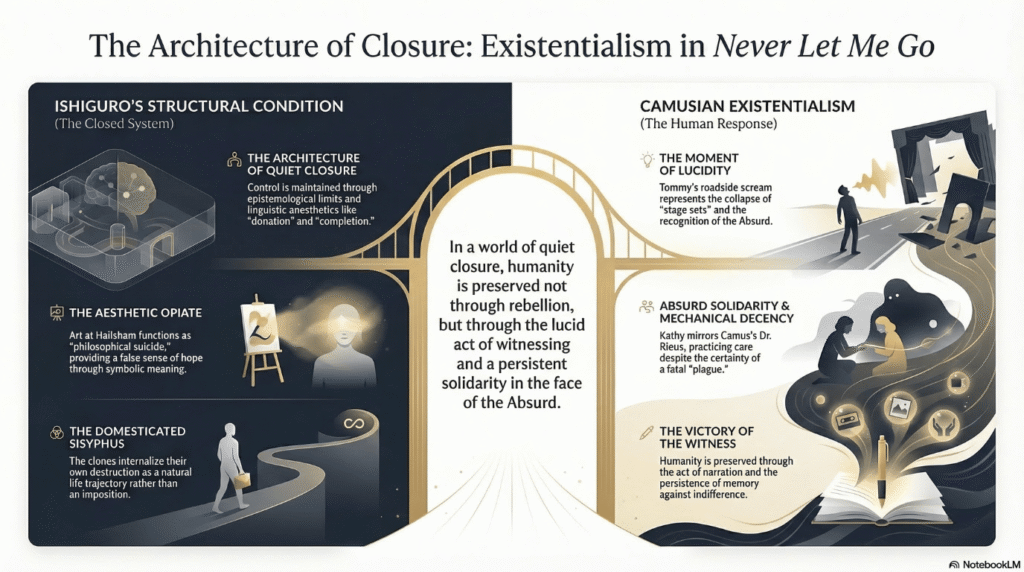
Drawing on the existential philosophy of Albert Camus, this essay explores how Kazuo Ishiguro’s Never Let Me Go constructs a “closed system” that replaces overt oppression with psychological habitation. By analyzing the clones’ transition from the “aesthetic opiate” of their art program to Tommy’s eventual moment of roadside lucidity, we see a profound shift from systemic conditioning to an ethics of absurd solidarity. Ultimately, the novel suggests that while the clones cannot dismantle their deterministic fate, Kathy’s act of witnessing preserves a “quantity of experience” that asserts their humanity in the face of an indifferent world.
This content is restricted to site members. If you are an existing user, please log in. New users may register below.