Life inside a medieval Abbey, Monks, Knowledge, Poverty, and Power in The Name of the Rose
When I started reading The Name of the Rose, I thought I was reading a medieval murder mystery. Instead, I ended up investigating life inside medieval abbeys and monasteries, theological conflicts, manuscript culture, inquisitors, poverty movements, and even medieval food.
This happens to me often with books. One small detail opens a trapdoor, and suddenly I am reading historical documents from the Library of Congress at midnight while questioning how ordinary medieval villagers even learned the Bible in the first place.
This research milestone focused on one simple question:
What was life actually like inside a medieval abbey?
And the deeper I investigated, the more I realized the abbey was not merely a religious building. It was an entire civilization compressed into stone walls.
Ora et Labora — Pray and Work
The foundation of Benedictine monastic life comes from the famous phrase:
Ora et Labora — Pray and Work.
The system originated from the Rule of St. Benedict, created by Benedict of Nursia around the sixth century. Later, the rule spread across Europe and became one of the foundations of Western monastic life.
I examined digitized medieval manuscripts from the University of Oxford and immediately wondered something practical:
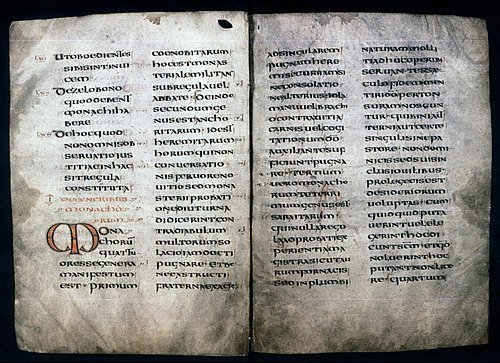
If books were expensive, handwritten, and rare, how did ordinary people learn about God?
Most villagers could not access manuscripts directly. Literacy itself was limited. My assumption is that religious understanding spread primarily through:
- priests
- wandering preachers
- sermons
- oral storytelling
- church rituals
If this is true, then control over interpretation becomes incredibly important. Whoever speaks to the villagers shapes their understanding of truth.
Suddenly, Brother William’s warning in the novel makes far more sense:
“The simple cannot choose their personal heresy…”1
The Discipline of Monastic Life
I also investigated modern Benedictine life through the website and videos from Saint Joseph’s Abbey. Surprisingly, many elements still resemble medieval rhythms. And, I love how they live in such a disciplined way. Look at the link below to find Horarium. The amazing part is that this is their ordinary life. This is something I must learn.
Our Day – Saint Joseph’s Abbey
The monks:
- rise before sunrise
- balance prayer and labor
- clean
- cook
- grow food
- meditate
- maintain physical discipline
One abbot explained that all work done for brothers and sisters is equally important. That statement stayed with me.
The abbey was not designed for comfort or self-expression. It was designed for:
- order
- discipline
- continuity
- devotion
Even daily labor became a spiritual practice.
Roles in Abbey
The Abbot: The Architect of Order
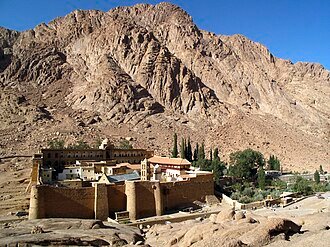
The abbot is not simply a spiritual guide. He is a ruler inside the abbey.
His responsibilities include:
- overseeing prayer and discipline
- managing land and finances
- resolving disputes
- negotiating with outside Church authorities
A strong abbot maintains balance between:
- obedience
- knowledge
- survival
- order
A weak abbot risks fragmentation. This became particularly interesting after reading parts of the Summa Theologiae. Thomas Aquinas feels intellectually disciplined. He encourages structured inquiry rather than blind fear. Yet in Eco’s abbey, some figures use orthodoxy as a mechanism of control rather than understanding.
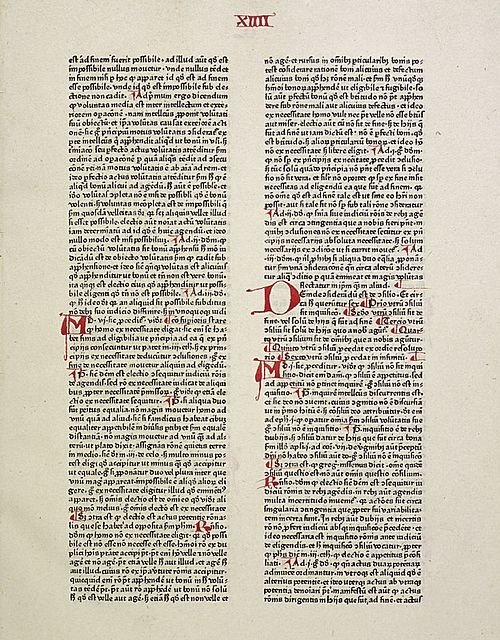
That distinction matters enormously.
The Librarian: Guardian of Dangerous Knowledge
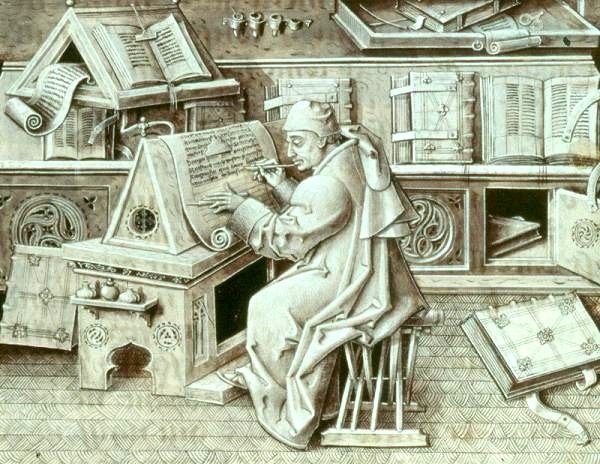
The role that fascinated me most was the librarian. In the modern world, libraries symbolize openness. In the medieval world, libraries could symbolize restriction.
Books were:
- rare
- expensive
- copied by hand
- potentially dangerous
To control books was to control interpretation itself.
The librarian:
- cataloged manuscripts
- restricted access
- supervised copying
- preserved knowledge across generations
This immediately reminded me of Michel Foucault and the relationship between knowledge and power. In The Name of the Rose, the library is not merely a storage. It is a mechanism of controlled truth. And this raises one of the novel’s most unsettling questions: What happens when the librarian controls truth more than the abbot? The danger is not simply censorship. The danger is defining what counts as truth in the first place.
The Novice: The Unformed Mind
The novice fascinated me for a different reason. It is because the Narrator is a Novice.
The novice is:
- trained
- observed
- corrected
- reshaped through repetition
His education focuses less on innovation and more on preservation. This led me to an important realization: Medieval questioning differs from modern questioning.
Modern mindset:
- questioning discovers truth
Medieval mindset:
- questioning clarifies already existing truth
This distinction completely changed how I understood the abbey. The fear was not questioning itself. The fear was uncontrolled interpretation.
Poverty, Hunger, and Reality
One of the most disturbing parts of the novel involves poverty. The Franciscans preach holy poverty. Yet Eco constantly places theological ideals beside physical suffering.
There are stories of:
- famine
- violence
- desperation
- social collapse
And then there is the nameless girl. She is not presented romantically. She exchanges her body because she is hungry.2 That changed how I understood the Franciscan debates.
Chosen poverty inside a monastery is very different from:
- starvation
- social vulnerability
- survival outside the abbey walls
Eco quietly asks a brutal question:
Can institutions built around spiritual ideals truly understand material suffering?
Brother William Between Aquinas and Ockham
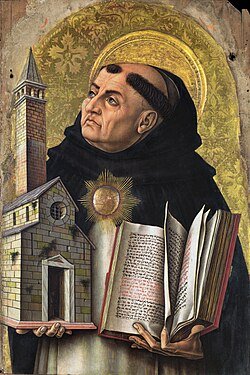
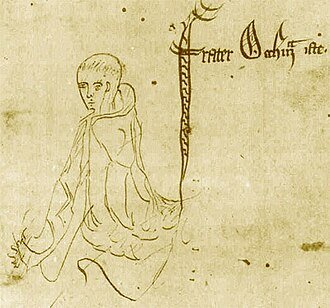
One of the strongest findings from this investigation is that William of Baskerville feels intellectually positioned somewhere between:
- Thomas Aquinas
- William of Ockham
William values:
- disciplined inquiry
- rational observation
- controlled interpretation
Unlike rigid inquisitors, he does not rush toward certainty through fear. That distinction became clearer after studying historical figures like Fra Dolcino, whose radical poverty movement eventually descended into instability and violence.3 Brother William understands something crucial: Ideas spread through people. And ordinary villagers often cling to whichever preacher reaches them first. Suddenly, controlling interpretation becomes politically and spiritually explosive.
The Abbey as a Self-Contained Civilization
The deeper I investigated, the more I realized the abbey mirrors a complete social structure:
- Abbot → Authority
- Librarian → Knowledge
- Novice → Continuity
- Herbalist → Survival
The monastery was simultaneously:
- spiritual
- intellectual
- educational
- practical
It functioned almost like a miniature civilization. And perhaps that is why The Name of the Rose feels so alive.
Eco does not romanticize the medieval world. He fills it with:
- hunger
- fear
- manuscripts
- politics
- discipline
- desire
- theology
- death
The result is not a fantasy Middle Ages. It feels disturbingly human.
Next in the Queue
My next research milestone will focus on:
Church Hierarchy vs. Monastic Structure
Church (Macro Level)
- Pope
- Cardinal
- Archbishop
- Bishop
Monastery (Micro Level)
- Abbot
- Prior
- Librarian
- Monks
- Novices
The key realization so far:
These are two overlapping power systems, not one.
Note:
- Umberto Eco, The Name of the Rose, trans. Richard Dixon (Gruppo Editoriale, 1983; repr., HarperCollins Publisher, 2014), 214. ↩︎
- Ibid, 262–67. ↩︎
- Ibid, 241–50. ↩︎