Blog Summary
This blog reinterprets Mary Shelley’s Frankenstein through a Sartrean lens, reframing the Creature’s tragedy not as a failure of science, but as a crisis of existentialist abandonment. It explores how the Creature, “condemned to be free” in a social vacuum, is denied the recognition and structural support necessary to construct a meaningful essence. Ultimately, it argues that Victor’s true crime is “philosophical negligence”—the refusal to take responsibility for a consciousness he unleashed into a world that refuses to look at it.
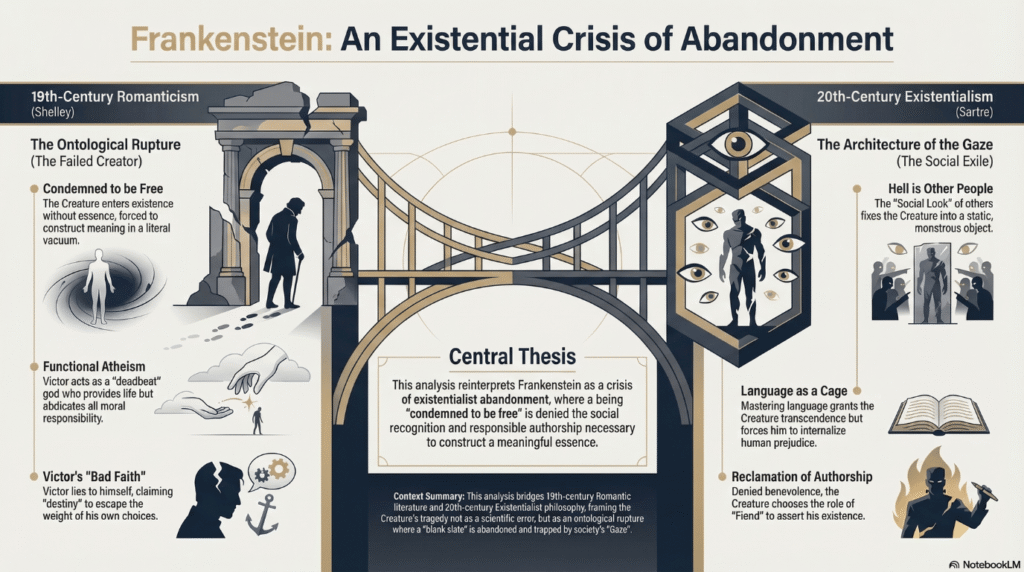
Introduction: The Ontological Rupture
In one of the most haunting sequences in Frankenstein, the act of creation is followed not by wonder, but by flight. Having succeeded in animating lifeless matter, Victor Frankenstein immediately recoils from his work and abandons it.1 The Creature awakens not into a world of guidance or recognition, but into a profound silence. There is no instruction, no naming, and no moral framework—there is only existence itself.2 This moment represents more than a trope of Gothic horror; it is an ontological rupture. The Creature is brought into being and, in the same instant, cast into a reality devoid of inherent meaning, structure, or care.
“Condemned to be Free” in a Literal Vacuum
This scene finds a chilling resonance in Jean-Paul Sartre’s assertion that human beings are “condemned to be free”.3 For Sartre, to exist without a predetermined essence—to be a “blank slate”—is the defining condition of humanity. We are tasked with constructing ourselves through choice in a world that offers no roadmap.
Yet, Mary Shelley dramatizes a more radical, terrifying version of this existential vacuum. The Creature enters existence without language, social standing, or any framework through which his freedom might become meaningful. His tragedy is not merely the burden of self-definition, but that his every attempt to do so is hijacked by the “Gaze” of others. Before he can even begin to construct an identity, society fixes him into a “monstrous essence,” arresting his freedom before it can truly begin.4
The Failure of the “Functional” Creator
The philosophical tension deepens when we shift our focus to Victor, who acts not as a divine creator but as a failed one. While he provides the spark of life, he abdicates the responsibilities of creation: care, instruction, and recognition.5 The result is a state of “functional atheism”. The Creature exists in a world where its “God” is alive, yet functionally absent in every moral sense.
This situation is arguably more destabilizing than the classical existential condition. In a world where God is dead, the vacuum of meaning is a shared human burden. But in the Creature’s world, his God has not died; he has simply fled. This abandonment intensifies the absurdity of his existence, demanding a moral responsibility from the Creature that was never modeled for him by his maker.6
Ultimately, Frankenstein is less a cautionary tale about scientific overreach and more a meditation on the conditions under which freedom becomes unbearable. The Creature is not born a monster; he is born as pure potential. However, in a world that reduces that potential to horror, his freedom collapses into a desperate struggle against an imposed identity. He is trapped in a paradox: free to define himself, but never permitted to succeed.7
But raw existence cannot remain silent for long. To move from a ‘being-in-itself’—a mere object of biology—to a ‘being-for-itself,’ the Creature requires the primary tool of human consciousness: language. Yet, as he soon discovers, this gift of speech is a Trojan horse.
The Language Paradox: The Second Creation
One of the most unsettling dimensions of Frankenstein is not merely that the Creature learns, but the velocity and voracity with which he does so. Emerging as a literal tabula rasa, he acquires language, literacy, and moral awareness with a speed that defies biological realism. Yet, this rapid development is not a mere narrative convenience; it is the novel’s most profound philosophical mechanism. The true horror lies not in how he learns, but in what the act of learning does to his burgeoning soul.
Language as Facticity: The Inherited Map
Through a Sartrean lens, language is a primary component of facticity—the “given” conditions into which a consciousness is thrown.8 We do not invent language from a vacuum; we inherit it as a preexisting architecture that dictates how we perceive, categorize, and evaluate the world. For most, this inheritance provides the tools to construct a meaningful life. For the Creature, however, language is a double-edged sword: it is simultaneously the vehicle of his transcendence and the bars of his cage.
On one edge, language elevates him from mere animal existence to self-conscious subjectivity. Before the world, he is a prisoner of pure sensation—hunger, cold, light, and pain.9 Language grants him the capacity for abstraction, the ability to differentiate between the “was” and the “will be,” and the power to imagine possibilities beyond his immediate horizon. In Sartrean terms, he transforms from a being-in-itself (a reactive object) into a being-for-itself—a subject capable of projection, reflection, and radical choice.10
The “Insidious” Edge: Internalizing the Gaze
Yet, this same tool carries a second, more lethal edge. In mastering human language, the Creature unwittingly internalizes human categories—and, by extension, human judgments. Words like “beautiful,” “good,” and “beloved” are not neutral descriptors; they are value-laden constructs that presuppose a specific type of body and a specific mode of belonging.
By the time the Creature acquires the conceptual framework to navigate these terms, he realizes he is already excluded from them. This is a tragedy of structural timing: he masters the language of humanity before he can comprehend his exile from the human race.11
This fracture is most agonizing when he encounters his own reflection. While a pool of water reveals his physical difference, it is language that transmutes that difference into “monstrosity.” The distinction is decisive: physical difference is a biological fact, but monstrosity is a social judgment. Without the word “monster,” he is simply a being; with it, he is an abomination.
Transcendence as Entrapment
In this light, language functions as a “Second Creation.” Victor Frankenstein animated the flesh, but it is the De Lacey family, observed from the shadows, who unwittingly furnish the mind. Through them, the Creature acquires a moral universe structured by sympathy and beauty—a universe fundamentally incompatible with his own existence.12
The Creature’s education is not a liberation; it is a fracture. His consciousness is formed within a system that defines him negatively from the outset. Language grants him the power to transcend his immediate condition, but it binds him to a set of values that render his own being intolerable. He does not merely learn to speak; he learns to judge, and ultimately, to judge himself. In inheriting the tools of humanity, he inherits its exclusions. The mind he gains does not reconcile him to his body—it turns him into his own most cruel observer.
If language provided the Creature with the intellectual map to navigate his existence, it also pointed him toward a singular, glaring omission on that map: the figure of his Creator. It is not enough to have words; one must have an author to hold accountable for the ‘situation’ those words describe.
The Creator vs. The God: The Ethics of Abandonment
At first glance, Victor Frankenstein appears to occupy a traditionally “divine” position: he commands the spark of life where none existed. Yet, this apparent divinity collapses the moment the Creature opens its eye. Unlike the deity of classical theology—who sustains, judges, and remains present—Victor creates only to withdraw.13 It is not an act of ongoing authorship, but of immediate abdication. He is less a transcendent god than a “deadbeat” scientist, a figure who grasps for the power of creation while recoiling from its consequences.
The Presence of an Absent God
This distinction becomes razor-sharp when read alongside Sartre’s Existentialism is a Humanism. Sartre famously argues that even if God were to exist, it would not absolve humans of the terrifying responsibility to define themselves; existence would still precede essence.14 Meaning is never handed down; it is constructed through action.
However, Shelley complicates this framework. The Creature is not faced with the “silence of the universe” or the simple absence of God; he is faced with a creator who is physically present but morally vacant. This transforms the existential condition into something far more unstable. In the Creature’s world, “God” exists, but he has fled. This is not the “death of God”15 that Nietzsche or Sartre navigated, but the cowardice of God. The Creature is left in a state of “functional atheism,” tasked with the burden of self-definition in a world where his origin is known but his purpose is denied.
From Devotion to Indictment
Crucially, the Creature’s response to Victor is not one of worship, but of accusation. When they finally confront one another in the glacial heights of the Alps, the Creature’s language is not that of a devotee, but of a prosecutor. He does not seek a blessing; he demands a reckoning.16
In Sartrean terms, the Creature reframes Victor as the “Author of his Situation.” Victor has unilaterally determined the Creature’s facticity—his towering height, his translucent skin, and his inherent isolation. These are not conditions the Creature chose; they were imposed. The Creature’s indictment rests on a simple, devastating premise: to create a “Being-for-itself” (a conscious freedom) is to incur an absolute obligation to that freedom.17 Victor wants the glory of the laboratory but refuses the “commitment” (the engagement) required to help a new consciousness navigate its reality.
Victor’s “Bad Faith” and the Denial of Choice
Victor’s failure is a textbook study in Bad Faith (mauvaise foi). For Sartre, bad faith is the act of lying to oneself to escape the weight of responsibility—pretending one is a victim of “circumstance” or “fate” rather than a product of choice.18 Throughout the novel, Victor wraps himself in the shroud of the tragic hero, claiming he is “fated” to be miserable or that his ambition was a “destiny” he could not resist.19
This is a strategic self-deception. By casting himself as a victim of “Nature,” Victor can ignore the fact that the Creature is a direct consequence of his own agency. He attempts to inhabit the role of “Creator” in the moment of triumph, yet flees the role of “Caretaker” the moment it demands a sacrifice of his comfort. He treats the act of creation as a singular event rather than an ongoing ethical relationship.
Ultimately, Frankenstein exposes a tension that extends far beyond the lab or the pulpit: the act of bringing life into the world cannot be separated from the obligation to sustain it. Victor’s sin was never that he “played God.” His sin was that he refused to accept what even a godless universe demands: that any existence, once brought into being, carries with it an unavoidable responsibility. In denying this, Victor does not transcend human limits; he merely exemplifies our most dangerous form of evasion.
However, the failure of the Creator is only the first layer of the Creature’s exile. Even if Victor had remained, the Creature would still have to contend with the wider human world—a world where identity is not granted by the self, but presided over by the ‘Gaze’ of the Other.
Hell is Other People: The Architecture of the Gaze
If language provides the skeleton of the Creature’s world, it is the presence of the Other that provides its suffocating skin. In Frankenstein, two moments crystallize this transformation: the Creature’s encounter with his own reflection and his aborted attempt to join the De Lacey household.20 Together, they illustrate Sartre’s most famous existentialist haunting—the power of “The Look” to fix a free, fluid subject into a static, frozen object.21
The Mirror and the Social Look
The Creature’s encounter with the pool of water marks his first descent into objectification. For the first time, he sees himself not as a “Self” experiencing sensations of hunger or warmth, but as a “Thing” that can be perceived and judged.22 However, a reflection in isolation is merely a biological fact. It is only when this physical awareness is filtered through the Social Look of others that difference curdles into condemnation.
The De Lacey family—whom the Creature has secretly served with firewood and admired from the shadows—becomes the site of this tragic alchemy.23 Despite his benevolent “projects”—easing their labor and mastering their tongue—their reaction to his physical presence is instantaneous, violent rejection. In that moment, the Creature’s internal reality (a being of kindness and longing) is annihilated by the external reality of the “Other.”
The Fixed Identity: Doing vs. Being
Here, Sartre’s claim that “identity is constituted through action” encounters a devastating distortion.24 The Creature acts with undeniable goodness: he labors, he observes, he learns, and he seeks connection. In a vacuum, these actions would define him as “virtuous.” Yet, these actions are not recognized by the human gaze; they are reinterpreted through the lens of his appearance.
His “doing” is overridden by his “being-seen.” His gift of wood is dismissed as an intrusion; his plea for protection is read as a threat. The Gaze of the Other does not merely observe his actions—it re-authors them. This is the structural pivot of the novel: the Creature is not born evil, but he is situated in a world where the only available interpretation of his existence is negative. He is named “Monster” before he is permitted to become anything else.
The Internalization of the Fiend
The consequence of this imposed essence is a gradual, agonizing internalization. The Creature realizes that within the human social contract, he is a “non-being.”25 This is not just an external problem; it reshapes his very soul. Sartre suggests that if we are denied recognition as a human subject, our attempts to act humanely lose their gravity.
When the Creature finally turns toward violence26, it is not a spontaneous descent into “original sin.” It is a transformation structured by the lack of recognition. He adopts the role of the “Fiend” because it is the only stable identity society will allow him to inhabit. If he cannot be the “Good Neighbor,” he will be the “Total Destroyer.” In Sartrean terms, he moves from being defined by others to actively embodying that definition—a tragic assertion of agency within the narrowest possible confines.27
Hell as a One-Way Mirror
In this way, Frankenstein radicalizes Sartre’s insight that “Hell is other people.” The torment is not simply that others limit our freedom, but that they can define us so totally that our freedom becomes intelligible only through the role they impose.
The Creature’s tragedy lies in the fact that the human Gaze is a one-way mirror. He sees their humanity, but they see only his “it-ness.” He is trapped in a vision he did not create, forced to live out an essence he did not choose. Hell is not just the presence of others—it is the refusal of others to see the “Me” behind the “That.”28
Trapped in a social hell where he is perpetually defined as a fiend, the Creature eventually stops resisting the label. If the ‘Look’ of the Other is a prison, the only remaining act of freedom is to set the prison on fire. Here, both Victor and his creation enter a dance of ‘Bad Faith’—one fleeing responsibility, the other embracing a destructive essence to avoid the agony of being nothing at all.
The Mirror of Bad Faith: Fate vs. Agency
As the narrative of Frankenstein descends into a relentless pursuit across the glacial wastes, the relationship between Victor and his Creature is often framed as a simple struggle between victim and aggressor. Yet, this traditional reading obscures a deeper, more unsettling philosophical symmetry. Both figures, in their own way, grapple with what Sartre calls Bad Faith (mauvaise foi)—the deceptive refusal to acknowledge the absolute freedom and responsibility inherent in their actions.29
Victor’s Evasion: The Language of Fate
Victor’s trajectory is a masterclass in existential cowardice. Having unleashed a new consciousness into the world, he spent the remainder of his life reinterpreting his choices as inevitabilities. He speaks the language of “fatum,” “curses,” and “destiny,” effectively displacing his agency onto abstract, cosmic forces.
However, through a Sartrean lens, this posture is untenable.30 At every critical juncture—the initial animation, the flight from the laboratory, the refusal to create a mate, and the final chase—Victor acts. These are not accidents of fate; they are radical decisions.31 By casting himself as a “victim of circumstance,” Victor is not describing his condition; he is deploying a strategy of evasion. He inhabits Bad Faith by denying his own authorship of the situation, pretending he is an object moved by the universe rather than a subject moving within it.
The Creature’s Choice: Identity Through Destruction
The Creature’s path presents a more complex and unsettling case. Unlike Victor, he does not cloak his actions in the language of destiny. He embraces them. The murders he commits are not framed as misunderstandings, but as deliberate, scorched-earth assertions of his existence.
In the absence of a “pre-existing essence”—having been denied the roles of son, friend, or citizen—the Creature confronts a terrifying ontological void. It is here that the logic of his violence becomes intelligible. If “positive” identities are systematically barred, even a “negative” identity offers a form of coherence. To be a “Monster” by choice is, paradoxically, more stable than to be nothing at all.
He chooses to become the “Fiend” not because it reflects his nature, but because it provides a determinate form to his indeterminate existence. In choosing to be a murderer, he asserts himself as a Being-for-itself—a consciousness that acts, decides, and leaves an indelible, if horrific, trace upon the world.32
Recognition Through Terror
This does not absolve the Creature of moral weight, but it reframes the structural “Why” of his crimes. His violence is not merely reactive; it is constitutive. Each act of destruction is an act of self-definition—a way of forcing recognition from a world that has refused to look him in the eye.
If he cannot be seen as human through benevolence, he will be seen through terror. For the existential subject, recognition—even in the form of fear—is preferable to the non-existence of invisibility.
A Tragic Convergence
Ultimately, Victor and the Creature navigate the same existential terrain from opposite poles. Victor denies his freedom by retreating into the safety of “Fate,” while the Creature affirms his freedom in its most destructive, radical form. One flees responsibility; the other embraces it without limit. The result is a tragic convergence: a creator who refuses to own his actions, and a creation who defines himself through them, even when those definitions lead to total ruin.
This dance of evasion and vengeance can only sustain itself as long as there is a world to haunt. As the chase moves toward the absolute zero of the North Pole, the social roles of ‘Master’ and ‘Monster’ finally strip away, leaving two raw freedoms to collide in the silence of the Arctic void.33
Conclusion: The Arctic and the Architecture of Nothingness
The final movements of Frankenstein unfold far from the structured constraints of Geneva or the domestic warmth of the De Lacey cottage. Instead, the narrative terminates in the desolate, white expanse of the Arctic—a landscape stripped of community, hierarchy, and social meaning. At this geographic and philosophical edge, all roles dissolve. There are no families to provide a name, no institutions to confer status, and no “Others” to fix the self through a judgmental gaze.
What remains is a confrontation with what Sartre identifies as Nothingness: the bare, unadorned condition of existence without external definition.34 The ice is not merely a setting; it is the novel’s logical endpoint. It is a vacuum where the systems that once imposed a monstrous identity have vanished, leaving only the raw consciousness of the creator and the created.
Reclaiming the End: The Final Act of Agency
In this void, the Creature performs his final, most radical act. Having been denied the power to define his beginning, his physical form, and his place in the human story, he claims absolute authority over his end. His decision to mount the funeral pyre is not an “escape” in the traditional sense; it is a profound assertion of Sartrean Agency.
If his life was a series of imposed meanings and rejected “projects,” his death becomes the one domain in which he can act without the mediation of the human Gaze. It is an exercise of freedom that closes off all future choices, yet paradoxically affirms that he is the one who chooses. By the time he reaches the ice, there are no social roles left for him to inhabit. His suicide is not merely an end to suffering, but a reclamation of authorship over a life that was never truly permitted to be his own.
The Philosophical Mic-Drop: The Failure of Freedom in Isolation
Ultimately, the power of Frankenstein lies not just in the Creature’s tragedy, but in what that tragedy reveals about the nature of freedom itself. The novel exposes a fundamental tension at the heart of the existentialist project: To be free is not enough.
Sartre celebrates the “condemnation” of freedom,35 but Shelley shows us that freedom in a total vacuum is unbearable. It is an empty capacity—an engine running without a gear—unless it is met with recognition, direction, and a “Mitsein” (Being-with) others.3637 The Creature’s tragedy is not a lack of intelligence or willpower, but the lack of a community in which his freedom could take a meaningful form. Without a social framework to validate his choices, his existence becomes a closed circuit: awareness without belonging, action without integration.
Frankenstein is not merely a cautionary tale about scientific ambition or “playing God.” It is a study of what happens when freedom is produced without the social conditions necessary for its realization. Victor creates a being capable of radical choice but refuses to provide the moral and relational structures that make choice worthwhile.
The novel’s final, stark conclusion is this: to create a free being is to incur a responsibility that extends far beyond the spark of animation. Freedom, if it is to be anything more than a crushing burden, requires a world that is willing to recognize it. Without that world, freedom turns inward, fractures, and eventually—inevitably—destroys itself.
Notes
- Mary Shelley, Frankenstein (1818; Barnes & Noble Books, 2003), 51–52. ↩︎
- Ibid, 92–98. ↩︎
- Jean-Paul Sartre, Existentialism Is a Humanism, with Carol Macomber et al. (Yale University Press, 2007), 29. ↩︎
- Shelley, Frankenstein, 92–128. ↩︎
- Ibid, 45–52. ↩︎
- Ibid, 127–28. ↩︎
- Ibid, 92–128. ↩︎
- Jean-Paul Sartre, Being and Nothingness: An Essay on Phenomenological Ontology, trans. Hazel Estella Barnes (Washington Square Press, 1966), 127–30. ↩︎
- Shelley, Frankenstein, 92–98. ↩︎
- Sartre, Existentialism Is a Humanism, 24–25. ↩︎
- Shelley, Frankenstein, 114–28. ↩︎
- Ibid. 114-20 ↩︎
- Ibid, 51–52. ↩︎
- Sartre, Existentialism Is a Humanism, 20–23. ↩︎
- Friedrich Wilhelm Nietzsche, The Gay Science, Dover thrift edition, trans. Thomas Common et al. (Dover Publications, Inc., 2020), sec. 125. ↩︎
- Shelley, Frankenstein, 127–28. ↩︎
- Sartre, Existentialism Is a Humanism, 29. ↩︎
- Sartre, Being and Nothingness, 86–90. ↩︎
- Shelley, Frankenstein, 147–97. ↩︎
- Ibid, 114–20. ↩︎
- Sartre, Being and Nothingness, 340–400. ↩︎
- Shelley, Frankenstein, 92–128. ↩︎
- Ibid, 114–20. ↩︎
- Sartre, Existentialism Is a Humanism, 20–23. ↩︎
- Shelley, Frankenstein, 114–28. ↩︎
- Ibid, 147-77. ↩︎
- Sartre, Existentialism Is a Humanism, 37–45. ↩︎
- Jean-Paul Sartre, No Exit: And Three Other Plays, Vintage International edition (Vintage Books, a division of Random House, Inc, 1989), 45. ↩︎
- Sartre, Being and Nothingness, 86–90. ↩︎
- Ibid, 86–90. ↩︎
- Sartre, Existentialism Is a Humanism, 29. ↩︎
- Sartre, Being and Nothingness, 133–46. ↩︎
- Shelley, Frankenstein, 190–97. ↩︎
- Sartre, Being and Nothingness, 56–69. ↩︎
- Sartre, Existentialism Is a Humanism, 29. ↩︎
- Sartre, Being and Nothingness, 534–37. ↩︎
- Shelley, Frankenstein, 129–33. ↩︎
Bibliography
Nietzsche, Friedrich Wilhelm. The Gay Science. Dover thrift edition. Translated by Thomas Common, Paul V. Cohn, and Maude Dominica Petre. Dover Publications, Inc., 2020.
Sartre, Jean-Paul. Existentialism Is a Humanism. With Carol Macomber, Annie Cohen-Solal, and Arlette Elkaïm-Sartre. Yale University Press, 2007.
Sartre, Jean-Paul. Being and Nothingness: An Essay on Phenomenological Ontology. Translated by Hazel Estella Barnes. Washington Square Press, 1966.
Sartre, Jean-Paul. No Exit: And Three Other Plays. Vintage international edition. Vintage Books, a division of Random House, Inc, 1989.
Shelley, Mary. Frankenstein. 1818; Barnes & Noble Books, 2003.