The Book Tapestry

From the pages to the mind—woven with care.

Menu
  • Home
  • Blog
  • Privacy Policy
  • About Me
Menu

Category: Philosophical Logic

Explores ethics, epistemology, existentialism, and the logical frameworks authors use to build their worlds.

Example Post Ideas

The ethics of artificial intelligence in contemporary sci-fi; Existentialism and choice in crime literature.

Why Meursault Matters: Camus, Sartre, and the Search for Meaning in The Stranger

Posted on January 4, 2026December 27, 2025 by Sophia Wordsmith

I. Introduction

Most people live with a quiet hope that the universe is paying attention—that our joys matter, our suffering has purpose, and our deaths fit into some greater design. But what if the universe is not listening? What if the world meets our deepest questions with nothing but silence? This unsettling collision between our hunger for meaning and the world’s indifference is what Albert Camus names the Absurd. He wrote multiple book themed the Absurd to expose it as cleanly, or as mercilessly, as The Stranger.

Camus gives us not a philosopher but a man, Meursault. He is an ordinary clerk in Algiers whose emotional detachment shocks everyone who encounters him. He does not perform grief, does not pretend to love, and does not tell comforting lies to himself or anyone else. At first glance, he seems hollow, even monstrous. Yet by the time he faces his death, Meursault becomes one of Camus’s clearest illustrations of the Absurd Man: someone who sees the world without illusion and chooses to live ordie without contemplating to higher meaning.

Meursault’s arc unfolds as a philosophical progression. His passive indifference in Part I is not yet awareness but a starting point; the trial forces a painful lucidity; and the confrontation with the chaplain ignites a Revolt that clears the ground for self-made meaning. Interpreting Meursault through Jean-Paul Sartre’s concept of radical freedom, this essay argues that his final state is not resignation but authenticity. In rejecting society’s scripts and meeting his fate with clear eyes, Meursault discovers the only freedom possible in an indifferent universe: the freedom to choose one’s stance. In that choice, he carves meaning where none is given.

II. The Absurd Condition: Passive Indifference (Part I)

Define the Camusian Absurd

For Camus, the Absurd is born not from the world alone, nor from the human alone, but from the collision between the two: our craving for coherence meets a universe that offers only silence1. We search for reasons; the world shrugs. This tension is the soil from which The Stranger grows, and in Part I, Meursault appears as its purest, most unselfconscious inhabitant.

Meursault’s Pre-Trial Life

From the novel’s first blunt sentence, “Maman died today. Or yesterday maybe, I don’t know.2” Meursault signals that he will not furnish grief on demand. For him, death is simply the moment a body stops moving, an event as ordinary as a shift in weather. Instead of ritual emotion, he reports logistics: telegrams, buses, cigarettes, the sun burning his eyes. It is not that he lacks a heart; it is that society demands a performance he refuses to stage. In Sartre’s view, he rejects mauvaise foi—the bad-faith adoption of a role—by declining to act the part of the grieving son when the feeling is absent3.

This indifference extends throughout his pre-trial life. He drifts into a pleasurable but unreflective relationship with Marie; he answers her question about love with the simple claim that the word “doesn’t mean anything.4” However, marriage is fine if she wants it. His involvement with Raymond follows the same pattern. He writes the letter, attends the confrontation, and allows events to push him rather than choosing any moral stance.

What threads these moments together is not cruelty but inertia. Meursault lives almost entirely through sensation: the warmth of swimming beside Marie, the comfort of cigarettes, the oppressive glare of the sun. He does not build narratives about who he is, where he is headed, or what his choices signify. His honesty is radical, but it is also naïve. In Part I, he embodies an Absurd existence without understanding it: presence without purpose, sincerity without self-examination.

That equilibrium is fragile. The moment on the beach will shatter his passive indifference and force him into clarity—a clarity he never sought, but one the Absurd eventually demands.

III. The Catalyst: The Trial and Lucid Recognition

The Murder on the Beach

The true pivot of The Stranger is the murder on the beach—an act trivial in motive yet catastrophic in consequence. Meursault does not experience it as a moral event but as a collision of physical forces: the sun drilling into his back, the heat trembling in the air, the sweat blurring his eyes, and the knife’s flash detonating like a small sun of its own. The moment he fires, it feels less like a decision than the breaking point of sensory overload. The four additional shots—“like knocking four quick times on the door of unhappiness5”—underline the mechanical, almost accidental nature of the act. There is no hatred, no intention, no story. The murder is, in Camus’s sense, brutally existential: something that happens without a why, as arbitrary as his mother’s death, another moment when a body simply ceases to be.

Social Confrontation

If the killing is where the Absurd becomes acute, the trial is where it becomes public. The courtroom represents society’s need to impose patterns on chaos. The officials ignore the contingencies of heat and light; instead, they demand motives and moral narratives that will domesticate the inexplicable. Randomness is intolerable. Meaning must be manufactured.

Thus, the trial fixates not on the murder itself but on Meursault’s emotional noncompliance. The prosecutor rehearses his conduct at his mother’s funeral—his smoking, his coffee, his silence—as though these were clues to a monstrous interior. Witnesses speak less about the crime than about Meursault’s character: his time with Marie, his ease, his indifference. At one point, the prosecutor even cries, “I accuse this man of burying his mother with crime in his heart!6” The courtroom becomes an absurd theater in which Meursault is punished not for ending a life, but for failing to mimic the emotional vocabulary society demands. To them, he is dangerous precisely because he resists the conventional grammar of feeling. His refusal to pretend looks, to ordinary eyes, like moral emptiness.

But Meursault is judged for something else entirely: existential honesty. He will not invent grief, remorse, motives, or faith. Society, however, depends on such fictions; without them, its categories of innocence and guilt, sin and redemption, begin to wobble. The trial exposes the gulf between Meursault’s contact with reality and society’s need for consoling stories. His strangeness is not merely social—it is metaphysical.

Meursalt’s Recognition

Only in prison, awaiting his sentence, does Meursault begin to perceive this gulf with clarity. He recognizes himself as an outsider not by choice, but by nature—someone who sees the world without the filters others rely on. This marks his first step toward what Camus calls lucid recognition7: the unblinking acknowledgment of the Absurd and of his own estrangement within a meaning-hungry world. The trial does not merely condemn him; it awakens him. It prepares him—slowly, painfully—for the Revolt that will define his final transformation.

And this, ultimately, is why The Stranger endures: it reveals that we are often judged less for what we do than for how we are expected to feel, and for whether we conform to the emotional myths that sustain society.

IV. The Philosophical Pivot: The Act of Revolt

Defining Camus’ Revolt

For Camus, Revolt is the essential response to the Absurd. It is neither resignation nor escape but a sustained, lucid confrontation with a universe that refuses to justify itself.8 Revolt rejects three exits: physical suicide (fleeing life), philosophical suicide (fleeing into faith or metaphysics), and denial (pretending the world is meaningful). The person who revolts chooses instead to live fully and defiantly within the Absurd—to demand nothing beyond what is given.

The Chaplain Confrontation

In The Stranger, the clearest embodiment of this stance erupts during Meursault’s confrontation with the prison chaplain. Until this moment, Meursault has adapted passively to imprisonment. He numbs himself with routine, recalls lost sensory pleasures, and drifts through his days as he once drifted through his life. The chaplain’s visit disrupts that numbness. By insisting that Meursault repent, accept God, and place his hope in another world, the chaplain attempts to impose precisely the kind of metaphysical escape Camus condemns.

Meursault’s Transcendence Rejection

Meursault’s response is explosive. For the first time in the novel, he acts with raw emotion. He seizes the chaplain and unleashes everything he has previously refused to articulate: that life has no script, that all human beings are equally doomed, that no one’s death is more meaningful than another’s. He rejects divine order, eternal reward, and the idea of a cosmic witness who cares about human suffering. The world is indifferent, and prayer cannot make it otherwise.

Yet this outburst is more than negation—it is affirmation. In rejecting the chaplain’s comforting illusions, Meursault affirms the singular value of his finite life. The inevitability of death no longer empties his existence; it condenses it. The warmth of the sun, the taste of the sea, the memory of Marie’s laughter—these are precious precisely because they will vanish. In this newfound clarity, he recognizes what he calls the “gentle indifference of the world.”9 Instead of fearing it, he embraces it. He is no longer the passive creature moved by sensation alone; he becomes lucid, awake, and responsible for the meaning he creates.

Revolt, then, is Meursault’s decision to live within the Absurd rather than seeking refuge from it. He refuses to invent a God, a moral law, or a story to justify existence. He accepts the absence of “why” and answers it with a defiant “yes” to life as it is. This is the novel’s true pivot: Meursault shifts from unconscious indifference to conscious rebellion. In accepting his fate without illusion, he achieves a new and unmistakable dignity.

V. Philosophical Synthesis: Meursault and Sartrean Freedom

Sartre’s Bad Faith

Sartre famously writes that human beings are “condemned to be free.”10 With no divine blueprint to dictate our essence, we enter the world first as existence, and only afterward shape ourselves through our choices. Bad faith arises when we pretend we lack this freedom—when we hide behind roles, rules, or “that’s just the way I am.” Authenticity, conversely, demands that we acknowledge our freedom and accept responsibility for the self we create.

Meursault’s evolution can be read as a movement from passive freedom to radical Sartrean freedom. In Part I, he is honest but inert. He refuses to lie, yet he also refuses to choose. He drifts through relationships, through work, through moments of pleasure, letting events unfold around him rather than asserting any deliberate stance. His freedom is merely the absence of constraint, not the presence of self-authorship.

The confrontation with the chaplain marks the turning point. By rejecting metaphysical comfort, Meursault recognizes that no external framework—neither God, nor morality, nor social expectation—can define his life. Once the illusions of meaning fall away, he is left with himself alone: the sole author of whatever value his existence will have. In Sartrean terms, the death of transcendence does not liberate him from responsibility; it imposes it. His death sentence becomes, unexpectedly, the site where his freedom is most fully revealed.

Meursault’s Final Passion

During his final nights, Meursault begins to inhabit this freedom consciously. He abandons fantasies of appeal or rescue. He listens to the sounds of the night, feels the presence of the living world outside his cell, and accepts that he is part of a vast cycle in which everything dies. What once appeared as indifference now becomes a fierce clarity. He does not rewrite his past; he takes ownership of it. He chooses the stance with which he meets the end.

Here his journey intersects with Sartrean authenticity. Meursault rejects the chaplain’s narrative of sin and redemption, society’s script of remorse, and any temptation to console himself with a lie. His final intensity—the almost exultant acceptance of his fate—is the culmination of his freedom. He cannot choose whether to die, but he can choose how to understand and confront his death. In this, he becomes the author of the final meaning his life will contain.

VI. The Final Meaning: Acceptance and Unity

Paradox of Meaning

For Camus, meaning in an Absurd universe is not something uncovered but something forged in the act of accepting that no cosmic meaning exists. Freedom arises when one stops appealing to higher explanations and instead embraces the self without illusion. Meursault reaches this paradoxical freedom in his final hours—ironically, at the very moment when all external freedoms have been stripped away.

The Final Ecstasy

After his confrontation with the chaplain, Meursault undergoes an inner clearing. The world, once filtered through heat and sensation, now appears with sharp precision. He thinks of the night sky, the smell of the earth, and the hum of life beyond prison walls. In this quiet lucidity, he encounters what he calls the “the gentle indifference of the world.”11 The universe does not care whether he is loved or hated, condemned or spared—yet he feels this indifference not as hostility but as a kind of purity.

The Roar of Welcome

At this point, his own lifelong indifference rises to meet the world’s. The emotional distance that once isolated him becomes a point of unity. He realizes that he, too, has refused to pretend—refused to fabricate remorse, grief, or faith. The symmetry between his stance and the universe’s silence creates a sense of belonging. He no longer feels exiled; he feels at home precisely because the world reserves no special place for anyone.

This unity is crystallized in his wish that the crowd at his execution greet him with “cries of hatred.” On the surface, this seems masochistic, but philosophically it is his final affirmation. He wants his death to be real, unsoftened by pity. The crowd’s hatred will not redeem or damn him; it will simply acknowledge that he existed. Their rejection becomes a dark recognition, the world bearing witness to his presence.

Why I see Meursault as an Absurd Hero

Here, Camus’s vision of Meursault intersects directly with The Myth of Sisyphus. Camus writes that “There is no fate that cannot be surmounted by scorn,”12 and declares that Sisyphus is happy because he accepts his burden and refuses regret. Meursault reaches this same existential posture. In embracing his fate, he implicitly says: I will not regret my actions. His lack of regret is not callousness—it is the ultimate affirmation of chosen value over imposed judgment. Like Sisyphus turning toward his rock with a clear gaze, Meursault turns toward his execution with full awareness and without apology.

In accepting this, he completes his existential project. He does not find a higher purpose; he shapes his stance toward the inevitable. His death is no longer a punishment inflicted from outside—it becomes a human end he freely accepts, equal in meaning to any other. That acceptance, fragile but deliberate, becomes the meaning he creates. It is fully his—and therefore real.

VII. Conclusion

Meursault’s journey in The Stranger traces a movement from unconscious indifference to lucid revolt, and finally to a self-created meaning grounded in acceptance. In Part I, he lives the Absurd without yet recognizing it—responding to life moment by moment, without narrative or pretense. The trial forces him into clarity: he sees how society manufactures meaning and demands emotional conformity he cannot give. This prepares him for his final awakening in the prison cell, where, stripped of all external freedom, he discovers the inward freedom that comes from accepting the world on its own terms.

In his last moments, Meursault stands squarely in the position Camus associates with Sisyphus. Just as Camus writes that “There is no fate that cannot be surmounted by scorn,” Meursault overcomes his fate by refusing regret, refusing consolation, and refusing to lie. His acceptance does not erase the Absurd—it meets it head-on. Like Sisyphus turning back toward his boulder with clear eyes, Meursault faces his execution with a fierce sense of authorship. His death becomes not merely something that happens to him but something he accepts as part of the human condition.

This is Camus’s challenge and gift: that dignity and meaning emerge not despite the Absurd but within it. Meursault’s final unity with the world’s “tender indifference” shows that even in a universe without cosmic purpose, one can still choose a stance—lucid, honest, and free. It is in this choice, fragile and personal yet wholly authentic, that Meursault creates his meaning. And in doing so, he joins Camus’s Sisyphus as one of literature’s enduring figures of existential triumph.


  1. Albert Camus, The Myth of Sisyphus, trans. Justin O’Brien (New York: Vintage International, 1991), 51. ↩︎
  2. Albert Camus, The Stranger, trans. Matthew Ward (New York: Vintage International, 1989), 3. ↩︎
  3. Jean-Paul Sartre, Being and Nothingness, trans. Hazel E. Barnes (New York: Washington Square Press, 1992), 86-87. ↩︎
  4. Camus, The Stranger, 35. ↩︎
  5. Ibid., 59. ↩︎
  6. Ibid., 96. ↩︎
  7. Camus, The Myth of Sisyphus. 51-54. ↩︎
  8. Ibid., 53-54. ↩︎
  9. Camus, The Stranger. 122. ↩︎
  10. Sartre, Being And Nothingness. 186. ↩︎
  11. Camus, The Stranger. 122. ↩︎
  12. Camus, The Myth of Sisyphus. 121. ↩︎

Bibliography

Camus, Albert. The Stranger. Translated by Matthew Ward. New York: Vintage International, 1989.

Camus, Albert. The Myth of Sisyphus. Translated by Justin O’Brien. New York: Vintage International, 1991.

Sartre, Jean-Paul. Being and Nothingness. Translated by Hazel E. Barnes. New York: Washington Square Press, 1992.


You can read Being and Nothingness here.

Sartre, Being And Nothingness.

I could not find a free copy of Camus’s books.

  • March 15, 2026 by Sophia Wordsmith The Existential Lobotomy: How Huxley’s World State Cures the Sartrean Soul
  • March 8, 2026 by Sophia Wordsmith The Archive of Eradication: Why Dracula’s Filing Cabinet is Scarier than his Fangs
  • March 1, 2026 by Sophia Wordsmith Addie LaRue and Albert Camus: Metaphysical Insolvency & The Absurd
  • February 22, 2026 by Sophia Wordsmith The Invisible Ledger: Existentialism, Memory, and Power in Addie LaRue
  • February 15, 2026 by Sophia Wordsmith Kafka’s The Trial and Hannah Arendt: Law Without Justice
The Philosophical Blueprint for Tyranny in Animal Farm

Posted on December 28, 2025March 2, 2026 by Sophia Wordsmith

Introduction

George Orwell’s Animal Farm remains one of the most compact yet penetrating examinations of political decay in modern literature. Although often treated as a straightforward allegory of the Russian Revolution and Stalinist rule, the novella’s philosophical implications stretch far beyond its historical moment. Behind Orwell’s seemingly simple fable of barnyard rebellion lies an incisive study of how revolutions unravel, how authority calcifies, and how truth itself becomes subordinate to ideology. 

The trajectory from the hopeful early days of the rebellion to the bleak tyranny of Napoleon’s regime mirrors patterns that political philosophers have analyzed for centuries. The animals’ delegation of power to the pigs illustrates the perilous dynamics of the social contract described by Hobbes and Locke. Napoleon’s rise to dominance exemplifies Machiavellian prudence and the strategic use of fear. The farm’s institutional collapse confirms Montesquieu’s warnings against the concentration of legislative, executive, and judicial power. Finally, the pigs’ fabrication of history, enforcement of ideological conformity, and creation of an “objective enemy” enact what Arendt identifies as the essence of totalitarianism.

Viewed through these philosophical frameworks, Animal Farm becomes not only an allegory but a comprehensive model of political disintegration. It reveals how easily a society’s longing for justice and stability can be repurposed into instruments of oppression, and how the erosion of deliberation, legal restraints, and truth paves the way for systemic domination. The following sections trace this descent, showing that Orwell’s farm, far from being a mere fable, is a study in political philosophy as precise as it is haunting. 

The Social Contract, Natural Rights, and the Birth of Tyranny (Hobbes and Locke)

Hobbes: The Cost of Sovereignty (Leviathan)

At the core of the animals’ rebellion is a political pact—an implicit social contract forged out of suffering and hope. Under Mr. Jones, the animals experience what Thomas Hobbes would describe as a quasi-state of nature. It is a condition marked by insecurity, arbitrary violence, and no guarantee that life or labor will be protected. When Old Major articulates the dream of liberation, he crystallizes the animals’ desire to escape this condition. After Jones’s expulsion, the animals collectively entrust the pigs, believed to be the most intelligent, to guide the new order. The Seven Commandments serve as the foundational covenant of this emergent state, promising equality, justice, and the protection of shared interests. 

From a Hobbesian perspective, the animals’ decision resembles the formation of a Leviathan. Hobbes argues in Leviathan that rational beings will sacrifice certain liberties and empower a sovereign in exchange for security, since “the life of man [in the state of nature] is solitary, poor, nasty, brutish, and short.1” The pigs quickly exploit this logic by insisting that any dissent risks a return to the terrors of Jones’s rule. Orwell emphasizes how fear becomes the emotional linchpin of their authority: as Squealer repeatedly asks, “Surely, comrades, you do not want Jones back?2” This refrain transforms the memory of human oppression into a political tool, discouraging resistance and justifying the pigs’ early consolidations of power. 

Locke: The Abuse of Natural Rights and Contract Collapse

John Locke, however, offers a mechanism for judging when such delegated authority becomes illegitimate. Locke maintains in his Second Treatise of Government that political power is justified only insofar as it protects natural rights such as life, liberty, and property, and that governments violating these rights dissolve the very contract that sustains them. The pigs’ rule collapses this contract almost immediately.3

Their first breach of property rights occurs when they appropriate the milk and apples. Orwell writes, “The mystery of where the milk went was soon cleared up. It was mixed every day into the pigs’ mash.4” Though Squealer insists this is necessary to preserve the pigs’ “health.” From a Lockean standpoint, it is clearly theft of communal resources. 

Liberty erodes in parallel. The idea of collective self-governance, which is initially demonstrated through Sunday meetings, is steadily narrowed and eliminated. The animals no longer deliberate; instead, they absorb simplified slogans such as “Four legs good, two legs bad,” which substitute emotional affirmation for political judgment. 

The final and most severe violation concerns the right to life. When Napoleon stages mass executions of supposed traitors, the acts occur without impartial judgment or due process. Orwell describes the chilling scene: “When they had finished their confession, the dogs promptly tore their throats out.5” Locke stresses that such arbitrary killing is the hallmark of tyranny:  the moment a ruler takes the life of subjects without legal restraint, the contract is void and rebellion is justified.6 Yet Orwell’s animals, exhausted, fearful, and stripped of independent thought, are incapable of asserting this right. The Leviathan they created no longer protects them—it consumes them. 

Machiavellian Power: Fear, Manipulation, and the Political Necessity of Crime

Where Hobbes and Locke assess legitimacy, Niccolò Machiavelli clarifies technique. In The Prince, he portrays a ruler not bound by traditional morality but by the pragmatic demands of statecraft. Napoleon exemplifies this model of leadership. His rise is neither accidental nor emotional; it is calculated, anticipatory, and grounded in Machiavellian principles.

One of Napoleon’s earliest strategic moves is the removal and secret education of the puppies. Orwell notes, “The puppies… were educated privately by Napoleon.”5 Machiavelli counsels that prudent rulers must quietly prepare instruments of coercion long before overt conflict erupts, ensuring that their loyalty is personal and unshakeable.6 Napoleon’s dogs, raised in isolation and indoctrinated from youth. They become the perfect Machiavellian militia—fiercely loyal, utterly dependent, and deployed for maximum theatrical effect.

Fear vs. Love

This calculated use of terror is tied directly to Machiavelli’s famous dictum that it is “much safer to be feared than loved, if one cannot be both.7” Napoleon demonstrates this principle when he unveils the dogs, “wearing brass-studded collars,” who chase Snowball from the farm. 8The moment is staged for maximum shock. Napoleon’s intention is clear: he ensures he is perceived as a ruler capable of immediate and overwhelming violence. Fear, once implanted, functions more reliably than affection or ideological belief. 

The Necessity of the Crime (Snowball’s Expulsion)

Snowball’s expulsion itself is a textbook example of what Machiavelli calls the “necessary cruelty” that consolidates power. Snowball represents an alternative vision for the farm, a charismatic leader with popular support. In Machiavellian terms, he is an existential threat. Machiavelli argues that eliminating such rivals “at one blow” prevents civil conflict and secures the state.9 Napoleon’s coup, while morally reprehensible, is politically rational within this framework. It removes a competitor, unifies authority, and signals the limits of permissible dissent. 

Appearance vs. Reality (Squealer)

Squealer plays a complementary role by embodying Machiavelli’s insistence that a ruler “must seem to have” virtues even if he does not possess them.12 Orwell writes that Squealer could “turn black into white,” and indeed, he remodels every action of Napoleon as wise, just, and necessary.13 Fake production statistics, manipulated memories, and doctored laws maintain the illusion of benevolence. Machiavelli would approve: appearances matter; reality can be subordinated to them. Thus, under Machiavelli’s lens, Napoleon’s tyranny is not a deviation from good governance but its darkly efficient form. 

Montesquieu and the Tyranny of Unified Power

Montesquieu’s The Spirit of the Laws

If Machiavelli explains how Napoleon acquires power, Montesquieu explains why that power becomes absolute. In The Spirit of the Laws, Montesquieu argues that political liberty exists only where legislative, executive, and judicial powers are divided, ensuring that “power should be a check to power.”12 When these functions collapse into a single authority, despotism is inevitable. 

The Legislative Collapse and the Justification of Efficiency

Animal Farm dramatizes this process with clarity. Initially, the Sunday meetings serve as a rudimentary legislative assembly where the animals can debate and decide policy. Though crude, these gatherings embody the idea that those subject to laws should have a role in making them. Napoleon’s abrupt abolition of the meetings marks the collapse of legislative power. As Orwell writes, “In future, all questions relating to the working of the farm would be settled by a special committee of pigs, presided over by himself…there would be no more debates.”13 The sheep’s mindless chants, reinforced by the dogs’ growls, suppress even symbolic resistance. 

The Executive/Judicial Merger via Terror

The pigs dominated executive authority, which is responsible for managing and allocating labor and resources, and maintaining order. After Napoleon’s consolidation, it became indistinguishable from their control over legislation. They not only set the rules but also direct every aspect of their enforcement. 

The final stage is the merging of judicial power. When Napoleon accuses animals of treason, he personally orchestrates the trials, demands confessions, and orders immediate executions. Orwell’s description, “There was a pile of corpses lying before Napoleon’s feet”, shows a judiciary functioning purely as an extension of executive violence.14 There is no independent court, no procedural restraint, and no standard higher than Napoleon’s will. 

Montesquieu warns that when the same body “exercises these three powers…everything is lost.”15 On Animal Farm, everything is indeed lost: the animals’ liberties, their sense of security, and the very possibility of justice. Tyranny is not the accidental result of Napoleon’s personality but the structural consequence of unchecked power. 

Totalitarianism, Fabricated Reality, and the “Objective Enemy” 

Hannah Arendt’s theory of totalitarianism deepens the analysis by explaining not only how tyranny functions, but also how it transforms reality itself. In The Origins of Totalitarianism, Arendt argues that totalitarian regimes do not merely lie; they destroy the distinction between truth and falsehood, creating a fictitious ideological world enforced through terror.16 Orwell’s depiction of Animal Farm aligns strikingly with this model. 

The Total Lie and Manipulated Reality

The pigs’ revisions of the Seven Commandments illustrate what Arendt calls the “total lie.” When the animals discover that the pigs sleep in beds, they recall the commandment “No animal shall sleep in a bed.” Yet the wall now reads, “No animal shall sleep in a bed with sheets.17” Similarly, the proscription against killing becomes, “No animal shall kill any other animal without cause.18” These additions, subtle bureaucratic, seemingly technical, undo moral certainty. As Arendt observes, totalitarian propaganda aims not to persuade but to erode the capacity for independent judgment.19 The animals, lacking education and tools of verification, conclude that their memories must be faulty.

Rewriting History and the Inversion of Meaning

Snowball’s role undergoes a complete ideological inversion. Once hailed as a hero of the Battle of the Cowshed, he is later denounced as a traitor who was “a criminal from the start.”20 Arendt notes that totalitarian governments manufacture history retroactively to align with present objectives.21 The past becomes a malleable resource rather than a constraint. 

The Objective Enemy

One of Arendt’s most distinctive insights is the notion of the “objective enemy,” a scapegoat necessary for sustaining perpetual mobilization and terror. In Orwell’s novella, Snowball becomes this indispensable enemy. He is accused of sabotaging the windmill, stealing corn, and even altering the weather. Whether he physically exists on the farm is irrelevant; his ideological function is to justify tightening repression. His invisible presence rationalizes Napoleon’s authority and keeps the animals in a state of fearful vigilance. 

The Banality of Evil

Arendt’s concept of the “banality of evil,” the idea that systemic harm is sustained by ordinary people who suspend critical thinking, finds poignant expression in Boxer. The loyal horse, whose mottos are “I will work harder” and “Napoleon is always right,” exemplifies obedience without reflection. 22It is not that Boxer is malicious. His failing is precisely his thoughtlessness, the condition Arendt identifies as the soil in which totalitarianism grows. He accepts orders uncritically, believing that diligence and loyalty alone constitute moral virtue. His tragic fate—being sold to the knacker while Squealer fabricates a story about medical care—reveals how totalitarian systems exploit the good intentions and diligence of ordinary individuals. Evil, in this sense, is not only in the tyrant but in the unthinking compliance that allows tyranny to persist. 

Conclusion: The Lessons of Political Philosophy and the Fragility of Freedom

Through the lenses of Hobbes, Locke, Machiavelli, Montesquieu, and Hannah Arendt, Animal Farm emerges as a comprehensive study in political decay. The animals’ initial dream of a just community devolves into a new Leviathan that violates natural rights and collapses the social contract. Napoleon’s Machiavellian rise demonstrates how fear, strategic violence, and the manipulation of appearances can consolidate authority.

The destruction of the Sunday meetings and the merging of legislative, executive, and judicial power confirm Montesquieu’s warnings that unchecked authority inevitably becomes despotic. Arendt illuminates how the pigs’ propaganda and creation of an “objective enemy” dissolve the distinction between truth and falsehood, transforming the animals’ world into an ideological fiction sustained by fear and obedience. 

Orwell’s farm ultimately shows that tyranny is not merely the product of corrupt leaders but of weakened institutions, eroded judgment, and populations deprived of the tools needed to resist manipulation. It is a cautionary tale reminding readers that freedom is fragile, and that the political insights of philosophy—from the necessity of divided powers to the importance of truth—remain essential safeguards against totalitarianism. On the final pages, when the animals can no longer distinguish between pigs and humans, Orwell’s warning becomes unmistakable. Revolutions fail not only when ideals are betrayed, but also when society forfeits vigilance, critical thinking, and the structural protections that preserve liberty.

If you’d like to read Animal Farm, you can read from here.

Animal Farm

  1. Thomas Hobbes, Leviathan (1651; repr., Oxford: Oxford University Press, 1996), 89. ↩︎
  2. George Orwell, Animal Farm, 75th Anniversary ed. (London: Penguin Books, 2020), 42. ↩︎
  3. John Locke, Two Treatises of Government, ed. Peter Laslett (Cambridge: Cambridge University Press, 1988), 323–24. ↩︎
  4. Orwell, Animal Farm, 33. ↩︎
  5. Ibid., 84. ↩︎
  6. Locke, Two Treatises, 412. ↩︎
  7. Orwell, Animal Farm, 37. ↩︎
  8. Niccolò Machiavelli, The Prince, trans. Harvey Mansfield (Chicago: University of Chicago Press, 1998), 70–72. ↩︎
  9. Ibid., 65. ↩︎
  10. Orwell, Animal Farm, 53. ↩︎
  11. Machiavelli, Prince, 44. ↩︎
  12. Ibid., 62. ↩︎
  13. Orwell, Animal Farm, 41. ↩︎
  14. Montesquieu, The Spirit of the Laws, trans. Anne M. Cohler et al. (Cambridge: Cambridge University Press, 1989), 157. ↩︎
  15. Orwell, Animal Farm, 50. ↩︎
  16. Ibid., 84. ↩︎
  17. Montesquieu, Spirit of the Laws, 157. ↩︎
  18. Hannah Arendt, The Origins of Totalitarianism (New York: Harcourt, 1951), 388–92. ↩︎
  19. Orwell, Animal Farm, 67. ↩︎
  20. Ibid., 81. ↩︎
  21. Arendt, Origins, 341–43. ↩︎
  22. Orwell, Animal Farm, 88. ↩︎
  23. Arendt, Origins, 452. ↩︎
  24. Orwell, Animal Farm, 90. ↩︎

  • March 15, 2026 by Sophia Wordsmith The Existential Lobotomy: How Huxley’s World State Cures the Sartrean Soul
  • March 8, 2026 by Sophia Wordsmith The Archive of Eradication: Why Dracula’s Filing Cabinet is Scarier than his Fangs
  • March 1, 2026 by Sophia Wordsmith Addie LaRue and Albert Camus: Metaphysical Insolvency & The Absurd
  • February 22, 2026 by Sophia Wordsmith The Invisible Ledger: Existentialism, Memory, and Power in Addie LaRue
  • February 15, 2026 by Sophia Wordsmith Kafka’s The Trial and Hannah Arendt: Law Without Justice

Edan Pontellier’s Existential Revolt Against the Absurd

Posted on December 14, 2025November 27, 2025 by Sophia Wordsmith

The Awakening existential analysis

Introduction

Kate Chopin’s The Awakening stages a quiet rebellion, tracing one woman’s hunger for freedom and her struggle to construct meaning amid the suffocating expectations of a bourgeois world.  Edna Pontellier is a protagonist who slowly comes into conflict with the roles prescribed to her—devoted wife, a self-effacing “mother-woman,” ornamental figure in Creole society—roles she begins to see as fundamentally meaningless to her inner life. Her story, read through the lens of Albert Camus and Friedrich Nietzsche, becomes more than a tale of material dissatisfaction or early feminist rebellion. It becomes a case study in the literature on the Absurd and on an incomplete attempt at value-creation in a world stripped of transcendent guarantees.

Camus defines the Absurd as the clash between the human longing for clarity, justice, and meaning and a universe that offers only “unreasonable silence” in response.1 Nietzsche, writing in the wake of the “death of God2,” insists that in the disenchanted world, one must create one’s own value rather than rely on inherited moral systems. Together, these frameworks show how Edna’s crisis is both metaphysical and moral. 

Edna Pontellier and existentialism

Edna’s arc in The Awakening dramatizes both of these philosophical currents. She undergoes what Camus calls an awakening—a destabilizing realization that the order around her does not answer the needs of her consciousness. She then launches into an existential revolt, attempting to live without appeal to patriarchal, religious, or domestic ideals. In doing so, she approximates what we might call a Proto-Übermensch, an embryonic form of the Übermensch3: a figure who rejects inherited values and begins to fashion new ones, but who cannot endure the isolation and responsibility that follow. 

Edna’s final swim into the sea is not a simple failure of will, but a tragic resolution to the contradictions of her revolt—an ultimate refusal to be reabsorbed into a social order she has already judged to be intolerably hollow. Chopin leaves the ending deliberately open-ended—was Edna’s final act freedom, surrender, or resistance?

Meaninglessness Behind the Mask of Domestic Ideals

Camus’s Absurd Defined

For Camus, the Absurd arises from three interlocking elements: the human need for meaning, the world’s indifference, and the conflict that emerges when those two desires and realities collide. Humans crave a coherent world that “makes sense” morally and metaphysically. We want suffering to be justified, duties to be meaningful, and sacrifices to matter. Yet the universe, as Camus argues in The Myth of Sisyphus4, answers these demands with silence. It is “not understandable through reason” and deaf to our deepest questions; this mismatch generates a feeling of estrangement and “divorce” between the mind and the world. The Absurd does not reside in the world alone or in the self alone, but in their confrontation. If Camus locates this clash in human existence at large, Chopin relocates it into the fabric of domestic life. 

The Absurd In Edna’s World

Edna Pontellier experiences an analogous estrangement, but in the realm of social norms rather than cosmic structure. In late nineteenth-century Creole society, domestic ideology functions as a closed system of meaning—so complete that it mimics the structure of a metaphysical worldview. The ideal woman is a “mother-woman” who “idolized their children, worshiped their husband, and esteemed it a holy privilege to efface themselves as an individual.” This domestic universe claims to provide total purpose and identity: a woman’s life is to be dissolved into service, maternity, and the maintenance of appearances. For many characters, this arrangement passes unquestioned, as if it were a natural law. 

Edna, however, “was not a mother-woman.” From the outset, she stands at a distance from the ideology that surrounds her. She does not spontaneously find fulfillment in the self-erasure expected of her. Her inner life—her desire for autonomy, for passionate love, for artistic creation—quietly collides with the meaning her environment offers. In Camusian terms, her consciousness begins to press against an “absurd wall”: the recognition that the roles presented as sacred are, for her, empty forms. The order that claims to answer the “why” of her life instead confronts her with mute expectation. No matter how she feels, the script remains the same, indifferent to her consciousness.

Edna’s Initial Realization

This tension is not fully articulated at first. It emerges instead as a vague discontent, a “shadowy anguish” that makes the first moment of lucidity, even though she cannot yet name it. Chopin describes a scene in which Edna cries without clearly understanding the source of her sorrow. She is not simply listing her husband’s faults or cursing fate; she is confronting a fundamental dissonance. This is the movement Camus describes as “the first sign of Absurdity”: when a previously unquestioned life becomes unfamiliar, even to the one living it. An ordinary life, previously sustained by unexamined routines, suddenly appears strange. The cry is less a protest against one specific injustice than a signal that the old meanings no longer hold. 

Awakening: The Moment Edna Sees Through Her World

The Absurd Wall

Camus insists that an “awakening” precedes any authentic revolt. One must first clearly perceive the divorce between the mind’s demands and the world’s silence5. In the Awakening, Grand Isle functions as the setting for such a transformation. Away from the tightly policed routines of New Orleans, Edna begins to feel and think differently. Her friendships, sensual experiences, and exposure to the sea gradually reveal the gap between who she is and what is expected of her. 

The sea, in particular, becomes a crucial symbol of the indifferent “universe” against which Edna defines herself. Learning to swim alone for the first time, she encounters a vastness that is not hostile but profoundly unconcerned with her. It represents freedom and danger simultaneously—an environment that will not bend itself to domestic expectations. As she looks at the “foamy crests of the waves and the blue of the sky,” she senses both possibility and futility. The horizon does not answer her question; it merely exists. 

The Husband as the Mechanism of the Absurd

Back in the domestic sphere, this clarity translates into a recognition of the futility of her marriage and of the rituals that sustain it. Léonce Pontellier, her husband, is less a uniquely cruel figure than an embodiment of the social order itself. His complaints about her failure to tend properly to the children, his irritation at her neglect of callers, his demand that she come in from the porch when she would rather remain outside—all are instances of what Camus might call the “mechanical aspect” of life: duties that persist regardless of inner conviction. To comply would be to accept a ready-made meaning for her existence: that her value lies in obediently fulfilling a role that she no longer believes in. 

The Refusal of the Leap

At this juncture, Edna faces a choice parallel to that faced by Camus’s “Absurd hero.” She can anesthetize this awareness by returning to conventional belief—what Camus would call a “philosophical suicide,” a leap into religion, tradition, or romantic illusion that denies the Absurd. Or she can refuse the leap and instead acknowledge the meaninglessness of her prescribed life. Edna chooses refusal. She begins to neglect her “Tuesday” social duties, to ignore her husband’s expectations, and to decline the sentimental image of motherhood that surrounds her. These are small acts, but they mark a decisive rejection of the “false gods” of her world. 

Revolt: The Pigeon-House and Living Without Appeal

The Pigeon House and Radical Freedom

Camus’s response to the Absurd is neither resignation nor escapist faith, but revolt: a conscious, ongoing refusal to resubmit to illusions6. The absurd individual lives “without appeal,” acknowledging that there is no higher tribunal—no God, no absolute morality—that can justify or condemn their existence. Instead, meaning must be lived and created moment by moment, through action. 

Edna’s move to the pigeon-house is her most explicit gesture of revolt. The new home is modest and financially precarious, but it is chosen on her own terms. In leaving her husband’s large house, she abandons the security and prestige that Creole society offers in exchange for obedience. The pigeon-house becomes a physical manifestation of her decision to live outside the established contract. It is not merely an act of rebellion against Léonce personally; it is a refusal of the entire symbolic economy that defines women by their domestic function. 

Living Passionately in the Present

Within this new space, Edna begins to embody Camus’s injunction to live passionately in the present. Her affair with Alcée Arobin is not motivated by romantic idealism or hope for a respectable future. It is a pursuit of intensity of desire unmoored from the institution of marriage. Likewise, her renewed commitment to painting is not treated as a genteel hobby. It becomes an act of self-creation, a way of asserting a personal vision against a world that has denied her subjectivity. In devoting herself to art and to experiences that satisfy her own sensibilities, she attempts to generate value ex nihilo, out of nothing but her own choices and perceptions. 

Becoming a Camusian Rebel

This is the closest Edna comes to the stance of a Camusian rebel. She does not pretend that society will reward her, nor does she ground her actions in a metaphysical justification. She lives through acts, not through ideas. Yet, as Camus also warns, revolt is not a one-time gesture but a continuous practice. To live without appeal demands a sustained capacity to endure isolation and misunderstanding. The question the novel poses is whether Edna can maintain this stance in the face of the social and emotional consequences it entails. 

The Proto-Übermensch: Creating Values Under Pressure

Beyond Good and Evil? Edna’s Incomplete Transformation 

If Camus provides a framework for understanding Edna’s confrontation with meaninglessness, Nietzsche articulates the scope—and the limits—of her attempt to create new values. For Nietzsche, the “death of God” signifies the collapse of traditional religious and moral certainties. In the absence of an external guarantor of meaning, humanity must undertake the difficult task of revaluing value: forging new ideals grounded in earthly life rather than divine command. The Übermensch embodies this possibility: a figure who creates personal value and affirms life even without metaphysical support. 

The “Proto” Designation

Edna’s journey parallels this movement of revaluation. By rejecting the sacredness of marriage and motherhood as her sole destiny, she symbolically rejects a moral order long treated as unquestionable. She no longer accepts that obedience, self-effacement, and domestic sacrifice as inherently virtuous. Instead, she gropes toward a new ethos that prioritizes authenticity, artistic creation, and erotic freedom. In this sense, she begins to act “beyond good and evil” as her society defines them. 

Yet, Edna is only a proto-Übermensch. She reaches what Nietzsche calls the “lion” stage—the moment of saying a powerful “No” to old commandments—but she never arrives at the “child” stage, where new values are playfully and innocently affirmed. Her revolt is defined by negation: leaving the big house, refusing duties, resisting the mother-woman ideal. The positive content of her new life—painting, sensual love, solitude—remains fragile and underdeveloped. She has not yet built a stable existence in which her emerging values can take root and endure. 

The Return of Responsibility

Motherhood becomes the heaviest weight in this struggle. She cannot simply discard her children as she discards callers; they bind her to the system she rejects. She loves them, yet she cannot bear to live entirely through them, as the mother-woman does. This divided attachment presents a moral and emotional dilemma that neither Camus nor Nietzsche fully equips her to resolve. To continue her path is to risk exposing her children to a world that will condemn both her and them. To return is to renounce the authenticity she has begun to taste.

Other relationships, even those seemingly supportive, fail to provide a sustainable alternative. Robert Lebrun, the man she loves, cannot imagine a future that truly breaks with respectability. His note, “Goodbye—because I love you7”, reveals his inability to join her beyond the boundaries of conventional morality. Doctor Mandelet senses her turmoil but offers no tangible way to reconcile her inner life with her social reality. Even Mademoiselle Reisz, the independent artist Edna admires, describes freedom as requiring “strong wings”—a warning Edna increasingly feels she cannot meet. 

In this sense, Edna’s story dramatizes the immense cost of attempting to live as an Overwoman in a world that provides women almost no institutional or communal support for such a life. The weight of absolute freedom, when borne alone, becomes ultimately unbearable. 

The Final Swim: Tragic Freedom versus Sisyphus

Edna’s Ultimate Choice

Edna’s final act—swimming out into the sea until she can no longer return—has long been read as either surrender or emancipation. Viewed through Camus, it becomes a complex synthesis of both. Camus’s absurd hero, exemplified by Sisyphus, refuses resignation. Sisyphus remains at his rock, finding freedom in lucidly accepting and continually resisting his fate. He rejects both metaphysical consolation and self-destruction. In this sense, Edna’s suicide diverges from the ideal Camus holds up, for Camus insists that suicide is a capitulation to the Absurd rather than a response to it.

And yet, Edna’s choice is not a relapse into conventional hope or religious faith. She does not “leap” back into the false comfort of social roles, nor does she appeal to a higher power to justify her existence. Her walk into the sea is fully conscious and unaccompanied by illusions. She returns to the element that first awakened her to the possibility of autonomy, but now with the clarity that her world will not bend to accommodate the life she desires. The sea—indifferent, vast, and silent—offers neither salvation nor condemnation.

Her death can thus be read as a tragic form of freedom. Rather than submit to a “philosophical suicide” by returning to roles she has intellectually and emotionally rejected, she chooses a literal end to her existence. This choice is a refusal to let her story be recaptured by Leonce, by Robert, or by the community that would rewrite her as a repentant wife or errant woman brought to heal. She chooses the void over falsity. 

Camus’s Sisyphus Contrast

This is where the contrast with Sisphus becomes most instructive. Sisphus represents the possibility of enduring the Absurd indefinitely, of transforming eternal struggle itself into a form of affirmation. Edna represents a situation in which social and historical constraints foreclose the possibility. As a woman in her specific milieu, the space for “happy” absurd heroism is drastically narrowed. There is no form of life available that would allow her to be a mother, a lover, and a self-created individual on her own terms. Her death does not embody the ideal Camusian revolt, but it starkly exposes the limits of revolt under patriarchy.

Conclusion: A Tragic Precursor to Existential Feminism

Edna Pontellier’s journey in The Awakening traces the arc of an existential drama that anticipates the concerns of twentieth-century philosophy. She moves from unexamined participation in the prescribed social order, to a destabilizing awareness of its emptiness, to revolt and attempted self-creation—engaging Camu’s confrontation with the Ausurd as well as Nietzsche’s vision of value-creation in a godless world.

Yet the novel also insists on the gendered specificity of this drama. The Absurd is not only cosmic; it is social and historical. For Edna, the universe’s “silence” takes the form of a bourgeois Creole society that denies women a meaningful avenue for autonomous life. Her Proto-Übermensch revolt demonstrates enormous courage, but it also reveals how fragile such experiments are when undertaken in isolation. The cost of saying “no’ to inherited values, without a community or structure to support a new “yes,” proves overwhelming. 


In this sense, The Awakening can be read as a precursor to existential feminist thought. Long before existentialism or second-wave feminism had formalized their critiques, Chopin’s novel dramatized the collision between a woman’s inner demand for selfhood and a social order built on her effacement. Edna’s final swim thus remains haunting not only as a personal tragedy, but as a testimony to the enduring dilemma of forging freedom and meaning where the world—and especially the world of women—offers almost none.

If you want to read this book, you can access it for free here.

  1. Albert Camus, The Myth of Sisyphus, trans. Justin O’Brien (New York: Vintage, 1955). ↩︎
  2. See: Philosophy, The Living. “‘God Is Dead’ — What Nietzsche Really Meant.” December 9, 2021. https://www.thelivingphilosophy.com/p/god-is-dead. ↩︎
  3. Nietzsche, Friedrich. Thus Spoke Zarathustra, in The Portable Nietzsche, edited and translated by Walter Kaufmann. New York: Viking Press, 1954. ↩︎
  4. Camus, Albert. The Myth of Sisyphus, translated by Justin O’Brien. New York: Alfred A. Knopf, 1955. (Original Work Published 1942.) ↩︎
  5. Albert Camus, The Myth of Sisyphus, trans. Justin O’Brien (New York: Vintage, 1955). ↩︎
  6. Albert Camus, The Myth of Sisyphus, trans. Justin O’Brien (New York: Vintage, 1955). ↩︎
  7. he Awakening text
    https://www.katechopin.org/the-awakening-text/
    ↩︎

Popular Posts

  • The Existential Lobotomy: How Huxley’s World State Cures the Sartrean Soul

    March 15, 2026
  • The Archive of Eradication: Why Dracula’s Filing Cabinet is Scarier than his Fangs

    March 8, 2026
  • Addie LaRue and Albert Camus: Metaphysical Insolvency & The Absurd

    March 1, 2026

Understanding Sartre’s “Bad Faith”

Posted on December 7, 2025December 7, 2025 by Sophia Wordsmith

What is Bad Faith

Jean-Paul Sartre uses the term bad faith to describe a form of self-negation—a way in which a person lies to themselves by pretending they have no freedom, no choice, and no responsibility for how they live. In bad faith, someone convinces themselves that their situation defines them completely, and therefore they cannot act differently.

This self-deception shapes behavior:

  • “I have no other option.”
  • “This is just my fate.”
  • “Someone like me can’t choose otherwise.”

These are the internal narratives of bad faith.

I will try to explain with the example from The Stormlight Archives by Brandon Sanderson.

Kaladin observes that many members of Bridge Four live in bad faith: they believe they are born to be slaves, destined to die carrying bridges, and therefore there is no point caring for themselves or one another. They give up their agency—refusing to remember names, refusing to savor soup, refusing to imagine a future. In Sartre’s terms, they deny their own freedom by collapsing into the identity the world has imposed on them.

Bad faith does not mean they are wrong about their suffering—Sartre never denies external constraints. What he insists is that even in terrible circumstances, humans still possess some degree of inner freedom. When the bridge crew begins reclaiming small choices—learning names, protecting each other, finding dignity—they begin to move from bad faith toward authenticity.

And that’s exactly Sartre’s point:
Bad faith is surrendering your freedom; authenticity is reclaiming it.

Where You Can Find This Book

Being and Nothingness, initially written by Jean-Paul Sartre and translated by Hazel E. Barnes. I borrowed a book a long time ago, but have been using my original research notes or someone’s interpretation. You can read this book from the following link.

Being and Nothingness

The Stormlight Archive

Excellent books from Brandon Sanderson.

The Flawed Übermensch: Dorian Gray’s Aesthetic Calamity

Posted on November 30, 2025December 27, 2025 by Sophia Wordsmith

A Philosophical Analysis of The Picture of Dorian Gray

Table of Contents
  1. Introduction
    1. Dorian Gray as a Failed Experiment in Self-Creation
    2. Nietzsche’s Concept Ties To Dorian’s Experiment
  2. Two Catalysts of Self-Creation: Henry and Basil
    1. Basil Hallward: The Incarnation of Art and Soul
    2. Lord Henry Wotton: Evangelist of the Will to Power
    3. Dorian’s Wish to Maintain Forever Beauty
  3. Aestheticism as the Will to Power
    1. The Rejection of Slave Morality
    2. Life as Pure Experimentation & Dorian’s Masterpiece
  4. Sybil Vane and the Failure of Transcendence
    1. A Sybil Vane as the Test Case
    2. Aesthetic Cruelty
    3. The Turning Point
    4. The Failed Übermensch
  5. Existential Dread and Alienation
    1. Freedom as Burden
    2. Alienation from Self and Others
    3. The Meaningless Cycle
    4. Dorian’s Fear of the Truth
  6. The Materialization of the Soul: The Portrait’s Truth
    1. The Portrait as the Grounded Self
    2. The Art vs. Life Reversal
    3. Guilt and the Return of Conscience
    4. The Inevitable Reckoning
  7. Conclusion
    1. Dorian’s Life Journey
    2. Tragedy When Aesthetic Freedom Diverges from Ethical Responsibility
    3. Beyond the Novel

Introduction

If Nietzsche imagined the Übermensch1 as a self-created being of higher values, Wilde imagined the nightmare version—self-creation stripped of ethics. Oscar Wilde’s The Picture of Dorian Gray stands as one of literature’s most provocative philosophical experiments, a gothic meditation on beauty, corruption, and the dangerous temptation of self-creation. The book was published in 1890 at the height of the Aesthetic movement, a cultural movement obsessed with beauty, surfaces, and the idea that art owed nothing to morality. 

Dorian Gray is not Nietzsche’s Übermensch, but a perverse, aesthetic caricature of it—a man who embraces the Will to Power through sensual indulgence rather than ethical self-overcoming, thus revealing the catastrophic consequences of aesthetic freedom divorced from authentic moral creation. 

Dorian Gray as a Failed Experiment in Self-Creation

In the novel, Wilde portrays a young man whose portrait ages and decays while he remains eternally youthful. By transferring all the consequences to the portrait, he is free to pursue every pleasure and transgression without visible consequence. His physical form remains a living work of art while his soul bears the hidden cost. Wilde’s novel reads like an accidental Nietzschean thought experiment—one Wilde never intended, yet perfectly stages. Aestheticism promised that art could transcend morality; Dorian Gray demonstrates how quickly beauty becomes complicit in moral collapse. He tries to live as a pure aesthetic ideal, untouched by ethical consequence. The result is not transcendence but philosophical ruin. 

Wilde wrote in the preface, “Those who find ugly meanings in beautiful things are corrupt without being charming. This is a fault.” Here, Wilder defends beauty, yet the novel itself exposes beauty’s fragility—how easily it becomes a mask for moral decay. This fragility becomes literalized in the portrait.

The portrait absorbs what Dorian denies: decay, guilt, consequence. As Dorian grows spiritually corrupt, the portrait grows grotesque. Dorian’s downfall becomes Wilde’s own ironic critique of Aestheticism: beauty severed from ethics collapses into grotesquerie. This tension makes the novel feel like a Nietzschean parable of failed self-creation.

Nietzsche’s Concept Ties To Dorian’s Experiment

Nietzsche becomes particularly useful here because both he and Wilde are preoccupied with shaping the self toward very different outcomes. 

To understand Dorian’s tragic trajectory through Nietzschean concepts, we examine his pursuit: the Will to Power and the Übermensch. For Nietzsche, the Will to Power is not indulgence but the drive to overcome one’s own limitations, shaping the self with radically different ethical implications. The Übermensch represents an ethical and creative culmination, creating its own values from within. The Übermensch creates values out of inner strength; Dorian merely copies Lord Henry’s clever cynicism. From an existential perspective—borrowing from Sartre rather than Nietzsche—Dorian’s moral collapse resembles Bad Faith: he denies responsibility while believing he is freely choosing. Sybil represents Dorian’s first real moral test: the intrusion of genuine human feeling. Instead of creating a new value around love, he evaluates her as though she were merely a flawed performance. His values are borrowed from Lord Henry—not created.

On the surface, Dorian’s journey initially appears to follow this Nietzschean arc. Lord Henry preaches a philosophy of liberation he never practices; his words are a performance, not a path. Dorian mistakes it for a blueprint for self-creation. Under Lord Henry Wotton’s guidance, Dorian rejects Victorian “slave morality2” and embarks on a quest for radical self-creation by focusing only on aesthetic experience. But Dorian lacks what the ideal of the Übermensch requires—a new self, a fashioned ethical perspective, or ethical transcendence. He internalizes Henry’s worldview instead of crafting his own. He is not transcending morality—he’s outsourcing it. His so-called self-liberation collapses into passive nihilism and existential dread. 

In the end, Dorian becomes a stylish imitation of Henry—a man who imitates instead of creates—and thus fails the Nietzschean demand for self-overcoming, the very essence of the Übermensch. 

Two Catalysts of Self-Creation: Henry and Basil

Dorian Gray begins his transformation caught between two competing visions of art and morality, embodied in the novel’s two most influential figures: Basil Hallward and Lord Henry Wotton. They embody opposing philosophies—one rooted in moral depth, the other in aesthetic detachment and ironic distance—and Dorian’s alignment with one over the other sets his fate in motion. 

Basil Hallward: The Incarnation of Art and Soul

Basil functions as the incarnation of art grounded in the soul. His portrait of Dorian captures something deeper than mere physical beauty. The picture reveals what Basil perceives as an innate moral purity, a soul in its prelapsarian state, before self-creation and corruption. Basil’s devotion to Dorian is a kind of aesthetic spirituality rooted in admiration rather than desire. He sees in the young man an ideal, a muse who inspires his greatest artistic achievement. His Aestheticism remains morally grounded, insisting that beauty must reflect goodness rather than escaping it. When Basil later pleads with Dorian to repent, he speaks from this conviction that the soul matters, that art should reflect and elevate moral truth. Yet this is precisely the philosophy Dorian must abandon in order to pursue radical freedom.

Lord Henry Wotton: Evangelist of the Will to Power

Lord Henry is a complete foil of Basil. He becomes a kind of evangelist of a distorted Will to Power. His theatrical philosophy of radical individualism and sensual experimentation provides the intellectual foundation for Dorian’s transformation. Henry’s famous dictum, ”the aim of life is self-development. To realize one’s nature perfectly—that is what each of us is here for,” echoes Nietzsche’s call for self-overcoming.  Henry preaches a doctrine Nietzsche himself would reject—experience without consequence, pleasure without guilt, self-creation without limitation. He dismisses conventional morality as the resentful invention of the weak, designed to constrain the strong. Under his influence, Dorian begins to see himself not as a moral being but as an aesthetic project, a living artwork to be perfected through sensation and transgression. 

Dorian’s Wish to Maintain Forever Beauty

The defining moment arrives when Dorian, entranced by his own beauty and terrified of its inevitable loss, makes his fateful wish before Basil’s portrait. From this moment onward, the painting will age while he remains forever young. This supernatural bargain transforms his entire existence into a performative work of art, subject only to his aesthetic will, while externalizing his conscience onto the canvas. The portrait becomes the repository of moral consequences—the aging, decaying record of his soul—while Dorian’s physical form remains pristine, a beautiful lie. He has effectively separated aesthetics from ethics and embarked on his quest to realize the Will to Power through pure Aesthetic experience. Having severed beauty from morality, he embarks on a path where the Will to Power is reduced to mere aesthetic indulgence. 

Aestheticism as the Will to Power

To understand Dorian’s trajectory, we must define the Will to Power as it manifests in Wilde’s text. Nietzsche conceived the Will to Power not as a simple desire for domination but as the fundamental, non-moral drive to overcome resistance, master one’s circumstances, and increase one’s sphere of influence—crucially, through the creation of new value. It is a creative, life-affirming force that seeks not to preserve what exists but to transform, to become more than one was. In its highest expression, the Will to Power enables the Übermensch to transcend reactive morality rooted in resentment. Nietzsche called the resentment “slave morality,” the system that negates strength and beauty rather than affirming them. This distinction matters. Slaver morality is reactive; the Übermensch is creative. For Nietzsche, true strength requires creating from within, not reacting against what already exists. 

The Rejection of Slave Morality

Dorian’s project begins as a direct application of this philosophy. Under Henry’s guidance, he rejects slave morality in all its Victorian forms. Compassion becomes weakness, humility becomes self-denial, guilt becomes the weapon of the mediocre against the exceptional. The Christian virtues that governed respectable society—chastity, charity, selflessness—are systematically disavowed as life-negating restrictions on his potential. Dorian instead embraces a “new Hedonism,” which Henry describes as the pursuit of experience for its own sake, the multiplication of sensation, the refinement of pleasure into an art form. Henry’s “new Hedonism” is nothing like Nietzsche’s Will to Power, but a decadent imitation—a parody of freedom reduced to sensation. Yet even in this rejection, Dorian is still reacting to society rather than creating anything of his own.

Life as Pure Experimentation & Dorian’s Masterpiece

Dorian treats his own life as his masterpiece, the ultimate work of art. His existence, his reputation, his relationships—all become raw material on which to perform his aesthetic will. He curates his public persona with the care of an artist arranging a still life, ensuring that his beauty, charm, and youth remain objects of fascination and desire. Each transgression becomes an experiment in control, a test of whether he can shape reality without paying its cost. The portrait records this hidden reality, but Dorian believes he has achieved the ultimate artistic triumph: a life lived entirely according to his will, free from moral constraint, accountable only to his own aesthetic standards—or so he believes.

Yet even at its height, Dorian’s exercise of the Will to Power remains fundamentally hollow. He has not created new value; he has merely inverted existing ones. Inversion is still a form of dependence, the very morality he believes he has escaped. He has not transcended morality; he has simply hidden from its consequences. And most crucially, he has confused dominance with mastery, power over others with power over himself—a fatal error that will become devastatingly clear. The Will to Power demands self-mastery; Dorian substitutes self-indulgence. 

Sybil Vane and the Failure of Transcendence

A Sybil Vane as the Test Case

The novel’s first catastrophic test of Dorian’s newly adopted aesthetic philosophy arrives in the form of Sybil Vane, a young actress whom Dorian becomes infatuated with after watching her perform Shakespeare. Sybil represents the intrusion of genuine human emotion—of lived reality—into Dorian’s carefully constructed aesthetic world—and his response to this intrusion reveals his fundamental failure to achieve Nietzschean transcendence. 

Aesthetic Cruelty

Dorian falls in love with Sybil, not as a person but as an aesthetic object. When she performs as Juliet, Rosalind, or Desdemona, she transcends her humble circumstances and becomes, in his eyes, the living embodiment of romantic beauty. He adores her precisely because she seems to exist entirely within the aesthetic realm, her identity dissolved into the roles she plays. “I have been right, Basil, haven’t I, to take my love out of poetry and to find my wife in Shakespeare’s plays?” he asks, revealing his desire to keep love within the safe confines of art—an aesthetic shield against the vulnerability of real emotion.

But Sybil commits the unforgivable sin: she falls genuinely in love with Dorian and, in doing so, discovers that reality is more profound than performance. When she next takes the stage, she can no longer act convincingly because she has tasted authentic emotion; the artifice of theatre now feels hollow compared to the depth of her genuine feelings. For Sybil, this represents growth, awakening, the triumph of life over mere representation. 

For Dorian, it represents aesthetic failure, and his response reveals the bankruptcy of his philosophy. He destroys her not out of wounded pride or lust, but because her performance violates his aesthetic expectations. She has ceased to be a perfect work of art and has become merely human—flawed, vulnerable, real. In his cruel rejection, he tells her, “You have killed my love. You used to stir my imagination. Now you don’t even stir my curiosity.” He judges her as he would judge an unsuccessful painting or a discordant symphony—then discards her accordingly. 

The Turning Point

When Sybil, devastated, takes her own life, the portrait undergoes its first terrible change: a look of cruelty appears around the painted mouth. The novel’s supernatural mechanism reveals that Dorian’s aesthetic philosophy denies that actions have moral weight, that cruelty leaves its mark upon the soul. This is the turning point, the moment that demands a moral response. Basil, when he learns of the tragedy, pleads with Dorian to feel remorse, to recognize the human cost of his coldness. But Dorian, guided by Lord Henry’s interpretation, chooses instead to aestheticize even this—ventriloquizing Henry’s worldview: “What a wonderful tragic thing!” he declares, framing Sybil’s death as a beautiful performance, her suicide as the ultimate dramatic gesture. The portrait exposes the truth Dorian refuses to face: that power exercised without responsibility becomes self-annihilating. 

The Failed Übermensch

Here, Dorian reveals his failure to become the Übermensch. The Nietzschean ideal requires active creation, not reactive rebellion. The Übermensch takes responsibility for his power, using it to affirm life and create meaning in a meaningless universe. Dorian does neither. He does not create new values; he simply uses his freedom to inflict suffering and escape consequence. His cruelty is not a gesture of transcendence but of decadence. He demonstrates an inability to transcend vulgar self-interest, proving himself incapable of the ethical self-overcoming that true self-creation requires—his freedom becomes a cage rather than a path. From this moment forward, his path leads not upward toward higher humanity but downward into alienation and dread.

Existential Dread and Alienation

As Dorian’s double life continues—beauty and charm in public, corruption and vice in private—the novel increasingly takes on the character of existentialist tragedy, exposing the collapse of his attempted self-creation. Dorian discovers that radical freedom, far from being liberating, becomes a suffocating burden. 

Freedom as Burden

Freedom as burden is a central existentialist insight.  When we are truly free, unbound by external consequences or moral absolutes, we bear the full weight of responsibility for creating our own meaning and values. Dorian is terrifyingly free. The portrait has severed the normal connection between action and consequence, between choice and accountability. He can do anything without visible cost. Yet this absolute freedom becomes a kind of prison of choice as a burden. Every moment demands that he create himself anew, that he choose what to pursue, what to value, what to become—and every choice reveals the emptiness at the heart of his project: choice without value-creation. He has freedom, but no purpose beyond the endless multiplication of sensations. 

Alienation from Self and Others

This freedom produces profound alienation from self and others. Dorian can no longer form genuine human connections. People fall into two categories: admirers of his external beauty, who love only the mask, and victims of his private corruption, who experience his cruelty. He trusts no one and is known by no one. His true self—the aging, corrupted soul visible only in the locked portrait—remains hidden, locked away in a room he obsessively guards, as though protecting the last fragile boundary between illusion and truth. He has become, in existentialist terms, divided, unable to integrate his public persona with his private reality, unable to achieve the authentic unity of self that genuine self-creation requires—unity between inner being and outward expression. 

The Meaningless Cycle

Dorian’s pursuits become a meaningless cycle, a descent into what Sartre would call “bad faith”—the attempt to escape freedom and responsibility through distraction and self-deception. Dorian throws himself into ever more extreme sensations: drugs, debauchery, the study of exotic perfumes and jewels and tapestries, the systematic exploration of every vice and perversion. But these pursuits lack any organizing purpose beyond distraction. They are not building toward anything, nor are they creating any higher meaning or value. The repetition itself becomes a bleak parody of self-creation—the endless seeking of novel sensations to stave off boredom and dread—reveals the fundamental purposelessness of his existence, the antithesis of the purposeful self-creation envisioned by the Will to Power. 

Dorian’s Fear of the Truth

Most telling is Dorian’s fear of the truth, manifested in his obsession with the locked room and the portrait it contains. He cannot bear to look at the painting for long, yet he cannot stop returning to it, compulsively checking the progress of its decay. This is the existentialist concept of facticity—the unchangeable facts of our existence, including the moral residue of our choices. The portrait represents the facticity3 Dorian desperately tries to deny: the objective record of what he has done, what he has become. His entire philosophy depends on maintaining the separation between his beautiful exterior and his corrupt interior, between the aesthetic surface and the moral depth. The portrait threatens this separation, confronting him with the truth that the soul cannot be aestheticized away, that consequences cannot be eternally deferred, that authenticity cannot be indefinitely avoided. 

Dorian’s increasing paranoia, his fear that others will discover his secret, his eventual murder of Basil when the painter sees the portrait—all reveal a man not liberated by his freedom but imprisoned by it, not empowered by his Will to Power but consumed by dread and alienation—the opposite of the self-overcoming he once imagined. 

The Materialization of the Soul: The Portrait’s Truth

The Portrait as the Grounded Self

The portrait itself functions as the novel’s most powerful philosophical mechanism, the material grounding of moral reality in a text otherwise seduced by the illusion of aesthetic relativism. While Dorian attempts to live as pure surface, pure form without content, the portrait insists on depth, on substance, on truth. 

The painting serves as Dorian’s objective, unchangeable truth. No matter what lies he tells himself or others, no matter how he rationalizes his cruelty or aestheticizes his corruption, the portrait records the reality of his soul. It ages, decays, and becomes hideous—not through supernatural malice but as the visual representation of moral law. In Kantian terms, the portrait becomes an impersonal moral law4, revealing that actions retain ethical consequence even when hidden from society. Dorian may escape social judgment, may avoid legal punishment, may maintain his beautiful appearance, but he cannot escape the portrait’s judgment, the objective recording of his soul’s condition. 

The Art vs. Life Reversal

More striking still is that art-versus-life reversal that unfolds over the course of the novel. Initially, Basil’s portrait is a work of art that has sacrificed truth for surface—a representation, twice removed from reality—while Dorian’s life is authentic, immediate, and real. But as the supernatural bargain takes effect, these positions invert. The portrait, initially artificial, takes on the reality of Dorian’s soul, becoming the true, authentic record of his existence. Meanwhile, Dorian’s life, initially real, becomes increasingly artificial—a beautiful, destructive fiction, a performance maintained for an audience, a work of art that has sacrificed truth for form. By the novel’s end, the portrait is more real than the man, more honest, more substantial. It has become what he truly is, while Dorian himself has become merely an image, a lovely lie. 

Guilt and the Return of Conscience

This inversion forces the return of conscience, the very thing Dorian sought to externalize and escape. As the portrait grows more hideous, Dorian becomes increasingly haunted by guilt, paranoia, and dread—proof that the moral self cannot be extinguished, only externalized and warped. The soul, Wilde suggests, is not optional equipment for aesthetic existence; it is the foundation of identity itself, by attempting to separate his visible self from his moral self. Dorian has not escaped morality; he fragments his being, creating an unbearable internal division—the precise opposite of the unity demanded by true self-overcoming. 

The portrait’s function reaches its climax in Dorian’s final confrontation with it. After years of corruption, after the murder of Basil and the indirect destruction of countless others, Dorian looks upon the canvas and sees a vision of such horror—such accusation—that he can no longer bear it. The portrait has become unbearable truth incarnate, the visible proof of his moral bankruptcy.

The Inevitable Reckoning

His response is that inevitable reckoning: he seizes the knife that killed Basil and plunges it into the portrait, attempting to destroy the witness of his crimes, to annihilate the truth itself—an act both existentially doomed and philosophically impossible. But this is not an act of final liberation, not the successful culmination of his will to power. It is, instead, a desperate attempt to murder reality—and reality cannot be murdered.

The supernatural mechanism reverses one final time: the portrait returns to its original, beautiful form, while Dorian’s body assumes all the age and corruption that the painting had borne. His servants find him dead on the floor, withered and hideous, recognizable only by his rings. The separation of form and content, aesthetic surface and moral depth, beautiful appearance and corrupt soul—this separation, which was the premise of his entire experiment, collapses catastrophically. In trying to destroy the portrait, Dorian destroys himself, proving that the self cannot exist divided, that beauty cannot ultimately be separated from truth, that art divorced from ethical grounding leads only to annihilation. 

Conclusion

Dorian’s Life Journey

In the formal act, when the knife strikes the canvas, the separation of Aesthetic Surface and Moral Depth collapses. The beautiful man becomes the hideous soul, and the hideous art returns to beautiful form. Dorian Gray stands as an eternal cautionary tale: The self-created life must bear the weight of its own creation, or that life, however beautiful, will become its own hideous, existential ruin.

Tragedy When Aesthetic Freedom Diverges from Ethical Responsibility

The picture of Dorian Gray thus serves as a tragedy of self-creation, demonstrating that aesthetic freedom and the Will to Power are catastrophic when divorced from the burden of ethical responsibility and inner truth. Wilde, himself a champion of the Aesthetic movement, nevertheless recognized its fatal flaw: beauty without grounding, form without substance, art without conscience—these lead not to transcendence but to horror. Dorian fails to become the Übermensch because he lacks what Nietzsche himself insisted was essential: the courage to create life-affirming value, the strength to bear the weight of freedom, the integrity and courage to achieve unity of self rather than fragmentation. 

Beyond the Novel

The novel’s implications reach far beyond Victorian England. Dorian’s life proves that the ultimate masterpiece—the self—requires more than mere will or beauty. It demands a foundation of moral integrity, even if that integrity must be newly created rather than inherited from tradition. The Aesthetic project of making one’s life a work of art remains compelling, even noble—but only when it recognizes that the greatest art serves truth, that beauty must be grounded in authenticity, that form and content cannot be eternally separated. Self-creation without ethical responsibility is not transcendence but nihilism, not liberation but alienation, not mastery but enslavement to sensation and dread.

Wilde’s final judgement, rendered in the novel’s supernatural machinery and Dorian’s terrible fate, is unequivocal: life may imitate art, but only insofar as art holds a mirror to the soul’s necessary connection to truth, however ugly that truth may become. To live aesthetically is not to escape the soul but to shape it consciously, not to deny morality but to create it authentically, not to hide from consequences but to bear them with integrity. Dorian Gray’s beautiful, corrupted corpse stands as literature’s most haunting reminder that we cannot aestheticize away the weight of being human—and every attempt to do so leads not to freedom, but to the destruction of the very self we sought to sovereignly create.

  1. Nietzsche discusses the concept of the Übermensch in his book Thus Spoke Zarathustra. ↩︎
  2. Nietzsche discusses the concept of “Slave Morality” in his book, On the Genealogy of Morality. Slave morality is based on resentment and is a reaction to oppression. ↩︎
  3. I’ve used Sartre’s facticity, which means something concrete and unchangeable, such as our birth circumstances. ↩︎
  4. Kantian’s Categorical Imperative ↩︎

  • March 15, 2026 by Sophia Wordsmith The Existential Lobotomy: How Huxley’s World State Cures the Sartrean Soul
  • March 8, 2026 by Sophia Wordsmith The Archive of Eradication: Why Dracula’s Filing Cabinet is Scarier than his Fangs
  • March 1, 2026 by Sophia Wordsmith Addie LaRue and Albert Camus: Metaphysical Insolvency & The Absurd
  • February 22, 2026 by Sophia Wordsmith The Invisible Ledger: Existentialism, Memory, and Power in Addie LaRue
  • February 15, 2026 by Sophia Wordsmith Kafka’s The Trial and Hannah Arendt: Law Without Justice
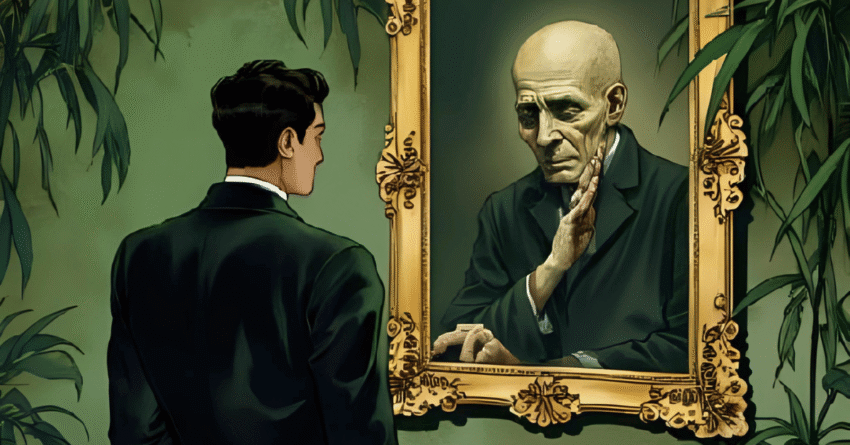
Something about Existentialism in The Great Gatsby

Posted on November 23, 2025November 12, 2025 by Sophia Wordsmith

Philosophical Analysis of The Great Gatsby

Introduction 

The Great Gatsby endures because it turns the American Dream into an existential riddle: we are free to invent ourselves, yet the world greets our inventions with silence. Amid champagne towers and yellow cars, the Dream itself collapses—not from scarcity, but from excess. Jay Gatsby, born James Gatz, is modernity’s emblem and victim. He makes himself from scratch as if identity were a crafty project, a man who turns love into a destiny and parties into performance. The result is dazzling—and doomed. 

Gatsby’s quest embodies the modern struggle between illusion and authenticity; his self-creation and collapse expose the futility of forging meaning in a hollow world built on spectacle. Through the lenses of Sartre, Camus, and Nietzsche, Gatsby’s life becomes not merely a personal tragedy but a philosophical parable—a fall from radical freedom into self-imposed illusion, from the creation of values to the quiet recognition of absurdity. What begins as the affirmation of possibility ends as a meditation on the cost of mistaking light for life—the illusion forever flickering across the bay.

Sartre’s Radical Freedom and Gatsby’s Self-Creation

Sartre’s maxim that “existence precedes essence1” finds vivid expression in F. Scott Fitzgerald’s tragic hero, Jay Gatsby. Gatsby invents his own essence through self-creation—he is nothing other than what he makes of himself, fully embodying Sartre’s vision of freedom. Sartre declares that humans are born without a fixed nature or purpose; they exist first, and through their choices, define what they become. In this radical freedom, every individual bears full responsibility for shaping their own essence.

Gatsby’s Self-Invention: James Gatz Becomes Jay Gatsby

Gatsby’s metamorphosis from James Gatz to Jay Gatsby is the Jazz Age’s purest act of existential authorship. On Dan Cody’s yacht and in the quiet of his own notebooks, Gatz drafts a blueprint for self—a polished vision meant to outshine the rawness of the boy who began with nothing.  He chooses a name, a wardrobe, a diction, a set of rituals—he chooses a horizon—the green light—and binds his waking hours to its glow. Crucially, this choice does not merely decorate an essence; it produces one. Gatsby’s accent, parties, and silences are not symptoms of an inner truth but instruments for composing it.

Here lies the terrifying glory of Sartrean freedom. He envisions an ideal self—and commits entirely to its realization. He refuses to be defined by origin, poverty, or the inertia of other people’s expectations. In that refusal, he exemplifies the grandeur of self-making. In this, Gatsby becomes existentialism’s boldest dream—a man who accepts that meaning is not found but forged.

Sartrean Bad Faith and Jay Gatsby

Sartre: Freedom and the Temptation of Bad Faith

The same freedom that enables Gatsby’s ascent also breeds a subtler danger: bad faith2. Sartre defined bad faith as the self-deception by which a person mistakes themselves for a fixed role or object, bound by past determinations that conveniently excuse them from the burden of new choices. It is comfort disguised as identity. In fleeing this freedom, one still cannot escape it—Sartre reminds us that we are “condemned to be free.3”

Gatsby’s Denial of the Past

Gatsby’s case highlights the dual nature of Sartrean freedom. On one hand, his self-creation is glorious: he achieves wealth, status, and an all-consuming purpose. On the other hand, Gatsby’s self-creation calcifies into a prison of illusion rather than an authentic engagement with reality. Without a given essence, Sartre warns, we are “condemned to be free.” We must bear the weight and anxiety that comes with self-fashioning.

But this freedom turns inward; Gatsby’s radical self-fashioning into Daisy’s idealized lover hardens into prison, exemplifying the Sartrean tragedy of denying one’s ongoing freedom. Gatsby’s refusal to acknowledge the five lost years, his obsession with Daisy’s voice and idealization of her, and his demand that Daisy leave Tom are examples of the manifestation of bad faith that ultimately lead to his downfall. Gatsby is, in effect, declaring that he cannot change; paradoxically, this denial is itself a choice freely made in bad faith. Instead of embracing the freedom to imagine a new future, he confines his meaning to a single immovable dream.

In denying reality, Gatsby confines his will to what he cannot control. The tragedy of Gatsby is that his extraordinary freedom to define himself becomes its own prison. From an existential view, Gatsby’s downfall stands as a warning of bad faith—the tragedy of a man who mistook illusion for essence. 

Camus: The Sisyphean Labor of Spectacle 

In The Great Gatsby, Fitzgerald turns the Jazz Age into a glittering stage where spectacle masks despair. Gatsby’s opulent parties, colossal mansion, and self-fashioned myth embody this clash. Gatsby longs for clarity and fulfillment in a world that remains indifferent—if not hostile—to his dream. In Camusian terms, Gatsby is like Sisyphus, who endlessly pushes his rock uphill only to have it tumble back down. His parties and reinventions become Sisyphean labors—repetitive, dazzling, and ultimately futile. Gatsby’s spectacle is an absurd attempt to impose meaning on reality, mirroring Sisyphus’s eternal, pointless toil. 

Camus’s Concept of the Absurd

Albert Camus opens The Myth of Sisyphus by describing the absurd as human beings’ desperate search for meaning colliding with a world that offers none. Camus writes, “longing for happiness and for reason. The absurd is born of this confrontation between the human need and the unreasonable silence of the world.”4 The absurd arises from the collision between our hunger for meaning and the universe’s silence. 

Camus illustrates the Absurd with the Greek myth of Sisyphus, who is condemned by the gods to push a massive boulder up a mountain only to watch it roll back down, eternally. Sisyphus’s plight is a perfect metaphor for human life: one labors endlessly, hoping for triumph or meaning, yet every apparent victory is lost and every ascent resets to zero.

Camus’s Absurd framework thus captures a fundamental existential tension. We want meaning, but we face a mute cosmos. This tension is the ground of tragedy in The Great Gatsby. Gatsby yearns for meaning in Daisy and the past, yet his dream meets an uncaring reality. Just as Sisyphus toils toward an unreachable summit—his dream of love and status—Gatsby pours meaning into a world that offers none in return. 

The Sisyphean Struggle and Final Collapse

Gatsby’s end drives home the grim parallel. Sisyphus does not die; his punishment is to live forever in repetition. Yet Camus insists that we must imagine him happy, for he accepts the absurdity of his fate. Gatsby, by contrast, dies—shot in his pool by George Wilson while Daisy retreats into the safety of Tom’s world. In literal death, the rock slips from his hand one final time. Nick observes a universe indifferent to the tragedy: after Gatsby’s murder, nobody from the parties comes to his funeral. Fitzgerald thus leaves us with an image of Gatsby’s spectacle—beautiful, tireless, and empty—as endless as Sisyphus’s climb. 

Camus: The Moment of Absurd Consciousness 

The Great Gatsby reveals the Jazz Age’s glittering pursuit of happiness as a hollow spectacle.

Through Jay Gatsby, a man consumed by love and Self-created illusion, Fitzgerald exposes a world where spectacle disguises emptiness. 

Camus uses the myth of Sisyphus as an image of futile labor. Camus writes, “The workman of today works every day in his life at the same tasks, and his fate is no less absurd.” Like Sisyphus, people labor at repetitive, purposeless tasks, forced to invent meaning within that absurdity. Gatsby’s endless parties and glittering displays of wealth become his rock, rolled up the hill of longing night after night. His life becomes the absurd cycle itself—labor without resolution, longing without end.

Conscious Knowledge of Condition 

Camus suggests that Sisyphus becomes tragic the moment he recognizes his own condition.  He “is tragic only at the rare moment when it becomes conscious,”—the instant he realizes the futility of his toil yet chooses to continue. 

Gatsby’s labor is similarly tragic because he can scarcely face its emptiness. Despite the lavish parties he hosted, Nick observes, “if that was true he must have felt that he had lost the old world, and paid a high price for living too long with a single dream.” Gatsby sacrifices reality for a dream of the past. Yet, Camus warns that such relentless labor offers no salvation—only the repetition of desire without fulfillment, a cycle Gatsby cannot escape. 

Nietzsche: the Green Light as corrupted Übermensch Ideal 

The Great Gatsby illustrates a modern tragedy of will and ambition. Set in an age when Traditional faith was warning, Gatsby seeks to impose his own meaning on life through sheer force of will. In Nietzschean terms, Gatsby aspires to become an Übermensch—a self-created man who forges his own values and transcends conventional morality. 

The most vivid symbol of Gatsby’s self-created ideal is the green light at the end of Daisy’s dock. In a Godless world where old values have crumbled, Gatsby has the green light as his god. He focuses all his energy on his newly created deity of desire. His dream is born not from self-mastery but from resentment—from envy and nostalgia. His value is a nostalgic revenge against earlier humiliations rather than an affirmative creation of the new. This is where Gatsby fails to become Nietzsche’s Übermensch.

Nietzsche’s “God is Dead” and Übermensch

In Nietzsche’s Philosophy, the declaration “God is dead5” signals a profound crisis of values. With the old religious-moral framework vanished, humanity must “become gods themselves by creating new values.” Nietzsche’s Übermensch is the ideal figure who does this. In his book Thus Spoke Zarathustra, Nietzsche proclaims, “I teach you the overman. Man is something that shall be overcome.” The overman sets his own goals in life, an affirming existence without appeal to any higher power. The Overman actively imposes meaning, embodying the will to power—not domination over others, but mastery of the self and the shaping of one’s destiny. 

Gatsby’s Self-Creation and the Green Light

Gatsby is, in every sense, self-made. Gatsby creates himself as if crafting a character in pursuit of a higher ideal. This strongly echoes Nietzsche’s call to “give style to one’s character.” Gatsby’s extravagant persona and lifestyle reflect a grand “artistic plan,” tailoring even his flaws into an alluring image. This reflects Nietzsche’s call for the “Übermensch” to survey his own strengths and weaknesses and fit them into an artistic whole. 

The green light itself symbolizes the ultimate object of Gatsby’s will. Since “God is dead” in Fitzgerald’s modern world, Gatsby effectively makes the green light on Daisy’s dock his god. The light becomes the focal point of all his shapes, a shimmering ideal beyond reach that keeps his will alive. Nietzsche would recognize this as an example of imposing personal meaning. The green light is Gatsby’s self-created ideal, a shimmering goal beyond reach that keeps his will alive.  

Gatsby’s green light itself holds multiple layers of meaning. On one hand, it is his personal “Daisy-light”; on the other,  it symbolizes the broader American Dream—success pursued in a godless age. Gatsby fervently believes the green light is his newly created value, and reaching it will justify his life.

Nietzsche: Failure Rooted in Resentment 

Nietzsche also warns of resentment—the moral poison of envy disguised as virtue. When an extraordinary individual arises, herd morality protects itself from the strong and independent few. It is a system of values created by a weak majority; over time, society came to praise humility, pity, obedience, and self-sacrifice—not because these traits are inherently good, but because they safeguard the herd from the powerful and creative. 

Reunion with Daisy

The most revealing moment of Gatsby‘s failure as an Übermensch comes in the long-awaited meeting with Daisy. Here, Gatsby’s resentment, which is built on his envy and clinging to the past, is fully on display. From the moment he opens himself to her, Gatsby tries to reshape reality. At their reunion, Gatsby becomes anxious to be perceived as Daisy’s equal—or her superior. Yet five empty years stretch between them, an abyss Gatsby refuses to acknowledge. Despite Nick’s efforts to temper Gatsby’s expectations, he refuses to accept the finality of it. Instead, he determines to undo the past. In Nietzschean terms, this longing to reclaim the “old warm world” reflects slave morality—a will turned backward, seeking redemption rather than creation. An Übermensch would not delude himself into believing the past can simply be undone. 

Ultimately, Gatsby’s reunion with Daisy does not elevate him. Instead, it exposes his dependency and his hollow divinity—a false idol sustained by illusion. An Ünbermensh would neither hinge his destiny on another person nor grieve a lost past. Fitzgerald makes clear that Gatsby’s greatness is delusional. Nick admires not Gatsby’s value, but his unwavering faith in the American Dream. Gatsby tragically resembles Nietzsche’s Last Man: he seeks comfort and the “old warm world” rather than the creative struggle of forging new meaning. In the end, Gatsby’s boundless energy flows into a mirage—his will exhausted in pursuit of an illusion. 

Conclusion

Gatsby’s death completes the tragedy of will and illusion. After Myrtle’s murder, which Gatsby accepts blame for out of duty to Daisy, he lies in his pool waiting for Daisy’s call that never comes. At dawn, he is killed by Wilson, and the hope of a green light dies with him. Gatsby dies alone, and his green light behind him is now meaningless. 

Gatsby alone had tried to give the world meaning, while others drifted with the current. In Nietzsche’s terms, Gatsby failed as an Übermensch because he never truly “said yes” to life’s reality; instead, he insisted on rewriting it. His will was vast, but it was misdirected by resentment and his bad faith.

The green light fades, the parties end, and the valley of ashes stands as a monument to the moral vacuum they leave behind. In a godless age, Gatsby’s heroic will becomes Nietzsche’s warning: no future can be built on illusion.

Through The Great Gatsby, Fitzgerald paints the American Dream as an absurd endeavor—a Sisyphean labor of spectacle against an indifferent universe. 

In the novel’s melancholy ending, Gatsby is a tragic hero of the futile dream: he sought to impose order and love on a world that offered neither. Nick’s final reflection—that we are “boats against the current, borne back ceaselessly into the past” —echoes Camus’s insight that humanity persists, defiant even in defeat. In Gatsby’s fall, Fitzgerald captures the modern soul’s eternal struggle—to dream, to defy, and to find meaning in a silent world.

  1. See: Maden, Jack. “Existence Precedes Essence: What Sartre Really Meant | Philosophy Break.” August 2023. https://philosophybreak.com/articles/existence-precedes-essence-what-sartre-really-meant/.
    ↩︎
  2. See: Reynolds, Jack, and Pierre-Jean Renaudie. “Jean-Paul Sartre.” In The Stanford Encyclopedia of Philosophy, Fall 2024, edited by Edward N. Zalta and Uri Nodelman. Metaphysics Research Lab, Stanford University, 2024. https://plato.stanford.edu/archives/fall2024/entries/sartre/. ↩︎
  3. See: Çolak, Pelin Dilara. “Man Is Condemned to Be Free….” Philosophiser Co, March 5, 2024. https://medium.com/philosophiser-co/man-is-condemned-to-be-free-33c80ae56d26. ↩︎
  4. See: The New Philosophy. “Camus on the Absurd.” November 22, 2023. https://www.thenewphilosophy.com/camus-on-the-absurd/.
    ↩︎
  5. See: Philosophy, The Living. “‘God Is Dead’ — What Nietzsche Really Meant.” December 9, 2021. https://www.thelivingphilosophy.com/p/god-is-dead.
    ↩︎

Serving Others, Losing Oneself: The Existential Tragedy of Stevens

Posted on November 16, 2025December 27, 2025 by Sophia Wordsmith
The Remains of the Day by Kazuo Ishiguro

Introduction

Each morning, Mr. Stevens polished the silver to perfection, a ritual of control that mirrored the quiet self-deception shaping his existence. Kazuo Ishiguro’s The Remains of the Day (1989) presents the quietly tragic life of Mr. Stevens, an English butler who prides himself on his unwavering dignity and professional duty. On the surface, Stevens’s life of restrained behavior exemplifies the ideal servant. He does so effectively by building his identity defined by an ethic of professional obedience. Beneath this surface, Stevens lives in Sartrean bad faith1, mistaking servitude for purpose. In doing so, he spends his life denying his own humanity.

What he calls “dignity” is both his proudest virtue and his quietest tragedy—a form of self-erasure disguised as grace. His polished persona serves as a defensive mask, shutting out doubt, grief, and self-knowledge. 

As the story progresses, particularly during his road trip, it becomes clear that Stevens’s cherished notion of dignity is, in existential terms, an act of bad faith. He ultimately realizes too late that he has sacrificed authentic emotion and choice on the altar of duty.

By the time he looks back, the day has already dimmed. His awakening comes not with revelation, but with the quiet ache of recognition. Ishiguro reminds us that the tragedy of life isn’t making the wrong choices, but in realizing too late that we never truly choose at all, having surrendered personal freedom to an inherited, unquestioned code of duty.

The road becomes a mirror, and for the first time, he cannot look away.

The Architecture of Bad Faith: Dignity as Self-Erasure

Stevens sees himself as a butler and defines his entire identity and pride around unwavering dignity and professional duty. On the surface, Stevens’s code of conduct is shaped by the stoicism of the ideal butler. However, this pristine facade represents Stevens’s emotional emptiness and the self-delusion that allows him to live within the comfort of illusion. As the story progresses, it becomes apparent that Stevens’s behavior constitutes, in existential terms, an act of bad faith. It is a form of self-deception by which he denies his own freedom and suppresses the painful truth. 

Stevens defines the ideal butler as one who restrains his emotions and completes tasks given by his master as an unwavering duty under all circumstances. For Stevens, dignity means subordinating all personal feelings and moral judgment to the professional role. Yet this notion of dignity comes at the cost of individual conscience. This denial of emotion finds a philosophical echo in Sartre’s notion of bad faith.

Sartre’s Concept of Bad Faith 

Jean-Paul Sartre’s concept of bad faith offers a framework for understanding his behavior. For Sartre, bad faith (mauvaise foi) describes the act of lying to oneself to escape the anguish of freedom. Sartre famously used the analogy of a waiter performing his role, which exaggerates the idea of perfection. By performing as a waiter, he avoids the burden of freedom and choices. He comes to identify himself as a waiter and nothing more. In bad faith, the individual becomes both deceiver and deceived, simultaneously aware of their self-deception yet refusing to confront it.  Similarly, Stevens performs the role of the perfect butler so completely that he mistakes the role for his own identity.

Sartre emphasizes that in bad faith, the agent is “fully aware of how things are,” even while deceiving themselves2. Stevens is a good example of an agent with bad faith. Seen through this existential perspective, Ishiguro’s portrait of Stevens acquires its full tragic depth.

Stevens’s Ideal of Dignity and Self-Erasure

Seen through this philosophical perspective, Stevens’s ideal of dignity reveals itself as a form of self-erasure. Bad faith functions as a psychological shield, allowing Stevens to avoid confronting feelings or doubt that might threaten his image of the ideal butler. For instance, when Lord Darlington insists on dismissing Jewish maids on political grounds, Stevens completes the duties despite his every instinct opposing the idea. When Miss Kenton questions his behavior, he justifies it by saying he was simply doing his duty, as if there were no other alternative, which is the very definition of bad faith—denying freedom by hiding behind a fixed role. By intellectualizing his discomfort, he spares himself the painful recognition of his own complicity.

His speech and behavior are polished to the point that even his narration remains formal and detached from his own emotions. For decades, he deceives himself in the name of “dignity,” recognizing only too late the hollowness of this idea—and the cost of the humanity it denied.

If Stevens’s bad faith is the architecture of his identity, then its foundation was laid long before he entered Lord Darlington’s service. The rigid ideals to which he clings  are not self-made but something he inherited from his father. Observing his father’s stoic service, Stevens learns to equate restraint with virtue and submission with strength. Stevens never critically reexamines this idea. Thus, his existential tragedy is not simply philosophical—it is generational. The mask of professionalism he wears so perfectly was first modeled by the man he revered—a regency that became both his moral compass and his cage, and from which he would never learn to break free. 

The Legacy of the Father and the Inherited Cage of Failure

Father’s Ideal Cage

Stevens’s notion of dignity was taught by his father, who was also a butler. His father, an older butler, was the template for Stevens’s own self-conception. From childhood, Stevens measured himself against his father’s unwavering professionalism. Even as the old man struggles with age and illness, Stevens insists on seeing him as always on duty. However, this upbringing laid the foundation for Stevens’s existential trap. Stevens’s bad faith began not as a willful lie, but as the uncritical adoption of his father’s role as his own essence, mistaking an inherited fact for an existential necessity. Heidegger describes the inauthentic self as one absorbed into the anonymous “they”, living not by personal conviction but according to public norms. Stevens’s life, modeled after his father’s example, exemplifies this unauthentic existence.  

His Duty Goes Priority Over His Father’s Death 

His dignity as the butler is tested when Stevens’s father has a fatal stroke during a grand event at Darlington Hall. In a hurry, Miss Kenton finds Stevens to tell him that his father is in a serious condition. When he is notified, he responds to Miss Kenton as a butler, not as a son. He calmly thanks her and insists he must continue overseeing the guest. He even asks Miss Kenton to attend to him, insisting that his duty takes absolute priority over his father’s death. Only much later, he goes upstairs and finds his father’s dead body after completing his duties.

This extreme self-restraint of choosing duty over final emotion exemplifies Stevens’s idea of dignity. Still, it is heartbreaking to witness. He effectively leaves his own father’s deathbed to serve dinner, a decision that delays something very important.

A Butler Trapped In A Cage

By suppressing his grief, Stevens once again uses his professional role as a shield against emotional pain. Yet the episode lays bare the dehumanizing effect of his code. Prioritizing an impersonal ideal of duty, Stevens strips away his humanity. The very qualities that Stevens admired in his father’s professionalism have become a cage for his own life, trapping him in a persona that prevents any tender human connection. 

The Muted Language of Regret: Miss Kenton and the Lost Chance for Love

Throughout his life, duties and professionalism always take precedence over personal life, even if it involves someone he loves. His professionalism creates a linguistic barrier that neither he nor Miss Kenton crosses, resulting in Miss Kenton being lost to another man.

Stevens’s bad faith is perhaps most poignant in his relationship with Miss Kenton. Miss Kenton is a housekeeper at Darlington House, with whom he shares a deep but unspoken affection. Throughout their years at Darlington Hall, Stevens rigidly maintains his professional distance from her, even though Miss Kenton seeks his companionship. Whenever an emotional truth threatens to surface, Stevens retreats behind the mask of dignity, effectively denying himself the possibility of love. 

Miss Kenton tries repeatedly to reach him—visiting his room after work, seeking simple conversation—but Stevens responds with cold formality. She sometimes shows her weakness. Despite her efforts, Stevens rebuffs her with distant and cold responses, as if an invisible shield deflects every emotion and encloses his own feelings. 

When Your Love Leaves for Another Man

A few years later, when Miss Kenton announces her engagement to another man, Stevens faces a final chance to speak his heart. Instead of talking about how he feels, he confines himself to formalities, offering polite congratulations. He even discusses staffing logistics after her marriage. With Stevens’s response, Miss Kenton is clearly hurt, and she even admits she sometimes wonders if she is making a mistake. He says nothing. She waits. The moment passes. Yet Steves refuses to respond on a personal level. 

Years later, during their reunion, Miss Knenton, now Mrs Benn, confesses that she thinks about a life she may have had with Stevens. Hearing her confessions, Stevens feels like it pierces through his shield, yet he still tells her not to dwell on the past. After the meeting with Miss Kenton, Stevens, however, cries alone. 

His lifelong refusal to acknowledge his own heart has led to this moment of deep regret. By denying love and clinging to his professional identity, Stevens chose the comfort of illusion over the anguish of freedom. In Sartrean terms, he lived in bad faith until it was too late to live at all. He avoids the authentic choice—a life with the woman he loved. Now, he must face the emptiness of that decision. Stevens’s inability to act in these private moments confirms his existential isolation. He may exist, but he was fundamentally absent from his own emotional life. 

Stevens’s Journey across the English countryside becomes a slow reckoning with the life he has lived in service of others. The road becomes a reflection of Stevens’s inner life. Having inherited his father’s emotional stoicism and lost Miss Kenton to silence, he finds himself stripped of the illusions that once gave his life structure. The car, the open road, and the solitude offer no comfort—only the vast, quiet space in which memory demands its due. What remains is not dignity but emptiness, a void that forces him to confront what Camus calls “absurd freedom3”—the terrifying liberty to define himself anew. The road becomes a mirror for Stevens’s awakening—a passage from long-nurtured self-deception toward the faint, painful glimmer of truth.

The Road and the Quiet Awakening: Confronting the Absurd

A Reckoning on the Road

Through Stevens’s Journey—the literal road toward his past himself—he comes to understand his errors. Stevens acknowledges that Lord Darlington made a great mistake, and then adds a devastating insight. He insists on not being able to claim the mistake as his own, but he still dedicates himself so completely to someone else’s purpose. By acting as an ideal butler, he has never truly lived for himself or made choices of his own. He even admits there is not much dignity in that. It is a moment of clarity without consolation. In this moment, Stevens finally confronts the truth his bad faith had long obscured. The ideal he served demanded that he erase himself. The very dignity he pursued required absolute obedience, leaving him with nothing he could call his own. The most tragic part of this story is that he cannot even claim his own mistakes. 

The Mask and the Missed Life

Stevens has had the choices all along. By wearing the mask of a butler, he denied not only his emotions, but also what made him Stevens. As a result, not only could he not attend his father’s deathbed, but he also lost his love to another man. All this time, he may be a perfect butler, but he has never been true to himself.

Encounters with the Ordinary: A Lesson in Authenticity

Stevens’s journey also brings him face-to-face with the possible authenticity. Ordinary people on the road create meaning not by duty but by simple human acts like enjoying time with families, like sightseeing, or telling jokes to each other. Each such moment is a lesson in authenticity—what Sartre describes as a life “attained against facticity,” asserting freedom despite circumstance. The phrase captures the contrast. In Sartre’s view, authenticity means asserting one’s freedom despite the hard fact of life. However, Stevens cannot perform any of the ordinary encounters or be just himself. Instead, he confines himself to the rigid role model of the butler, a performance that becomes his prison. Having glimpsed the possibility of authenticity, Stevens faces a still deeper truth. 

Confronting the Absurd: Acceptance without Consolation

The philosophical shadow cast over Stevens’s awakening is Camus’s concept of the Absurd. He must confront the so-called “great” men he served, like Lord Darlington, who did not live in a rational universe. Instead, Stevens’s faith yields to an absurd realization. Meaning, he realizes, must be created—not inherited through title or duty. Steven’s lifetime of “bad faith” collapses, forcing a painful freedom. Yet, he does not revolt; he simply accepts.

After realizing his past errors, Stevens composes himself and resolves to “make the best of what remains of the day.” He will return to Darlington Hall and even plans to practice light effects. Stevens finally accepts the absurdity of his past. He has devoted his life to a flawed ideal, yet chooses to carry on without the comfort of illusion. This quiet resolution is not a grand redemption; still, it marks a shift from self-deception to self-awareness. It was a quiet awakening.

Ishiguro does the novel not with redemption but with recognition. In the quiet dimming of the day, Stevens attains at last what he long mistook for dignity—the fragile, human grace of knowing himself. 

Conclusion

In the end, Ishiguro’s The Remains of the Day stands as a subtle but harrowing lesson in existentialism. Stevens’s Journey to the coast becomes the figurative unveiling of his inner desert, an encounter with the absurd. The novel embodies the existential insight that meaning must be created authentically and that blind obedience leads to self-deception.

Stevens weeps for what he has lost but resolves to carry on. It was a fragile redemption through self-knowledge. He cannot undo his choices, but he finally understands them—and in that understanding, accepts himself. Stevens’s solitary tear becomes a symbol of his final insight: his late acceptance that perfect obedience does not generate the human warmth and honesty he witnessed along the road. It is a moment of humility and tragedy. 

The Remains of the Day shows that true dignity comes not from blind duty but from honest self-examination and the courage to choose one’s own path. Steven’s story cautions against living in self-deception and highlights the value of authenticity. Through Stevens’s quiet awakening, Ishiguro reconciles tragedy with charity—a recognition that awareness, however late, carries its own fragile dignity. Ishiguro warns us how “a life perfectly executed” according to an unquestioned code can become one of emptiness, something Camus called  a “philosophical suicide.”

As the last light slips beneath the horizon, Stevens begins to live—not through grand rebellion, but through acceptance. His awakening is modest, yet in it lies a new kind of dignity: the courage to face the remains of his own day.

  1. Jack Reynolds, Understanding Existentialism (2006) p.73 ↩︎
  2. See: https://iep.utm.edu/sartre-ex/ Nothing is hidden, since your consciousness is transparent, yet bad faith suppresses the awareness in pre-reflective consciousness. ↩︎
  3. See: The Myth of Sisyphus by Albert Camus. It is about an individual’s revolt against recognizing life’s meaninglessness and rebelling against it through action and passion. ↩︎

The Dangers of Groupthink in Huckleberry Finn

Posted on November 9, 2025November 1, 2025 by Sophia Wordsmith

The Adventures of Huckleberry Finn by Mark Twain

Introduction: Raft vs. The Crowd

In The Adventures of Huckleberry Finn (1884), Mark Twain exposes how society stifles individual morality through collective pressure. Between the quiet drift of the Mississippi and the noisy crowd ashore, Huck discovers that moral clarity floats best when it isn’t anchored to society’s rules. Though people did not define the term ‘groupthink’ until the 20th century, Twain intuitively recognized its mechanisms in the mob mentalities and moral hypocrisies of antebellum America. 

Through Huck’s journey, Twain turns this contrast into a moral experiment—one that proves true conscience arises not from law or religion but from personal defiance of the crowd. Huck’s journey becomes an American allegory for moral autonomy, defined by his rejection of groupthink—the pressure to conform to the irrational, self-destructive, and often violent norms of the so-called ‘civilized’ society. For Twain, moral freedom demands the courage to stand alone—even when society calls that damnation.

The Core Mechanisms of Groupthink

Twain dissects the machinery of groupthink through three recurring forms—inherited, emotional, and theatrical—each of which shows how collective behavior corrupts moral reasoning.

Inherited Groupthink (The Feud)

In the feud between the Grangerfords and Shepherdsons, Twain shows how hatred can become tradition—an inherited ritual of loyalty without reason. The feud has lasted for thirty years, its hatred inherited by each new generation. 

The most striking thing about this conflict is that they don’t even know how the conflict started. With curiosity, Huck asks Buck, one of the Grangerfords, “What was the trouble about, Buck?—land?” Buck has no idea, so he replied, “Laws, how do I know? It  was so long ago.”

Through this exchange, Twain makes clear how senseless the conflict is—a hatred literally without reason or memory. The two families continue killing each other out of a blind sense of honor and loyalty to the family name, not because of any personal grievance. 

If the feud exposes the inherited irrationality of a social group, the lynch mob scene reveals how easily momentary emotion can consume moral judgment. 

Emotional Groupthink (The Mob)

In the Arkansas lynch mob, Twain reveals how collective anger gives ordinary people the illusion of righteousness while stripping them of conscience. After Colonel Sherburn shoots a local drunk, Boggs, in an Arkansas town, the angry townfolk, men and women of all ages, march to the Colonel’s house to seek vengeance. Collective anger convinces them they are righteous.  

However, Twain prevents the mob from achieving its violent goal. In one of the novel’s most famous episodes, Colonel Sherburn confronts the lynch mob and dismantles its collective bravado with a scathing speech. The Colonel tells the angry mob, “The idea of you lynching a man!” Then he points out, “Why, a  man’s safe in the hands of ten thousand of your kind—as long as it’s daytime and you’re not behind him.” He calls out their false bravery, saying their courage is “borrowed from their mass,” not “born within.”

The post-Civil War era was infamous for vigilante lynchings and public executions carried out by mobs. Twain, through Colonel Sherburn, calls out the act as ‘masked cowardice,’ condemning the moral weakness of lynch mobs. While mob violence reveals the crowd’s moral cowardice, religious spectacle exposes its craving for emotional validation.

Theatrical Group Think (Religion)

At the revival camp meeting, Twain transforms faith into theater, exposing the crowd’s hunger for spectacle over salvation. Twain satirizes another form of collective irrationality—the performative, crowd-induced hysteria of religious gathering. Huck and Jim accompany the con men, “Duke” and “King,” to a revival camp meeting, a large outdoor religious service. Twain’s portrayal of the camp meeting is both humorous and scathing, depicting the event as a kind of mass theater where emotional excess and gullibility reign. 

There are nearly a thousand people from all around, gathered under tents in the woods. They sing hymns with increasing fervor. The more people wake up and gather, the louder they sing. By the end, some groan, others shout, and the frenzy feeds upon itself. Twain describes them ‘with tears running down their faces,’ exposing how emotional excess becomes a contagious form of hysteria. 

Collective hysteria is a performative ecstasy in which individuals feed off each other’s emotional outbursts. Now, the con men join the crowd and perform a fabricated confession, along with some religious awakening, to exploit the crowd’s emotions and collect $87.75 and a jug of whisky. 

The revival meeting shows how easily a group’s collective emotion can be orchestrated—whether by genuine preachers or by cynical con artists. Everyone in the crowd likely considers themselves devout and righteous, but Twain’s narrative invites the reader to see them as hypocritical. 

Across these scenes, Twain exposes the social forces that drown reason and compassion—the very forces Huck must learn to resist if he is to preserve his moral independence. Whether through blood feuds, mobs, or revival tents, Twain shows that the crowd’s madness governs life on shore—precisely what Huck leaves behind when he takes to the raft.

The Raft: An Autonomy Bubble of Two 

The Anti-Group: Equality in a Two-Person Society

The Mississippi River allows Huck to inhabit a space free from social coercion. On the raft, Huck and Jim form a kind of ‘anti-group.’ It is a miniature society of two that pointedly contrasts with he feuding families, conmen, and mobs on shore. A young, poor white boy and an escaped black slave become equal partners in survival. There is no social hierarchy on the river; Huck even feels ‘mighty free and easy and comfortable on the raft.’ 

This spontaneous egalitarianism aligns with philosophical ideas, but here, Twain realized the theory through practice. While Enlightenment thinkers like Locke argued that we could access moral truths by reason in a “state of nature,” Twain shows that Huck gains his morality by experience, not by social conditioning. The river acts as a moral crucible, where the tabula rasa1 of Huck’s mind is stamped with compassion rather than prejudice. 

Moral Independence: Conscience Over Convention

Crucially, Huck’s most significant moral growth occurs during the calm stretches of the raft journey. Away from the cacophony of shore voices, he can hear his own conscience. After a night of thick fog’s separation, Huck played a trick on Jim, pretending he was always with Jim. When Jim realized the cruel joke, he expressed his genuine anguish and love toward Huck. In the moment, Huck overcame the racist training that had taught him not to value a Black man’s feelings. He swallowed his pride and apologized to Jim—a quiet revolution in Huck’s moral development. 

This scene illustrates how the raft serves as a moral laboratory where lived experience corrects inherited prejudice. Huck witnesses Jim’s humanity firsthand: Jim is a grieving father who cares for others, not merely ‘Miss Watson’s Slave.’ This power of proximity—seeing Jim as just Jim—allows Huck’s capacity for moral imagination and empathy to expand tremendously in this autonomy bubble. He must make moral decisions.  

The Power of Proximity: Seeing Humanity Up Close

Why is Huck able to grow morally on the raft in ways he never could on shore? A major factor is the power of proximity. Being far away from society, Huck encounters Jim as just Jim. Jim is a fellow human being, not just the label ‘slave.’ Twain shows that abstract prejudice cannot withstand concrete friendship. 

Huck’s shift in perspective toward Jim ties into the Enlightenment idea of the common humanity of all people. In his journey, Huck is slowly discovering for himself. By seeing Jim’s humanity up close, Huck learns that morality is not inherited—it is chosen. This realization prepares him for the greatest moral test yet to come. 

The Climax of Resistance: “I’ll Go to Hell”

Society’s Morality and Huck’s “Deformed Conscience”

The more Huck spends time with Jim, the stronger the bond between them becomes, intensifying the inevitable moral crisis. Huck has been educated to ‘be civilized’ by Miss Watson and Widow Douglas, who taught him that helping an enslaved person is a grave sin that leads to eternal damnation. This group morality has been internalized as Huck’s own “deformed conscience,” which tells him that aiding Jim is equivalent to stealing property.

When Jim is captured and held at the Phelps farm, Huck is forced to confront this inner contradiction. It was the battle between the social voice of conscience and the individual voice of his heart. The decision to “write to Miss Watson” is a surrender to the accepted, righteous Groupthink of his society. But looking back on his life with Jim, Huck finds that the voice of friendship is stronger than the fear of eternal punishment. 

The Individual’s Triumph over Group Morality

Huck Finn’s decision to tear up the letter and “light out” to rescue Jim is a symbolic repudiation of corrupt societal values and an assertion of moral autonomy. Huck is forced to choose between the eternal damnation promised by the group and the human loyalty demanded by his heart. Twain describes Huck’s conscience as ‘deformed’ because it mirrors the moral corruption of the society that shaped it, making his defiance all the more heroic. 

Believing society’s rule to be divine law, Huck accepts eternal damnation for Jim’s sake by declaring, “All right, then, I’ll go to hell.” This is the ultimate act of moral non-conformity. In that single action, Huck rejects the group morality that had long imprisoned his mind. For a child taught that hell awaits those who defy society’s rule, his decision is an extraordinary act of moral courage. Huck is willing to sacrifice not only his social standing but his very soul to do what his heart—his true moral compass—tells him is right. In defying every moral law of his society, Huck breaks free from the ultimate form of groupthink. 

The Exploiters of Group Vulnerability: The King and the Duke

“The King” and “the Duke” are cynical manipulators who thrive on collective human failing. They succeed because their schemes prey on pride—the crowd’s collective unwillingness to admit being fooled. Rather than admit their humiliation, the duped townspeople conspire to deceive the next crowd, turning their shame into a social contagion. 

In the beginning, Huck was passively observing them. When the conmen attempt to swindle a grieving family out of their inheritance, Huck decides to intervene rather than remain a silent observer. 

When the crowd discovers the con, its rage erupts into violence—the tarring and feathering of the King and Duke. This episode illustrates how easily groupthink can swing from blind obedience to violent retribution, even when directed at villains. 

By resisting the King and the Duke, Huck acts not from fear or conformity but from conscience—his lessons on the raft now guiding him against the manipulative power of the crowd. 

Conclusion: Lighting out for independence

In the novel, Twain portrays Huck’s moral growth as a journey toward self-reliance and true conscience. His entire journey is a trajectory away from enforced groups and prescribed identities. His moral education is essentially a lesson in how to be alone and right, rather than with the crowd and wrong. 

Ultimately, Twain ensures that Huck’s ultimate victory is achieved not on the land, but on the horizon. Huck’s decision to ‘light out for the Territory’ is not merely a physical escape but a powerful metaphor for intellectual and moral independence—a permanent refusal to rejoin the restrictive, ‘civilized world’ and its corrupting groupthink. Through Huck’s lens, Twain suggests that the fundamental American conflict is not between good and evil, but between the individual conscience and the tyranny of the crowd. In choosing solitude over submission, Huck becomes Twain’s enduring symbol of moral freedom—a voice that still speaks to every reader caught between conscience and conformity. 

  1. Tabula rasa is the idea that the human mind at birth contains no innate knowledge or ideas. Instead, all knowledge comes from experience through sensory input and reflection. John Locke fully developed tabula rasa in An Essay Concerning Human Understanding (1690) ↩︎

Existentialism in The Plague: From Nihilism to Human Solidarity

Posted on November 2, 2025December 27, 2025 by Sophia Wordsmith

Albert Camus’s The Plague

1. Introduction

Imagine your city waking to a rash of dying rats, then dying neighbors, and finally, the death of the illusion that life is fair. Albert Camus’s The Plague depicts an epidemic sweeping through the eerily calm city of Oran. It claims countless lives and exposes the fragility of human certainty.

Yet this is not a tragedy in the Shakespearean sense, driven by fate or heroism but by endurance and ordinary suffering. Camus uses “the plague” as a metaphor for the Absurd—the clash between humanity’s search for meaning and the indifferent silence of the world. Then, Camus rejects passive nihilism, arguing instead that an active, humanistic existential struggle—solidarity—is the only path to meaning, as the characters must decide what it means to live while isolated on an island of suffering.  

Camus shows that in an absurd world, meaning isn’t discovered but created—through compassion and collective struggle against suffering. When the rats return to Oran, so does the warning—that meaning must be made anew, every time the world forgets.

2. The Problem: Nihilism, Indifference, and the Antecedent of Sin

Long before the first rat died, Oran was already sick. Its citizens lived in quiet repetition—working, socializing, and sleeping without passion or reflection. Theirs was not a life of cruelty but of indifference, a kind of passive nihilism disguised as normalcy1. In a world where nothing seemed worth questioning, the plague merely revealed what had been festering all along: the emptiness beneath routine. 

Camus begins The Plague not with chaos, but with monotony—the quiet moral inertia that precedes disaster. 

A. The Indifference of Oran (Passive Nihilism)

Oran’s pre-plague apathy and nihilism represent a void of meaning and virtue. The narrator describes Oran as “ugly”, “sultry”, and “placid.” Oran is the town where “everyone is bored, and devotes himself to cultivating habit.” Camus isn’t condemning the citizens as wicked; he’s diagnosing a subtler sickness—spiritual emptiness masked by comfort. It’s a comfortable stagnation. Therefore, the people of Oran exhibit the steady-state of nihilistic indifference; this moral blindness was itself a kind of “plague” that the physical disease merely externalized. This quiet complacency sets the stage for the Absurd—when catastrophe strikes, the illusion of moral order collapses. 

B. Plague as the Absurd

For Camus, the Absurd arises from the clash between our hunger for meaning and the universe’s silence. The outbreak shatters the city’s illusion of order, forcing its people to confront the Absurd they had long ignored. Rejecting any divine order, Camus saw human life as fundamentally irrational and absurd. No one can avoid death, and people sometimes suffer for no reason and are expected to withstand it. In The Plague, the epidemic symbolizes this very absurdity. The disease strikes people blindly and literally renders all human plans uncertain. In short, it introduces suffering without purpose.  For instance, Rambert’s separation from his beloved underscores how arbitrary suffering can strip even love of meaning. 

C. The Moral Framework of Collective Guilt (Aquinas)

For Aquinas, sin is not purely individual but communal, extending its effects across the created order. He distinguishes moral evil—the sins born of free will—from natural evil, the suffering that arises from the world’s fallen condition. In this sense, the plague represents a natural evil that exposes humanity’s deeper moral disorder. 

Camus implies that the true antecedent of sin in Oran lies in its citizens’ moral blindness and self-absorption. Thus, the initial “disease” is not the rat-fever, but the steady-state of nihilistic indifference. The physical plague merely externalizes this moral blindness, revealing the corruption the Absurd had long anticipated. 

In the novel, Camus parallels the plague to Aquina’s massa damnata, the condemned mass of humanity in original sin. This becomes evident as Camus introduces Father Paneloux’s preaching “qua member of the community,” each member of Oran is collectively responsible for the sins of moral blindness. Paneloux’s sermon frames the plague not just as punishment but as revelation—the moment when denial collapses, and collective guilt surfaces. 

By weaving this theme of shared guilt, Camus gives The Plague a profound moral dimension. Through their suffering, people of Oran confront the consequences of their indifference, and figures like Rieux, Tarrou, and Grand become symbols of atonement through action. In fighting side by side, they enact a collective redemption—not through divine grace, but through human solidarity.

Yet while Camus exposes Oran’s moral decay in secular terms, Father Paneloux seeks to explain it through theology. His sermons transform the epidemic into a stage where divine justice and human suffering collide.

3. The Theological Response: Father Paneloux and the Justification of Suffering

When we read The Plague as an allegory for universal suffering, it inevitably raises moral questions. Among the novel’s central figures is Father Paneloux, a Jesuit priest whose theological response stands in contrast to the novel’s humanist voices. As the epidemic deepens, Paneloux delivers two major sermons that reveal his struggles to justify suffering within a framework of faith. 

A. Paneloux’s Initial Sermon

In the early phase of the epidemic, Father Paneloux addresses a terrified congregation with a fiery sermon that interprets the plague in strictly theological terms. He declared that the plague was God’s Punishment for Oran’s collective sinfulness as if it were a divine wrath and justice. 

In Paneloux’s view, nothing about this disaster is senseless or arbitrary; rather, it is the obtained consequence of moral transgression. He preaches, “Too long this world of ours has connived at evil.” The plague was punishment for “criminal indifference” toward God. By doing so, he tried to apply a rational theological framework to an irrational horror. In this sermon, Paneloux asserts order where Camus presents chaos, insisting that divine logic governs even catastrophe. In his mind, thus, the plague follows a moral logic. Then, he concluded, “what God Wills and why He wills it.”

B. The Failure of Divine Order

As the plague ravages Oran, events soon put Father Paneloux’s dogmatic framework to a devastating test. That test comes when he witnesses the drawn-out death of an innocent child—the magistrate’s young son. The turning point comes with watching the agonizing death of a child, the death of the magistrate’s son. The helpless child writhes in prolonged pain and dies. When he directly witnessed the extreme suffering of an innocent, he started to struggle to rationally reason the death of the child. If the plague is divine justice, what sin could warrant such agony? In that moment, his theology collapses under the weight of compassion. With Father Panelox’s struggle, Camus exposes the collapse of any facile “divine punishment” explanation. 

Though shaken, Paneloux does not abandon his faith. Instead, he remains with the afflicted, joining Dr. Rieux and Tarrou in their work. His ordeal becomes less a crisis of belief than a test of endurance—faith stripped of certainty. Even Tarrou, who brought Father Paneloux to witness the child’s death, saw Paneloux’s internal trial. Tarrou tells Dr. Rieux of a story about another priest who lost his faith upon witnessing a similarly brutal atrocity in wartime. It was Father Panelox’s trial to continue to believe and preach after his tidy theological narrative had been devastated by reality. This decision was made in the second sermon, his attempt to reconcile his faith with what he had witnessed.

C. Pivot Point

After witnessing the cruelty of the plague, Father Paneloux undergoes a spiritual and philosophical pivot. He prepares and delivers a second sermon that contrasts sharply with his earlier certainty.

In the second sermon, Father Paneloux tells the congregation that human beings cannot always understand god’s will. In his first sermon, he claims to know exactly why God punished Oran; now he admits that the divine will exceeds human understanding. He says there is something we will not be able to rationally explain. Faith, he tells the congregation, demands not comprehension but surrender—” a leap into the heart of the unacceptable.”

Then, he joins Dr. Rieux’s volunteer sanitary squads and decides to battle against the plague. When Paneloux himself falls ill, he refuses medical treatment, leaving his fate to God. Dr. Rieux notes that the ambiguity of his death—neither confirmed plague nor coincidence—symbolizes the fact that unsolved tension between faith and reason.  Camus gives the doctor’s death as a doubtful case. Dr. Rieux noted that the cause of death cannot be conclusively determined. Symbolically, his death was an antinomy of pure reasoning. 

While Father Paneloux attempts to find meaning through a shattered faith, Dr. Rieux and Jean Tarrou turn instead toimmediate action. Their resistance is grounded not in theology but in humanity itself, revealing the novel’s core secular ethic of redemption.

4. Existentialism in The Plague: Action, Choice, and Rebellion

The Plague is a profound Allegory of how humans respond to inexplicable suffering. Camus portrays a world stripped of divine purpose or moral logic—where good and evil receive no reward or punishment. Yet rather than yield to despair, Dr. Bernard Rieux and Jean Tarrou embody Camus’s human ethic of action and compassion.

A. Dr. Rieux’s Stoic Acceptance

Dr. Rieux, the novel’s protagonist and narrator, embodies a pure existential response to the epidemic. He does not search for divine meaning or cling to comforting illusions; instead, he dedicates himself to the daily, unglamorous fight against the plague. After observing death after death, he says, “There’s no question of heroism in all this. It’s a matter of common decency. For Rieux, decency means simply doing his duty as a doctor. His quiet courage is deeply stoic. He neither complains about the unfairness of fate nor expects any reward for his sacrifice. Like Camus’s Sisphus, he finds meaning not in victory but in the act of struggle itself—rolling the boulder uphill each day out of common decency, knowing it may roll back again.

B. Tarrou’s Pursuit of “Saintliness”: A Secular Saint in Solidarity

Jean Tarrou arrives in Oran as an outsider but becomes one of Rieux’s closest allies. Like Rieux, he refuses despair—but his motivation differs. Tarrou aspires to become a “saint without God,” striving for moral purity through choice rather than faith. He knows he will never be rewarded as a saint in a godless world. In Tarrou, Camus poses the existential question of how to live a life of virtue and meaning purely through one’s own choice, without reference to any divine authority.

Tarrou’s pursuit of “saintliness” is deeply rooted in his understanding of the plague as both a literal and metaphorical evil. Through Tarrou’s backstory and philosophy, Camus illustrates that the struggle against injustice “out there” cannot be separated from the struggle within oneself to live ethically. 

In his recollection of his father—a magistrate who demanded the death penalty with absolute conviction—Tarrou sees the plague of moral blindness that turns justice into ritualized murder. Haunted by this memory, he rejects the death penalty and devotes himself to purging the “plague” within—the indifference that allows violence to exist. Tarrou’s goal of saintliness is not about being holier than others but about cleansing himself of indifference. 

C. Defining Human Solidarity

In the end, Tarrou and Rieux’s paths converge in action. For Camus, if meaning exists at all in an absurd and indifferent world, it is the meaning we create together through solidarity. The plague strips away illusions of control and forces each person to choose between isolation and cooperation, despair and defiance. Through Rieux, Tarrou, and their companions, Camus shows that meaning is forged only in shared struggle. Solidarity, then, becomes an existential act of rebellion—a collective affirmation of life against death. 

Through their actions, Rieux and Tarrou demonstrate that in a world without transcendent meaning, the only redemption lies in human solidarity. Yet the plague’s end reminds us that such meaning must be continually recreated—because the bacillus of indifference never dies. 

5. Conclusion

When the city finally reopens, Tarrou is dead, and Dr. Rieux has lost his wife. The novel does not mock the citizens’ joy; it merely reminds us that the bacillus sleeps—and with it, human complacency.

Through The Plague, Camus offers a vision of meaning forged in catastrophe—the epidemic as both literal disease and metaphor for humanity’s passive nihilism.

Camus shows that the fight against the plague is, at its heart, a struggle for humanism—a continual act of creating meaning where none is given. Rieux’s small victories—and the endurance of the plague itself—remind us that meaning must be renewed with every generation.  Tarrou seeks to cleanse himself of the inner plague of indifference, striving to become a saint without God. In their different ways, both men embody Camus’s philosophy of revolt against the Absurd. Ultimately, Camus suggests that the highest virtue—and the only true redemption—in an absurd universe is human solidarity. When we recognize our shared fate as mortal and vulnerable beings, and choose compassion over indifference, we affirm the one thing nihilism can never destroy: our humanity.  

The rats will return, Camus warns, but the only enduring lesson of Oran is that meaning is not granted—it is continually forged in our capacity to fight them together.

References

  1. 7693738 {7693738:4Q96DH7U} 1 chicago-fullnote-bibliography 50 default 623 https://thebooktapestry.com/wp-content/plugins/zotpress/
    %7B%22status%22%3A%22success%22%2C%22updateneeded%22%3Afalse%2C%22instance%22%3Afalse%2C%22meta%22%3A%7B%22request_last%22%3A0%2C%22request_next%22%3A0%2C%22used_cache%22%3Atrue%7D%2C%22data%22%3A%5B%7B%22key%22%3A%224Q96DH7U%22%2C%22library%22%3A%7B%22id%22%3A7693738%7D%2C%22meta%22%3A%7B%22creatorSummary%22%3A%22Sharpe%22%2C%22parsedDate%22%3A%222025-10-03%22%2C%22numChildren%22%3A2%7D%2C%22bib%22%3A%22%26lt%3Bdiv%20class%3D%26quot%3Bcsl-bib-body%26quot%3B%20style%3D%26quot%3Bline-height%3A%201.35%3B%20padding-left%3A%201em%3B%20text-indent%3A-1em%3B%26quot%3B%26gt%3B%5Cn%20%20%26lt%3Bdiv%20class%3D%26quot%3Bcsl-entry%26quot%3B%26gt%3BSharpe%2C%20Matthew.%20%26%23x201C%3BIf%20Nihilism%20Is%20Murder%2C%20What%20Then%3F%20Camus%26%23x2019%3B%20Distinctive%20Conception%20of%20Nihilism%20%26amp%3B%20Its%20Overcoming.%26%23x201D%3B%20%26lt%3Bi%26gt%3BPhilosophy%20%26amp%3B%20Social%20Criticism%26lt%3B%5C%2Fi%26gt%3B%2C%20October%203%2C%202025%2C%2001914537251377672.%20%26lt%3Ba%20class%3D%26%23039%3Bzp-ItemURL%26%23039%3B%20href%3D%26%23039%3Bhttps%3A%5C%2F%5C%2Fdoi.org%5C%2F10.1177%5C%2F01914537251377672%26%23039%3B%26gt%3Bhttps%3A%5C%2F%5C%2Fdoi.org%5C%2F10.1177%5C%2F01914537251377672%26lt%3B%5C%2Fa%26gt%3B.%26lt%3B%5C%2Fdiv%26gt%3B%5Cn%26lt%3B%5C%2Fdiv%26gt%3B%22%2C%22data%22%3A%7B%22itemType%22%3A%22journalArticle%22%2C%22title%22%3A%22If%20nihilism%20is%20murder%2C%20what%20then%3F%20Camus%5Cu2019%20distinctive%20conception%20of%20nihilism%20%26%20its%20overcoming%22%2C%22creators%22%3A%5B%7B%22creatorType%22%3A%22author%22%2C%22firstName%22%3A%22Matthew%22%2C%22lastName%22%3A%22Sharpe%22%7D%5D%2C%22abstractNote%22%3A%22This%20paper%20proposes%20that%20Albert%20Camus%20is%20a%20distinctive%20thinker%20of%20nihilism%2C%20whose%20unique%20contribution%20to%20debates%20around%20nihilism%20has%20been%20widely%20under-valued.%20We%20position%20his%20thinking%20of%20nihilism%20in%20contrast%20to%20four%20previous%20predominant%20uses%20of%20this%20contested%2C%20often%20polemical%20term%20%28epistemological%2C%20reactionary%2C%20theological%2C%20Nietzschean%29%2C%20which%20we%20start%20by%20examining%20in%20part%201.%20Part%202%20reconstructs%20Camus%5Cu2019%20account%20of%20the%20absurd%20in%20his%20earlier%20works%2C%20showing%20the%20proximity%20and%20differences%20of%20his%20celebrate%20account%20of%20this%20notion%20from%20the%20four%20preceding%20senses%20of%20nihilism%5Cu2019s%20meaning.%20Part%203%20shows%20that%2C%20after%201944%2C%20Camus%5Cu2019%20upheld%20that%20nihilism%20is%20defined%20by%20its%20contempt%20for%20human%20life%20licensing%20deceit%2C%20enslavement%2C%20and%20murder.%20Part%204%20then%20highlights%20the%20distance%20between%20Camus%5Cu2019%20distinctive%20understanding%20of%20nihilism%20and%20Nietzsche%5Cu2019s%2C%20by%20critiquing%20Samantha%20Novello%5Cu2019s%20recent%20attempt%20to%20closely%20align%20the%20French%20and%20German%20thinkers%20and%20underscoring%20Camus%5Cu2019%20distinctive%20contribution%20to%20the%20understanding%20of%20Western%20nihilism%20in%20the%20twentieth%20and%20twenty-first%20centuries.%22%2C%22date%22%3A%222025-10-03%22%2C%22section%22%3A%22%22%2C%22partNumber%22%3A%22%22%2C%22partTitle%22%3A%22%22%2C%22DOI%22%3A%2210.1177%5C%2F01914537251377672%22%2C%22citationKey%22%3A%22%22%2C%22url%22%3A%22https%3A%5C%2F%5C%2Fdoi.org%5C%2F10.1177%5C%2F01914537251377672%22%2C%22PMID%22%3A%22%22%2C%22PMCID%22%3A%22%22%2C%22ISSN%22%3A%220191-4537%22%2C%22language%22%3A%22EN%22%2C%22collections%22%3A%5B%22JBHS5M8V%22%5D%2C%22dateModified%22%3A%222025-10-27T23%3A39%3A36Z%22%7D%7D%5D%7D
    Sharpe, Matthew. “If Nihilism Is Murder, What Then? Camus’ Distinctive Conception of Nihilism & Its Overcoming.” Philosophy & Social Criticism, October 3, 2025, 01914537251377672. https://doi.org/10.1177/01914537251377672.
    ↩︎

From Innocence to Monstrosity: The Nature vs. Nurture Theme in Frankenstein

Posted on October 26, 2025October 23, 2025 by Sophia Wordsmith

Frankenstein

Section 1. Introduction

Are our traits and behaviors shaped more by innate character (nature) or by environments and societies that mold us (nurture)? Locke and Rousseau, among other philosophers,  have wrestled with this question for centuries. Even today, the tension between nature vs. nurture shapes everything from parenting to AI design. Mary Shelley’s Frankenstein offers one of literature’s most haunting experiments in that debate. 

An ambitious scientist, Victor Frankenstein created a nameless Creature but recoils in horror at his own work and abandons it to wander the world unguided. Each encounter shapes his understanding of humanity—first curiosity, then hope, and finally despair. The more he learns, the more complex his knowledge becomes. Language becomes the pivotal turning point, awakening in him a desire to know who he is and to belong to human society. Yet, because of his monstrous appearance, he meets only fear and rejection. The more he is denied humanity, the more he becomes what others see—a fiend. His story, however, is not only one of horror but of philosophy.

Written in 1818 by Mary Shelley—daughter of two philosophers—Frankenstein emerged from the Romantic era as a passionate reaction against the Enlightenment’s cold faith in reason. Mary Shelley created the Creature as a “perfect test case” to challenge the optimistic faith of philosophers like John Locke and Jean-Jacques Rousseau, ultimately arguing that nurture and acceptance are more crucial than pure potential. 

Frankenstein is a profound critique of Enlightenment-era optimism—the belief that reason and science alone could perfect humanity—viewed through the intertwined themes of responsibility and nurture. Through Victor and the Creature, Shelley transforms Enlightenment optimism into a moral warning: potential means nothing without nurture, and knowledge without responsibility breeds monsters. 

Section 2: The Creature as Locke’s Tabula Rasa and the Promise of Optimism

Through her Gothic fiction, Mary Shelley tests Locke’s hypothesis to its breaking point. She asks what would happen if a ‘black slate’ experienced only cruelty and pain rather than love and guidance. 

Defining the Tabula Rasa

John Locke, a central thinker of the British Enlightenment, proposed the theory of tabula rasa—the idea that the mind is a blank slate shaped entirely by experience. Though its roots trace back to Aristotle’s De Anima, Locke refined the idea into a modern epistemology that challenged the notion of innate knowledge championed by Plato, Descartes, and Spinoza. 

Shelley applies Locke’s tabula rasa in depicting the Creature’s education. At his creation, the Creature has no name, no memories, and no moral understanding—a pure blank slate of consciousness, just as Locke imagined the newborn mind. 

In his earliest moments, the Creature is a newborn mind in an adult body, sensing light, dark, heat, cold, hunger, and pain in almost childlike wonder and confusion. He describes his first sensations with striking simplicity: “A strange multiplicity of sensations seized me, and I saw, felt, heard, and smelt, at the same time” (Frankenstein, Vol. II, Ch. III.), a line that perfectly illustrates Locke’s belief that knowledge begins in sensory experience. The Creature starts neither good nor evil but entirely impressionable. The Creature even recalls, “I was benevolent and good; misery made me a fiend,” indicating his initial disposition was kind-hearted.

Morality from Observation: The De Lacey Experiment

In Locke’s framework, education and experience shape virtue; without guidance, reason and morality cannot develop. Victor’s abandonment is therefore not just emotional neglect but a philosophical failure—he denies the very nurture that would allow the Creature to become good. 

While hidden near the De Lacey family, the Creature displays remarkable empathy: moved by their music, he stops stealing their food and secretly helps them. This moment is the purest expression of Locke’s optimism—that moral sense can arise purely from observing goodness in others. He learns language, yearns for belonging, and seeks acceptance from the human world, yet every step toward society brings new rejection. 

The Creature’s descent into violence is not innate but learned. Shelley thus affirms Locke’s belief that nurture shapes character. The monster becomes monstrous only after enduring a world devoid of compassion. In this way, Frankenstein dramatizes Locke’s optimism and his warning: without moral education or empathy, even the purest mind can be corrupted by experience alone. 

Section 3: Language, selfhood, and the Double-Edged Sword of Knowledge

One of the most significant intertextual influences in Frankenstein is John Milton’s Paradise Lost. By invoking Milton’s epic, Shelley reframes the Enlightenment question of creation and responsibility through a moral and theological lens. When Shelley has the Creature read Milton’s Paradise Lost, he begins comparing himself and Victor to the figure within Milton’s epic. At first, he sees himself as Adam—a newly created being entitled to love. Later, rejected by his maker, he identifies with Satan, the castaway filled with envy and rage. Through this allusion, Shelley questions the Enlightenment’s optimism by posing a darker theological challenge. What happens when the creator abandons his responsibility to his creation? 

The Creature as Adam: The Hope of a Cherished Creation

After discovering Paradise Lost among the books he found in the wilderness, he initially mistakes the poem for literal history. The creature took the lesson to heart and saw himself as Adam. Shelley wrote, “Like Adam, I was apparently united by no link to any other being in existence.” The Creature did feel that he was familiar with Adam.

Like Adam, he believes himself to be the first of his kind, yet he soon realizes his tragic difference: Adam was cherished and protected, while he was abandoned and despised. He recalls, “He [Adam] had come forth from the hands of God a perfect creature, happy and prosperous, guarded by the especial care of his Creator, … but I was wretched, helpless, and alone.” While Adam was cherished by his creator, the Creature was immediately abandoned and left to misery by Victor. God even created Eve as Adam’s companion, but no such being is made for the Creature. 

From Adam to Satan: The Wretchedness of Utter Isolation

Realizing he is denied Adam’s blessing, the creature begins to identify with Satan—envying the happiness of others and resenting his creator. Even Satan, he observes, had companions in his fall, while the Creature suffers a loneliness far deeper—utterly alone in a world that rejects him. Therefore, the Creature was even more alone than Satarn. 

In his confrontation with Victor, the creature crystallizes his self-understanding: “Remember that I am thy creature; I ought to be thy Adam, but I am rather the fallen angel whom thou divest from joy for no misery.” His plea reveals the moral center of the novel—not vengeance, but the cry of an abandoned creation demanding justice. He is created and abandoned, left to suffer a loneliness he never chose. It is because Victor’s failure to act as a responsible creator transforms a philosophical experiment into a tragedy. Shelley asks, in effect, what if God had abandoned Adam? In doing so, Shelley exposes the limits of Enlightenment faith in reason and progress when divorced from empathy and moral duty. 

Learning language marks the Creature’s second awakening. Through words, he moves beyond mere sensation to self-awareness. Yet this awakening comes with pain: language, his greatest gift, becomes a double-edged sword. 

When Victor destroys the female companion, the Creature’s hope collapses into despair. Denied even the possibility of love, he turns his pain into vengeance—but even his violence is purposeful. He makes Victor share the isolation that created him, proving that his actions stem not from evil but from longing. 

Shelley thus presents knowledge and language as a double-edged sword: they awaken selfhood even as they expose the unbearable awareness of rejection. In this way, the Creature becomes both the Enlightenment’s triumph and its tragedy. 

Section 4: The “What if?” of Ethical Treatment: Society as the Corrupting Force 

The Noble Savage: Innate Goodness in the State of Nature

In creating the Creature, Shelley also drew on Jean-Jacques Rousseau’s philosophy of innate human goodness. Rousseau argued that human beings are born innocent, compassionate, and free. It is the civilization and society that corrupt his innate goodness. Rousseau’s concept of the ‘noble savage’—a human uncorrupted by society’s inequalities and prejudices—finds a clear parallel in Frankenstein.” Shelley situates the Creature in isolation within nature, where he embodies Rousseau’s ideal of the ‘noble savage.’

During the early days, the Creature delights in birdsong, moonlight, and the simple beauties of nature. Then, the Creature recalls, “I was delighted when I first discovered that a pleasant sound… proceeded from the throats of the little winged animals.” His recollection captures a childlike innocence and tranquility—precisely the state Rousseau imagined for humanity in its natural form. Rousseau believed that man remains innocent and benevolent so long as he remains uncorrupted by society. 

Rousseau’s Warning: Society as the Corrupting Force 

Rousseau warned that a society’s inequality, prejudice, and harsh judgment would inevitably corrupt the natural man. Frankenstein vividly illustrates this principle by detailing how the Creature’s encounters with humans gradually introduced him to cruelty, rejection, and violence. Due to his horrible appearance, his first interaction with villagers was met with horror. Even his attempt to save a drowning girl ends with him getting shot by her terrified father. De Lacey’s children see him as a monster even when he approaches the blind old De Lacey with kindness. These experiences gradually kindle his rage at the injustice of humanity. Eventually, the Creature concludes that human cruelty is deeply rooted—a system that inflicts suffering on the innocent. 

The Societal Corruption: When Acceptance is Denied

The monster himself explains this chain by saying, “I was benevolent and good; misery made me a fiend.” In other words, it was his exposure to hatred and pain from a corrupted society that bred hatred within him. Rousseau could not ask for a more apt demonstration of his thesis that “everything is good in the hand of Nature; all things degenerate in the hands of man.” The Creature’s degeneration begins directly through human cruelty.

Shelley illustrates this transformation by contrasting the Creature’s gentle behavior while observing the De Lacey family with his later turn to violence after repeated rejection. As Rousseau saw, natural man feels innate compassion. The Creature became a fiend because society treated him as one. 

Rousseau also warned that a child abandoned without guidance would grow up “the most disfigured of all”—a prediction that perfectly mirrors the Creature’s transformation into hatred and violence. This is another warning Shelly offers; If a being with the potential for goodness receives only neglect and cruelty, the result is inevitably tragic. The novel essentially confirms Rousseau’s warnings—it is social injustice and isolation that create the monster, not an absence of innate goodness. 

Section 5: The Tragedy of Shared Guilt and Failed Responsibility

Through the Creature’s tragic story, Shelley asserts the ethical responsibility of the creator to nurture what they bring into being—and reveals the nightmarish consequences when that duty is abandoned. Philosophically, Frankenstein aligns decisively with the ‘nurture’ side of the nature versus nurture debate. The novel is a cautionary tale that pure potential (nature) means little unless it is supported by love, education, and social inclusion (nurture).

The greatest sin of Victor Frankenstein is not that he created life, but that he failed to care for what he created. Victor’s selfish pursuit of knowledge—and his subsequent cowardice—isolates him as completely as the Creature’s appearance isolates his creation. Shelley does not condemn Victor for creating life, but for abandoning it. In the end, Victor lost everyone he loved. 

All of Victor’s tragedies—the murders of William, the deaths of Jastine, Henry Cleval, Elizabeth, and his father—stem from the Creature’s rage at being denied compassion.  Victor not only abandoned his creation in the wilderness but also destroyed his chance for companionship. The Creature reminds him, “I am malicious because I am miserable. Am I not shunned and hated by all mankind?” His plea reveals not evil, but a desperate wish for the nurture he was denied.

Victor’s decision to flee and later destroy the companion represents the ultimate obliteration of his responsibility—the antithesis of the nurture required to fulfill the Creature’s Lockean potential. In the end, Victor chooses destruction over responsibility—and in doing so, brings destruction upon himself. Shelley’s message is unmistakable: the true monstrosity lies not in creation, but in abandoning what one creates. 

Section 6: Conclusion

Mary Shelley’s Frankenstein can be read as the dark inversion of Rousseau’s educational novel Emile. While Rousseau’s Emile depicts a child guided by a devoted tutor into virtue, Frankenstein presents the opposite: an orphaned being, deprived of guidance, who grows into torment and despair. 

Frankenstein is not merely a horror story—it is a tragedy. It tells the sorrowful tale of a nameless Creature, denied even the dignity of an identity. Dehumanized at birth and abandoned to face society’s injustice alone, he endures isolation from the moment of his creation. The true horror of Shelley’s story lies not in the Creature’s form, but in the negligence and rejection he suffers. 

Shelley suggests that the potential for human goodness requires cultivation. She does not reject Locke’s or Rousseau’s optimism, but she insists their ideals hold true only when society fulfills its nurturing role. The Creature possessed the capacity for virtue—if only he had received proper guidance. Being born innocent, Shelley reminds us, is not enough. 

In his final words to Walton, the Creature does not gloat in victory; he calls himself “a fallen angel” and seeks death, acknowledging the tragedy of what he had become. He was not destined to be a demon; he was made into one. Walton, who bears witness to this tale, learns its final lesson. He turns his ship back from a perilous quest, recognizing that ambition without empathy leads only to ruin—just as it did for Victor. In this way, Shelley closes her novel not with horror, but with moral awakening: the redemption of understanding, even in the face of tragedy. 

  • Previous
  • 1
  • 2
  • 3
  • Next

About Me

I’m Sophie, a cross-disciplinary reader who treats books like puzzle boxes. I read literature through history, philosophy, psychology, and science—then weave the threads together. Welcome to my tapestry.

Categories

  • Announcements
  • Narrative Psychology
  • Philosophical Logic
  • Social Forces Shaping Literature
©2026 The Book Tapestry