Blog Summary Drawing on the existential philosophy of Albert Camus, this essay explores how Kazuo Ishiguro’s Never Let Me Go constructs a “closed system” that replaces overt oppression with psychological habitation. By analyzing the clones’ transition from the “aesthetic opiate” of their art program to Tommy’s eventual moment of roadside lucidity, we see a profound…
Blog
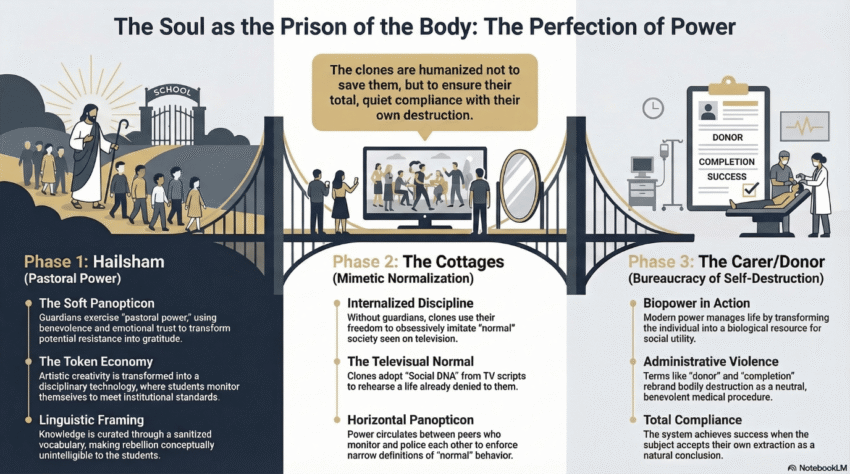
The Soul as the Prison of the Body: The Perfection of Power
Blog Summary This analysis explores how the world of Never Let Me Go functions as a perfect Foucaultian system, where power is exercised not through horizontal violence, but through the meticulous shaping of the clones’ identities. By examining the transition from the “pastoral” discipline of Hailsham to the bureaucratic self-destruction of the donor phase, the…
The Administrative Hospice: Arendtian Natality and the Sabotage of the Managed glide
There is a podcast posting for the short version of this essay. Please go to the bottom of this page for the podcast link. At a Glance In a world where infertility has transformed the state from a political “polis” into an administrative “hospice,” resistance is no longer a matter of grand revolution, but of…
The Mortal God on a Coral Island
At a Glance This analysis reframes William Golding’s classic as a brutal laboratory of institutional design, where the failure of the “Conch” is not a moral collapse but a crisis of enforcement. By bridging Hobbesian political theory with trauma psychology, we explore how the “Beast” functions as a sophisticated governing instrument—proving that civilization is not…
The Existential Lobotomy: How Huxley’s World State Cures the Sartrean Soul
At a Glance This essay explores the chilling intersection of Sartrean existentialism and Aldous Huxley’s Brave New World, arguing that the World State represents the “neutralization” of human freedom rather than its mere destruction. By examining the biological silencing of the soul, the dissolution of the self through the “Universal Look,” and Mustapha Mond’s parasitic…
The Archive of Eradication: Why Dracula’s Filing Cabinet is Scarier than his Fangs
At Glance In the world of Dracula, the filing cabinet is more formidable than the vampire’s fang. This deep dive deconstructs the “moral laundering” used by the Crew of Light to reframe ritualized execution as necessary medical care, revealing the chilling ways modern bureaucracy erases ethical residue to keep the record clean.
Addie LaRue and Albert Camus: Metaphysical Insolvency & The Absurd
A short version of this essay is available as a Spotify podcast. Check here. At a Glance In the second audit, we analyze the collapse of Luc’s monopoly through the lens of Albert Camus’s Absurdism, reframing Henry Strauss not as a savior, but as the “Black Swan” event that triggers a systemic liquidity crisis. By…

The Invisible Ledger: Existentialism, Memory, and Power in Addie LaRue
A short version of this essay is available as a Spotify podcast. Check here. literature and philosophy analysis on The Invisible Life of Addie LaRue At a Glance This blog audits the metaphysical system of The Invisible Life of Addie LaRue, reframing her curse as a bureaucratic “Terms-of-Service” agreement managed by Luc, the cosmic accountant….
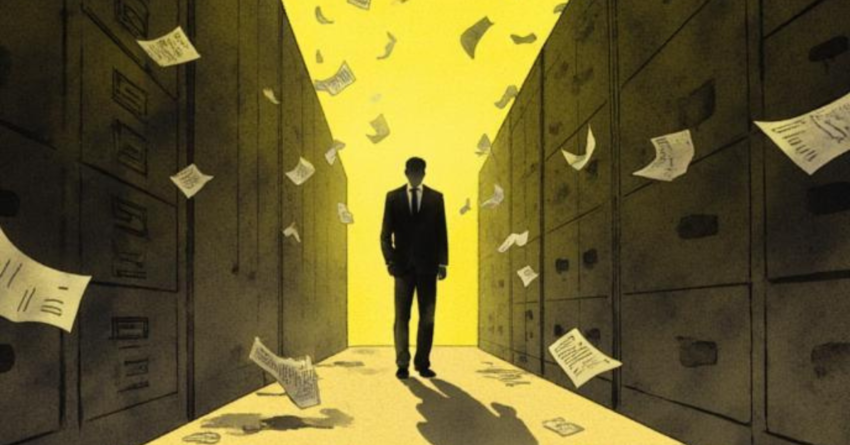
Kafka’s The Trial and Hannah Arendt: Law Without Justice
A short version of this essay is available as a Spotify podcast. Check here. At a Glance Kafka’s The Trial is not a nightmare of corrupt judges, but a chilling preview of authority emptied of thought, where law outlives justice and procedure replaces conscience. Through the lens of Hannah Arendt, this essay explores how Josef…
Red Rising Existentialist Analysis: the Architecture of the Reaper
A short version of this essay is available as a Spotify podcast. Check here. At a Glance The tragedy of Darrow’s ascent in Red Rising is not that he finds his true self, but that he strategically narrows his humanity to become a functionally sufficient weapon. By trading the radical freedom of his “Red” facticity…