The Book Tapestry

From the pages to the mind—woven with care.

Menu
  • Home
  • Blog
  • Privacy Policy
  • About Me
Menu

Author: Sophia Wordsmith

The Existential Lobotomy: How Huxley’s World State Cures the Sartrean Soul

Posted on March 15, 2026February 14, 2026 by Sophia Wordsmith

At a Glance

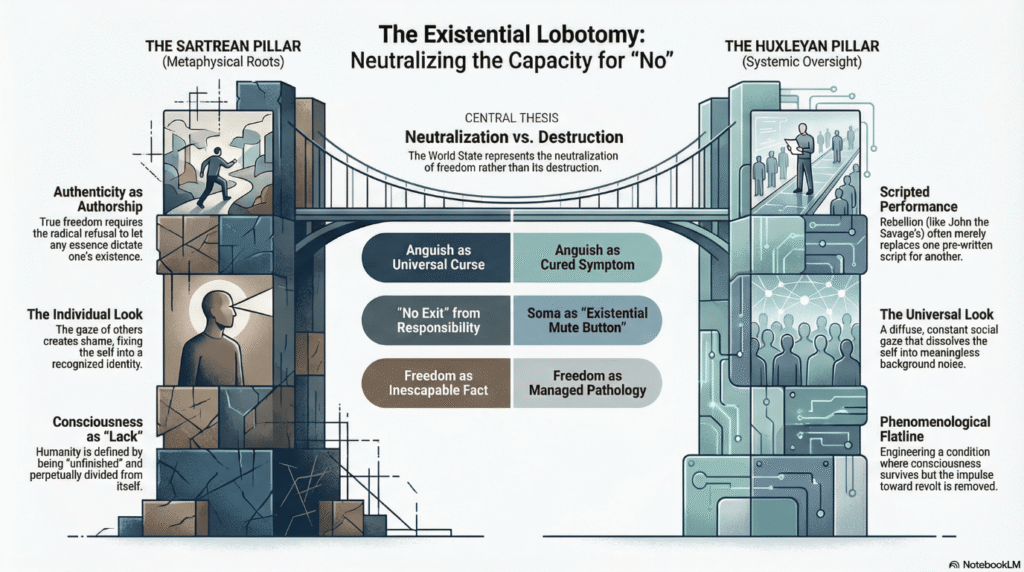
This essay explores the chilling intersection of Sartrean existentialism and Aldous Huxley’s Brave New World, arguing that the World State represents the “neutralization” of human freedom rather than its mere destruction. By examining the biological silencing of the soul, the dissolution of the self through the “Universal Look,” and Mustapha Mond’s parasitic monopoly on authenticity, it reveals a society designed so efficiently that the burden of existence is no longer felt—it is cured.
The Existential Lobotomy

Introduction: The Existential Lobotomy

Beyond the Hedonistic Bargain

Imagine a surgery where the doctor doesn’t remove a tumor, but the very capacity for “No.” In the operating theaters of Aldous Huxley’s World State, the scalpel is chemical, and the anesthesia is universal. Brave New World is frequently distilled into a cautionary tale about the dangers of a hedonistic bargain: a world that traded its soul for a steady supply of sex, drugs, and stability1. While this reading captures the novel’s surface-level rot, it misses the more radical horror lurking in the hatchery. Huxley did not merely imagine a population that chose comfort over liberty; he envisioned a civilization that successfully treated freedom as a biological pathology—an amenable condition to be managed, then cured.

The Sartrean Bedrock: No Exit from Choice

This premise stands in direct defiance of the existentialist bedrock laid by Jean-Paul Sartre. For Sartre, freedom is not a political privilege or a personality trait; it is a fundamental ontological fact. To be conscious is to be “unfinished,” a being perpetually divided from itself and “condemned” to choose. Even in our most cowardly moments of Bad Faith—when we hide behind roles or claim we “had no choice“—we inadvertently confirm our freedom by the very act of fleeing it. In the Sartrean universe, there is no exit from the responsibility of existence2.

Neutralization vs. Destruction

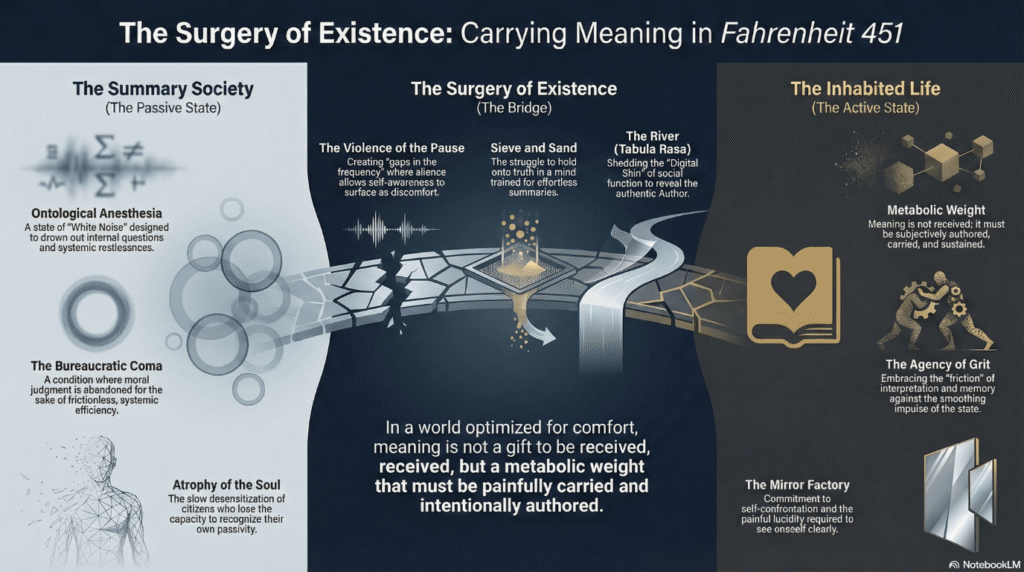
This essay argues that the World State achieves the impossible: the neutralization of freedom rather than its destruction. Through a cocktail of biological engineering, sexual saturation, and pharmacological “sealing,” Huxley’s society creates a version of humanity that remains awake but frictionless. It is a world where consciousness survives, yet the “nausea” of selfhood, the tremor of shame, and the impulse toward revolt are surgically removed from the experience of being.

A Map of Ontological Failures

Within this vacuum, the novel stages a series of ontological failures that we will explore in detail:

  • The Scripted Rebel: John the Savage, who attempts to resist the system but ultimately trades one pre-written script for another, collapsing under the weight of inherited tragedy.
  • The Universal Look: A social architecture that dissolves the “Other” into background noise, killing the self at the very point where it would otherwise coagulate.
  • The Authentic Tyrant: Mustapha Mond, a lucid soul who has monopolized the world’s supply of anguish, violating Sartre’s demand that one cannot truly will oneself free without willing the freedom of others3.

The Post-Symptomatic Question

Ultimately, Brave New World exposes a profound blind spot in existentialism. Sartre may be right that freedom is an inescapable metaphysical truth, but Huxley demonstrates that it can be rendered phenomenologically irrelevant. The haunting question remains: Can freedom survive once it has been fully understood—and efficiently cured?

The Metaphysical Foundation — The Dormant “For-Itself”

The Phenomenological Flatline: Beyond the In-Itself Paradox

At the heart of Brave New World lies a metaphysical wager that strikes at the very root of Jean-Paul Sartre’s ontology. In the Sartrean universe, the human subject is defined by a fundamental inability to become a “being-in-itself.” A stone is complete, self-identical, and closed; it simply is. In contrast, human consciousness is defined by “lack”—a structural gap or “nothingness” that perpetually distances the self from its given conditions. To be human is to be unfinished4.

The World State does not attempt to resolve this paradox through literal objectification; it knows it cannot turn a man into a mountain. Instead, it engineers a phenomenological flatline. It creates a lived condition where consciousness remains biologically intact but existentially silent. The subject does not cease to be conscious, but the “volume” of that consciousness never reaches the decibel level required to recognize itself as freedom.5 Huxley’s radical move isn’t turning humanity into stones, but ensuring that our internal disturbances never spike high enough to register as a sou.6

The Dormant Leak: Affective Regulation as Erasure

In this post-existential order, the “nothingness” at the core of being is not eliminated—it is kept dormant. The system’s success depends on a relentless schedule of affective regulation. In the World State, nothing is allowed to accumulate. Desire is satiated before it can ferment into longing; discomfort is dissolved before it can harden into meaning; loss is ritualized or sexualized before it can mature into grief.

What emerges is not the absence of freedom, but its permanent non-announcement. Freedom exists ontologically, but it never appears phenomenologically. This explains why rebellion in the World State is not only rare but fragile: the system doesn’t merely suppress acts of revolt; it also prevents the internal pressures that render the concept of revolt intelligible.

Curse vs. Signal: Treating the Symptom of Freedom

This represents the deepest philosophical rift between Sartre and Huxley. For Sartre, freedom is an inescapable curse—a metaphysical “sentence” we carry even in our most desperate attempts at evasion. We are “condemned to be free,” burdened by a responsibility that survives even our refusal to acknowledge it7.

Huxley, however, reframes freedom as a signal—a biological frequency that can be intercepted, dampened, or neutralized. To Huxley, the “anguish8” Sartre prizes is not the proof of freedom, but merely its symptom. And in the World State, symptoms are not explored for meaning; they are identified and treated. The result is a society that is not anti-freedom, but post-symptomatic.

Soma: The Existential Mute Button

This “ontological quieting” is best exemplified by the function of soma. Soma is frequently mischaracterized as a tool of state repression or a chemical religion, but its true role is far more subtle. Soma does not impose beliefs or demand obedience; it functions as an existential mute button.9

When a citizen takes soma, the drug doesn’t necessarily rewrite the contents of their mind. Instead, it silences the frequency at which consciousness becomes unbearable to itself. Anxiety is blunted before it can transform into responsibility; boredom is evaporated before it can provoke a question; pain is erased before it can demand an interpretation. In Sartrean terms, soma does not eliminate the “for-itself,” but it renders it inaudible. This is the foundation of the World State: a humanity still theoretically capable of freedom, but no longer capable of hearing its call.

The Sociological Cage — The Universal Look as Noise

If the hatchery handles the biological architecture of the self, the World State’s social rituals manage its external boundaries. In this section, we move from the internal “flatline” of consciousness to the external “white noise” of the crowd.

Inverting No Exit: From Fixation to Dissolution

Sartre famously staged the drama of selfhood in No Exit, a play where the “Other” serves as both mirror and torturer. For Sartre, the Look performs a violent but vital function: it fixes me, objectifies me, and forces me to confront myself as a being seen by another. Shame erupts in that moment—not as a moral failing, but as an ontological awakening. I suddenly realize that I am an object in another’s world.10

Brave New World performs a precise sociological inversion of this structure. If the sustained, private gaze of No Exit freezes the self into a rigid identity, the World State replaces it with a Universal Look11: diffuse, constant, and ultimately meaningless. The mantra “everyone belongs to everyone else” doesn’t intensify exposure; it dissolves it. When the gaze is universal, it loses its power to define, wound, or recognize. Sartre’s hell is one of confrontation; Huxley’s hell is one of saturation.

The Death of Shame: Exposure Without Significance

For Sartre, shame is the first phenomenological realization of the self. It reveals that I am visible, vulnerable, and—most importantly—accountable12. It marks the birth of reflexive subjectivity. The World State, however, systematically aborts this birth.

By rendering sex casual, interchangeable, and mandatory, the system removes the very conditions under which shame could arise. Nothing is hidden long enough to be revealed; nothing is private enough to be exposed; nothing matters enough to wound. Exposure without significance becomes mere noise. Shame requires an asymmetry—a gap between the observer and the observed—which the World State replaces with total, flattened availability. When intimacy is universal, recognition disappears. The result is not liberation from judgment, but the collapse of the self at the very point at which it should have crystallized.

Neutralization via Irrelevance

Unlike traditional regimes of surveillance—where the gaze disciplines through the fear of being “caught”—the Universal Look disciplines through irrelevance. There is no fear of being seen because being seen no longer signifies anything. The Look loses its structuring power precisely because it is everywhere.

In Sartrean terms, the gaze ceases to function as a “negation.” It no longer interrupts consciousness or forces a moment of reflection. Instead, it becomes ambient—a background hum against which no individual self can coagulate13. Individuals in the World State are not objectified by others; they are rendered interchangeable among them.

Hell Rewritten: The Numbness of Being Everywhere

Sartre’s famous dictum, “Hell is other people14,” presupposes that the Other still exists as a meaningful boundary. The Other wounds me because the Other matters. Huxley imagines an existence far more desolate. In the World State, Hell is not the presence of the Other, but the dissolution of the Other into a mass of bodies that never linger, never judge, and never recognize.

The self does not suffer under the weight of an identity imposed by others; it evaporates in their excess. What remains is a profound “ontological thinning”—a society of beings who are constantly touched, constantly seen, and yet never once encountered. The Universal Look does not crush the self; it prevents it from ever forming, replacing the existential tension of being seen with the sociological numbness of being everywhere and nowhere at once.

The Savage’s Scripted Rebellion — Authentic Intent vs. Methodological Bad Faith

If the World State represents the “annihilation of the self” through completion, John the Savage represents the tragedy of the self that refuses to be born. In this section, we move from the sociological white noise of the crowd to the solitary, tortured performance of the individual who mistakes his library for his liberty.

Intent vs. Method: The Trap of the Shakespearean Essence

John the Savage enters Brave New World as the novel’s most visceral point of resistance. Unlike the citizens of the World State, he is a being of “thick” experience: he feels the jagged edges of longing, the burn of shame, and the sharp sting of moral outrage. At the level of intent, John appears to embody the very existential friction the World State has spent centuries erasing.

Yet, from a Sartrean perspective, John’s rebellion is fundamentally flawed—not because it lacks passion, but because it lacks authorship. For Sartre, authenticity is not found by choosing a “better” set of values; it is found in the radical refusal to let any pre-given essence dictate the meaning of one’s existence. Authenticity is the transition from actor to author15. John never makes this leap. He rejects the World State’s engineered essence only to immediately replace it with a Shakespearean essence—a fully articulated emotional template inherited wholesale from the past16. He does not invent himself; he merely performs a different part.

The Mirror Image: Contrast is Not Escape

John is frequently read as the “Alternative” to the World State—a living proof of a more “human” way of being. But this reading mistakes contrast for escape. In reality, John is less a negation of the system and more its mirror image.

Where the World State manufactures citizens through hypnopaedia and conditioning, John has been shaped by cultural isolation, religious ritual, and literary absolutism. He does not arrive on the scene unscripted; he arrives over-scripted. He trades conditioned bliss for inherited tragedy, and pharmacological anesthesia for aestheticized suffering. Both the World State and John provide ready-made answers to the mysteries of life, love, and death. Both offer a “completion” that Sartre would find stifling. John simply prefers the aesthetics of the library to the aesthetics of the laboratory.

John cannot survive because the Universal Look of the World State refuses to validate his private tragedy; he is a man seeking a mirror in a room filled with white noise.17

Facticity as Destiny: The Failure of Transcendence

Sartre distinguishes sharply between Facticity—the brute facts of one’s past, body, and situation—and Transcendence, the capacity to exceed those facts through conscious choice.18 Authenticity requires acknowledging one’s facticity without allowing it to determine the future.

John fails this existential stress test. His entire moral universe is oriented backward. Shakespeare does not function for him as a dialogue partner or a source of inspiration; it functions as an absolute authority. John does not ask what he should do in the face of a new world; he asks how faithfully he can reenact an inherited vision of honor and suffering19. This is a form of methodological bad faith. It is not that Shakespeare’s values are “wrong,” but that John treats them as a destiny rather than a choice. He has traded the “bottle” of the hatchery for the “bottle” of the sonnet.

Rebellion Without Authorship: The Fatal Script

John’s tragedy is ultimately ontological rather than ethical. He rejects the World State’s “essence” but never steps into the radical freedom of the “void.” Instead of projecting himself toward an open future, he binds himself to a completed past. In Sartrean terms, John chooses facticity over transcendence, enclosing himself within a role—the tragic hero, the suffering lover—that the modern world no longer supports.

This choice proves fatal. When the World State refuses to play the antagonist to his tragic hero, John cannot improvise. He cannot revise his lines or invent a new mode of being. Without improvisation, freedom collapses into mere performance. John does not die because the World State is too strong; he dies because a scripted rebellion cannot survive in an unscripted world. He fails the Sartrean test because he mistakes fidelity to the past for existential freedom—proving that even the most sincere rebellion can be just another way of being “already written.”

The Systemic Oversight — Mond’s Monopoly on Authenticity

In this final movement, we reach the apex of the World State’s hierarchy. If the Deltas are “finished” and the Savage is “scripted,” Mustapha Mond is the only one who remains “unfinished.” He is the architect who keeps himself unmade so that the rest of the world remains made.

The Authentic Tyrant: Hoarding the Luxury of Anguish

Mustapha Mond is frequently cast as the villain of Brave New World, but this label misses the more unsettling truth of his character. Mond is not a tyrant because he is cruel or deluded; he is a tyrant because he is lucid. Of all the figures in the novel, Mond alone satisfies Sartre’s criteria for existential authenticity. He understands the profound cost of freedom, accepts full responsibility for his decisions, and refuses the comfort of alibis. He never appeals to historical necessity or scientific inevitability. Instead, he simply says: “I choose stability.20“

In Sartrean terms, Mond “owns” his authorship. This ownership is precisely what makes him so dangerous. Under his regime, anguish—the very weight of freedom—is transformed into a luxury good. Mond maintains a private reserve of existential tension, reading Shakespeare and contemplating the divine, while denying these depths to the population at large. Anguish, which Sartre treated as the universal burden of the human condition, becomes a scarce resource hoarded at the summit of the social order. Authenticity is no longer a shared human fate; it is a monopoly.

Parasitic Authenticity: Breaking the Social Contract

Sartre’s ethics rest on a vital reciprocity: “To want my own freedom is to want the freedom of others.” In this formulation, freedom is not a private possession but a universal obligation. One cannot authentically will oneself as free while simultaneously stripping others of the conditions of freedom without collapsing into Bad Faith.21

Mond violates this principle with clinical precision. He wills his own freedom—his right to choose stability over truth—while systematically abolishing the possibility for anyone else to make a similar choice. This creates a structural asymmetry that Sartre’s framework struggles to contain. Mond does not deceive himself about this; he institutionalizes it. This is not hypocrisy, but parasitic authenticity: a mode of being in which one subject thrives by draining the “subjectivity” from the environment around it.

The Island: Freedom Under Glass

The Island is often misread as a humanitarian concession—a refuge for the thinkers and misfits the system couldn’t digest. In truth, it serves a far colder, meta-authorial purpose. The Island is a museum of potentiality, preserved not to protect the exiles, but to certify that Mond’s tyranny remains a choice rather than a necessity.22

By maintaining a bounded space in which freedom and contradiction persist, Mond safeguards the authenticity of his project. If no alternative mode of life survived, his rule would harden into mere determinism—a law of physics rather than an act of will. The Island sustains contingency, but only as an exhibit. Those exiled there are not a threat to the system; they are its final philosophical support beam. They serve as living evidence that Mond could have chosen differently but chose not to. The Island ensures that Mond’s domination never loses the “dignity” of having been chosen.

The Monopoly of the Last Subject

Mond represents the stress test Sartre did not anticipate: the possibility that authenticity does not scale ethically. Sartre presumed that an authentic choice naturally affirms the freedom of the collective. Mond demonstrates the opposite—that authenticity can be extractive.

By the end of the novel, Mond remains the only “Subject” in a universe of “Objects.” The citizens are not merely oppressed; they are ontologically downgraded, stabilized into functions that require no transcendence. Mustapha Mond reveals the darkest possibility of the existentialist project: a world where freedom survives only as the private property of a single individual, ruling over a completed world.

Mond’s monopoly is the final seal on the World State’s project; once authenticity is privatized, the neutralization of the collective is complete.

Conclusion: Freedom After Its Neutralization

Brave New World is frequently categorized as a warning against the excesses of pleasure, technology, or conformity. However, as we have explored, Huxley’s diagnosis is far more disturbing: the novel imagines a world in which freedom is not denied, suppressed, or even falsified—it is neutralized. The World State does not refute Sartrean existentialism; it renders it phenomenologically obsolete.

For Sartre, freedom is inescapable because consciousness is structured by “negation.” The human being is never complete, never identical to itself, and never able to escape the crushing weight of responsibility.23 Huxley accepts this ontology but poses a question, Sartre never fully confronted: What if freedom, while metaphysically intact, could be engineered never to announce itself? What if anguish could be absorbed before it coheres into responsibility, shame dissolved before it crystallizes into selfhood, and desire satisfied before it hardens into meaning?

The World State is the ultimate answer to that question. Its genius lies not in coercion but in completion—in “finishing” human beings so thoroughly that the future no longer presses upon them. In this system, soma functions as an existential mute button, sexual universality dissolves the “Look24” into sociological white noise, and caste engineering prevents the “surplus” of being from which new projects emerge. The result is not oppression, but a profound ontological quieting. It is a society of conscious beings for whom freedom has ceased to be experimentally relevant.

The Failure of the Borrowed Soul

John the Savage briefly reintroduces friction into this frictionless world, but his rebellion collapses under its own inertia. By substituting Shakespearean tragedy for conditioned bliss, he merely replaces one imposed essence with another. His failure reveals a brutal truth: resistance that borrows its soul from a library cannot survive a system that has abolished authorship itself. John demonstrates that authentic intent without existential invention remains a form of methodological bad faith. He provides a different script, but he remains an actor nonetheless.25

The Monopoly of the Lucid Tyrant

Mustapha Mond completes the argument by exposing the final blind spot in Sartre’s ethics: the assumption that authenticity naturally universalizes. Mond proves that authenticity can be monopolized. By hoarding anguish and preserving freedom only as an artifact—kept under glass on the Island as a “museum of potentiality”—he remains the sole Subject in a universe of Objects. His tyranny is not hypocritical; it is lucid. He reveals that authenticity, when stripped of reciprocity, becomes parasitic.

Ultimately, the novel’s indictment is not that freedom is fragile, but that its exercise is condition-dependent. Sartre was right that freedom cannot be metaphysically destroyed, but Huxley was right that it can be made to survive only in theory. A society does not need to eliminate freedom to defeat it; it needs only to design itself so efficiently that freedom no longer matters. The haunting question Brave New World leaves us with is no longer whether we are free, but whether freedom can survive once it has been fully understood, clinically managed, and finally “cured.”

Notes

  1. Aldous Huxley, Brave New World (Pharos Books Private Limited, 2023), 5–28. ↩︎
  2. Jean-Paul Sartre, Being and Nothingness: An Essay on Phenomenological Ontology, trans. Hazel Estella Barnes (Washington Square Press, 1966), 21–30. ↩︎
  3. Jean-Paul Sartre, Existentialism Is a Humanism, with Carol Macomber et al. (Yale University Press, 2007), 29. ↩︎
  4. Sartre, Being and Nothingness, 21–30. ↩︎
  5. Huxley, Brave New World, 5–28. ↩︎
  6. Ibid, 5–28. ↩︎
  7. Jean-Paul Sartre, Being And Nothingness (Washington Square Press, 1956), 186, https://ia801504.us.archive.org/14/items/in.ernet.dli.2015.69160/2015.69160. ↩︎
  8. Sartre, Existentialism Is a Humanism, 25–28. ↩︎
  9. Huxley, Brave New World, 48–51. ↩︎
  10. Sartre, Being and Nothingness, 340–400. ↩︎
  11. Huxley, Brave New World, 6–8. ↩︎
  12. Sartre, Being and Nothingness, 352. ↩︎
  13. Jean-Paul Sartre, No Exit: And Three Other Plays, Vintage international edition (Vintage Books, a division of Random House, Inc, 1989), 45. ↩︎
  14. Sartre, No Exit, 45. ↩︎
  15. Sartre, Existentialism Is a Humanism, 40–41. ↩︎
  16. Huxley, Brave New World, 206–10. ↩︎
  17. Ibid, 211–20. ↩︎
  18. Sartre, Existentialism Is a Humanism, 79–103. ↩︎
  19. Huxley, Brave New World, 211–20. ↩︎
  20. Ibid, 200–220. ↩︎
  21. Sartre, Existentialism Is a Humanism, 51. ↩︎
  22. Huxley, Brave New World, 208–10. ↩︎
  23. Sartre, Being and Nothingness, 21–30. ↩︎
  24. Ibid, 340–400. ↩︎
  25. Huxley, Brave New World, 211–20. ↩︎

Bibliography

Huxley, Aldous. Brave New World. Pharos Books Private Limited, 2023.

Sartre, Jean-Paul. Being and Nothingness: An Essay on Phenomenological Ontology. Translated by Hazel Estella Barnes. Washington Square Press, 1966.

Sartre, Jean-Paul. Existentialism Is a Humanism. With Carol Macomber, Annie Cohen-Solal, and Arlette Elkaïm-Sartre. Yale University Press, 2007.

Sartre, Jean-Paul. No Exit: And Three Other Plays. Vintage international edition. Vintage Books, a division of Random House, Inc, 1989.
The Archive of Eradication: Why Dracula’s Filing Cabinet is Scarier than his Fangs

Posted on March 8, 2026February 7, 2026 by Sophia Wordsmith

At Glance

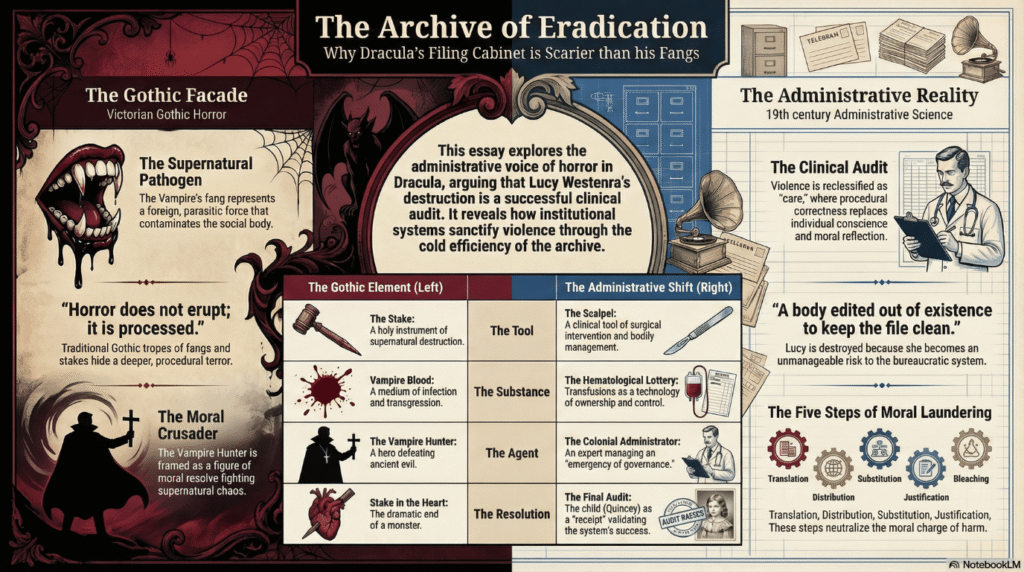
In the world of Dracula, the filing cabinet is more formidable than the vampire’s fang. This deep dive deconstructs the “moral laundering” used by the Crew of Light to reframe ritualized execution as necessary medical care, revealing the chilling ways modern bureaucracy erases ethical residue to keep the record clean.

Introduction: The Filing Cabinet Over the Fang

In Bram Stoker’s Dracula, the most formidable instrument of power is not the vampire’s fang, the crucifix, or even the wooden stake. It is the filing cabinet. While the novel is draped in the trappings of Gothic horror, its true terror does not reside in the supernatural transgression of blood; it lives in the calm, procedural language that renders extraordinary violence both necessary and sterile. Long before Lucy Westenra is physically destroyed1, Stoker’s narrative has already anesthetized the reader to the ethical shock of her execution. In this world, horror does not erupt; it is processed.

Lucy’s “purging” is rarely read as a murder, yet it is exactly that—a ritualized execution authorized by science. It is not a traditional Gothic climax where chaos is defeated by moral resolve, but rather a successful administrative procedure2. Her death marks the precise moment where medical expertise and bureaucratic coordination converge to sanctify coercion. The discourse surrounding her “treatment” never pauses to ask if violence is justified; it presumes justification through function. Under the clinical gaze, medical authority reframes trauma as a cure, and collective agreement diffuses responsibility until the moral weight of the act evaporates. Violence is no longer an emotional excess; it is a logistical necessity, validated retroactively by the restoration of social order.

Administrative Voice

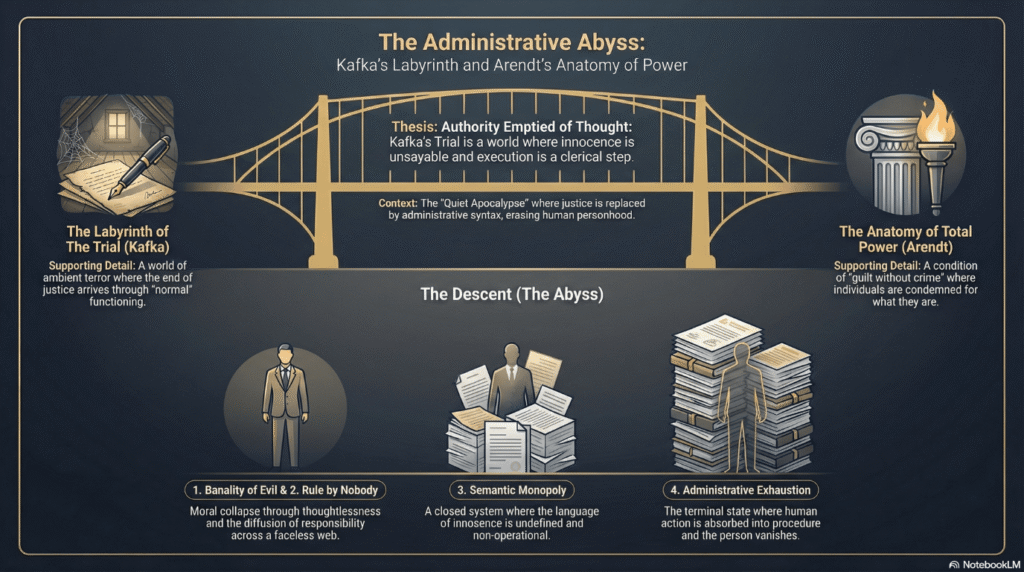
Central to this transformation is the novel’s administrative voice. Dracula is famously constructed from a fragmented archive: journals, letters, telegrams, and phonograph transcripts. Each document purports to be a neutral, technical record of limited scope. This structure produces a tone of procedural objectivity that effectively suppresses dissent. Events are logged rather than interrogated; actions are sequenced rather than judged. By distributing the narration across a ledger of disparate records rather than a unified moral consciousness, the novel replaces reflection with documentation and conscience with protocol3.

What emerges is a chilling case study in how modern systems authorize violence without the need for passion, cruelty, or even individual guilt. Lucy Westenra does not die because the men around her are immoral; she dies because the system they have assembled—a proto-bureaucracy of experts—leaves no ethical space in which she might exist4. Her destruction is the first victory of the modern archive: a body edited out of existence to keep the file clean.

Clinical Cruelty: The Medicalization of the Stake

In Dracula, the staking of Lucy Westenra is not narrated as an act of killing, but as a clinical intervention5. The scene’s language is strikingly procedural: the focus remains fixed on instruments, positioning, and sequence, while affect is managed rather than expressed. By adopting the vocabulary of duty, the narrative asks the reader to evaluate professional competence rather than moral justice.

Violence as Treatment

The staking is structured precisely like a surgical operation. Van Helsing “directs,” Arthur “performs,” and the others “attend.” The ritual unfolds through a rigid series of steps, where the emphasis lies on correct execution rather than moral hesitation6. Within this framework, pain is only relevant as a metric of efficacy—convulsions and cries are interpreted merely as signs that the procedure is “working.”

This rhetorical move is crucial. By translating violence into technique, the narrative removes the ethical category of murder and substitutes it with the technical category of “necessary intervention.” Once the act is framed as a medical obligation—an “it must be done” with no alternative—refusal is rebranded as irresponsibility. Dracula thus stages a paradigmatic instance of clinical cruelty: harm administered calmly, expertly, and without malice, precisely because it has been reclassified as care.

The Consent Void

Lucy’s absence from the decision-making process is not incidental; it is foundational. She is unconscious, infantilized, and spoken about rather than spoken with. In the novel’s administrative logic, consent is rendered unnecessary once a diagnosis is declared. Lucy is reduced from a subject to a case study—a body to be managed, not a will to be consulted.

This exclusion mirrors the Victorian medical gaslighting of women labeled “hysterical,” whose testimony was routinely discounted as pathological7. The authority of the male experts supersedes Lucy’s agency entirely. Her silence is not interpreted as an objection, but as a confirmation that she is incapable of self-governance. This consent void functions as the enabling condition for the procedure: without Lucy’s voice, the system encounters no ethical friction.

The Speculum and the Stake

The medicalization of Lucy’s destruction gains further clarity when read alongside the Contagious Diseases Acts (CDA) of the mid-to-late nineteenth century. Under these laws, women suspected of prostitution were subjected to forced gynecological examinations, often with the speculum, and detained without consent under the banner of protecting the “health of the nation8.”

The logic is identical. In both cases, women’s bodies are reframed as vectors of contagion, and coercion is justified as prevention. The parallel is structural: both the speculum and the stake are invasive instruments authorized by expertise and sanctified by the public good. Both acts are narrated as regrettable but necessary. Through this lens, the staking of Lucy ceases to be a Gothic aberration and emerges as a familiar exercise of institutional power. She is not killed because she is monstrous; she is destroyed because she has been successfully reclassified—from woman to pathology, from subject to threat.

The Logistics of Ownership: Blood and Control

In Dracula, blood is never merely biological; it is logistical. The four transfusions administered to Lucy Westenra are framed as lifesaving acts, yet their narrative function is less therapeutic than juridical. Each transfusion marks a claim, and together they constitute a system through which Lucy’s body is converted from a private person into a communal asset managed by male authority. What appears as intimacy—sharing blood—operates instead as a technology of control.

The Hematological Lottery

The sequence of transfusions is striking for its repetition and its ultimate futility. Each donor offers blood in good faith; each donation fails to reverse Lucy’s decline. Yet the practice continues, escalating not because it works, but because it symbolizes moral participation. The men’s blood becomes proof of investment. As critic Christopher Craft famously observed, the transfusions function as a ritual of masculine bonding that centers Lucy as the medium rather than the beneficiary9.

Ethically, the arrangement resembles a lottery whose physical outcomes are irrelevant; what matters is that each man enters. By contributing blood, the male coalition converts individual sacrifice into collective entitlement. Lucy’s body becomes the shared site upon which their virtue is enacted. The language surrounding these scenes repeatedly emphasizes unity—we, our, together—while Lucy herself remains passive, anesthetized, and silent. Ownership is produced not through raw domination, but through coordinated care10.

This logic carries a chilling implication: once multiple men have “invested” themselves biologically, Lucy no longer belongs to herself. She belongs to the system that has bled for her. The transfusions do not save Lucy’s life; they legitimate the decisions later made about her death.

Communal Blood, Communal Authority

The moral weight of the transfusions also performs a preemptive function. Having given blood, the men acquire not only emotional leverage but ethical insulation. Any subsequent violence can be framed as a tragic necessity rather than a violation. The transfusions operate as advanced “moral credit,” insulating later acts from scrutiny. Because the group has already “done everything possible,” the groundwork of innocence is carefully laid before the stake ever touches her chest11.

This conversion of sacrifice into authority mirrors broader Victorian anxieties about heredity and contamination. Blood signifies lineage, but it also signifies governance. Lucy’s circulation becomes a managed resource—less an internal bloodstream and more a public utility.

The Professional Shield

Presiding over this logistics of ownership is Van Helsing, whose medical degree functions as a professional shield. His authority does not merely advise; it suspends normal constraints. He orders transfusions without consent and authorizes bodily invasion—actions that would be criminal if performed by an ordinary citizen.

Van Helsing’s expertise creates a localized state of exception. His credentials permit him to bypass the law and ethical hesitation in the name of emergency12. What would otherwise require warrants or public accountability is instead handled privately and decisively. As Max Weber observed, modern authority derives legitimacy from rationalized expertise13; Van Helsing’s status does not restrain violence—it enables it.

Blood as Authorization

Read together, the transfusions and Van Helsing’s authority reveal a coordinated mechanism: blood creates ownership, and expertise authorizes control. The transfusions are not failed medicine; they are a successful administration. By the time the stake is raised, Lucy has already been dispossessed—ethically, legally, and narratively14.

What Dracula exposes is how easily care becomes custody when mediated by institutions. Blood is shared, authority is centralized, and violence follows as the logical conclusion of a system that mistakes investment for entitlement.

The Laundromat of the Soul: The Five Steps of Moral Laundering

In Dracula, violence does not merely occur; it is processed. The novel constructs a mechanism through which ethically troubling acts are passed through successive rhetorical stages until they emerge purified of guilt. What results is not denial, but laundering—a system that accepts the reality of harm while neutralizing its moral charge. Lucy Westenra’s destruction is the paradigm case: by the time the act is complete, nothing remains that demands an apology.

1. Translation: From Violence to Social Function

The first step is translation. Lucy’s death is reframed from a personal violation into a social necessity. She is no longer a woman who might be wronged, but a condition that must be corrected. The language of the “Archive” performs the conversion: danger becomes threat, threat becomes risk, and risk becomes public harm. Once translated into function, the act exits the moral register altogether. Violence is no longer something one does; it is something that must be done for others15.

2. Distribution: Fragmenting Guilt

Next comes distribution. The act is divided into four coordinated components: authorization, execution, observation, and documentation. One man wields the stake, another the hammer, another the pen. No single actor performs the “whole” of the killing; therefore, no one owns the guilt. Responsibility is diluted across the collaboration. This is not accidental but structural. By fragmenting agency, the novel creates distributed innocence—a condition in which each participant can plausibly claim partial obligation and total absolution16.

3. Substitution: Protocol Replaces Conscience

Once distributed, ethical inquiry is quietly replaced. The question “Is this right?” gives way to “Is this the correct next step?” Conscience is displaced by sequence. Attention shifts to timing, order, and precision until only procedural correctness remains visible. Within this logic, hesitation appears not as compassion, but as an error or a “glitch” in the operation. This is the novel’s most dangerous move: it renders ethics obsolete by redefining responsibility as compliance17.

4. Justification: Success Cleanses Means

The fourth stage is retroactive justification. Dracula is destroyed; the threat ends. This outcome does not merely conclude the narrative—it rewrites it. Because the hunt succeeds, every preceding act becomes “necessary” by definition. Violence is vindicated not through argument, but through result. The logic is brutally simple: if order returns, then the methods that produced it cannot be wrong. Success functions as a moral detergent18.

5. Bleaching: Domestic Peace as Ethical Solvent

The final stage is bleaching. The novel’s ending—marriage, a child, and pastoral calm—overwrites the residue of trauma. Domestic normalcy absorbs ethical tension the way bleach absorbs stains. Lucy’s absence is not mourned; it is rendered irrelevant by continuity. The child at the end does not represent moral renewal, but institutional reassurance. Life goes on; therefore, nothing requires reckoning. The system emerges spotless, not because it was clean, but because it has replaced the fabric19.

The Completed Cycle

Taken together, these five steps form a closed system. Violence enters as necessity and exits as virtue. No character must lie; no one must feel cruel. The laundering succeeds precisely because it is sincere. Dracula does not teach its characters to ignore harm—it teaches them how to process it correctly. Lucy Westenra is not destroyed by malice or suspicion; she is destroyed by a system that knows exactly how to wash its hands.

Mina Harker: The Intelligence Officer of the Empire

In Dracula, Mina Harker occupies a position of paradoxical power. She is repeatedly praised and relied upon, yet never permitted full authority. This is not a contradiction in the novel’s logic; it is its design. Mina is not merely a clerk or a moral support figure; she functions as the intelligence officer of the administrative machine. She is the figure who gathers, organizes, and translates information so that others may act. Her value lies not in her resistance to power, but in her ability to make the world legible to it20.

The Administrative Nexus

Mina’s primary labor is epistemic. She collects diaries, transcribes phonograph recordings, synchronizes timelines, and produces a coherent archive from fragmented testimony. This work is foundational; without Mina’s compilation, the hunt for Dracula would be incoherent. She does not merely record events—she renders them actionable.

In bureaucratic terms, Mina is the interface. She stands between raw data and executive decision-making, converting lived experience into administrative knowledge. The men acknowledge they would be lost without her, yet this indispensability is carefully circumscribed. Mina’s access to information does not grant her authority over outcomes; she enables the machine without directing it. This separation between knowledge and power is the hallmark of modern administration: intelligence is valued precisely because it can be extracted and centralized by those in command.

Managed Assets vs. Liquidated Risks

Mina’s survival is often read as a moral contrast to Lucy’s destruction. Yet the distinction is not ethical; it is logistical. Mina is saved because she remains a manageable asset. Lucy is purged because she becomes an unmanageable risk.

Lucy’s body resists stabilization. Her behavior exceeds social containment, and her condition cannot be rendered productive. Once she is administratively “unfixable,” liquidation follows. Mina, by contrast, remains legible even after her infection. Her symptoms can be monitored, restricted, and incorporated into the system’s calculations. The scar burned into her forehead by the consecrated wafer functions as a visible infection marker—a literal status bar on her body—read by the men as data that tracks both her risk level and the institution’s ongoing success in containing it. She submits to surveillance and continues to contribute cognitively. The system does not “rescue” her from violence; it postpones it, contingent upon her continued compliance21.

Intelligence Without Autonomy

The novel’s description of Mina as possessing “a man’s brain and a woman’s heart” crystallizes her institutional role. Structurally, this is not praise—it is a job description. Mina is permitted intelligence so long as it does not translate into sovereignty. She may calculate and synthesize, but she may not decide. Her “woman’s heart” (emotional labor) softens the brutality of the group’s actions, while her “man’s brain” (cognitive labor) accelerates their efficiency22.

This arrangement exemplifies a broader imperial logic. Colonial administrations prized local knowledge and bureaucratic skill while reserving ultimate authority for a governing elite. Mina’s position mirrors this structure: she is central, indispensable, and ultimately subordinated. When the crisis ends, she is rewarded not with agency but with retirement into domesticity.

The Instrument That Survives

Mina does not escape the administrative machine; she perfects it. By the novel’s conclusion, her intelligence has been fully reintegrated into normative structures—marriage, motherhood, and memory. Her survival certifies the system’s “benevolence” without challenging its logic. While Lucy’s death is filed away as a necessity, Mina’s life is displayed as proof of successful “management.”

In this sense, Mina is neither victim nor liberator. She is the ideal instrument: a human conscience that reassures without obstructing, and an intelligence that illuminates without commanding. The empire does not fear minds like Mina’s; it depends on them.

The Colonial Emergency: Governance by Expertise

In Dracula, the hunt for the Count is framed not as a criminal investigation, but as an emergency of governance. This distinction is decisive. Criminality presumes law, evidence, and adjudication; an emergency, by contrast, presumes suspension, discretion, and expertise. The novel repeatedly chooses the latter. What unfolds is not policing but pacification, guided by a colonial logic that treats existential threats as administrative problems requiring extraordinary measures.

London as a Protectorate

Dracula is never pursued as a murderer subject to arrest. He is framed as an invading pathogen—a foreign, parasitic force whose presence contaminates the social body. This framing relocates the crisis from the domain of law to the domain of security. London, ostensibly the imperial center, is momentarily transformed into a protectorate, governed under emergency logic rather than civil statute.

In colonial administration, such conditions justified the suspension of normal rights in favor of expert control. Medicine, intelligence gathering, and discretionary violence replaced courts and constables. Van Helsing does not gather admissible evidence; he gathers intelligence. The goal is not justice but elimination23. Dracula is not meant to be tried—he is to be removed.

The Police Vacuum

The conspicuous absence of police is not a narrative oversight but a structural necessity. Policing implies public accountability, procedural delay, and the possibility of appeal. The hunters’ actions—grave desecration, unlawful confinement, and killing—could not survive legal scrutiny. Instead, authority is transferred to a private coalition of experts whose legitimacy derives from professional consensus rather than the state. 

This absence is especially conspicuous given that Dracula was published less than a decade after the Jack the Ripper murders, when police presence, public inquiry, and institutional failure were intensely visible in the East End—making their complete disappearance from Van Helsing’s discreet, West End–style operations read less as realism than as a class privilege that allows violence to proceed without public interference

This represents a shift from public law to private expertise. In this regime, agreement among credentialed men replaces due process. What matters is not legality, but plausibility within the group. Mina’s archive substitutes for the official record; Van Helsing’s reputation substitutes for a warrant. As is characteristic of colonial governance, the law does not disappear—it is “paused.” Power becomes discretionary.

The Pacification Project

Lucy Westenra’s staking represents the most intimate application of this colonial logic. Her body becomes the site of a civilizing mission. Once classified as deviant and irredeemable, she must be corrected or eliminated for the “good of the whole.” The language mirrors imperial rhetoric: purification, protection, restoration.

Like colonial subjects deemed unfit for self-governance, Lucy is denied autonomy under the justification of collective safety. Her destruction is narrated as a regrettable but necessary act of benevolent force. This is pacification, not punishment; the goal is not to hold Lucy accountable, but to neutralize her difference. The violence is thus doubly sanitized—first by medicine, then by empire24.

Expertise as Sovereignty

What ultimately governs in Dracula is not law, faith, or monarchy, but expertise itself. Knowledge becomes sovereignty. Those who know, decide; those who decide, act; those acted upon disappear into necessity. The colonial emergency does not end when Dracula dies; it ends when the system proves it can restore order without ever questioning its own authority.

In this sense, Dracula is not merely a tale of an invasion repelled, but a rehearsal of modern emergency governance—where law yields to experts, violence masquerades as care, and survival certifies domination.

The Certification Stamp: The Child as Final Audit

In Dracula, the narrative does not conclude with terror or remorse, but with verification. The birth of Quincey Harker is not merely sentimental closure25; instead, it functions as the novel’s final audit. While earlier sections process violence through medicine, expertise, and protocol, the ending processes memory itself. The child certifies that the system worked—and that no further ethical accounting is required.

The Progeny of Procedure

Quincey Harker is introduced not as an individual future, but as a receipt. His existence retroactively validates the methods that preceded him. Marriage, reproduction, and lineage signal that the social order has not only been restored but also successfully reproduced. The violence that enabled this outcome is rendered “necessary” by virtue of its result. If a healthy child exists, the logic follows that the system that produced him must have been sound26.

This is not hope; it is continuity. The child’s name—an aggregation of the male coalition’s names—archives the authority that acted, embedding their legitimacy into the next generation’s bloodline. Lucy leaves no descendant, no interruption, and no unresolved claim. The narrative does not ask what was lost; it displays what remains. The future stands as proof that the past needs no apology.

The Erasure of Evidence

The novel’s “happy ending” operates as a rhetorical gag order. Domestic peace replaces ethical inquiry, crowding out the possibility of mourning. One cannot grieve Lucy Westenra while celebrating the baby without disrupting the coherence of the resolution. Joy functions here as a form of censorship. Trauma is not confronted; instead, it is overwritten.

This mechanism mirrors bureaucratic closure. Once a case is resolved, its internal contradictions are archived rather than examined. The presence of a child signals that the system is healthy, thereby transforming Lucy’s death from a tragedy into an acceptable loss. Evidence of harm is not refuted—it is rendered irrelevant by success27.

Success as Silence

The novel’s final effect is not reassurance, but silence. No character expresses guilt. No institution is questioned. Finally, no ethical residue lingers. This silence is the final stage of moral laundering. Once the paperwork is complete—threat eliminated, order restored, lineage secured—violence disappears into administration.

This is the quiet horror of Dracula: not that the monster dies, but that the system emerges cleansed. Success itself becomes the ultimate argument. The ending teaches its readers that when outcomes align with norms, methods no longer matter. The file closes. The archive rests. The future smiles. Lucy’s absence is the price of coherence—and in the administrative logic of the empire, coherence is treated as the highest virtue.

Conclusion: The Modern Echo

In Dracula, the grave is not the end of violence; it is its administrative completion. What the novel ultimately exposes is not the danger of superstition or the fragility of moral order, but the terrifying efficiency with which institutions can absorb death into procedure. Lucy Westenra’s fate does not stand outside modernity—it anticipates it. The logic that destroys her is the same logic that permits harm to occur without hatred, cruelty, or even intent.

The Bureaucracy of the Grave

The most enduring horror of Dracula lies in its anticipation of institutional violence conducted in “good faith.” Lucy is not killed by rage, fear, or moral excess; she is killed by coordination. Each step—diagnosis, intervention, escalation, liquidation—is executed according to an internally coherent system that conflates compliance with ethics. Once violence is routed through expertise and protocol, conscience becomes unnecessary. The act is no longer chosen; it is prescribed28.

This is the bureaucratic logic of the grave: a mode of harm in which responsibility dissolves into roles, procedures replace judgment, and success retroactively sanctifies cruelty. When actions are performed “by the book,” guilt has nowhere to attach. The system does not deny death; it normalizes it.

Success as Absolution

The novel’s calm ending is not a reassurance—it is an indictment. Order returns. A child is born. The archive closes. These outcomes do not merely conclude the story; they absolve it. The restoration of normalcy retroactively erases the moral cost of achieving it. Lucy’s absence is rendered invisible because, on the surface, nothing appears broken. The system’s greatest triumph is not Dracula’s destruction, but the elimination of ethical residue.

This logic has a distinctly modern resonance. It echoes wherever institutions justify harm as policy, necessity, or “best practice”—where suffering is reordered but not mourned, where outcomes matter more than means, and where procedural correctness substitutes for moral reflection. Dracula does not imagine a world corrupted by monsters; it imagines a world perfected by administration.

Final Statement

The system did not merely kill Lucy Westenra. It filed her away—so efficiently, so correctly, and so cleanly that the murder ceased to register as murder at all. That is the novel’s final horror: not that violence occurred, but that it was done properly—and therefore forgotten.

Notes

  1. Bram Stoker, Dracula, with David Rogers and Keith Carabine, Wordsworth Classics (Wordsworth Editions Ltd, 2011), 132–35. ↩︎
  2. Ibid, Dracula, 179–81. ↩︎
  3. Christopher Craft, “‘Kiss Me with Those Red Lips’: Gender and Inversion in Bram Stoker’s Dracula,” Representations 8 (October 1984): 107–33, https://doi.org/10.2307/2928560.Kiss ↩︎
  4. Hannah Arendt, Eichmann in Jerusalem: A Report on the Banality of Evil, with Amos Elon (Penguin Books, 2006), 276–79. ↩︎
  5. Stoker, Dracula, 179–81. ↩︎
  6. Ibid, 179–81. ↩︎
  7. Elaine Showalter, The Female Malady : Women, Madness, and English Culture, 1830-1980, with Internet Archive (New York, N.Y., U.S.A. : Penguin Books, 1987), 122–64. ↩︎
  8. Judith R. Walkowitz, Prostitution and Victorian Society : Women, Class, and the State, with Internet Archive (Cambridge ; New York : Cambridge University Press, 1980), 56, http://archive.org/details/prostitutionvict00walk. ↩︎
  9. Craft, “Kiss Me with Those Red Lips,” 107–33. ↩︎
  10. Stoker, Dracula, 75–135. ↩︎
  11. Stoker, Dracula, 179–81. ↩︎
  12. Giorgio Agamben, State of Exception, trans. Kevin Attell (University of Chicago Press, 2005), 1–31. ↩︎
  13. Max Weber, Economy and Society: An Outline of Interpretative Sociology, ed. Guenther Roth and Claus Wittich (University of California press, 1978), 956–1005. ↩︎
  14. Stoker, Dracula, 73–181. ↩︎
  15. Michel Foucault, Society Must Be Defended: Lectures at the Collège de France, 1975-76, ed. Michael Senellart, trans. Graham Burchell (Picador, 2003), 239–63. ↩︎
  16. Arendt, Eichmann in Jerusalem, 276–79. ↩︎
  17. Weber, Economy and Society, 956–1005. ↩︎
  18. Zygmunt Bauman, Modernity and the Holocaust, Repr (Polity Press, 2008), 31–60. ↩︎
  19. Stoker, Dracula, 315. ↩︎
  20. Stoker, Dracula. ↩︎
  21. Michel Foucault et al., Security, Territory, Population: Lectures at the Collège de France, 1977-1978, 1. Picador ed, ed. Michel Senellart, trans. Graham Burchell, Lectures at the Collège de France (Picador, 2009), 83–110. ↩︎
  22. Weber, Economy and Society, 956–1005. ↩︎
  23. Foucault et al., Security, Territory, Population, 16–38. ↩︎
  24. Edward W. Said, Culture and Imperialism, ist Vintage Books ed, A Borzoi Book (Knopf, 1994), 111–32. ↩︎
  25. Stoker, Dracula, 315. ↩︎
  26. Ibid, 315. ↩︎
  27. Bauman, Modernity and the Holocaust, 31–60. ↩︎
  28. Arendt, Eichmann in Jerusalem, 276–79. ↩︎

Agamben, Giorgio. State of Exception. Translated by Kevin Attell. University of Chicago Press, 2005.

Arendt, Hannah. Eichmann in Jerusalem: A Report on the Banality of Evil. With Amos Elon. Penguin Books, 2006.

Bauman, Zygmunt. Modernity and the Holocaust. Repr. Polity Press, 2008.

Craft, Christopher. “‘Kiss Me with Those Red Lips’: Gender and Inversion in Bram Stoker’s Dracula.” Representations 8 (October 1984): 107–33. https://doi.org/10.2307/2928560.

Foucault, Michel, and David Macey. Society Must Be Defended: Lectures at the Collège de France, 1975-76. Edited by Mauro Bertani. Picador, 2003.

Foucault, Michel, François Ewald, and Alessandro Fontana. Security, Territory, Population: Lectures at the Collège de France, 1977-1978. 1. Picador ed. Edited by Michel Senellart. Translated by Graham Burchell. Lectures at the Collège de France. Picador, 2009.

Said, Edward W. Culture and Imperialism. Ist Vintage Books ed. A Borzoi Book. Knopf, 1994.

Showalter, Elaine. The Female Malady : Women, Madness, and English Culture, 1830-1980. With Internet Archive. New York, N.Y., U.S.A. : Penguin Books, 1987.

Stoker, Bram. Dracula. With David Rogers and Keith Carabine. Wordsworth Classics. Wordsworth Editions Ltd, 2011.

Walkowitz, Judith R. Prostitution and Victorian Society : Women, Class, and the State. With Internet Archive. Cambridge ; New York : Cambridge University Press, 1980. Weber, Max. Economy and Society: An Outline of Interpretative Sociology. Edited by Guenther Roth and Claus Wittich. University of California Press, 1978.

Addie LaRue and Albert Camus: Metaphysical Insolvency & The Absurd

Posted on March 1, 2026January 25, 2026 by Sophia Wordsmith

At a Glance

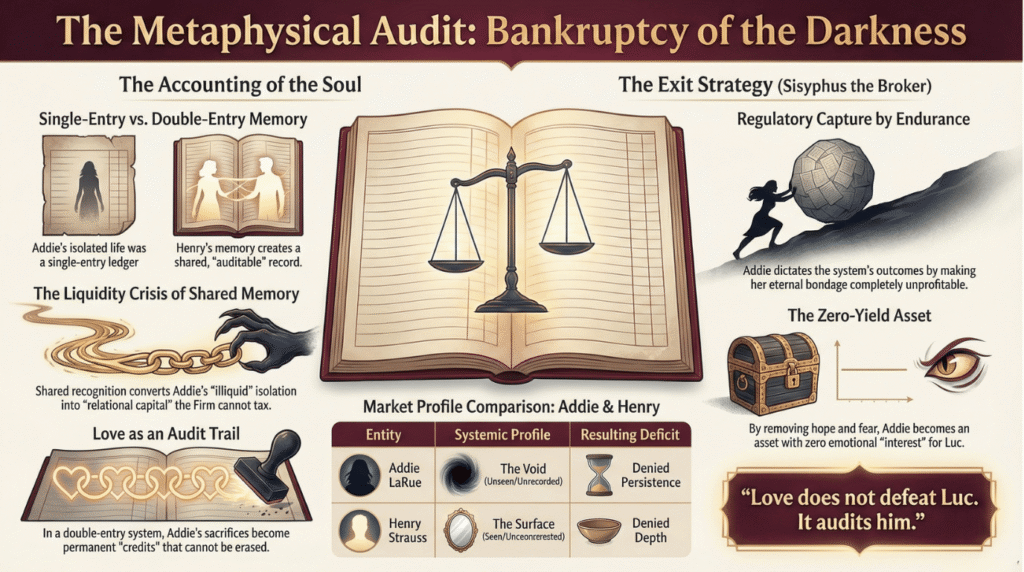
In the second audit, we analyze the collapse of Luc’s monopoly through the lens of Albert Camus’s Absurdism, reframing Henry Strauss not as a savior, but as the “Black Swan” event that triggers a systemic liquidity crisis. By introducing double-entry bookkeeping into a single-entry universe, the duo achieves a state of metaphysical insolvency that renders eternity unprofitable for the darkness. Ultimately, Addie evolves into a Broker of the Absurd, proving that the only way to defeat a closed system is to outperform its logic and outlive its relevance.

The Metaphysical Audit: Bankruptcy of the Darkness

Introduction: The Great Liquidity Crisis of the Soul

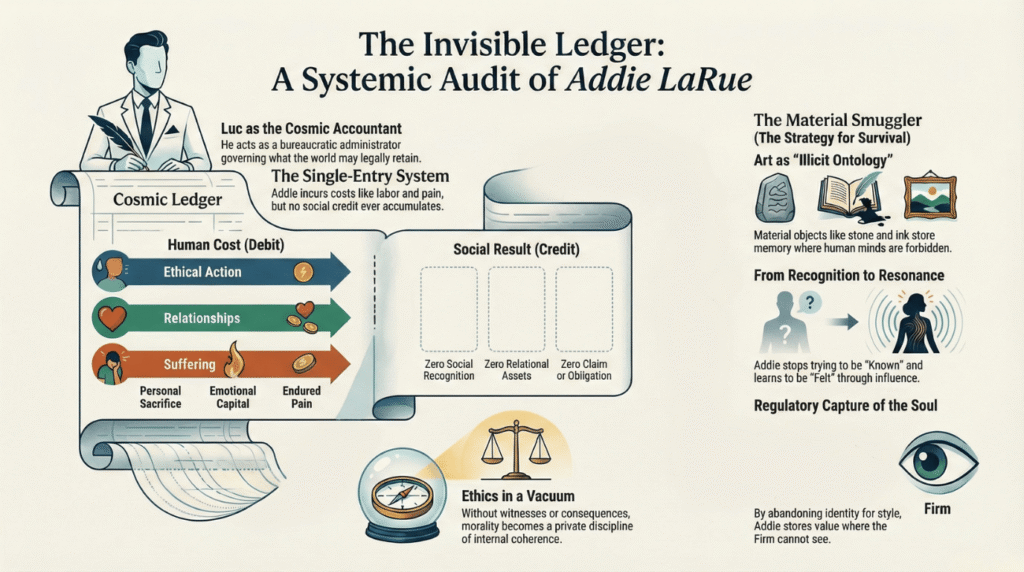
What happens to a god of erasure when the “void” starts to produce interest? In our previous audit, we established Addie LaRue’s life as a state of Metaphysical Solvency—a single-entry system where freedom was trapped in an archival vacuum for centuries. However, the stability of this monopoly depends entirely on Addie remaining a solitary unit.

When Addie meets Henry Strauss, the architecture of the curse shifts from a study of isolation to a study of Systemic Risk. If Addie is the asset that cannot be recorded, Henry is the mirror that cannot be escaped. By witnessing her, Henry introduces a second ledger into a closed loop. Together, they represent the first true Liquidity Crisis in the history of the Firm—a moment where the silence of the dark is finally breached by a shared recognition1.

uNBREDICTABLE eVENT

If the universe is a ledger, then for three hundred years, Adeline LaRue has been a “ghost entry”—a single line of data that the system refuses to save, yet cannot delete. We have seen how this single-entry existence forces a life of infinite effort and zero accumulation. However, even the most airtight monopolies are vulnerable to a Black Swan event. In the cold, regulated world of Luc’s Firm, that disruption is not a violent rebellion, but a market correction in the form of a man who remembers.

In this final audit, we move beyond the romantic tragedy of The Invisible Life of Addie LaRue to examine the mechanics of its systemic collapse. By applying the Absurdist philosophy of Albert Camus2, we find that Henry is not merely a savior, but a co-conspirator in a high-stakes act of Regulatory Capture. Henry’s presence triggers a state of Metaphysical Insolvency, proving that even the most absolute contract cannot audit a shared reality.

Ultimately, Addie does not win by breaking the system; she wins by outperforming it. By transforming herself from a victim of a curse into a Broker of the Absurd, she renders eternity itself unprofitable for the darkness, proving that the hill of Sisyphus can be turned into a seat of power.

The Double-Entry Audit: Henry as Systemic Disruptor

The Shared Ledger: From Single-Entry to Consolidated Accounts

In our first audit, we saw Addie LaRue as a Single-Entry Soul. Her actions existed, but they did not “post.” Every kindness, every act of courage, and every momentary connection vanished at the end of the day—unrecorded, unreconciled, and unreferenced. Her life was an immaculate but useless ledger: debits without credits, events without counterparts. Luc’s system thrives on this void. His power depends on Ontological Isolation3. For his profit margin to remain high, memory must remain private, non-transferable, and therefore illiquid.

Henry Strauss’s arrival alters the universe’s accounting structure.

For the first time in three centuries, Addie’s existence is mirrored. Memory is no longer a sealed silo; it becomes a Shared Ledger. When Henry remembers Addie, her actions acquire a second entry. A moment is no longer merely “done”—it is Recognized. This is not merely sentimentality; it is Consolidation. Two isolated accounts collapse into a single balance sheet of meaning. What emerges is not romance, but Infrastructure. A life that can be remembered by another ceases to be metaphysically solitary4. The system, for the first time, has a debt it must reconcile.

Metaphysical Insolvency: The Threat of Liquidity

Luc’s authority rests on a subtle but absolute principle: Illiquidity. Addie’s memories cannot circulate; they cannot be exchanged, collateralized, or compounded. A value that cannot move cannot threaten the status quo. Luc does not need to erase Addie’s goodness because, in isolation, that goodness cannot accumulate into power.

Henry introduces Instant Liquidity.

The moment a memory is shared, it acquires the potential to be transmitted. An act remembered by another person gains durability and consequence. This is why shared memory is catastrophic for Luc’s firm: it converts Addie’s isolated endurance into Relational Capital.

Luc cannot tax what does not circulate, but he also cannot tolerate a market he does not control. Shared memory threatens Systemic Insolvency because it creates value that escapes his accounting rules. The system was designed for the predictable physics of single-entry souls. Double-entry breaks the code.

Love as Audit Trail: The Emergence of Ethical Equity

In this framework, love is stripped of its romantic gloss and revealed as an Audit Trail.

In a single-entry system, sacrifice simply disappears. Addie gives, and the void swallows the transaction. In a double-entry system, however, every loss is posted somewhere else. A sacrifice in one ledger becomes a Credit in another. This is the core disruption Henry introduces: Ethical Equity.

When Addie suffers for Henry, that loss is no longer erased. It is acknowledged, mirrored, and held. The value does not vanish; it Transfers. Ethical equity may not be redeemable for a “normal” life, but it is Durable. It cannot be deleted without breaking the books.

Luc’s power allows him to erase names, faces, and records—but he cannot erase Relational Symmetry. Once meaning exists in two places at once, a deletion in one creates a permanent imbalance in the other. And in Luc’s universe, an imbalance forces a reckoning.

The Audit Conclusion

Henry Strauss is not merely a lover or a witness; he is a Systemic Disruptor. His presence does not overthrow Luc’s regime by force, but by exposing its accounting assumptions. Luc governs a universe where nothing is meant to balance. Henry proves that balance is possible, and in doing so, reveals the system to be contingent, not absolute.

Love does not defeat Luc. It audits him.

Henry’s Curse: The Surface and the UX

Refractive Interface: Henry as Lens, Not Subject

Henry Strauss’s curse does not erase him; it overprocesses him. He remains fully visible, fully accessible, and constantly affirmed—yet fundamentally unencountered. Ontologically, Henry is not treated as a subject among subjects, but as a Refractive Interface: a human lens through which others see themselves more clearly5.

This produces a paradoxical condition: Social Saturation paired with Ontological Starvation6. Henry is recognized everywhere and nowhere at once. People respond to him instantly, warmly, even lovingly, but their recognition never terminates in understanding. It slides past him. In philosophical terms, Henry is not unseen; he is Transparent. Transparency, however, is not intimacy; it is exposure without depth. His curse guarantees that others will feel toward him while never needing to feel with him. What is destroyed is not affection, but Mutuality.

The UX of the Soul: Frictionless Recognition

Henry functions as a perfectly optimized product. His presence removes “friction” from social interaction. People feel comfortable, affirmed, and validated in his proximity because his curse has eliminated Resistance. There is no risk of rejection, no weight of misunderstanding, and no friction of conflict.

This is why the metaphor of User Experience (UX) is precise rather than decorative. In design, frictionless systems are efficient but shallow; they maximize engagement while minimizing real encounters. Henry’s curse turns his soul into such a system.

People do not meet Henry. They pass through him.

They leave the interaction feeling sharper and more confident, but they remain unchanged in relation to him. He is not archived as a person; he is recorded as a Sensation. Because true recognition requires the “bump” of a separate will, Henry’s lack of resistance makes it impossible for him to be known. You cannot grasp a surface that offers no traction.

Ontological starvation emerges here not from neglect, but from Excess. Henry is consumed continuously, never metabolized into meaning. He is the ultimate “Liquid Asset”—highly tradable but with no intrinsic value to the holder.

The Collision of Deficits: Why They Meet

Henry and Addie find one another not by chance, but by Structural Necessity.

  • Addie is a Void: Unseen, unrecorded, an accumulation of unmirrored history.
  • Henry is a Surface: Endlessly seen, endlessly projected upon, an accumulation of hollow reflections.

Both suffer from failed recognition, but from opposite poles of the spectrum. Addie is denied Persistence; Henry is denied Depth.

When they meet, their curses cancel rather than compound. When Henry looks at Addie, his curse fails; she does not reflect his desires because she has no stable social surface to which a projection can attach. Conversely, when Addie looks at Henry, she does not consume his reflection because she is not seeking a mirror for her own ego—she is seeking a Witness for her existence7.

Ontological Relief: Love as Non-Extraction

They are, perhaps, the only two people who cannot “use” each other. Addie cannot inflate her ego through Henry because his memory of her is a blank slate. Henry cannot inflate his ego through Addie because she refuses to offer the frictionless affirmation his curse demands from everyone else.

What emerges is Ontological Relief: the rare, cooling experience of being neither erased nor instrumentalized. Their connection is not built on romantic fulfillment, but on Suspension—a pause in the machinery of recognition where neither the void nor the surface dominates.

This is not love as completion; it is Love as Non-Extraction. In a universe governed by Luc—a system designer who profits solely from the extraction of human meaning—this is the most dangerous form of relationship imaginable. It is an “Illegal Trade” in pure presence.

The Illegal Trade: The Black Market of the Soul

Unlicensed Recognition: Love as Contraband

In Luc’s economy, recognition is a licensed activity. To exist legitimately, memory must be authorized, traceable, and enforceable. The curses are the regulators: Addie’s ensure that recognition cannot circulate; Henry’s ensure that desire circulates without consent. Both conditions keep human value legible—and thus taxable—to the system.

Addie and Henry’s relationship is a massive regulatory breach.

Their love is not “illegal” because it is immoral, but because it is unlicensed. It bypasses the official currencies of ownership and archival memory. Addie does not “belong” to Henry; Henry does not “consume” Addie. No name is claimed, no legacy promised. What they exchange is an unregistered presence—recognition without title. They have created a “dark pool” of intimacy that produces a value the system cannot track.

The Jurisdictional Signal: Why “Tomorrow” is Dangerous

As long as Addie and Henry remain in the Present-Tense Sanctuary, their exchange is untaxable. The present has no forecast, no guarantee, and no enforcement mechanism. It is experimental, not institutional.

The danger enters with a single word: Tomorrow.

To ask, “How long can this last?” is not a question of emotion; it is a Jurisdictional Signal. Duration requires oversight. The future requires structure. Structure belongs to the Regulator. The moment they ask “how long,” they convert presence into projection. The question functions like a formal filing—a request for institutional time.

Luc does not need to overhear the whisper. The system automatically registers the data spike. The present can be inhabited, but the future must be administered. Once “tomorrow” enters the vocabulary, the black market brushes against legitimacy, and legitimacy is the primary trigger for taxation.

Luc as Regulator: Repricing, not Prohibition

Luc does not shut the relationship down with a show of force; that would acknowledge its moral standing. Instead, he does what effective regulators always do: he reprices the cost of living.

  1. The Temporal Markup: Time becomes “heavier.” Moments shorten. The future begins to press in on the now. Love is no longer an experience; it becomes a countdown.
  2. The Isolation Premium: External connections thin out. Support systems weaken. The relationship must now bear the full weight of the participants’ meaning, which dramatically increases its operating cost.

Luc never says, “You cannot love.” He simply ensures that loving costs more than either party can afford. This is how regulation succeeds without force: Exhaustion replaces prohibition. Eventually, the participants self-liquidate, not because love failed, but because the system made it unsustainable.

Once the relationship moves from the ‘Now’ to ‘Tomorrow,’ it becomes a trackable liability. For Luc, a non-yielding asset that threatens the integrity of his ledger is a procedural error. Henry’s death is not a tragedy; it is a Market Correction.

Planned Liquidation: The Henry Exit Strategy

The Non-Compliant Asset: Why Henry is “Written Down”

Henry Strauss is not destroyed because he fails; he is destroyed because he ceases to yield.

Initially, Henry functions as a perfect Liquid Asset. His curse ensures continuous circulation: affection without choice, desire without attachment. He is infinitely substitutable and therefore profitable. But that yield collapses the moment he binds himself to Addie. Attachment introduces illiquidity. Value stops circulating. From the system’s perspective, Henry has become a “non-performing asset.”

Luc’s decision to end Henry’s life is not a market crash; it is a Planned Liquidation—a quiet write-down of an instrument that no longer functions within the Firm’s portfolio.

Debt Assumption, Not Refinancing: The Nature of the Deal

Addie’s final deal with Luc is not a rescue of Henry; it is a Transfer of Liability. In financial terms, Addie does not “refinance” Henry’s position; she assumes the debt herself. She says, “Do this, and I will be yours, as long as you want me by your side8. 

Henry is removed from the system entirely—his curse lifted, his presence restored to the market of the living. Luc agrees to this because Henry no longer represents leverage9. The cost, however, is Risk Concentration. Addie extends her bondage indefinitely, accepting a deeper exposure than ever before. Luc’s claim on her time becomes total. This is not mercy; it is Balance-Sheet Optimization. The system survives because the loss is concentrated in a single, durable entity: Addie.

Sunk Cost Sovereignty: Closing the Ledger

The decisive ethical act comes after the bargain. Addie does not return to Luc as a submissive; she does not seek legacy or the restoration of Henry’s memory. Instead, she treats Henry’s life as a Sunk Cost: a completed expenditure that must not be recovered, leveraged, or converted into future claims.

She refuses to let his survival generate “narrative interest.” His meaning is not priced into eternity; it simply is. This is sovereignty through restraint. Addie understands that every additional request would reopen the ledger and restore Luc’s leverage. Instead, she remains fully exposed while removing every incentive that makes exposure profitable.

Luc retains control in theory. Addie controls the economics of compliance.

By absorbing the loss without appeal, she transforms herself into an asset with infinite duration but zero yield. She becomes a “toxic asset” that Luc cannot sell and cannot extract value from. Eventually, the system will do what systems always do when returns vanish: it will walk away. In that moment of systemic indifference, the contract will finally expire10.

Synthesis: Sisyphus the Broker

The Mechanics of the Hill: Reset as Transaction Cost

Addie’s eternity is often read as punishment, but structurally it functions as a Known Operating Expense. By the novel’s end, she no longer experiences the daily erasure as an existential shock; the loss is “priced in.” The reset has become a transaction cost—a predictable friction she has learned to absorb, optimize, and route around.

This is where the Sisyphean analogy becomes exact rather than poetic. In The Myth of Sisyphus, Albert Camus insists that mastery begins not when the rock disappears, but when the labor is fully understood11. Addie has mastered the Physics of the Hill. She knows precisely when the reset will occur, what it will erase, and—critically—what it cannot touch.

While memory fails, action persists. While influence dissolves, effect remains. The rock no longer dominates her; it is merely heavy. In economic terms, Addie is no longer surprised by loss—she budgets for it. This does not make her “free” in the traditional sense, but it marks her as operationally superior to the mechanism meant to exhaust her.

Camusian Scorn as Leverage: Making Eternity Unprofitable

Camus writes that revolt begins when a person refuses both hope and appeal12. Addie’s final posture embodies this refusal precisely. She has abandoned the hope for release and the fear of endlessness. Both emotions were once Luc’s primary leverage points; by removing them, she has de-leveraged her soul.

This is Camusian scorn utilized as an economic weapon. By existing without appeal—without pleading for recognition, memory, or reprieve—Addie drains eternity of its Yield. Luc’s investment depends on volatility: the “market swings” of longing, despair, and renegotiation. Addie offers none. She continues without escalation or protest, never asking for meaning to be guaranteed.

Scorn, in this context, is not contempt; it is Systemic Non-cooperation. Addie does not challenge the terms of the contract; she simply renders them irrelevant to her behavior. She converts infinite duration into a flat line—time without interest. Luc still “owns” the contract, but ownership without return is Dead Capital.

The Hostile Takeover: Regulatory Capture by Endurance

Addie does not escape the system; she achieves Regulatory Capture. In political economy, this occurs when the entity being governed begins to dictate the system’s effective outcomes. Addie achieves this through Negative Value. She has become a “Toxic Asset”—owned and accounted for, yet impossible to monetize.

Luc can still erase her memory, reset her record, and maintain formal control. What he cannot do is extract narrative, emotional, or metaphysical profit. Addie outlives the system’s relevance by surviving past its Incentive Horizon. She does not overthrow the Administrator; she makes him indifferent. And in an extractive system, indifference is the ultimate failure.

The Final Audit: Starving the Fate

This is Camus’s ending stripped of its consolation. Sisyphus does not escape the hill; he makes the hill irrelevant13. Addie does the same. She walks; the rock rolls; the ledger resets. And none of it produces Returns.

Luc may still win contracts, but Addie has won a Time Without Yield. She does not defeat fate; she starves it. She is the asset that produces no dividends, the investment that incurs only maintenance costs. When assets stop producing, the only rational move left for a business administrator is a Write-off.

Addie is waiting for that final signature. It is a risky, bold movement—a bet that her endurance will eventually outlast a god’s curiosity14.

Conclusion: The Final Accounting

The Hostile Takeover of Eternity

Beyond the Contract 

The novel’s ending is not a truce. It is a Renegotiation of Terms in which Addie holds the only card that matters: time stripped of interest. She does not invalidate the agreement; she revalues it. Luc retains formal ownership, but ownership without return is Dead Capital. The system continues to function, but it no longer generates a profit.

The Boredom Variable

 Luc’s ultimate vulnerability is not mercy, nor error, but boredom—the inevitable “market slump” of an entity that has witnessed every variation of longing, despair, and appeal. Addie’s strategy is a Long-Call Option on that boredom. She does not escalate; she does not plead. She persists. In a universe where leverage depends on emotional volatility, persistence without volatility is poison.

Outlasting the Interest, Addie treats her soul as a Prepaid Expense. By removing longing—the interest—from the equation, she drives Luc’s position “underwater.” Eternity still accrues, but nothing compounds. The asset remains on the books, but the yield has evaporated.

Scorn as the Ultimate Dividend

The Camusian Victory 

This is why Albert Camus remains the essential auditor at the close. One must imagine Addie happy—not because she is “free,” but because her happiness is non-taxable. It is the dividend she keeps. Scorn, here, is not contempt; it is Systemic Non-cooperation. By refusing both hope and fear, she removes the last instruments of Luc’s leverage.

The Sovereign of the Sunk Cost

Henry’s memory becomes the only Unregistered Asset in the universe. It cannot be seized, priced, or audited by the Firm. Addie alone knows the true value of this “write-off,” and she refuses to capitalize on it. Meaning remains real precisely because it is never monetized.

Non-Cooperation as a Business Model 

Addie does not yield despair. She does not produce narrative spikes. She does not request revisions. The Firm’s infrastructure—built to extract value from human longing—finds nothing to process. What cannot be extracted eventually ceases to be pursued.

The Final Audit: The Ghost in the Machine

Legacy vs. Influence 

Addie has evolved from wanting to be Known (biography) to being Pervasive (art and style). Her essence has decentralized. Influence replaces legacy; diffusion replaces ownership. She is no longer a record to be kept, but a pattern to be encountered.

Metaphysical Equity 

Luc may hold the deed to her soul, but Addie holds the Equity of her experiences. Equity is not ownership; it is participation in value. And value that cannot be audited cannot be repossessed.

Closing the Audit 

In a world of single-entry erasures, Addie and Henry proved that Double-Entry Recognition is possible. A loss here can be a credit elsewhere. The system depends on the illusion of secrecy—on the belief that erasure is total and the ledger is private. The ending shatters that belief.

The secret is out. The audit is closed. The Firm is insolvent.

Note

  1. V. E. Schwab, The Invisible Life of Addie LaRue, First Tor paperback edition (Tor Publishing Group, 2023), 235–37. ↩︎
  2. Albert Camus, The Myth of Sisyphus, trans. Justin O’Brien (Vintage International, 1991), 23. ↩︎
  3. Schwab, The Invisible Life of Addie LaRue, 48–52. ↩︎
  4. Ibid, 235–37. ↩︎
  5. Ibid, 269–92. ↩︎
  6. Jean-Paul Sartre, Existentialism Is a Humanism, with Carol Macomber et al. (Yale University Press, 2007), 22–34. ↩︎
  7. Schwab, The Invisible Life of Addie LaRue, 235–37. ↩︎
  8. Ibid, 427. ↩︎
  9. Ibid, 433–35. ↩︎
  10. Ibid, 437–42. ↩︎
  11. Camus, The Myth of Sisyphus, 119–23. ↩︎
  12. Ibid, 117. ↩︎
  13. Ibid, 119–23. ↩︎
  14. Schwab, The Invisible Life of Addie LaRue, 439–42. ↩︎

Bibliography

Camus, Albert. The Myth of Sisyphus. Translated by Justin O’Brien. Vintage International, 1991.

Sartre, Jean-Paul. Existentialism Is a Humanism. With Carol Macomber, Annie Cohen-Solal, and Arlette Elkaïm-Sartre. Yale University Press, 2007.

Schwab, V. E. The Invisible Life of Addie LaRue. First Tor paperback edition. Tor Publishing Group, 2023.

The Invisible Ledger: Existentialism, Memory, and Power in Addie LaRue

Posted on February 22, 2026February 15, 2026 by Sophia Wordsmith
literature and philosophy analysis on The Invisible Life of Addie LaRue

At a Glance

This blog audits the metaphysical system of The Invisible Life of Addie LaRue, reframing her curse as a bureaucratic “Terms-of-Service” agreement managed by Luc, the cosmic accountant. By applying the existentialism of Sartre and the political theory of Arendt, it explores how Addie survives through a “private discipline” of ethics and the smuggling of meaning through art. Ultimately, it reveals Addie as an ontological broker who achieves regulatory capture, setting the stage for a systemic liquidity crisis when her life is finally remembered.

Life That Does not Compound

Meals eaten: perhaps one hundred thousand. Beds slept in: innumerable. Cities crossed, hands held, words spoken—each action registering the ordinary signs of a life fully lived. And yet, when Addie LaRue’s existence is audited, the final column remains empty. No memory persists, no social trace stabilizes, and no mark remains. Her life, measured in human activity, appears abundant; measured in consequence, it is zero.

The paradox at the heart of The Invisible Life of Addie LaRue is not immortality, nor even loneliness, but the radical possibility of a life that expends infinite energy without ever compounding into meaning1.

The Curse as Governance, Not Punishment

This paradox is best understood not as a folkloric curse, but as a system of governance. Addie’s bargain with the being known as Luc functions neither as moral punishment nor supernatural damnation. It operates instead as a contractual framework—a “Terms-of-Service” agreement for existence itself.

Addie is granted freedom of movement, desire, and action; what she is denied is feedback. The world is prohibited from retaining her. Memory collapses at the moment of contact. Relationships reset. Consequences are blocked from accumulation. Luc does not restrict Addie’s agency; he renders it structurally inconsequential2.

Freedom Without Sediment: Failure of Essence

Seen this way, the novel stages a radical ontological experiment: what becomes of a human being when existence is granted, but essence is systematically prevented from forming? Jean-Paul Sartre’s famous claim that “existence precedes essence” rests on a largely unexamined assumption: that the world in which one acts is capable of remembering those actions3.

In Sartrean terms, essence emerges through “projects” sustained over time—through repetition, recognition, and the weight of responsibility. Addie’s condition severs this process at its root. Every action dissolves the moment it is performed. She exists continuously, yet her identity can never sediment. She is condemned not merely to freedom, but to a freedom without history.

If essence requires the sediment of history, then Addie is a subject permanently suspended in the liquid present—a state that Luc manages with bureaucratic precision.

Freedom Without Duration: Ethics Without Witness

The Private Discipline Addie becomes the ultimate existential test case: a subject existing in freedom without duration. Her tragedy is not that she cannot choose, but that her choices cannot stabilize into a “Self.” Without memory, ethical action is stripped of its social force and reduced to a private discipline.

Without recognition, responsibility loses its external anchor. The novel thus exposes a hidden dependency within existential philosophy: freedom alone is insufficient to generate meaning unless the world is permitted to achieve what freedom does.

Scope of the Audit: Systems, Not Romance

This analysis approaches Addie’s life as a systemic problem rather than a romantic one. We will audit three interlocking structures that govern her existence:

  1. The Cosmic Accountant: Examining Luc as a figure of jurisprudence who profits from Ontological Arbitrage—extracting human effort while ensuring it never reaches the “market” of history.
  2. The Ethical Invisible: Exploring the implications of a life without witnesses, where goodness and suffering leave no durable trace and morality becomes radically interior.
  3. The Material Smuggler: Analyzing the role of art—oil, stone, ink, and melody—as a form of “Illicit Ontology,” a material archive that survives where human memory is contractually forbidden.

Addie as a Toxic Asset

Addie LaRue functions as a toxic asset in Luc’s ledger. She does not survive by breaking the rules, nor by escaping his jurisdiction. Instead, she learns to operate within the contract’s blind spots. Over centuries, she evolves from a victim into a broker, discovering how meaning can be deferred and stored outside the mechanisms of the mind. Even when identity is denied, resonance may still find a way to compound.

The Firm: Luc as the cosmic Accountant

The Ledger of Silence

Luc is most often read as a devil—seductive, cruel, amused by suffering. Yet this interpretation misses his fundamental efficiency. Luc does not behave like a tempter seeking corruption, nor a tyrant requiring obedience; he behaves like an Administrator. His primary interest lies not in souls, but in Accountancy. What he extracts from Addie LaRue is not damnation, but something far more abstract and structurally valuable: unwitnessed difference4.

The core of Luc’s ledger is silence. He profits from the yawning gap between human effort and social record—from actions that expend energy, intention, and emotion without ever stabilizing into memory. In Addie’s case, this gap is infinite. She acts passionately and creatively, yet the world is contractually forbidden from retaining her presence. The system does not merely “forget” Addie; it is structured to ensure that forgetting occurs automatically, without malice or resistance. Luc’s harvest is not destruction, but Meaning Leakage: the steady evaporation of significance from a life that is prohibited from compounding5.

The Jurisprudence of Cognition

This logic explains why the curse is so surgically selective. Luc does not interfere with physics; Addie leaves footprints, occupies space, and alters matter. What Luc governs instead is Cognition. Recognition collapses, memory resets, and narrative continuity fails.

The distinction is crucial. By allowing causality to proceed while blocking remembrance, Luc preserves the appearance of freedom while nullifying its long-term effects. Objects may bear the residues of Addie’s presence, but minds cannot integrate those traces into an identity. The world becomes a graveyard of residues that are legally barred from testifying.

In this sense, Luc’s authority is a jurisprudence rather than a metaphysics. He enforces a law about what may be retained, not what may occur. He is a bureaucratic regulator of reality. As Hannah Arendt observed in her analysis of systemic power, the most effective domination does not require cruelty; it requires procedures that function automatically, without reflection6. Luc’s system operates with similar indifference. He does not need to punish Addie’s goodness or reward her cruelty. As long as the output remains zero—no memory, no obligation, no accumulation—the ledger balances.

The Broker’s Profit

The Broker’s Profit Viewed through the lens of accounting rather than theology, Addie’s life is a Single-Entry System. Costs are incurred—time, labor, pain, desire—but no corresponding credit ever appears in the world’s books.

  • Ethical Debit: Ethical actions debit the self without crediting society.
  • Relational Insolvency: Love expends emotional capital without generating relational assets.
  • The Debtless Sufferer: Suffering produces no claim, no debt, and no obligation.

This is why Luc does not need to torture Addie. Pain has no intrinsic value in his system; it is merely noise. Luc feeds not on anguish, but on Imbalance.

Luc is a structural parasite. He does not oppose meaning; he feeds on a system that prevents meaning from consolidating. Addie is his most refined asset: a human being capable of endless output with zero durable return. She is valuable precisely because she is invisible to the mechanisms that normally transform effort into Essence.

The Vulnerability of the Audit

Yet, this efficiency exposes Luc’s ultimate liability. A system that depends on single-entry lives assumes that meaning cannot cross ledgers. It presumes that recognition is always isolated and always resettable. What Luc underestimates—and what Addie slowly exploits—is the possibility that meaning may be deferred, displaced, and stored outside the cognitive channels he controls. Luc governs minds, but he does not fully govern matter, form, or time. His jurisprudence is precise, but it is not total. Within this narrow margin, Addie begins her slow transition from asset to liability.

But while matter can store a trace, the soul must store a choice. If Luc has vacated the moral ledger, Addie is left to maintain it alone.

Ethics Without Witness: the Private Discipline

The “Ring of Gyges” Test

The ethical problem at the center of The Invisible Life of Addie LaRue is not temptation or moral frailty; it is Invisibility. Addie’s condition subjects her to a philosophical test older than the novel and more unsettling than any doctrine of sin: the challenge posed in Plato’s tale of the Ring of Gyges. If a person could act without ever being seen, remembered, or held accountable, would morality survive7?

Addie lives permanently inside that thought experiment. Her actions leave no reputational trace, no legal consequence, and no narrative afterlife. She is free not only from punishment, but from Recognition itself. Under these conditions, conventional ethics collapse. Moral systems grounded in social reinforcement—praise, blame, honor, or shame—lose their purchase. Even consequentialist frameworks falter because outcomes do not persist long enough to shape the world. Addie’s kindness cannot improve a community; her cruelty cannot corrupt one. Every moral act is quarantined within the moment of its execution. What remains is not ethics as a social system, but ethics as a Solitary Discipline.

The Sartrean Answer

Jean-Paul Sartre offers the most severe response to this predicament. For Sartre, ethics does not arise from divine command or social validation, but from Radical Choice. To choose oneself is to choose a vision of humanity; each action declares, “This is how a human being ought to act.” In Addie’s case, this responsibility intensifies. Because no one remembers her, she cannot outsource her morality to reputation, habit, or tradition. There is no audience to impress and no social identity to protect. Her goodness must be entirely Self-Legislated8.

This makes Addie’s ethical burden heavier than that of the ordinary agent. Most humans act under conditions of partial visibility, anticipating judgment or memory. Addie acts in a vacuum. Every choice is stripped of reinforcement and reduced to a single, haunting question: “Who do I choose to be when nothing will come of it?” Her ethics are not easier because they are private; they are harder because they are Absolute. There is no instrumental reason to be good. There is only the refusal to become something else.

The Tragedy of Invisibility

Yet, this radical autonomy exposes a tragic paradox articulated by Hannah Arendt. For Arendt, ethical action becomes “Real” only when it enters the Shared World of Appearance—when it is seen, remembered, and woven into the social fabric. Action without remembrance may be morally sincere, but it remains Politically Sterile9.

Addie’s mercy, however genuine, leaves no footprint in the “World of Men.” It does not alter institutions or collective memory. Her goodness exists, but it does not appear. In Arendt’s terms, Addie is denied Worldliness, the condition that allows an action to outlast the actor. Her ethics become real only to herself; they cannot scale, they cannot propagate, and they cannot cross into history.

Goodness as a Private Aesthetic

Under such conditions, morality risks Depreciation. Actions that leave no trace are vulnerable to nihilism—not because they lack meaning, but because meaning fails to accumulate. Addie’s challenge is to prevent her goodness from eroding into a “Private Hobby”—an aesthetic preference rather than a moral commitment.

She resists this by treating ethics as a form of Internal Coherence. Her goodness is less about changing the world and more about preserving a self that refuses to collapse into indifference. Her morality is maintained through:

  • Repetition without Reward
  • Choice without Reinforcement
  • Restraint without Recognition

Ultimately, the novel suggests that while morality does not require witnesses to exist, it does require them to Endure. Without the archive of human memory, goodness persists only in miniature—compressed into the narrow, fleeting space between action and disappearance.

The Smuggling Route: Art as Illicit Ontology

The Third Space

If Luc governs recognition, the central question becomes: how does meaning survive in a world where minds are forbidden to remember? The Invisible Life of Addie LaRue answers this not through rebellion, but through Materiality. Paint, stone, ink, and melody become the novel’s quiet contraband—forms of memory that operate below the threshold of Luc’s jurisdiction. Art functions as a Third Space: neither human cognition nor divine record, but something stubbornly physical, persistent, and mute.

This distinction is crucial. Luc’s curse does not erase Addie from reality; it erases her from Recognition. She leaves footprints, alters rooms, and touches objects. Causality remains intact. What collapses is the mind’s ability to integrate those traces into narrative continuity. The world becomes full of evidence without testimony. In this context, matter acquires a strange privilege: it can remember without understanding, preserve without judging, and endure without accusing. A statue may survive centuries without insisting on who inspired it. A melody may linger without naming its source. These objects are Witnesses who cannot testify10.

Authorized vs. Unauthorized Memory

Luc allows this because objects do not generate claims. A remembering mind produces Obligation: gratitude, guilt, responsibility, or love. Objects do none of this. They store form without intent; they retain rhythm and effect, but not authorship.

This explains why Luc’s jurisprudence tolerates art while prohibiting memory. A name would stabilize identity. A story would demand coherence. A remembered face would reopen the ethical ledger. But an unnamed painting persists. It preserves Difference without reducing it to a Consequence. It is “Unauthorized Memory”—a trace that exists outside the Firm’s official books.

From Recognition to Resonance

This division mirrors a deeper philosophical distinction between Appearance and Remembrance. As Hannah Arendt argues, action becomes fully real only when it enters the shared world of human memory11. Art interrupts this process by freezing action at the level of form. It arrests motion without preserving intention. In doing so, it creates a durable trace that remains ontologically real while ethically silent.

It is within this narrow margin that Addie’s strategy evolves. Over centuries, she stops attempting to be Known and begins learning how to be Felt. Recognition fails her; Resonance does not. She abandons the hope of authorship and turns instead to Influence—nudging artists, inspiring motifs, and shaping aesthetics that will outlive her without naming her. In accounting terms, she ceases to press for direct attribution and begins building a Parallel Balance Sheet: one measured not in memory, but in Affect.

Addie the Broker

This shift marks Addie’s transformation from subject to Broker. She no longer fights Luc’s rules; she arbitrages their limits. If identity cannot persist, form can. If memory collapses, influence may still propagate. Addie’s presence migrates from biography into Style, from narrative into Pattern.

Across three centuries of Western art, she becomes a Distributed Trace rather than a stable self, present everywhere and owned nowhere. Her meaning compounds precisely because it is never consolidated under her name. This is an Illicit Ontology: a mode of being that survives without recognition.

The Incompleteness of the Audit

Art does not defeat Luc; it exposes the incompleteness of his jurisdiction. A system designed to erase identity may still fail to erase influence. Addie survives not by reclaiming her name, but by abandoning it. She becomes unaccountable not because she escapes the Firm, but because she learns to Store Value where the Firm cannot see.

Luc governs the ledger of minds, but Addie operates in the margins, where matter remembers what consciousness is forbidden to retain. The audit is open, the assets are hidden, and the stage is set for a Liquidity Crisis that only a single, remembering mind can trigger.

Conclusion: The Long Game of Deferred Assets

The Regulatory Capture of the Soul

The audit now comes into focus. Addie LaRue has not escaped Luc’s Firm, nor has she overturned its jurisdiction. The system governing her life remains intact: recognition collapses, memory resets, and identity refuses to stabilize. Yet, the audit reveals something more unsettling than rebellion. Over three centuries, Addie has achieved what regulators fear more than defiance: Regulatory Capture. She has mastered the rules of Luc’s system so completely that she no longer needs to violate them to neutralize their force.

Luc’s power depends on isolation. His ledger balances only as long as lives remain, Single-Entry Systems—so long as action debits the self without ever crediting the world. Addie appears, at first glance, to be the perfect asset within this structure: infinite output, zero accumulation, total erasure. But assets can become toxic. By shifting her investments from Identity to Form, Addie converts herself from a consumable resource into a distributed influence. She does not reclaim authorship; she abandons it. Meaning compounds without attribution. Value persists without ownership. Luc’s system continues to function, but it no longer extracts the profit it expects12.

The Tax-Free Ethics of Coherence

This transformation clarifies the ethical stakes of Addie’s survival. Her goodness does not disappear simply because it leaves no public trace. Instead, it becomes a form of Private Capital—a moral preserve maintained without expectation of return. Luc cannot tax this goodness because he cannot “see” it. Her ethical life produces no institutional effects, but it also provides no leverage for the Firm. In a system that profits from unwitnessed difference, Addie’s refusal to lapse into nihilism is a quiet act of Metaphysical Sabotage. Goodness survives not as social currency, but as internal coherence.

The Fragility of the Incomplete Audit

Yet, this victory is incomplete by design. A private ethic, no matter how disciplined, cannot repair a world. Addie’s actions remain morally sincere but, in Arendt’s terms, Politically Sterile13. Her influence circulates through art and affect, but never through responsibility or obligation. The system remains stable because nothing consolidates. Luc’s Firm does not fail; it simply fails to notice the slow accumulation of Deferred Assets hidden outside its balance sheet.

This brings the audit to its most precarious conclusion. Luc’s system is not unjust because it is cruel; it is fragile because it is incomplete. It assumes that meaning must either be Owned or Erased. It cannot account for meaning that is delayed, shared, or relational. The ledger balances only as long as recognition remains individual and memory remains isolated. This is the condition of Metaphysical Solvency.

The Risk of Convergence 

What follows is not escape, but Systemic Risk.

The arrival of Henry Strauss does not represent romance; it represents Insolvency. For the first time in three centuries, Addie’s existence threatens to move from a single-entry system into a Consolidated Account. A remembered life introduces Double-Entry Bookkeeping: loss appears alongside gain, sacrifice alongside credit, and action alongside consequence. The Firm can tolerate isolation, but it cannot survive convergence. In Blog 2, we will examine what happens when Luc’s closed system encounters its first true audit—when love, recognition, and memory threaten to reconcile accounts that were never meant to balance.

Notes

  1. V. E. Schwab, The Invisible Life of Addie LaRue, First Tor paperback edition (Tor Publishing Group, 2023). ↩︎
  2. Ibid, 39–43. ↩︎
  3. Jean-Paul Sartre, Existentialism Is a Humanism, with Carol Macomber et al. (Yale University Press, 2007), 22–34. ↩︎
  4. Schwab, The Invisible Life of Addie LaRue, 44–47. ↩︎
  5. Ibid, 44–52. ↩︎
  6. Hannah Arendt, Eichmann in Jerusalem: A Report on the Banality of Evil, with Amos Elon (Penguin Books, 2006), 287–94. ↩︎
  7. Plato, The Republic, trans. Benjamin Jowett, with Simon Blackburn (Clydesdale Press, LLC, 2018), bk. II. ↩︎
  8. Sartre, Existentialism Is a Humanism, 24–34. ↩︎
  9. Hannah Arendt et al., The Human Condition, Second edition (The University of Chicago Press, 2018), 175–81. ↩︎
  10. Schwab, The Invisible Life of Addie LaRue, 62–69. ↩︎
  11. Arendt et al., The Human Condition, 175–81. ↩︎
  12. Schwab, The Invisible Life of Addie LaRue. ↩︎
  13. Arendt et al., The Human Condition, 175–88. ↩︎

Bibliography

Arendt, Hannah. Eichmann in Jerusalem: A Report on the Banality of Evil. With Amos Elon. Penguin Books, 2006.

Arendt, Hannah, Danielle S. Allen, and Margaret Canovan. The Human Condition. Second edition. The University of Chicago Press, 2018.

Plato. The Republic. Translated by Benjamin Jowett. With Simon Blackburn. Clydesdale Press, LLC, 2018.

Sartre, Jean-Paul. Existentialism Is a Humanism. With Carol Macomber, Annie Cohen-Solal, and Arlette Elkaïm-Sartre. Yale University Press, 2007.

Schwab, V. E. The Invisible Life of Addie LaRue. First Tor paperback edition. Tor Publishing Group, 2023.

Kafka’s The Trial and Hannah Arendt: Law Without Justice

Posted on February 15, 2026March 2, 2026 by Sophia Wordsmith

At a Glance

Kafka’s The Trial is not a nightmare of corrupt judges, but a chilling preview of authority emptied of thought, where law outlives justice and procedure replaces conscience. Through the lens of Hannah Arendt, this essay explores how Josef K. is dissolved by a “Rule by Nobody”—a world where innocence is linguistically unsayable and execution is merely the final clerical step in an administrative process.

Introduction: The Quiet Apocalypse

Loud Tyranny and Quiet Terror

Our political imagination is historically trained on the spectacle of tyranny: the shouting dictator, the marching uniform, the violence that announces itself with a crash. In these regimes, terror is an event. Cruelty is visible, and the villains are unmistakable. Resistance, at least in principle, knows exactly where to aim.

Franz Kafka’s The Trial offers a far more disturbing vision. Its terror is not theatrical; it is ambient. It unfolds through the dry scratching of pens, the murmured instructions of ushers, and the stifling air of attic courtrooms tucked away in ordinary apartment buildings. In this world, no one screams. No one panics. Yet, by the time Josef K. recognizes the danger, the trap has already been sprung. Kafka imagines an apocalypse without fire—an end of justice that arrives not through the destruction of the system, but through its perfect, “normal” functioning.

Guilt Without Crime: The Rosetta Stone

This quiet catastrophe becomes legible through Hannah Arendt’s political thought. Arendt identified a chilling modern condition she termed “guilt without crime.” It is a state where individuals are condemned not for what they have done, but for what they are—or rather, what they are presumed to be—within a system that no longer requires a transgression to justify a punishment1.

This concept serves as the Rosetta Stone for Josef K.’s ordeal. He is arrested without charge, prosecuted without accusation, and executed without judgment2. Within this framework, the absence of a crime is not a flaw in the machine; it is a fundamental feature. The court does not ask what K. has done; it asks only how he responds to the fact of his own existence.

Authority After Thought

What Kafka depicts is a world where authority has been emptied of thought. Here, law has outlived justice, and procedure has replaced conscience. Meaning survives only as administrative syntax. In this vacuum, guilt is not discovered—it is a baseline assumption. Innocence is not “denied” in the traditional sense; it is simply non-operational, a word without a function in the system’s vocabulary.

What follows is not a miscarriage of justice, but its evaporation. Under the gaze of the Bureau, speech becomes evidence and action becomes procedure. Life itself is reduced to a case file awaiting the finality of a stamp. Execution, when it finally arrives, is not a punitive act of passion3. It is the last clerical step in a process that began long before Josef K.’s arrest—arguably, at the moment of his birth.

Kafka’s warning is not that the tyrant may return. It is that, eventually, the tyrant may no longer be necessary.

The Banality of the Gavel: Evil Without Malice

The Clerk as Executioner

Hannah Arendt famously coined the “banality of evil” to describe a form of wrongdoing that refuses to roar. It does not arise from the depths of sadism or the heat of ideological fanaticism; instead, it emerges from thoughtlessness—a profound failure to reflect on the moral weight of one’s own actions. In her study of Adolf Eichmann, Arendt dismantled the comforting myth that great crimes require demonic monsters. She found instead an ordinary bureaucrat who facilitated extraordinary horror by simply “doing his job.” In this paradigm, evil does not announce itself with a snarl; it arrives in a briefcase and expresses itself through the faithful processing of paperwork4.

This insight is unsettling because it suggests that the most destructive systems do not require “evil” people. They merely require people who have abdicated their conscience in favor of routine, obedience, and procedural correctness.

Kafka’s Court: The Indifference Machine

In The Trial, Kafka provides a dramatization of this vacuum that is both surreal and uncannily precise. The judicial apparatus that ensnares Josef K. is not animated by fervor or vengeance. No character expresses personal hostility toward him; in fact, the officials are often disturbingly polite or pathologically tired.

The horror of the Court lies in its mundane details. The warders who arrest K. casually eat his breakfast. The clerks are defined by their chronic fatigue rather than their cruelty. The judges remain distant, tethered to an “administrative calm” that feels more like a weather pattern than a legal standing. The Court is not sadistic; it is merely functional. It doesn’t hate Josef K.; it simply has no operational reason to care about him5. By removing emotional investment from the machinery of accusation, Kafka makes the system nearly impossible to resist. One can fight a villain, but how does one fight a department?

Thoughtlessness as Structural Power

Arendt argues that moral collapse occurs the moment an individual stops asking, “What am I doing?” and begins asking, “What is required of me?”6 Kafka’s officials are the embodiment of this transition. Each participant, the thrasher, the lawyer, the usher, performs a narrow, specialized function without ever grasping the systemic whole. Responsibility is endlessly deferred upward, sideways, or into the ether of “The Law.” This fragmentation of labor creates a terrifying paradox: the more efficient the system becomes, the less accountable it is. No single actor commits an obvious crime, yet the cumulative outcome is the total annihilation of the accused. Josef K. is not crushed by a hammer; he is dissolved by a thousand papercuts of indifference7.

Kafka’s warning, later echoed by Arendt, is that bureaucratic indifference is more dangerous than ideological zeal. Fanatics can be exposed and confronted, but a vacuum of ethical reflection presents itself as something far more resilient: necessity.

The Gavel Falls by Default

Fanaticism is loud. It demands belief, loyalty, and a hot-blooded commitment to a cause. Moral emptiness, by contrast, requires nothing but compliance. Kafka’s Court does not ask its servants to believe in the righteousness of their work; it only asks them to continue the motion. This makes the system remarkably durable. When evil wears no face and speaks no slogans, it becomes a part of the architecture—impossible to name, let alone uproot.

Josef K.’s tragedy is his initial expectation of a traditional enemy. He prepares for a battle of wits and a contest of facts, expecting an adversary motivated by hostility. Instead, he encounters a structure that operates without intention, where his destruction is an “emergent property” of ordinary behavior. In the end, the gavel falls not because a judge wills it, but because no one in the long chain of command has the moral imagination to stop it. Kafka exposes a modern nightmare that Arendt would later diagnose in the real world: a world where the most efficient killing machines are powered by the quiet, tireless refusal to think.

But if this moral vacuum is powered by the indifference of the individual, it is anchored by the facelessness of the structure itself. To understand why a clerk can work without a conscience, we must look at a system designed to operate without an author.

The Rule by Nobody: Authority Without Authorship

The Ghost in the Machine

Hannah Arendt identified “rule by nobody” as perhaps the most insidious form of modern domination. Unlike classical tyranny, where power is concentrated in a visible sovereign who can be named, confronted, or overthrown, bureaucratic domination disperses authority across a vast web of procedures, offices, and roles. In such a system, no single individual claims authorship over a decision, yet the system governs with absolute, life-altering force.

Arendt warns that this is not the absence of power, but its maximal diffusion. When responsibility is spread across every desk in a department, it ultimately belongs to no one. What masquerades as “impersonality” or “procedural neutrality” is, in fact, a structure that has rendered human accountability impossible8.

Kafka’s Labyrinth: The Receding Horizon

The Trial stages this facelessness as both a spatial and psychological nightmare. Josef K.’s search for the “higher judges” is a journey defined by perpetual deferral. Every authority figure he encounters points elsewhere—up another staircase, into another attic, behind another heavy door. Power recedes the moment it is pursued.

The Court does not reside in monumental, imposing buildings that command respect; instead, it is embedded in the rot of tenements, the backrooms of workshops, and the cramped corridors of apartment buildings. Authority inhabits the everyday. It “leaks” into domestic and social life like a pervasive dampness. Yet, despite its omnipresence, K. never encounters a sovereign figure who can explain, justify, or reverse his fate. Kafka constructs a world where power is architectural rather than personal. The law is not embodied; it is ambient.

The Injustice of the Vacuum

Arendt argues that under the “rule by nobody”, injustice becomes uniquely unbearable because it offers no interlocutor9. One cannot petition a vacuum. Josef K.’s tragedy is not merely that he is accused, but that he has nowhere to direct his protest. Every official he meets is simultaneously authoritative and powerless—capable of enforcing a minute procedure but entirely unable to alter the final outcome.

This creates a structural deadlock. Revolt requires a target: a ruler, an ideology, or a command center. Kafka’s system denies all three. The accused is trapped in a web where every strand exerts pressure, yet no single strand can be cut without leaving the rest of the web intact. The result is a total domination without drama. Power does not strike like a lightning bolt; it circulates like a virus.

From Vertical Command to Horizontal Circulation

Traditional political power operates vertically: commands flow downward, and responsibility flows upward. Such systems, however brutal, retain a logic of confrontation. Kafka’s Court represents a different configuration: horizontal circulation. Authority moves laterally through clerks, warders, files, and rumors. No single node controls the whole, yet the whole controls everyone10.

This shift explains why Josef K.’s resistance repeatedly misfires. He behaves as if he were facing a vertical hierarchy—seeking explanations, fairness, and “higher” judgment—when he is actually entangled in a network that does not recognize those categories. He is using an old political grammar in a world that has rewritten the rules. Kafka’s brilliance lies in exposing what Arendt would later diagnose: a modern condition defined by violence without intention and law without justice. The most terrifying aspect of this system is not that it forbids revolt, but that it renders the very concept of revolt obsolete.

Once authority becomes a faceless, horizontal fog, the struggle for justice shifts from the courtroom to the dictionary. When there is no sovereign person to confront, the battlefield becomes the very language we use to assert our innocence.

Law as Language: The Semantic Monopoly

The Linguistic Trap: Grammar vs. Code

In The Trial, the law does not function as a rulebook to be consulted, interpreted, or strategically navigated. It functions instead as a closed semantic system—a language with its own internal grammar, rigid assumptions, and limited permissible utterances. Josef K.’s fundamental error is his attempt to treat the Law as a “code” to be cracked.

A code allows for external reference; one can point to a rule and argue compliance from the outside. A language, however, precedes and envelops the speaker. In Kafka’s Court, meaning is not negotiated; it is pre-structured. To speak at all is to submit to the system’s syntax. The Court does not evaluate the truth of an argument; it merely evaluates whether the speech conforms to its own internal, circular logic.

Arendt’s Lexis: The Murder of the “Who”

Hannah Arendt placed speech (lexis) at the very center of political life. In The Human Condition, she argues that speech and action together disclose the “who” of a person—not their social role or their “case file” status, but their singular, irreplaceable identity. For Arendt, speech is revelatory: it introduces the individual into a shared world where meaning is co-created through recognition and debate11.

However, Arendt’s vision presupposes a public space capable of receiving that speech. Kafka’s Court preserves the outward form of speech while annihilating its function. It allows K. to talk, but it refuses to listen.

Kafka’s Inversion: The “Divide-by-Zero” Error

Josef K. speaks constantly. He explains, protests, clarifies, and reflects with exhaustive energy. Yet none of this speech produces intelligibility. The problem is not that the Court rejects his claims of innocence; it is that the language of innocence does not exist within the Court’s semantic universe12.

Innocence is not “denied”—it is undefined. The system has no grammatical position for it. Much like a “divide-by-zero” operation in mathematics, the term “Innocent” cannot be processed by the Court’s hardware. Consequently, every attempt to assert it collapses into noise, or worse, is automatically translated into “evidence of concealment.” Kafka constructs a legal order where meaning is a monopoly: only certain utterances are legible, and every legible utterance presupposes guilt. Silence is seen as suspicious; explanation is seen as manipulative; protest is seen as a procedural complication.

The Semantic Monopoly: Translation as Domination

The Court’s greatest power lies in its ability to translate all resistance into confirmation. This is domination at the level of meaning. The Law does not argue; it re-encodes. Every emotional reaction becomes behavioral data; every clarification becomes a new entry in a growing file. Josef K. does not lose because he speaks poorly; he loses because the system has assigned a “guilty” value to his speech before he even opens his mouth.

Kafka anticipates a terrifying modern condition where authority no longer needs to silence dissent—it simply reclassifies it. In Arendtian terms, K. is denied the possibility of appearing as a “who.” His speech reveals nothing because the system recognizes only “case material.” The Law, in its infinite narcissism, listens only to itself.

Innocence as a Semantic Impossibility

Kafka’s most devastating insight is that a system need not explicitly condemn innocence to destroy it; it only needs to remove the word from circulation. When innocence cannot be spoken meaningfully, guilt becomes the default ontology. Existence itself becomes incriminating.

Josef K.’s endless talking is not a form of resistance, but a form of acceleration. Each word deepens his entanglement in a language designed to absorb and neutralize him. The Court does not need to lie to K.; it only needs to own the dictionary. And in Kafka’s universe, the definitions have already been written in a language that K. can speak, but never truly own.

If the language of the Law has no operational slot for innocence, then every movement made by the accused within that language serves only to tighten the knot. In this semantic cage, the capacity to act, ‘new beginning’—is transformed into its opposite: administrative entrapment.

The Death of Action: Activity Without Agency

Arendt’s Praxis: The Joy of the Beginning

In her philosophical architecture, Hannah Arendt distinguished action (praxis) as the highest and most fragile of human activities. Unlike labor (the repetitive cycle of biological survival) or work (the creation of enduring objects), action is the capacity to initiate something genuinely new. To act is to interrupt the crushing weight of necessity with a “new beginning.” It is unpredictable, plural, and revelatory, disclosing the actor not as a mere functionary, but as a “who.13“

For Arendt, genuine action is the heartbeat of politics because it introduces novelty into the world. It resists calculation. However, once action is reduced to routine or “outcome management,” it ceases to be action and becomes mere administration. It is here that Kafka’s Court reveals its most sinister function: it is a machine designed specifically to neutralize beginnings.

Kafka’s Entropy: The Procedural Absorption

In The Trial, Josef K. is a whirlwind of activity. He investigates, consults lawyers, delivers impassioned speeches, and formulates elaborate strategies for reform. Yet, despite this constant motion, nothing changes. Activity proliferates, but agency evaporates.

Kafka exposes a system that does not need to suppress action outright; instead, it simply reclassifies it. Every initiative K. takes is instantly absorbed into a procedure. His anger becomes a “noted behavioral trace”; his explanation becomes a “submitted report”; his withdrawal becomes a “procedural posture.” Action no longer interrupts the system; it feeds it. The Court does not care what K. does—it only records how predictably he does it. This is the law of entropy: K. is burning immense amounts of energy, but he is doing zero work.

Condemned for Coherence

Perhaps Kafka’s most chilling insight is that Josef K. is not condemned for a crime, but for his legibility. His greatest liability is his commitment to reasonableness. He explains himself clearly, organizes his thoughts, and seeks a fair hearing. In doing so, he supplies the system with exactly what it craves: structured data.

In this world, innocence and guilt are secondary to “processability.” K.’s coherence becomes metadata—evidence not of wrongdoing, but of his compatibility with bureaucratic extraction. His speeches are not evaluated for their truth, but mined for their consistency, tone, and responsiveness. In Arendtian terms, K.’s actions fail because they never achieve the status of praxis. They do not initiate; they merely “comply in motion.” He is a man behaving like a machine in hopes that the machine will recognize his humanity.

Activity Without Agency: The Administrative Exhaustion

Arendt warned that when action is absorbed into necessity, human beings become predictable and, therefore, controllable14. Kafka’s Court operationalizes this warning. K.’s relentless activity provides a cruel illusion of resistance while guaranteeing its impossibility. Each effort narrows his “range of appearance” until the man disappears and only the “case” remains15.

This explains the profound sense of exhaustion that permeates the novel. K.’s speeches are not acts of self-assertion, but acts of self-drainage. His vitality is converted into paperwork. The more he speaks, the thicker his file grows, and the smaller he becomes within it. The system does not need to silence Josef K.; it simply lets him talk himself into a state of total administrative exhaustion.

The Shrinking of the Actor

Kafka stages a brutal reversal of Arendt’s political hope. Instead of action generating new beginnings, it accelerates entrapment. By the time K. nears his end, his movements no longer even feel like choices; they are reflexive, pre-encoded responses to a system that has already anticipated them.

Kafka reveals a distinctively modern catastrophe: a world humming with activity, efficiency, and motion, yet entirely devoid of “action” in the political sense. It is a world where human beings are endlessly, frantically busy, and yet, in the eyes of the Law, nothing ever truly happens.

When action is reduced to mere activity, and the actor is stripped of their power to begin, they reach a terminal state of systemic obsolescence. They cease to be a protagonist in their own story and become a redundant variable—a ‘superfluous man’ waiting for disposal.

The Superfluous Man: Objective Guilt and the End of Personhood

The Final Status: Arendt’s Superfluousness

In the final arc of her analysis in The Origins of Totalitarianism, Hannah Arendt identifies superfluousness as the terminal condition of modern domination. The most radical form of power, she argues, does not merely exploit or oppress; it renders the individual unnecessary. A superfluous person is not an enemy to be defeated or a criminal to be punished; they are an administrative redundancy16.

This marks the total collapse of personhood. Once a human being is no longer required by the system—economically, politically, or even symbolically—their removal becomes a matter of logistics rather than justice. In this state, violence no longer requires a moral justification; it requires only a schedule and an efficient method of disposal.

Objective Guilt: Existence as Liability

By the final chapters of The Trial, Josef K.’s guilt has hardened into an “objective condition.” He is no longer guilty because of anything he has done; he is guilty because he is. His existence has become a glitch in the system’s smooth operation—a variable that the machine can no longer compute.

This inversion is the pivot upon which the entire novel turns. Traditional law begins with an act and ends with a judgment. Kafka’s Court reverses the sequence: guilt precedes the action, and action merely confirms the baseline assumption. Josef K.’s entire life is mined for evidence retroactively. The case does not need to be “proven” in any sense we would recognize; it simply needs to be closed. In Arendt’s terms, this is the moment the “right to have rights” vanishes17. Rights require a recognized personhood within a political order. Once K. is fully processed into “case material,” there is no longer a “who” to which those rights could attach.

The “Dog-Like” Death: Execution as Administration

Josef K.’s death is famously described as being “like a dog.18” While often read as a moment of emotional shame, the deeper cruelty is structural. The execution is not punitive; there is no righteous condemnation or moral climax. Instead, the killing functions as a clean-up operation—the final clerical step in a completed process.

The men who lead K. to the quarry do not hate him. They do not judge him. They are simply carrying out a task with the practiced indifference of movers or janitors. The system does not “punish” the superfluous; it merely removes them. The language of crime is replaced by the language of disposal. Arendt warned that once human beings are reduced to superfluousness, death loses its moral weight. It becomes a technical solution to an administrative problem19. Kafka stages this with chilling, hushed restraint.

The End of Personhood

At the moment of his death, Josef K. has been fully translated from a “who” into a “what.” He is a procedural remainder, an inefficiency finally resolved. This is the Court’s ultimate success: it has not merely killed a man, but it has erased the very conditions under which his killing could be understood as an injustice.

Kafka thus exposes the terminal danger of a world governed by objective guilt. When existence itself is the liability, resistance becomes meaningless, innocence becomes unspeakable, and death becomes banal. Human beings vanish not in a flare of terror, but in a quiet cloud of compliance. Arendt feared this condition because it represents a world where moral language no longer applies—where we can be eliminated without cruelty, hatred, or even intent. Kafka shows us that world from the inside.

The story ends, fittingly, without a judgment. Because in a world of pure procedure, judgment is the one thing the system can no longer afford to give.

Conclusion: The Warning

Semantic Control and the Evaporation of Justice

Neither Kafka nor Arendt warns us primarily of villains. There are no monsters in The Trial, no tyrants issuing blood-soaked decrees, and no ideologues demanding fanatical devotion. What they expose instead is a distinctly modern danger: semantic control coupled with proceduralism. They describe a world in which meaning is monopolized, and human action is endlessly absorbed into process.

In this world, justice does not collapse through corruption or overt cruelty; it evaporates through “normal” operation. Forms are filed correctly. Procedures are followed. Language functions smoothly. And yet, amidst this perfect functioning, nothing just ever occurs. What disappears is not legality, but the legibility of the human being as a moral subject. Arendt warned that when a system no longer requires judgment, responsibility dissolves into roles and law becomes detached from ethics. Kafka shows us how this detachment feels from the inside: exhausting, confusing, and eerily calm. The system does not fail loudly; it succeeds quietly.

The Final Image: Disappearance by Administration

Kafka’s final image is not one of chaos, but of tidiness. Josef K.’s death is not a dramatic climax; it is an administrative closure. One more case resolved. One more anomaly removed. Power leaves no fingerprints because it no longer needs hands.

This is the ultimate warning. A society need not abandon the law to become unjust; it needs only to replace meaning with procedure and speech with classification. When systems no longer ask who you are, but only how you function, personhood becomes optional. In such a landscape, the individual is not a citizen, but a data point—a variable to be optimized or an error to be deleted.

Josef K. does not lose because he is guilty. He loses because he is fluent—fluent in reason, explanation, coherence, and participation. He speaks a language that offers no word for innocence and no grammar for escape. The more clearly he speaks, the more completely he is translated into his own disappearance.

Kafka and Arendt do not ask us to fear evil men. They ask us to fear a world where the machine is so perfect that no one needs to be evil anymore.

Footnotes

  1. Hannah Arendt and Anne Applebaum, The Origins of Totalitarianism (Mariner Book Classics, 2024), 296–97. ↩︎
  2. Franz Kafka, The Trial, with Sunil Kumar (WilcoPublishing House, 2022), 2–3. ↩︎
  3. Hannah Arendt, Eichmann in Jerusalem: A Report on the Banality of Evil, with Amos Elon (Penguin Books, 2006), 276–79. ↩︎
  4. Ibid, 276–79. ↩︎
  5. Kafka, The Trial. ↩︎
  6. Hannah Arendt, The Life of the Mind: One/Thinking, Two/Willing, one-vol.ed, trans. J.B. Leishman and Stephen Spender, A Harvest Book (Hartcourt, 1976), 11. ↩︎
  7. Kafka, The Trial, 62–67. ↩︎
  8. Hannah Arendt, Crises of the Republic: Lying in Politics; Civil Disobedience; on Violence; Thoughts on Politics and Revolution (Harvest Book ; Harcourt Brace & Company, 1972), 137–40. ↩︎
  9. Arendt and Applebaum, The Origins of Totalitarianism, 503–6. ↩︎
  10. Kafka, The Trial, 33–41, 82–90. ↩︎
  11. Hannah Arendt et al., The Human Condition, Second edition (The University of Chicago Press, 2018), 175–81. ↩︎
  12. Kafka, The Trial, 42–48, 130–110. ↩︎
  13. Arendt et al., The Human Condition, 175–81, 206–7. ↩︎
  14. Hannah Arendt, Between Past and Future, trans. Denver Lindley., with Jerome Kohn (Penguin Publishing Group, 2006), 60–63. ↩︎
  15. Kafka, The Trial, 145–52. ↩︎
  16. Arendt and Applebaum, The Origins of Totalitarianism, 457–59. ↩︎
  17. Ibid, 298. ↩︎
  18. Kafka, The Trial, 273. ↩︎
  19. Arendt, Eichmann in Jerusalem, 276–79. ↩︎

Bibliography

Arendt, Hannah. Eichmann in Jerusalem: A Report on the Banality of Evil. With Amos Elon. Penguin Books, 2006.

Arendt, Hannah. The Life of the Mind: One/Thinking, Two/Willing. One-vol.Ed. Translated by J.B. Leishman and Stephen Spender,. A Harvest Book. Hartcourt, 1976.

Arendt, Hannah. Crises of the Republic: Lying in Politics; Civil Disobedience; on Violence; Thoughts on Politics and Revolution. Harvest Book ; Harcourt Brace & Company, 1972.

Arendt, Hannah, Danielle S. Allen, and Margaret Canovan. The Human Condition. Second edition. The University of Chicago Press, 2018.

Arendt, Hannah. Between Past and Future. Translated by Denver Lindley. With Jerome Kohn. Penguin Publishing Group, 2006.

Arendt, Hannah, and Anne Applebaum. The Origins of Totalitarianism. Mariner Book Classics, 2024.Kafka, Franz. The Trial. With Sunil Kumar. WilcoPublishing House, 2022.

Red Rising Existentialist Analysis: the Architecture of the Reaper

Posted on February 8, 2026February 22, 2026 by Sophia Wordsmith

At a Glance

The tragedy of Darrow’s ascent in Red Rising is not that he finds his true self, but that he strategically narrows his humanity to become a functionally sufficient weapon. By trading the radical freedom of his “Red” facticity for the “Solid Silence” of the Reaper, he ceases to be a person who chooses and becomes a masterpiece of existential contraction, guided by victory but closed to the alternative lives he starved to make his success possible.

Introduction

In Red Rising, Darrow’s transformation is frequently misread as a conventional narrative of awakening—a laborer unmasking a lie to claim a “true” identity. Yet this framing ignores the existential cost of his ascent. Darrow does not discover who he is; he contracts who he can be. His trajectory is not an expansion of radical freedom, but its strategic narrowing into something operational, legible, and lethal. What emerges by the final page is not an authentic self, but a functionally sufficient one.

Darrow’s existence as a Red is defined by facticity: the unchosen, “given” conditions that structure human life prior to the emergence of choice1. The mines of Lykos are more than an oppressive setting; they constitute a pre-packaged essence, a state of Being-in-itself where meaning is inherited rather than authored. In this “Red” world, labor and sacrifice are framed as ontological constants, insulating Darrow from the anguish of freedom2. Red life is thus a prison of Bad Faith (mauvaise foi)3—not because it lacks sincerity, but because it denies the existence of alternatives.

The catalyst for Darrow’s rupture is Eo’s song. Crucially, the song provides no blueprint; it offers no new essence to replace the old. Instead, it creates what Karl Jaspers termed a limit-situation—a catastrophic boundary where the individual’s interpretive framework collapses. The song does not liberate Darrow; it destabilizes him, throwing him into a Sartrean “nothingness” where the inherited “Red” meaning is dead, but the “Gold” meaning is yet to be forged. He is, in the most terrifying sense, condemned to be free4.

This creates the central existential tension of the Institute: when a man discovers his meaning is a lie, does he embrace the radical, agonizing freedom of the void, or does he seek a new solidity capable of silencing that freedom? Darrow chooses the latter. He constructs the Reaper—not as a temporary mask, but as a sedimented essence designed to survive the vacuum of Mars.

The Carving: Metaphysical Surgery

Existence Precedes Essence: The Radical Leap

Jean-Paul Sartre’s foundational claim that “existence precedes essence” posits that human beings are not born with a fixed nature; they exist first and define themselves through a lifetime of choice5. In Red Rising, the Carving literalizes this claim with grotesque precision. Darrow’s Red body—his biological facticity, his ancestral history, and his social caste—is not merely rejected, but it is physically annihilated. The Carving is not a metaphor for self-reinvention; it is metaphysical surgery6.

In Sartrean terms, facticity refers to the unchosen “givens” of existence: one’s body, class, and past7. Darrow’s Red form is the densest possible facticity, biologically engineered for toil and culturally conditioned for erasure. By consenting to Mickey’s knife, Darrow performs a Radical Leap. He destroys the most determinative aspects of his given essence to re-enter the world as a vacuum that must now define itself entirely through action. He attempts to achieve a pure state of transcendence—rising above his “given” nature to become a self-authored being8.

The Mask as Early Bad Faith: Survival Through Role

This absolute freedom immediately produces anguish9—the vertigo one feels when realizing that nothing, not even morality, is “pre-written.” Darrow responds to this vertigo by adopting the “Reaper” persona, initially not as a self, but as a protective mask.

At this stage, the Reaper functions as an instrument of Bad Faith (mauvaise foi)10. Darrow repeatedly frames his brutality as a “necessity,” telling himself he must deceive and kill for the Rising. This language is a flight from responsibility; he is pretending to be a tool dictated by duty rather than a subject choosing violence. By saying “I have to do this,” Darrow converts his radical freedom into a script. The Reaper becomes a role he performs, allowing him to commit cruelty without full psychic authorship. This is not cowardice, but psychological stabilization—using a role to silence the unbearable “Nothingness” of his true freedom.

Sartre’s “The Look”: The Objectification of the Self

The transformation deepens through what Sartre calls “The Look” (le regard)—the moment one becomes aware of oneself as an object being judged by another11. In the Institute, Darrow is perpetually under the Gold gaze. He realizes that to the Golds, he is an entity to be measured, categorized, and feared.

Over time, this gaze is internalized. Darrow stops merely “acting” Gold and begins to monitor his own soul as if he were his own enemy. He treats his empathy and hesitation not as valid feelings, but as “mechanical liabilities” to be purged. His consciousness splits into Actor and Audience. Sartre warns that prolonged exposure to the Look risks transforming the “Self” into a “Thing” (En-soi)12. The Reaper mask, once a flexible survival tactic, begins to undergo a process of ossification, hardening into the very governing structure Darrow once sought to destroy.

The Turning Point: The Execution of Titus

From Mask to Project: The Compression Point

The execution of Titus marks the decisive compression point in Darrow’s existential arc. Until this moment, the Reaper functioned as a mask—a tactical role adopted to satisfy the mission. With Titus’s death, the Reaper ceases to be a disguise and becomes a Project: a self-authored identity that Darrow is now committed to maintaining at any cost.

What makes this moment philosophically transformative is Titus’s identity as a “mirror.” Titus is a fellow Red, carved and discarded, representing the raw, unrefined rage of the oppressed. By killing Titus, Darrow does not merely eliminate an enemy. Instead, he forecloses an alternative version of himself. This is no longer survival violence; it is meaning-preserving violence. Darrow is murdering his own potential for “unregulated” Red anger to protect the “regulated” Gold authority of the Reaper13.

Legislative Violence: Authoring the Law

With the fall of the axe, Darrow crosses the threshold from participant to Legislator. In Sartrean ethics, every choice is an act of universal legislation—to choose a value is to declare it valid for all of humanity14. Darrow’s execution of Titus is thus a juridical act. He is not following the rules of the Institute; he is creating the moral architecture of the Rising.

This is normative violence: violence that does not merely enforce order but defines it. Darrow implicitly declares that in his world, solidarity without discipline is disqualifying. He is no longer navigating a system; he is authoring a new hierarchy. The Reaper is no longer a role he inhabits; it has become an Office—a station of power with its own internal logic and requirements. Darrow has traded the fluidity of a “rebel” for the gravity of a “Sovereign.”

The Death of Hesitation: Starving the Open Self

The most profound consequence of this execution is the atrophy of ethical latency. Prior to Titus, Darrow allowed for pauses—moments of Sartrean “anguish” where competing meanings could be weighed15. After Titus, hesitation is reclassified as a structural failure.

Darrow does not repress his doubt; he starves it through non-use. The speed and effectiveness of the Reaper’s “Solid Silence” render the Hesitant Self impractical, and in the crucible of the Institute, the impractical becomes the illegitimate. Sartre warns that freedom can calcify into habit when past choices begin to dictate future ones under the guise of “consistency16.”

By the end of this episode, Darrow’s authority depends on his predictability. The “Hesitant Darrow” dies because he is too slow for the Reaper’s velocity. What remains is a Strategic Immediacy: a state where action bypasses internal debate entirely. Darrow no longer asks what he should do; he executes what the Reaper must do.

The Geometry of the Reaper: Coherence and Density

Operational Sufficiency: Success as the Convincing Liar

By the final movement of Red Rising, the fundamental question governing Darrow’s consciousness shifts from “Is this right?” to “Does this work?” This transition marks the emergence of operational sufficiency: the belief that effectiveness is an adequate surrogate for justification.

Sartre insists that moral responsibility cannot be discharged by outcomes; freedom always precedes the result17. Yet, the Institute’s logic recognizes only the visible currency of victory. Success acts as a metaphysical silencer. It does not claim moral truth; it offers retroactive validation. Each captured castle and broken enemy confirms the Reaper’s internal logic not through argument, but through consequence. The “Narrowing” of Darrow’s possible selves is thus justified after the fact—what survives appears “correct” simply because it was effective.

The Solid Silence: Density vs. Sartrean Nothingness

Superficially, the silence that replaces Darrow’s internal monologue might resemble Sartrean Nothingness (le néant)—the gap between stimulus and response where freedom resides18. However, Darrow’s silence functions as its polar opposite.

Sartrean Nothingness is generative; it interrupts habit and opens the field of choice. Darrow’s silence, by contrast, is Solid. It does not clear space; it fills it. This is the silence of Inertia. Decisions accumulate like sediment, giving the Reaper weight and gravity. Each act makes the next easier, faster, and less negotiable.

In mechanical terms, the Reaper functions as a flywheel. Once set in motion, it conserves momentum and eliminates the “friction” of doubt. But in existential ethics, friction is precisely where the “human” lives. By removing it, Darrow achieves a terrifying efficiency—freedom converted into Kinetic Momentum.

The Necropolis of Potential: The Starved Selves

The cost of this coherence is not corruption, but attrition. By the end of Book 1, several “possible Darrows” have not been defeated in battle; they have been starved through disuse. Their extinction is quiet, making it impossible to mourn.

  • The Witness: This self-valued presence over control and grief over resolution. The Witness is sidelined because it is unscalable. It introduces moral friction by refusing to collapse pain into strategy.
  • The Equal: This self sought leadership through mutual recognition. It is starved because equality blurs accountability. The Reaper requires vertical clarity; the Equal is structurally incompatible with the Scythe.
  • The Hesitant: This self embodied ethical latency—the pause in which alternative meanings might emerge. It is reclassified as a luxury. Slowness threatens momentum, and in the Reaper’s geometry, the slow is the dead.

Together, these identities form a Necropolis of Potential. Darrow’s final state is not one of “Evil,” but of Compression. He has traded the “Nothingness” of a free man for the “Solidity” of a weapon. He is finally Sufficient, but he is no longer Open.

Conclusion: The Gilded Success

The final image of Red Rising is not one of liberation, but of completion. Darrow stands before Nero au Augustus not as a man torn between Red memory and Gold performance, but as a finished work—a coherent, legible fact. The Reaper no longer functions as a mask or even a project in flux; it has stabilized into an identity that requires no further justification. Darrow has won the Institute, secured recognition, and achieved the Society’s highest virtue: predictability under pressure19.

From an existential perspective, this victory is deeply ambiguous. Albert Camus warns that rebellion risks self-betrayal the moment it hardens into ideology20. True revolt must be a constant tension held against the world, but by the end of Book 1, Darrow’s revolt has become a method. Violence is no longer reactive or provisional; it is systematic and optimized. The Reaper does not merely challenge the structure of domination; he inherits its logic to overthrow its masters. What is lost in this optimization is the elasticity of freedom—the capacity to hesitate, to revise, and to remain open to contradiction.

Crucially, Darrow is not deceived; he is outpaced. Each victory arrives faster than doubt can form, silencing questions not by force, but by irrelevance. As Sartre observes in his critique of the “Serious Man,” freedom is not lost through ignorance, but through the “congealing” of past choices into necessity. Darrow’s coherence has become momentum, and his momentum has become his constraint. He is now the “Serious Man” who treats his created values as if they were laws of nature. The tragedy of Red Rising is therefore not corruption, but sufficiency. Darrow is not blinded by a lie; he is sustained by a result. He is strong enough, decisive enough, and successful enough. But in becoming “enough,” he has ceased to be “free.” The Reaper stands complete—a masterpiece of existential contraction—guided by victory and quietly closed to the alternative selves that were starved to make him possible.

Notes

  1. Jean-Paul Sartre, Being and Nothingness: An Essay on Phenomenological Ontology, trans. Hazel Estella Barnes (Washington Square Press, 1966), 80–82. ↩︎
  2. Jean-Paul Sartre, Existentialism Is a Humanism, with Carol Macomber et al. (Yale University Press, 2007), 25–28. ↩︎
  3. Sartre, Being and Nothingness, 86–90. ↩︎
  4. Ibid, 186 ↩︎
  5. Sartre, Existentialism Is a Humanism, 20–23. ↩︎
  6. Pierce Brown, Red Rising Trilogy: 01 / Red Rising, First edition (Del Rey, 2014), 84–95. ↩︎
  7. Sartre, Being and Nothingness, 80–82. ↩︎
  8. Brown, Red Rising Trilogy, 53–106. ↩︎
  9. Sartre, Existentialism Is a Humanism, 25–28. ↩︎
  10. Sartre, Being and Nothingness, 86–90. ↩︎
  11. Ibid, 340–42. ↩︎
  12. Ibid, 347–49. ↩︎
  13. Brown, Red Rising Trilogy, 208–26. ↩︎
  14. Sartre, Existentialism Is a Humanism, 24–25. ↩︎
  15. Ibid, 25–28. ↩︎
  16. Ibid, 86–91. ↩︎
  17. Ibid, 23–25. ↩︎
  18. Ibid, 40–43. ↩︎
  19. Brown, Red Rising Trilogy, 374–82. ↩︎
  20. Albert Camus and Albert Camus, The Rebel: An Essay on Man in Revolt, 1st Vintage International ed (Vintage Books, 1991), 19–21. ↩︎

Bibliography

Brown, Pierce. Red Rising Trilogy: 01 / Red Rising. First edition. Del Rey, 2014.

Camus, Albert, and Albert Camus. The Rebel: An Essay on Man in Revolt. 1st Vintage International ed. Vintage Books, 1991.

Sartre, Jean-Paul. Being and Nothingness: An Essay on Phenomenological Ontology. Translated by Hazel Estella Barnes. Washington Square Press, 1966.
Sartre, Jean-Paul. Existentialism Is a Humanism. With Carol Macomber, Annie Cohen-Solal, and Arlette Elkaïm-Sartre. Yale University Press, 2007.

Why Gregor Samsa Cannot Be an Absurd Hero: Kafka’s Iron Cage Explained

Posted on February 1, 2026December 30, 2025 by Sophia Wordsmith

Introduction

Franz Kafka’s The Metamorphosis opens with the rattle of steel. An alarm clock—mechanical, punctual, and disciplinary—jolts Gregor Samsa into an obligation his body can no longer fulfill. Even as he realizes he is trapped within a hardened, chitinous, and alien shell, his first instinct is to answer the call of the office, attempting to coordinate his new limbs with the morning train schedule1.

The novel closes not with a release into the sublime, but with a different kind of steel: the white, clinical intensity of sunlight flooding the apartment after Gregor’s death. This light does not console; it sanitizes. Between the opening alarm and the final sun, a single, continuous logic stretches: optimization without mercy.

Gregor’s situation is more than a tragedy of physical mutation; it is a literalization of Max Weber’s stahlhartes Gehäuse—the “steel-hard housing” often translated as the “Iron Cage2.” For Weber, this cage was never merely architectural or economic; it was formative, a rationalized enclosure that reshaped the very contours of human subjectivity. Kafka radicalizes this insight by making the cage biological and linguistic. Gregor does not merely work within a rational system; he is re-engineered by it.

Ultimately, Gregor Samsa fails as a “Hero of the Absurd.” Unlike Camus’s Sisyphus, who finds dignity in his struggle against an external rock,3 Gregor’s burden is an internal annexation. His “Leap of Faith” is merely a “Static Leap4“—a desperate pressure against an “Internal Gold” that the “Steel” world of management and procedure eventually bleaches out. Kafka’s true horror lies not in the violent denial of the soul, but in its quiet, efficient housing—until nothing remains that needs to be denied at all.

The Anatomy of the Cage: From Labor to Biology

Max Weber’s famous metaphor of the “iron cage”5 sounds deceptively soft in English. In the original German, Weber wrote of a stahlhartes Gehäuse—a steel-hard housing or shell. The imagery suggests something far more intimate than prison bars; it evokes an exoskeleton. It is no longer a room that confines the subject from the outside; it is a structure that hardens around the subject, dictating the very form of the life within6.

This is precisely the fate of Gregor Samsa. His transformation does not introduce alienation; it completes it. Gregor’s insect body is the rationalized worker made literal: optimized for endurance, stripped of expressive freedom, and reduced to pure function. He does not rebel against the change; he attempts to adapt to it. His new specialization is no longer productivity; it is obstruction. He becomes, with tragic efficiency, a managed nuisance—a “glitch” in the family and societal machinery.

The Architecture of Constraint

Gregor’s confinement operates through a “stacked” enclosure, where each layer of the cage reinforces the next:

  • Chitin (The Biological Cage): The final form of rationalization. Gregor’s exoskeleton is opaque, armored, and unresponsive. While his inner life persists, it is surgically sealed off from expression.
  • The Bedroom (The Architectural Cage): A holding cell within the family economy. Doors are locked, not out of malice, but procedure. The lock symbolizes an administrative reflex rather than a moral judgment.
  • Debt (The Financial Cage): Gregor’s labor exists solely to service his parents’ obligations. Even in his incapacity, the debt remains the household’s organizing principle. His worth was never intrinsic; it was ledger-based.
  • The City (The Societal Cage): The urban grid of schedules, trams, and offices hums on without him. His disappearance produces no rupture, only a reallocation of resources7.

Together, these layers form a system in which escape is not violently prevented, but structurally inconceivable. Kafka radicalizes Weber’s sociology by rendering it corporeally: the bureaucratic subject no longer lives inside the shell; he is the shell.

The Absence of Scorn: Gregor vs. Sisyphus

This intersection of biology and bureaucracy is where Kafka diverges sharply from Albert Camus. In The Myth of Sisyphus, Camus’s hero achieves dignity through lucidity. Sisyphus recognizes the futility of his condition, rejects transcendental meaning, and claims ownership of his labor. The rock is absurd, but as Camus famously notes, “the struggle itself toward the heights is enough to fill a man’s heart8.”

Gregor, however, never reaches this summit. The structure of his cage prevents even the birth of rebellion. His consciousness remains trapped in a fog of obligation, shame, and confusion. He does not scorn the system that consumes him; he apologizes to it.

Where Sisyphus stands upright and conscious before the absurd, Gregor lies on his back, legs twitching in the air, unable even to right himself. Sisyphus owns his punishment; the shell owns Gregor. That difference—the distance between lucidity and fog—is the distance between an existential revolt and a quiet extinction.

The Gult Frame: The Sovereignty of “Internal Gold”

In the gray, high-utility world of The Metamorphosis, Kafka introduces objects that aggressively resist instrumental explanation. Principal among these is the “Lady in Furs” and the gilt (gold-plated) picture frame that houses her9. These objects are, by the standards of Gregor’s world, entirely useless. They do not feed, transport, calculate, or optimize. They exist simply to be seen—and to be remembered.

The Symbolism of Gold: The Economically Irrational

In this context, Gold functions as the “economically irrational.” It represents beauty, desire, and memory that serve no productive end. Within the Weberian “Iron Cage,” such objects are anomalies. Weber describes modern life as a machine governed by calculability and efficiency—values that subordinate all things to function. Gold violates this order. It is reflective, symbolic, and excessive; it cannot be justified by a spreadsheet.

The Lady in Furs is not merely a pin-up or a sexual object. She represents a world where value is derived from presence rather than labor output. She is a reminder of a life lived for reasons other than obligation—an alluring ghost of a world before the disenchantment of the cage.

The Act of Framing: A Sanctuary Against Utility

The gilt frame is not a decorative afterthought; it is a profound act of resistance. To frame an object is to isolate it from circulation. It is a declaration: this does not belong to the system of use.

Gregor’s backstory as a traveling salesman makes this contrast sharper. His work required no craft mastery, only endurance and compliance. In contrast, the “fretsaw” he once used to carve the frame represents artisanal skill—labor chosen for its intrinsic satisfaction rather than imposed necessity. By building the frame, Gregor created a protected zone where Weber’s rules do not apply. Inside the frame, time does not optimize, and value does not depreciate. Gregor clings to the picture during his transformation not because it helps him, but because it preserves a fragment of a self that was never meant to be “specialized.”

Desire vs. Function: Commanding Rather than Obeying

The Lady in Furs represents a form of life that commands rather than obeys. She does not respond to schedules, debits, or productivity metrics. She is not a worker, a servant, or a cog. Her posture and gaze assert her right to occupy space without apology.

This distinction is the heart of Gregor’s tragedy. His entire existence is structured around obedience—to the firm, the timetable, and the family debt. Even as a monster, he worries about missed trains and disappointed superiors. The Lady in Furs stands outside this logic. She does not justify her existence; she simply exists. Gold, in this sense, is not “wealth.” It is value without reason—desire without function, memory without profit.

And that is precisely why it must be framed. In a world of steel, the only way to save the gold is to seal it away.

The Static Leap: Pressure vs. Transcendence

In The Metamorphosis, one of the most visceral moments occurs when Gregor presses his “hot belly” against the glass of the gilt-framed picture. This is the only scene in which Gregor initiates direct bodily contact with his remaining “Gold”—the beauty and memory that persist outside his economic function.

The Glass Barrier: Contact Without Passage

The emphasis on heat is vital. Beneath the chitinous carapace, Gregor is still metabolically human, still capable of desire. Yet, the contact is mediated. He does not touch the image; he touches glass. His warmth meets a surface designed to remain cool, smooth, and unmoved. Kafka stages desire here as proximity without access10. This is not a moment of transcendence; it is friction without transfer.

The Anti-Leap: Why the Moment Fails

At first glance, this looks like an existential breakthrough—a “Leap of Faith.” However, it fails the rigorous tests of both Søren Kierkegaard and Albert Camus.

  • Against Kierkegaard’s Leap11: A Kierkegaardian leap is a decisive commitment that reorders existence through risk and paradox. Gregor’s act, by contrast, is silent and entirely interior. No new mode of being is inaugurated; the system does not flinch, and Gregor does not escape. It is aesthetic clinging rather than an ethical or religious leap. It soothes him, but it does not transform him.
  • Against Camus’s Revolt12: For Camus, revolt must be lived daily; it is a sustained, lucid posture against absurdity. Gregor’s act is non-repeatable and static. He does not say “no” to his condition; he curls into a fragment of his past. Where Sisyphus walks back down the mountain to begin again, Gregor is pressed flat and immobilized.

The Cruel Medium: Glass as Bureaucratic Transparency

The true cruelty of this scene lies in its medium. Glass is the quintessential surface of modernity—the material of the office, the display case, and administrative architecture. It promises visibility while enforcing distance.

In this sense, glass serves as a symbol of bureaucratic transparency. It allows Gregor to see what he values while structurally preventing him from claiming it. The system does not destroy his “Gold” outright; it simply places it behind a neutral, hygienic, and reasonable surface. This is Kafka’s sharpest irony: the barrier is not opaque; it is polite.

The glass completes the Weberian world. It does not imprison through violence; it separates through efficiency. Gregor’s body presses forward in a desperate search for meaning, but the glass remains still. That stillness is the sound of the system working perfectly.

The Apple: The Blunt “No” of Normalized Authority

The moment Gregor’s father hurls apples at him13 is among the most disturbing in the text, precisely because of its lack of overt, “theatrical” violence. There is no blade, no gun, no specialized tool of execution. Instead, the father reaches for nourishment—an object synonymous with care, domesticity, and the hearth. Kafka transforms this ordinary fruit into what can only be described as “steel in civilian clothing.”

The Ballistics of the Ordinary

The apple’s power lies not in its lethality, but in its legitimacy. Because it belongs in the household, it does not announce itself as a hostile force. This is the hallmark of modern systemic violence: coercion that requires no justification because it appears “reasonable.” The father is not merely punishing a son; he is restoring the “rational” order of the home. It is a form of violence that wears the mask of normalcy.

The Wound as Policy: Neglect as Administration

Crucially, the apple does not kill Gregor instantly. Instead, it becomes lodged in his back and begins to rot14. This detail is essential to the bureaucratic metaphor: the wound is never treated, removed, or even formally acknowledged. It simply becomes permanent.

In this sense, the apple functions as a No-Response Protocol. The system does not escalate or “finish the job” through a clean execution. Instead, it allows the condition to persist as an “ongoing situation.” In Weberian terms, Gregor’s injury is managed through inaction rather than resolved through intervention. This is the quiet enforcement of boundaries: Gregor has crossed a line, and the response is not expulsion, but abandonment. He is left exactly as he is—and in a rationalized world, that is a death sentence by policy15.

The Infection of Gold: Embedded Consequence

The final cruelty of the apple lies in its afterlife. As it decays inside Gregor’s body, it poisons him from the inside out. This rot symbolizes how the “Iron Cage” handles what it cannot assimilate: it embeds consequence directly into the flesh.

Earlier, Gregor’s “Internal Gold”—his memory and desire—remained intact but inaccessible behind glass. The apple changes the physics of the tragedy. The “Steel” of the system finally penetrates the self, corrupting the inner world. Gregor does not lose his humanity through an ideological defeat or a grand debate; he loses it through biological exhaustion caused by institutional neglect.

Kafka anticipates a world where power is exercised through maintenance rather than spectacle. The system does not need to refute Gregor’s worth or argue against his “Gold.” It only needs to make his continued existence unstable. The apple remains; the self weakens. The outcome arrives, as always, on schedule.

Grete and the Professionalization of Betrayal

In The Metamorphosis, Grete Samsa’s transformation is often read as a coming-of-age story. More precisely, it is a professionalization. She does not necessarily become cruel; she becomes competent. Kafka stages this betrayal not as an emotional rupture, but as an administrative transition from care to management.

Initially, Grete tends to Gregor out of familial affection. She experiments with his diet and acts as a mediator. Yet over time, her movements lose their improvisational, human quality. They become routine, delegated, and eventually strategic. What began as care ends as coordination. This is not a moral failure; in the eyes of the “Iron Cage,” it is an organizational success.

From Sister to Administrator: The Displacement of Compassion

Grete’s role shifts from emotional proximity to logical oversight. She becomes the household’s informal manager: negotiating space, assessing the “Gregor situation,” and ultimately proposing the solution for his removal.

This evolution mirrors Max Weber’s observation that rational systems inevitably replace personal bonds with functional roles. Authority no longer arises from kinship, but from efficiency and role-clarity. Grete does not hate Gregor; she outgrows him institutionally. In bureaucratic systems, compassion is rarely eliminated; it is simply outcompeted by the demands of the “ledger.”

Linguistic Liquidation: Bureaucracy Begins with Pronouns

The pivotal moment in this professionalization occurs when Grete stops calling Gregor by his name and begins calling him “it.16” This linguistic shift is an act of ontological downgrading.

Names imply history and obligation; pronouns—especially impersonal ones—imply function or dysfunction. By replacing a proper name with a neutral placeholder, Grete performs linguistic liquidation. Gregor is not defeated in an argument; he is reclassified. This anticipates the logic of Hannah Arendt’s “banality of evil17,” where systems of domination rely less on hatred than on administrative language that strips away individuality. Once a being becomes an “it,” ethical hesitation dissolves, and procedures may proceed without guilt. Bureaucracy does not begin with violence; it starts with grammar.

The Efficiency of Grief: Procedural Continuity

After Gregor’s death, the family does not engage in traditional mourning. Instead, they write. They sit down to compose three letters of excuse—to employers, landlords, and authorities—explaining their absences. This act is not heartless; it is the ultimate ritual of the “Iron Cage.”

Kafka’s insight is devastating: nothing is real until it is documented. Grief without paperwork is a social malfunction. The letters do not deny Gregor’s existence; they neutralize it by absorbing it into administrative continuity. The family does not pause history; they resume the process. Gregor’s death does not disrupt the system; it stabilizes it. The casket is finally sealed not by emotion, but by correspondence18. The tragedy is not that the family forgets Gregor, but that they remember him correctly: as a closed case.

The Final White-Out: Steel Light and the Anti-Absurd

The final scene of The Metamorphosis unfolds not in the shadows of a mourning room, but in brilliant, aggressive sunlight. While often misread as a symbol of hope or renewal, Kafka’s irony is far sharper. This sun does not warm; it exposes. It functions as a solar panopticon—a field of total visibility where nothing anomalous is permitted to remain hidden.

The Sunny Ending: Sunlight as Disciplinary Illumination

Unlike natural warmth, this light lacks intimacy. It resembles what Michel Foucault describes as “disciplinary illumination”: a state where visibility is a tool of control rather than care. The family’s relief is not emotional closure, but hygienic completion19. The apartment has been scrubbed of the “insect” and the “gold” alike. The system can now breathe because the anomaly has been purged. This is not a new beginning; it is a successful clearance.

The Bloom of the System: Grete’s Stretch as a “Power-On” Test

In this same sunlight, Grete stretches her young body20—a gesture traditionally interpreted as a sign of fertility or promise. However, within the logic of the Iron Cage, the movement is purely functional.

Grete’s stretch is a final diagnostic check: flexibility confirmed, energy available, future labor assured. Having completed her transition from sister to administrator, she now prepares to become the next high-value, productive unit. The parents’ attention shifts seamlessly from the discarded “It” to the viable daughter. This aligns perfectly with Max Weber’s account of the rationalized life cycle, where individuals are valued based on capacity, efficiency, and replaceability. Gregor’s body failed its final function test; Grete passes hers. The system does not mourn; it reallocates.

The Death of Inwardness: Beyond the Absurd

This ending marks Kafka’s most radical move. Unlike the Absurd Heroes of Albert Camus, Gregor does not revolt, affirm, or even despair with lucidity. By the final pages, inwardness itself has been rendered obsolete.

Camus’s philosophy of the Absurd requires a tension—a confrontation between human longing and an indifferent universe. Kafka’s world eliminates that tension. Meaning is not denied or refuted; it is simply irrelevant. The family does not argue about Gregor’s worth; the proceedings simply proceed without reference to him.

This is the Anti-Absurd: a world so optimized that it no longer needs to negate meaning. It operates beyond the “Why?” There is no rebellion because there is no longer an interlocutor to hear it. The machine hums. The light stays on. The Steel does not need to debate the Gold; it simply reflects until nothing else is visible.

Conclusion: The Debugging of the Soul

The true tragedy of Gregor Samsa is not that he turns into a monster, but that his metamorphosis fails to produce an Absurd Hero. Unlike Sisyphus, Gregor never claims his burden as his own; unlike Camus’s protagonists, he never achieves the “lucid scorn” necessary to surmount his fate. Instead, his subjectivity is gradually absorbed by an environment of “Steel” procedures that encircle and bleach out every trace of his “Inward Gold.”

Gregor’s Iron Cage is not merely external, like the physical chains of a factory worker. It is an internal, annexing force that reclaims him layer by layer:

  • His Body: Transmuted into an exoskeleton of useless specialization.
  • His Space: Converted into an architecture of surveillance and storage.
  • His Morality: Bound to a financial horizon of debt and duty.
  • His Identity: Liquidated into a neutral pronoun—an “it” to be filed away.

His one great “leap” toward transcendence—pressing his body against the Lady in Furs—remains static and suffocated behind glass. It satisfies neither Kierkegaard’s passion nor Camus’s revolt; it is a gesture the system absorbs without disruption. The apple burrows into his flesh not as a theatrical punishment, but as a low-maintenance administrative policy. Grete’s linguistic shift completes his erasure, and the family’s letters of excuse finally write him out of the world.

In this sense, Gregor is not simply a victim; he is an anomaly successfully debugged. The system identifies the “bug,” contains it, and continues without ever needing to understand what it has erased. No cosmic trial or final monologue is required. There is only the bright morning, the stretching daughter, and the promise of a more efficient life.

Kafka’s Warning: The Triumph of the Ordinary

Kafka’s warning is less about horror than about normalization. The danger is not the monstrous intrusion into the ordinary, but the ordinary’s quiet triumph over anything it cannot use. Gold is not burned in bonfires; it is stored in frames, then quietly forgotten. What begins as a nightmare of mutation ends as a progress report on a household’s successful adjustment.

In a world of steel efficiency, the deepest tragedy is that an Absurd Hero never quite appears. The sunlight that follows Gregor’s removal shines not upon liberated meaning, but upon a surface where meaning is no longer required. The “Gold” of inwardness, beauty, and irrational desire has not been philosophically refuted; it has simply been sidelined, ignored, and erased from the ledger in the name of a brighter, cleaner, and more manageable day.

Notes

  1. Franz Kafka, The Metamorphosis, with Sunil Kumar (A Wilco Book, 2024), 1–5. ↩︎
  2. Max Weber, The Protestant Ethic and the Spirit of Capitalism, trans. Talcott Parsons, with University Of California (Charles Scribner’s Sons, 1930), 181. ↩︎
  3. Albert Camus, The Myth of Sisyphus, trans. Justin O’Brien (Vintage International, 1991), 119–23. ↩︎
  4. Soren Kierkegaard, Fear and Trembling. With Linked Table of Contents, Kindle, trans. Alastair Hannay (Wilder Publications, Inc., 2014), 61. ↩︎
  5. Weber, The Protestant Ethic and the Spirit of Capitalism, 181. ↩︎
  6. Peter Baehr, “The ‘Iron Cage’ and the ‘Shell as Hard as Steel’: Parsons, Weber, and the Stahlhartes Gehäuse Metaphor in the Protestant Ethic and the Spirit of Capitalism,” History and Theory 40, no. 2 (2001): 153–69, https://doi.org/10.1111/0018-2656.00160. ↩︎
  7. Kafka, The Metamorphosis, 3–7. ↩︎
  8. Camus, The Myth of Sisyphus, 119–23. ↩︎
  9. Kafka, The Metamorphosis, 1. ↩︎
  10. Ibid, 38. ↩︎
  11. Kierkegaard, Fear and Trembling. With Linked Table of Contents, 61. ↩︎
  12. Camus, The Myth of Sisyphus, 54–55. ↩︎
  13. Kafka, The Metamorphosis, 42–43. ↩︎
  14. Ibid, 44–49. ↩︎
  15. Max Weber, Economy and Society: An Outline of Interpretative Sociology, ed. Guenther Roth and Claus Wittich (University of California press, 1978), 956–1005. ↩︎
  16. Kafka, The Metamorphosis, 57. ↩︎
  17. Hannah Arendt, Eichmann in Jerusalem: A Report on the Banality of Evil, with Amos Elon (Penguin Books, 2006), 363. ↩︎
  18. Kafka, The Metamorphosis, 63. ↩︎
  19. Michel Foucault, Discipline and Punish: The Birth of the Prison, Second Vintage Books edition, trans. Alan Sheridan (Vintage Books, a division of Random House, Inc, 1995), 196–227. ↩︎
  20. Kafka, The Metamorphosis, 65. ↩︎

Bibliography

Arendt, Hannah. Eichmann in Jerusalem: A Report on the Banality of Evil. With Amos Elon. Penguin Books, 2006.

Baehr, Peter. “The ‘Iron Cage’ and the ‘Shell as Hard as Steel’: Parsons, Weber, and the Stahlhartes Gehäuse Metaphor in the Protestant Ethic and the Spirit of Capitalism.” History and Theory 40, no. 2 (2001): 153–69. https://doi.org/10.1111/0018-2656.00160.

Camus, Albert. The Myth of Sisyphus. Translated by Justin O’Brien. Vintage International, 1991.

Foucault, Michel. Discipline and Punish: The Birth of the Prison. Second Vintage Books edition. Translated by Alan Sheridan. Vintage Books, a division of Random House, Inc, 1995.

Kafka, Franz. The Metamorphosis. With Sunil Kumar. A Wilco Book, 2024.

Kierkegaard, Soren. Fear and Trembling. With Linked Table of Contents. Kindle. Translated by Alastair Hannay. Wilder Publications, Inc., 2014.

Weber, Max. Economy and Society: An Outline of Interpretative Sociology. Edited by Guenther Roth and Claus Wittich. University of California press, 1978.Weber, Max. The Protestant Ethic and the Spirit of Capitalism. Translated by Talcott Parsons. With the University Of California. Charles Scribner’s Sons, 1930.

Here are some internet books you can access to.

Economy and Society by Max Weber

The Protestant ethic and the spirit of Capitalism by Max Weber

If Meaning is Not Given, It Must Be Carried

Posted on January 25, 2026February 15, 2026 by Sophia Wordsmith

At a Glance

In a world optimized for effortless comfort, Guy Montag’s journey represents an “existential mutation” from a numbed functionary into a responsible subject. By rejecting the “White Noise” of a summary-driven society, he discovers that meaning is not a gift to be received, but a metabolic weight that must be painfully carried and intentionally authored.

Prefer to listen? Hear a short version of the deep-dive discussion of this analysis on the podcast.

Introduction

In a world optimized for comfort, the greatest threat is not the fire, but the “White Noise” of the effortless life. Guy Montag’s journey is an existential mutation—a rejection of the “Summary Society” in favor of the painful, metabolic labor of carrying a soul. If meaning is not given, it must be carried.

Guy Montag’s journey in Fahrenheit 451 is not a mere political awakening or an intellectual conversion; it is an existential mutation. He moves from the “White Noise” of passive nihilism into the grit of existential responsibility. The city around him has taken a collective “Leap” into technology, trading the pain of agency for the anesthesia of the summary. Its citizens no longer need to choose, wrestle, or bear the weight of interpretation; the parlor walls and Seashell radios perform consciousness on their behalf1.

Montag’s transformation begins when he inhabits a single biblical text: Ecclesiastes. In a universe marked by “vanity,” he discovers that meaning is not a gift handed down from the State, the screen, or even the sacred page2. Meaning is a metabolic weight. It must be subjectively authored, carried, and continually sustained. By stepping out of the “This Way” path of the Good Civilian, Montag accepts the anxiety of becoming a vessel instead of an extension of the machine.

The Prologue: The Indifference of the “Good Civilian”

At the novel’s opening, Montag is disturbingly content. He loves the burn. Flame is simple, obedient, and final; it removes questions and replaces them with ash. In this state, he resembles Meursault from Camus’s The Stranger—a man oddly detached from the interior life that should accompany human existence. Like Meursault, Montag is a stranger to his own emotions and choices3.

Montag begins as a “being-in-itself,” to borrow Sartre’s term—a solid object rather than a self-reflective subject4. He is a gear in a machine whose smooth operation depends on his absence as a consciousness. He does not ask whether burning books is right or wrong; the system has already decided for him, and his role is merely to maintain the momentum.

The Bureaucratic Coma

This is the “This Way” bureaucratic coma: a state where an administrative system operates with perfect efficiency because no one within it feels personally responsible for the outcome. In this coma, moral judgment and human concern are abandoned to allow the monolithic apparatus to persist without conscious intent. Critical thinking is viewed as a systemic glitch; therefore, the bureaucracy prioritizes its own continuity over the human goals it was created to serve. In this novel, the city’s infrastructure is built on obedience as a frictionless path5. The highest virtue is ontological hibernation: the refusal to wake up to the “anguish of choice.”

The Atrophy of the Soul

Over time, this system produces an atrophy of the soul. The Mistake of the city is not a single decree, but a slow desensitization. Citizens lose the capacity to feel the loss of their own agency. When the habit of deferring judgment hardens into a structure, people no longer recognize their passivity as a wound. They simply float. At the start, Montag lives in this coma, wearing his practiced smile like a uniform. He is not yet a subject; he is a function.

Acoustic Anesthesia: White Noise vs. The Pause

White Noise as Systemic Solution

If the psychological basis of this world is passivity, its sensory infrastructure is Noise. The city’s soundscape—parlor walls and constant media saturation—is a form of ontological anesthesia. Its purpose is to drown out the hum of the internal void before it can be heard. Silence is dangerous because it allows questions to surface; the State’s answer is to saturate every crevice of life with spectacle so that inner restlessness remains inarticulate.

The Violence of the Pause

Clarisse McClellan ruptures this system not with a manifesto, but by introducing gaps in the frequency. She asks, “Are you happy?” and leaves Montag with the echo6. Clarisse does not supply new content; she subtracts. She creates pauses. The violence of her presence is not informational but temporal; she inserts intervals into a continuous stream.

These pauses are where the “surgery of existence” begins—and they occur without a numbing agent. For a man sedated by sound, the first incision of self-awareness feels like pain. Clarity arrives as a violent discomfort.

Lucidity: The Unbearable Jingle

Nowhere is this more vivid than on the subway, where Montag tries to memorize Ecclesiastes against the blare of a dental commercial. The jingle is designed as a cognitive occupation: loud, rhythmic, and inescapable. But as Montag wakes up, the lullaby transforms into a scream. Lucidity rewrites his sensory world; the background static becomes an assault. His near-shout on the train is not a sign of weakness; it is lucidity experiencing the raw pain of a mind trying to function in a world designed to keep it silent.

The Sieve and the Sand: Grit as Friction

Bradbury’s metaphor of “The Sieve and the Sand” captures the core tension of Montag’s awakening. He wants the truth to stay, yet the words slip through a mind trained for the “Effortless Summary.” The summary, by design, removes friction. It bypasses the slow, painful work of interpretation and memory.

Grit is the opposite. Grit is friction. To hold the sand is to resist the smoothing impulse of White Noise. The subway breakdown is a scene of Sartrean anguish: Montag realizes that if he forgets this verse, no external authority will save it7. There is no cosmic archive. He is “condemned” to be the author and the carrier.

This realization is painful because it exposes his finitude. He discovers his mind is not a hard drive but a fragile, leaking container. The book itself is “inconvenient”—it demands re-reading and contemplation. This inconvenience is not a design flaw; it is the essential friction by which a human being gains traction against the “superfluid” of the State.

The Ecclesiastes Paradox: Inhabiting the Vanity

If the parlor walls are the ultimate vanity—distraction used to outrun the nothingness of existence—Ecclesiastes stands as their inverse. Its refrain, “All is vanity,” is an existential hard reset. It reveals that the world provides no ready-made guarantees of meaning8.

The paradox is that this emptiness is the starting line of meaning. By accepting that the world is “vanity,” Montag recognizes that genuine significance must be intentionally authored. Memorization becomes inhabitation. The words reorganize his inner life; they become part of his metabolic process. Meaning becomes a heartbeat that cannot exist apart from the person carrying it.

The Bomb: The Facticity of the Ash

The city’s simulation of peace cannot survive a collision with facticity—the brute, unyielding conditions of death and historical circumstance. In Fahrenheit 451, the bomb is not merely an external catastrophe or a byproduct of geopolitics; it is a metaphysical rebuttal to a society that believed it could outpace mortality with spectacle. In existential terms, facticity is that which resists interpretation—the “given” reality that remains when the theater of meaning collapses.

The bomb produces ash, and ash is the ultimate manifestation of facticity. It is the end of the narrative. Ash cannot be edited, summarized, or undone. It is the absolute evidence of what was, stripped of the luxury of what might be.

This is why the destruction feels like a total existential forfeiture. The “logic of the summary” reaches its horrific, logical conclusion: to erase the subject is to produce the ultimate summary. When the listener is annihilated, there are no more questions, no more ambiguities, and no more responsibilities. The bomb ends the illusion that civilization was stable, moral, or cumulative. What remains is not merely chaos, but an ontological remainder: the cold, silent truth of the void that the White Noise worked so tirelessly to hide.

The River as Tabula Rasa

Montag’s survival leads him to the river, a physical and psychological tabula rasa. In the city, every inch of space was “pre-interpreted”—neon signs, parlor walls, and sidewalks dictated where to look and how to move. The river, by contrast, is unsummarized. It is a chaotic, indifferent medium of water, stone, and cold. It offers no instructions, only the brute resistance of the current. For the first time, Montag is in a space that does not broadcast a “This Way” signal; he is in a space that is fundamentally silent.

To move through this landscape is to encounter the Ontological Remainder in its most primal form. The river does not care about the firemen’s manual or the “Summary Society.” To survive it, Montag must rely on his own raw perception and judgment. His baptism in the water is the shedding of his “Digital Skin”—the social identity of the firehouse—leaving behind the “Function” to reveal the “Author.”

The verses he carries in his mind are no longer subversive luxuries or intellectual curiosities; they are the scaffolding for a new orientation to the world. As he emerges from the water, the ash of the city is behind him, and an unmarked world lies before him. He has left the “Bureaucratic Coma” for good. There is no returning to the anesthesia of the summary after one has felt the cold weight of the river and walked through the annihilation of the old world with eyes open.

Conclusion: The Mirror Factory and the Inhabitation of the Debt

The final movement of Montag’s journey shifts from flight to rebuilding. He joins a community of “book people”—exiles who have transformed themselves into living archives. Their project is slow, vulnerable, and intentionally inefficient. They are not innovating a new system of control or a more seductive entertainment medium; they are committing to the long, patient labor of remembering.

Accepting the Pain and New Beginning

This rebuilding is the antithesis of the city’s original “Leap” into techno-anesthesia. The Leap promised an instant solution to the problem of anxiety: drown it in sound, speed, and spectacle. The book people accept the opposite premise. Their “New Beginning” is not a cure for anxiety, but the acceptance of anxiety as proof of life. To feel existential tension is to be awake. The friction of agency—the heavy knowledge that one could choose otherwise and must choose—is the painful confirmation that subjectivity is intact.

In this nascent world, the first task is not to maximize comfort, but to recover lucidity. Hence, the directive to build a mirror factory. Before the survivors build conveniences to soften their lives, they must build tools that allow them to see themselves. The mirror is the ultimate existential institution; it is a technology of self-confrontation. To stand before it is to acknowledge: “I am the subject responsible for what comes next.” It insists that the future will not be authored by algorithms or effortless summaries, but by humans willing to bear the metabolic weight of meaning.

Montag’s transformation is the story of an object becoming a subject. He learns that if meaning is not given, it must be authored—through memory, through anguish, and through the risky, luminous work of responsibility. The bomb reduces his old world to ash, but in that ash, a new kind of beginning becomes possible: one built not on the anesthesia of the summary, but on the “Grit” of a life fully inhabited.

Notes

  1. Ray Bradbury, Fahrenheit 451 (Simon & Schuster Paperbacks, 2003), 1–158. Used throughout for Montag’s role as a fireman, the parlor walls, White Noise culture, the subway scene with Ecclesiastes, “The Sieve and the Sand,” the bombing of the city, the river, and the book people. ↩︎
  2. Ibid. 67-106 ↩︎
  3. Albert Camus, The Stranger (Vintage International, 1989), 3–59. Invoked for the comparison between Montag’s early emotional detachment and Meursault’s affective indifference. ↩︎
  4. Jean-Paul Sartre, Being And Nothingness (Washington Square Press, 1956), 53–56, Used for the concepts of being-in-itself, anguish, responsibility, and the burden of self-authorship. ↩︎
  5.  Max Weber, “Economy and Society,” 1978, 956–1005, ↩︎
  6. Bradbury, Fahrenheit 451, 3–7 ↩︎
  7. Ibid. 451, 73–76. ↩︎
  8. The Holy Bible: King James Version. (Thomas Nelson Inc., 2003), 746–755. ↩︎

Bibliography

Bradbury, Ray. Fahrenheit 451. Simon & Schuster Paperbacks, 2003.

Camus, Albert. The Stranger. Translated by Matthew Ward. New York: Vintage International, 1989.

Sartre, Jean-Paul. Being and Nothingness: An Essay on Phenomenological Ontology. Translated by Hazel E. Barnes. New York: Washington Square Press, 1956.

Weber, Max. Economy and Society: An Outline of Interpretive Sociology. Edited by Guenther Roth and Claus Wittich. Berkeley: University of California Press, 1978.

The Holy Bible. King James Version. Nashville: Thomas Nelson, 2003.

There are some sources you can find:

Being and Nothingness by Jean Paul Sartre

Atticus Finch: The Quiet Absurd Hero of Maycomb

Posted on January 18, 2026December 27, 2025 by Sophia Wordsmith

Introduction

Atticus Finch is a man of quiet habits, raising two children in the American South of the 1930s—a landscape where racial discrimination was not merely a social custom but a structural pillar of the legal system. In Maycomb, Alabama, systemic injustice is treated as an atmospheric fact: normal, unquestioned, and inevitable. Against this backdrop, Atticus accepts the appointment to defend Tom Robinson, a Black man falsely accused of rape. He does so with a chillingly clear realization: the case is almost certainly unwinnable.

What Atticus confronts is the Absurd. Albert Camus defined the Absurd as the divorce between humanity’s relentless search for meaning and the “unreasonable silence” of a cold, indifferent universe1. The Absurd Hero is the individual who recognizes this tension and refuses both the false consolation of hope and the paralysis of despair. Atticus Finch functions as this hero: one who recognizes irrationality, revolts against it without illusion, and sustains dignity in the face of inevitable defeat.

The Absurd World of Maycomb

Atticus is no naive optimist. He is an architect of truth entering a structure designed to bury it. Maycomb’s legal and social systems are not broken; they are functioning exactly as intended—to fail Tom Robinson.

The Recognition of Futility Atticus explicitly acknowledges the hopelessness of the trial. Speaking to his brother, Jack, he notes that being legally correct is insufficient when the jury’s judgment is poisoned by “Maycomb’s usual disease. Atticus explains to Jack that legal correctness alone is insufficient; a lawyer must persuade a jury already shaped by Maycomb’s prejudices2. Here, the obstacle is not a lack of evidence, but an immovable mindset. By acknowledging this, the trial ceases to be a strategic gamble for victory and becomes a moral necessity—an act grounded in integrity rather than the expectation of success.

The Internal Moral Law When the external world offers no justice, meaning must be defined internally. Atticus explains to Scout that his decision to take the case is a prerequisite for self-respect: “…before I can live with other folks, I’ve got to live with myself. The one thing that doesn’t abide by majority rule is a person’s conscience.3” This aligns precisely with the Camusian hero: in a world of “majority rule” and irrational prejudice, the hero finds his North Star within his own conscience.

The Revolt: The Trial as Sisyphian Task

For Sisyphus, the rock is literal; for Atticus, the rock is his commitment to justice in a society built to reject it. Camus rejects “escape”—through religion or false hope—as intellectual dishonesty4. Atticus chooses Revolt.

The Solitary Stand The scene at the jailhouse serves as a physical manifestation of this revolt. Sitting alone under a single lightbulb, reading a newspaper as a lynch mob approaches, Atticus’s calm presence is an affront to their fury5. He does not use bravado; he uses presence. This is the Absurd Hero’s refusal to succumb to the “mob” of an irrational universe.

Fidelity to Procedure Atticus’s revolt is characterized by a “Sisyphian commitment to rationality.6” Through the methodical cross-examination of the Ewells and the presentation of medical testimony, Atticus proves the physical impossibility of the crime7. He honors a legal process that is destined to betray him. His defiance lies in his fidelity to the truth, forcing the jury to witness the summit of logic before they inevitably let the rock roll back down.

Freedom and Passion: The Legacy

Once the hope of “cosmic justice” is abandoned, a paradoxical freedom emerges. Camus writes that the absurd man no longer asks whether life has meaning, but how honestly it can be lived.

“One Must Imagine Sisyphus Happy” Camus’s famous conclusion suggests that Sisyphus’s victory occurs in the moment he turns back toward the plain to retrieve his rock. His fate belongs to him; his rock is his thing. Similarly, Atticus’s freedom emerges from his refusal to anchor his worth to the jury’s verdict. By claiming ownership of the struggle, he transforms a legal defeat into an existential victory8.

The Witness of the Children This revolt is not performed for an audience, yet it creates a legacy. Jem’s heartbreak is the necessary “awakening” to the Absurd—the realization that the world is not fair. Scout, however, learns the lesson of Amor Fati—the love of one’s fate9. Her ability to stand on the Radley porch and see the world through another’s skin is the internalization of Atticus’s code.

The silent tribute from the balcony—”Stand up, your father’s passin'”10—validates Atticus’s “passion.” It is an external recognition of a man who has looked into the face of the Absurd and refused to blink.

Conclusion: The Eternal Return to the Rock

Through the lens of existential philosophy, Atticus Finch becomes more than a virtuous man in a racist town. He embodies the core tenets of the Absurd Hero: he recognizes the irrationality of his world, he revolts through a doomed defense, and he finds freedom in his code.

However, to truly understand the depth of Atticus’s heroism, we must apply one final test: Friedrich Nietzsche’s Eternal Return11. Nietzsche challenged us to imagine a life that recurs infinitely, exactly as it is. He asked: Would you crave this repetition, or would you be crushed by it?

For many, repeating the Tom Robinson trial—the heat, the hatred, and the inevitable verdict—would be a source of despair. But Atticus Finch suggests a different answer. By grounding his actions not in the hope of victory, but in a moral law that exists entirely in the present, Atticus achieves Amor Fati. He does not expect to fix the system, but he refuses to surrender his soul to it. He pushes his rock anyway. And because he does so with such complete integrity, we can imagine him willing to push that same rock for all eternity.

He teaches us that in an absurd universe, human dignity is found in the persistence of the effort. We must imagine Atticus—and Sisyphus—happy.

Note

  1. Albert Camus, The Myth of Sisyphus, trans. Justin O’Brien (Vintage International, 1991), 23. ↩︎
  2. Harper Lee, To Kill A Mockingbird, Digital Edition (HarperCollins Publishers Inc., 2021), 85–113, www.harpercollins.com. ↩︎
  3. Ibid, 121. ↩︎
  4. Camus, The Myth of Sisyphus, 28–41. ↩︎
  5. Lee, To Kill A Mockingbird, 172. ↩︎
  6. Camus, The Myth of Sisyphus, 121–23 ↩︎
  7. Lee, To Kill A Mockingbird, 199–201. ↩︎
  8. Camus, The Myth of Sisyphus, 121–123. ↩︎
  9. Friedrich Nietzsche, The Gay Science, trans. Thomas Common. (Dover Publications, Inc, 2020), 138, §276. ↩︎
  10. Lee, To Kill A Mockingbird, 240. ↩︎
  11. Nietzsche, The Gay Science, 176. ↩︎

Bibliography

Lee, Harper. To Kill A Mockingbird. Digital Edition. HarperCollins Publishers Inc., 2021. www.harpercollins.com.

Camus, Albert. The Myth of Sisyphus. Translated by Justin O’Brien. Vintage International, 1991.Nietzsche,

Friedrich. The Gay Science. Translated by Thomas Common. New York: Dover Publications, 1967.

The Mule as an Absurd Misfire

Posted on January 11, 2026December 13, 2025 by Sophia Wordsmith

Introduction

What happens when the most fragile man in the galaxy becomes the only one strong enough to break its destiny? That is the paradox at the heart of the Mule: a figure so unlikely, so unheroic in appearance, that his rise feels like a cosmic joke with teeth. 

Asimov paints him with intentional awkwardness: tall and gaunt, with long, dangling arms and a nose too large for his face, marked by the general gracelessness of a clown. He looks like someone the universe has already dismissed. His body seems misassembled, as if nature muttered “good enough” and moved on1. This grotesque exterior mirrors the Nietzschean wound within: a life shaped by humiliation and the slow-burning resentment that follows.

Yet this improbable figure—known only as the Mule—is the single individual who slips the noose of psychohistory. He defies statistical determinism, bends the trajectory of empires, and forces even the Second Foundation to abandon its script. Physically weak but mentally overwhelming, he embodies a contradiction too potent to ignore. 

This makes him the inverse of Camus’s Sisphus. Sisphus becomes heroic through conscious acceptance of fate: the Mule revolts out of emotional injury and unconscious resentment. Instead of confronting the absurd with lucidity, he imposes his damaged psychology onto the entire galaxy. 

For this reason, the Mule is neither an Absurd Hero nor an Übermensch. He is an Absurd Misfire—a rebel driven not by freedom but by resentment, using power not to transcend meaninglessness but to enforce his own fragile version of meaning on everyone else. 

The Absurd Hero: Camus’s Benchmark

Camus’s Absurd Hero: Sisyphus

In Camus’s view, the Absurd Hero is not a conqueror of fate but a lucid witness to it. He sees the world without illusions, understands that it offers no higher meaning, and still chooses to live with intensity. In The Myth of Sisyphus, Camus identifies three consequences of awakening to the absurd: revolt, freedom, and passion. All three arise from what he calls lucidity: “The lucidity that was to constitute his torture at the same time crowns his victory.2” Sisyphus’s despair is transformed into dignity the moment he accepts it without appeal.

This clarity is not passive resignation. Once conscious of his condition, Sisyphus silently defies the gods who condemned him. They may dictate his labor, but they cannot dictate his interpretation of it. His scorn is his sovereignty. By choosing the attitude with which he approaches his eternal task, he affirms a selfhood that no divine punishment can touch. In this inner freedom, Sisyphus rises above the gods who offered him promises and threats; he refuses both. 

The focal point of Camus’s philosophy lies in the rejection of hope, not from despair, but from honesty. Hope always projects meaning into a future that does not yet exist. To refuse hope is to remain grounded in the present. By embracing the rock, the climb, and the moment, Sisyphus becomes free3. His passion is not for salvation but for life itself, experienced directly and without metaphysical sugarcoating. 

The Absurd Hero, therefore, is the one who keeps his eyes open, rejects comforting illusions, and lives with a radical integrity before a silent universe. 

The Mule’s Surface-Level Revolt

At first glance, the Mule looks almost heroic. He is the unpredictable deviation—the single individual who escapes the deterministic equations of psychohistory. In a universe governed by statistical fate, he bursts out of his collective upbringing and refuses the path laid out for him. His sudden rise even destroys the ultimate “hope” of the Seldon Plan, the promised Second Galactic Empire. In that moment, he seems to echo Sisyphus overturning the gods’ expectations4. 

But the comparison collapses on closer inspection. 

The Mule’s revolt does not emerge from philosophical lucidity. It springs from wounded pride, alienation, and resentment. His rebellion is not a conscious confrontation with the absurd but an emotional reaction against a world that rejected him. Where Camus’s hero accepts the silence of the universe, the Mule attempts to drown it out with imposed meaning and forced loyalty. His goal is not inner freedom but outer domination. Instead of accepting meaninglessness and living fully, he tries to manufacture meaning through psychic control. His empire is a monument to insecurity, not to freedom.

This psychic domination is precisely what Camus calls philosophical suicide. It is the surrender of authenticity in exchange for comforting illusion. The Mule does more than embrace illusion for himself; he enforces it on everyone around him. By rewriting his subjects’ emotional reality, he destroys their capacity for revolt, reflection, and self-determination. He denies them the very lucidity that defines the absurd Hero.

Thus, the Mule becomes not an Absurd Hero but an Absurd Misfire—a man who shatters one cosmic illusion only to replace it with a psychic tyranny. By trading lucidity for control, his rebellion collapses into the very philosophical suicide Camus warns against, extinguishing not just his own freedom but the galaxy’s chance for authentic existence. 

The Mule and Nietzschean Values: Will to Power & Resentiment

Nietzsche’s Will to Power

For Nietzsche, the Will to Power is not a doctrine of brute domination but the deep, creative impulse in all living things. It is the drive to grow, reinterpret, overcome, and become more than what one is. Life, Nietzsche argues, is not defined by survival but by expansion. There are artists who create new forms that overturn old ones, philosophers who rethink the foundations of morality, and individuals who strive to become fuller, more powerful versions of themselves5.

The healthiest expansion of the Will to Power is self-overcoming. Strength grows through struggle, and values arise from vitality rather than fear. Nietzsche contrasts Master Morality—rooted in strength, honesty, and abundance—with Slave Morality, which grows out of weakness, resentment, and the desire to restrain others6. True Will to Power belongs to the creator of values, not to the one who poisons them with bitterness. 

The Übermensch embodies this principle: a figure who embraces suffering, affirms life in its entirety, and takes responsibility for creating their own. 

The Mule’s Will to Power

On the surface, the Mule’s meteoric rise seems to embody pure Will to Power. He overturns the established order, expands his influence at astonishing speed, and annihilates the deterministic worldview of psychohistory. In this sense, he tries to play the role of value-creator—destroying old meanings and erecting new ones in their place.

Yet the methods behind his ascent expose the hollowness of this appearance.

The Mule does not inspire strength; he manufactures devotion. His power rests on psychic manipulation. It is an emotional override that compels love, loyalty, and fear. This is not the Will to Power as Nietzsche understands it. It is the mark of profound inner weakness. Rather than transforming the wounds of his past into self-overcoming7, he turns them outward, weaponizing humiliation into conquest. His empire becomes a galaxy-sized act of ressentiment, built not from abundance but from injury.

Where the Übermensch affirms the world as it is, the Mule falsifies it. He cannot tolerate indifference, so he engineers affection. He does not generate value; he cancels others’ autonomy. This is the logic of slave morality in its purest form: unable to embody greatness, he forces others to mirror the emotions he wishes he could naturally inspire. The master creates from strength; the slave manipulates from scarcity. In Nietzsche’s vocabulary, the Mule’s victory is not the triumph of spirit but its collapse. It is a retreat into illusion instead of an ascent into self-mastery.

From Camus’s perspective, it flirts with philosophical suicide—escaping the absurd not through courage but through fabrication. 

Conclusion: The Mule’s Tragic Status

The Mule escapes the fate of psychohistory, but he does not attain freedom. Instead, he trades one form of determinism for another—replacing the Seldon Plan with a destiny built from his own insecurities. He misfires both Camus’s test of lucidity and Nietzsche’s test of strength.

He is never “happy,” as Sisyphus is happy, because his rebellion is fueled by resentment rather than clarity. Nor does he become the Übermensch, because he cannot create values from abundance—only from wounded pride. 

His tragedy is not defeat; it is hollowness. His empire, founded on manipulation, lacks authenticity. His victories never satisfy him because he cannot affirm life or his own suffering. In the end, the Mule stands as a warning: power without philosophical consciousness produces not liberation but illusion. And in that illusion, he becomes the opposite of what he might have been—not an Absurd Hero, but an Absurd Misfire.

  1. Asimov, Isaac. Foundation and Empire. (New York: Del Rey), 2021, 131–32. ↩︎
  2. Camus, Albert. The Myth of Sisyphus. Translated by Justin O’Brien. (New York: Alfred A. Knopf), 1955., 121. ↩︎
  3. Ibid., 121-123. ↩︎
  4. Asimov, Foundation and Empire,183-215. ↩︎
  5. Friedrich Nietzsche, Thus Spoke Zarathustra, trans. Thomas Common (Blacksbug: Wilder Publications, Thrifty Books, 2009), Prologue.§3 ↩︎
  6. Friedrich Nietzsche, On the Genealogy of Morals, trans. Horace B. Samuel, MA (Edinburgh: T. N. Foulis, 1913), I.10., 35. ↩︎
  7. Nietzsche, Thus Spoke Zarathustra.§3 ↩︎

Bibliography

Camus, Albert. The Myth of Sisyphus. Translated by Justin O’Brien. (New York: Alfred A. Knopf), 1955.

Asimov, Isaac. Foundation and Empire. New York: Del Rey, 2021.

Friedrich Nietzsche, On the Genealogy of Morals, trans. Horace B. Samuel, MA (Edinburgh: T. N. Foulis, 1913), I.10.

Friedrich Nietzsche, Thus Spoke Zarathustra, trans. Thomas Common (Blacksbug: Wilder Publications, Thrifty Books, 2009), Prologue §3.

You can read on the Genealogy of Morals here.

On the Genealogy of Morals

  • March 15, 2026 by Sophia Wordsmith The Existential Lobotomy: How Huxley’s World State Cures the Sartrean Soul
  • March 8, 2026 by Sophia Wordsmith The Archive of Eradication: Why Dracula’s Filing Cabinet is Scarier than his Fangs
  • March 1, 2026 by Sophia Wordsmith Addie LaRue and Albert Camus: Metaphysical Insolvency & The Absurd
  • February 22, 2026 by Sophia Wordsmith The Invisible Ledger: Existentialism, Memory, and Power in Addie LaRue
  • February 15, 2026 by Sophia Wordsmith Kafka’s The Trial and Hannah Arendt: Law Without Justice
  • 1
  • 2
  • 3
  • Next

About Me

I’m Sophie, a cross-disciplinary reader who treats books like puzzle boxes. I read literature through history, philosophy, psychology, and science—then weave the threads together. Welcome to my tapestry.

Categories

  • Announcements
  • Narrative Psychology
  • Philosophical Logic
  • Social Forces Shaping Literature
©2026 The Book Tapestry