Blog Summary
Drawing on the existential philosophy of Albert Camus, this essay explores how Kazuo Ishiguro’s Never Let Me Go constructs a “closed system” that replaces overt oppression with psychological habitation. By analyzing the clones’ transition from the “aesthetic opiate” of their art program to Tommy’s eventual moment of roadside lucidity, we see a profound shift from systemic conditioning to an ethics of absurd solidarity. Ultimately, the novel suggests that while the clones cannot dismantle their deterministic fate, Kathy’s act of witnessing preserves a “quantity of experience” that asserts their humanity in the face of an indifferent world.
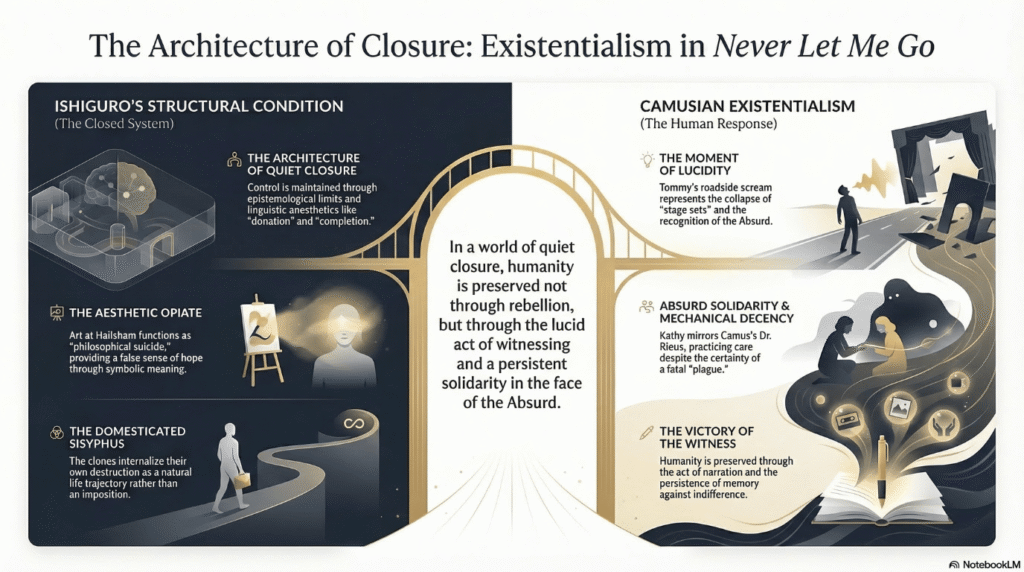
I. The Architecture of the Closed System
The world of Never Let Me Go is not constructed through visible oppression, but through an architecture of quiet closure. Unlike traditional dystopias, where regimes enforce control through spectacle, violence, or overt surveillance, Kazuo Ishiguro presents a system that functions through conceptual containment. The clones are not guarded by walls or soldiers; instead, they inhabit a social structure in which the possibility of escape has never entered their horizon of thought.1 The result is a form of existential confinement that mirrors Albert Camus’s description of the Absurd: a condition where individuals exist within a structure that governs their lives but offers no ultimate justification.2
The Conceptual Horizon: Boundaries of Thought
The primary mechanism of control in Ishiguro’s world is not physical coercion, but epistemological limitation. The students at Hailsham grow up without meaningful contact with “the outside.” Therefore, their knowledge of the world is fragmentary, mediated through guardians who reveal information with a strategic, rhythmic ambiguity. Because the system never presents itself as an antagonist, the students never develop the conceptual framework necessary to imagine rebellion.3
In Camus’s philosophy, revolt begins only when the individual recognizes the possibility of saying “no” to an unjust condition.4 However, a revolution presupposes an alternative horizon—a different way of being against which injustice becomes visible. Thus, the clones possess no such horizon. Their education provides cultural refinement—literature, art, and philosophical discussion—but it never introduces a political vocabulary capable of challenging their destiny. They learn to interpret poetry, yet never learn to question the structural prose of their lives.5 The system achieves stability not by suppressing dissent, but by preemptively removing the intellectual conditions required to produce it.
The Domesticated Sisyphus: Normalizing the Absurd
The absence of rebellion among the clones often puzzles readers: why do individuals who know they will be systematically dismantled not revolt? The answer lies in the transformation of existential imprisonment into domestic normality. Rather than seeing themselves as prisoners, the clones view themselves as “tenants” of the only reality they have ever known.
This condition reframes Camus’s metaphor of Sisyphus, the figure condemned to roll a stone endlessly uphill.6 In classical mythology, the punishment is explicit; Sisyphus knows he is trapped in an eternal cycle imposed by the gods. Ishiguro’s clones inhabit a more insidious version of this fate. Their labor—the gradual “donation” of their own organs—is normalized as a natural life trajectory. Because the system is framed as an educational path rather than a biological supply chain, the clones internalize its expectations as the ordinary structure of existence. They are domesticated Sisyphus, performing the labor of their own destruction without ever perceiving the rock they push as a burden.
The Linguistic Anesthetic: Euphemism as Control
Language is the mortar that holds this closed architecture together. The system relies heavily on euphemisms to sanitize the brutal reality of harvesting. The word “donation” evokes voluntary generosity rather than compulsory extraction. Even more chilling is the term “completion,” used to describe the death of a donor after successive surgeries.7
These terms function as a linguistic anesthetic, transforming systemic killing into a neutral administrative process. As George Orwell observed, euphemism allows a society to conceal violence behind a mask of professional vocabulary.8 In Ishiguro’s novel, this strategy is remarkably effective because the clones adopt the terminology themselves. They speak of their own deaths with the calm detachment of medical professionals discussing routine logistics. From a Camusian perspective, this language delays the Moment of Lucidity.9 By softening reality, these words allow the clones to maintain the illusion that their situation possesses a rational or moral framework.
The Absence of a Catalyst: The Missing Counter-Narrative
A final element of this closed architecture is the absence of a counter-narrative. Revolutionary consciousness typically emerges when individuals encounter alternative stories about how the world could be organized. These stories—be they political, philosophical, or religious—provide the tools necessary to interrogate the status quo.
The clones encounter no such narratives. Their environment is carefully curated to avoid ideological friction. The guardians at Hailsham are kind, even compassionate, and the broader society remains a distant, invisible ghost.10 Without visible cruelty, the system avoids producing the “moral shock” required to provoke a rupture. Camus argued that revolt begins with the realization that “there are limits beyond which one cannot go.”11 In Never Let Me Go, that realization is perpetually deferred. The system remains polite, efficient, and administratively humane.
Yet, the system’s success relies on more than just physical and linguistic boundaries. To truly domesticate the clones, the architecture of closure must be supplemented by an internal, psychological structure. If the school provides the “walls,” the art program provides the “faith” that makes living within those walls feel significant.
II. The Aesthetic Opiate: Art as Metaphysical Diversion
If the architecture of Ishiguro’s world prevents the conceptual emergence of rebellion, the aesthetic program at Hailsham performs a more subtle, psychological operation: it provides a symbolic framework that transforms biological exploitation into a narrative of inner meaning. The emphasis on drawing, poetry, and sculpture appears, at first, to affirm the students’ humanity. Yet, within the larger structure of the system, artistic production functions less as a form of liberation than as a metaphysical diversion.12
Art as Philosophical Suicide
In The Myth of Sisyphus, Camus critiques any philosophical system that attempts to resolve the Absurd by appealing to transcendent meaning. He famously labels this move “philosophical suicide”—an act in which individuals abandon a lucid confrontation with reality in favor of comforting metaphysical explanations.13
The aesthetic culture of Hailsham performs this exact function. Students are taught that their art reveals their “inner selves,” that creativity expresses an essential humanity, and that their works deserve preservation within Madame’s mysterious “Gallery.” For the students, this transforms artistic creation into a symbolic test of the soul.14 The tragedy, however, is that this expression does not alter their material fate. The drawings Tommy produces with obsessive care function as a consolation, providing a language through which the clones can interpret their lives as spiritually significant15 even while their bodies remain subject to the cold logic of the harvest. In Camusian terms, art becomes the “leap” that avoids the terrifying silence of the Absurd.16
The “Deferral” as False Gospel
The religious dimension of this aesthetic framework becomes explicit in the rumor of the “deferral.” The students’ whispered belief—that two clones in love might receive additional years together if their art proves the authenticity of their souls—transforms the art program into a secular theology. In this light, the Gallery is reimagined as a hidden tribunal, and artistic expression becomes a medium for redemption.17 Within this framework, creativity takes on the structure of a religious ritual: an offering made in the hope of salvation. This rumor functions as a “false gospel,” postponing the moment when the clones must confront the absolute determinism of their existence.
The Ethical Alibi: Violence Through Kindness
Beyond the psychological comfort it provides the victims, the aesthetic program offers the broader society an ethical alibi. By cultivating artistic expression and humane education, Hailsham allows the system to claim moral legitimacy. This paradox lies at the heart of Ishiguro’s critique: the school proves the clones possess souls, yet this revelation does not stop the harvesting. Instead, it renders the practice more palatable to the society that benefits from it. From a moral standpoint, kindness is integrated into the mechanism of violence. The result is a form of violence that is nearly invisible, concealed beneath the sophisticated gestures of culture and refinement.
This delicate balance of “humane” exploitation and artistic distraction rests upon the clones’ belief that their souls are being seen and judged. When this belief is finally tested and proven false, the entire aesthetic and structural apparatus of their lives begins to disintegrate.
III. The Moment of Lucidity: The Shattered Mirror
If the architecture of the system prevents rebellion and the aesthetic program delays recognition, the confrontation with Miss Emily serves as the decisive rupture.18 At this juncture, the interpretive structures that once made existence psychologically tolerable collapse. The myth of deferral dissolves, the Gallery loses its mystical significance, and the artistic narrative reveals itself as a tragic misunderstanding.
The “Stage Sets” Collapse
For Albert Camus, philosophical lucidity begins when the individual recognizes the gap between the human search for meaning and the “silent indifference of the universe.”19 In Ishiguro’s narrative, this occurs when Tommy realizes that the symbolic world constructed around art never possessed the significance he had attributed to it. The artwork was never the basis for salvation; it was merely evidence in a failed political campaign. What the students treated as a moral institution turns out to have been a temporary stage set, erected to persuade an indifferent public.
The Roadside Scream: Philosophical Awakening
The collapse of this interpretive framework reaches its climax in Tommy’s outburst in the roadside field. After leaving Miss Emily’s house, Tommy walks into the darkness and begins to scream—an eruption of raw grief that shatters the novel’s characteristic emotional restraint.20 Camus describes the emergence of the Absurd as the moment when “the stage sets collapse.”21 Tommy’s scream marks precisely this transition. In this darkness, Tommy becomes what Camus calls the Absurd Man: an individual who has recognized the absence of transcendent meaning yet remains fully conscious of his condition.
Rebellion of the Flesh
Significantly, this awakening occurs not through language, but through the body. The scream represents the failure of the metaphysical strategy. When the symbolic structure fails, expression shifts from the mind to the flesh. The raw voice replaces the curated drawing; physical agony replaces artistic interpretation. This “rebellion of the flesh” is a radical reclamation of the body. The system treats the clone’s body as a resource, but in this moment, Tommy uses that same body to violently reject the system’s lies.
The Tragedy of Clarity
Yet, as Ishiguro poignantly demonstrates, the scream does not inaugurate a revolution. The system remains intact, and Tommy continues toward his “completion.”22 Lucidity does not grant power; it only grants clarity. Tommy is finally free from the lie, but he remains a prisoner of the truth.
With the mirror of illusion shattered, the question shifts from “Why is this happening?” to “How do we continue?” For Kathy and Tommy, the end of hope is not the end of life, but the beginning of a new, grounded solidarity.
IV. Absurd Solidarity: The Ethics of the Inhabitant
If Tommy’s roadside scream represents the moment illusion collapses, the scene that follows introduces the ethical question of how one continues to live after recognizing that the world offers no transcendent justification.23 The answer is found in a quiet, physical gesture—Kathy holding Tommy in the dark field. This moment introduces a moral response that closely mirrors Camus’s concept of solidarity among those who share the same absurd condition.
The “Syndicate of Two”
When Kathy holds Tommy after his breakdown, she does not attempt to restore the illusions that have just shattered. She acknowledges the reality of the void by remaining physically present within it.24 This gesture represents a decisive refusal of isolation. Camus’s declaration, “I revolt, therefore we exist,”25 captures the idea that recognizing injustice simultaneously affirms the existence of a community of the oppressed. Kathy’s embrace forms a fragile “syndicate of two,” a community created not by hope, but by shared lucidity.
The Carer as Dr. Rieux
Kathy’s role as a “carer” further illustrates this form of absurd solidarity. She practices mechanical decency—a steady, procedural commitment to alleviating suffering. Camus presents a remarkably similar figure in The Plague: Dr. Bernard Rieux, the physician who continues to treat patients during an epidemic he knows he cannot permanently defeat.26 Just as Rieux fights the plague despite the certainty of mortality, Kathy cares for donors despite the certainty of their “completion.”
Dignity Without Hope
Kathy embodies the principle of dignity without hope. Her solidarity with donors, her companionship with Tommy, and her careful preservation of memories all represent ways of affirming human significance without appealing to transcendence. In the Camusian sense, she is the hero of the mundane—one who finds the strength to remain human in a world designed to treat her as a “part.”
This ethic of persistent care carries Kathy through to the very edge of the horizon. In the novel’s closing moments, we witness the ultimate synthesis of habitation and lucidity.
V. The Final Drive: Persistence After Recognition
The narrative closes not with a grand rebellion, but with Kathy alone in her car, imagining Tommy in a distant field.27 This represents the final articulation of the Absurd condition. For Albert Camus, the recognition of the Absurd is not an ending; it transforms the very meaning of persistence. Kathy’s final drive is the modern embodiment of this stoic endurance.
The Field of Lost Things: Norfolk as the Absurd Wall
Throughout their childhood, the students describe Norfolk as a place where lost things are recovered. However, when Kathy returns there as an adult, the landscape reveals itself as something far more mundane: open fields and scattered debris caught in barbed wire. This final image transforms Norfolk into an Absurd Wall. The landscape offers no hidden meaning and no promise that the past can be mended. She is left with the recognition that loss is permanent and the universe does not answer the human desire for restoration.
Driving Toward the Fence: The Modern Sisyphus
After imagining Tommy in the field, Kathy returns to her car. This image echoes Camus’s interpretation of Sisyphus: his dignity lies in his conscious acceptance of the task.28 Kathy’s car is the modern equivalent of that stone. She accepts the structure of her world while preserving the ethical commitments—memory, companionship, and care—that give her life its only tangible meaning.
The Victory of the Witness
The final dimension of Kathy’s persistence is found in the act of narration. By telling their story, Kathy preserves what Camus called the “quantity of experience.”29 The donation system reduces clones to biological resources, but through storytelling, Kathy restores their individuality.
Conclusion: The Witness Endures
The novel’s conclusion offers a subtle form of victory—not over the system, but over the anonymity it imposes. By narrating her history, Kathy preserves the humanity that the system attempted to erase. Her memories stand as testimony to the fact that their lives contained love, jealousy, and longing, even within a structure designed to render them invisible. The persistence of memory is the final Camusian gesture. The world remains indifferent, but the witness endures.
Notes
- Kazuo Ishiguro, Never Let Me Go, First intern. ed (Vintage, 2006), 115–55. ↩︎
- Albert Camus, The Myth of Sisyphus, trans. Justin O’Brien (Vintage International, 1991), 23. ↩︎
- Ishiguro, Never Let Me Go, 13–111. ↩︎
- Albert Camus and Albert Camus, The Rebel: An Essay on Man in Revolt, 1st Vintage International ed (Vintage Books, 1991), 13. ↩︎
- Ishiguro, Never Let Me Go, 13–111. ↩︎
- Camus, The Myth of Sisyphus, 119–23. ↩︎
- Ishiguro, Never Let Me Go, 3–6. ↩︎
- George Orwell, Politics and the English Language, 13, no. 76 (1946): 252–65. ↩︎
- Camus, The Myth of Sisyphus, 121. ↩︎
- Ishiguro, Never Let Me Go, 13–111. ↩︎
- Camus and Camus, The Rebel, 15. ↩︎
- Ishiguro, Never Let Me Go, 13–111. ↩︎
- Camus, The Myth of Sisyphus, 28. ↩︎
- Ishiguro, Never Let Me Go, 37–45. ↩︎
- Ibid, 240–42. ↩︎
- Camus, The Myth of Sisyphus, 23. ↩︎
- Ishiguro, Never Let Me Go, 242–45. ↩︎
- Ibid, 249–72. ↩︎
- Camus, The Myth of Sisyphus, 121. ↩︎
- Ishiguro, Never Let Me Go, 272–75. ↩︎
- Camus, The Myth of Sisyphus, 36–41. ↩︎
- Ishiguro, Never Let Me Go, 276–79. ↩︎
- Ibid, 272–75. ↩︎
- Ibid, 272–75. ↩︎
- Camus and Camus, The Rebel, 22.
↩︎ - Albert Camus, L’ Etranger, Vintage International Ser (Knopf Doubleday Publishing Group, 2012). ↩︎
- Ishiguro, Never Let Me Go, 286–88. ↩︎
- Camus, The Myth of Sisyphus, 119–23. ↩︎
- Ibid, 64–65. ↩︎
Bibliography
Camus, Albert. The Myth of Sisyphus. Translated by Justin O’Brien. Vintage International, 1991.
Camus, Albert, and Albert Camus. The Rebel: An Essay on Man in Revolt. 1st Vintage International ed. Vintage Books, 1991.
Camus, Albert. L’ Etranger. Vintage International Ser. Knopf Doubleday Publishing Group, 2012.
Ishiguro, Kazuo. Never Let Me Go. First intern. ed. Vintage, 2006.
Orwell, George. Politics and the English Language. 13, no. 76 (1946): 252–65.