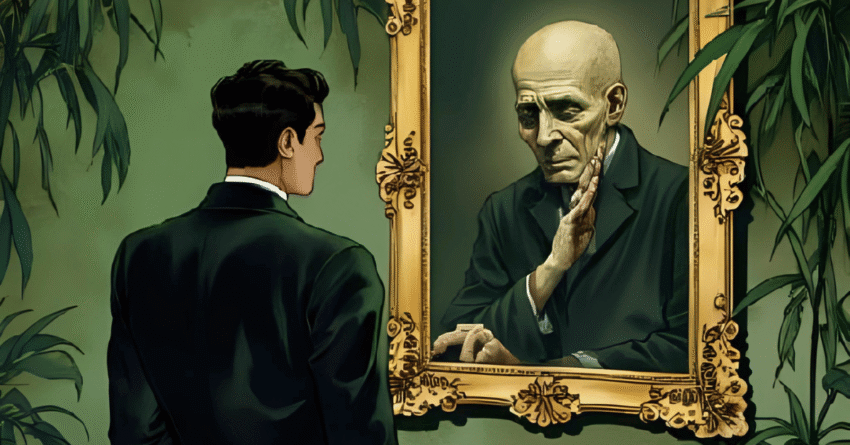
A Philosophical Analysis of The Picture of Dorian Gray
- Introduction
- Dorian Gray as a Failed Experiment in Self-Creation
- Nietzsche’s Concept Ties To Dorian’s Experiment
- Two Catalysts of Self-Creation: Henry and Basil
- Basil Hallward: The Incarnation of Art and Soul
- Lord Henry Wotton: Evangelist of the Will to Power
- Dorian’s Wish to Maintain Forever Beauty
- Aestheticism as the Will to Power
- The Rejection of Slave Morality
- Life as Pure Experimentation & Dorian’s Masterpiece
- Sybil Vane and the Failure of Transcendence
- A Sybil Vane as the Test Case
- Aesthetic Cruelty
- The Turning Point
- The Failed Übermensch
- Existential Dread and Alienation
- Freedom as Burden
- Alienation from Self and Others
- The Meaningless Cycle
- Dorian’s Fear of the Truth
- The Materialization of the Soul: The Portrait’s Truth
- The Portrait as the Grounded Self
- The Art vs. Life Reversal
- Guilt and the Return of Conscience
- The Inevitable Reckoning
- Conclusion
- Dorian’s Life Journey
- Tragedy When Aesthetic Freedom Diverges from Ethical Responsibility
- Beyond the Novel
Introduction
If Nietzsche imagined the Übermensch1 as a self-created being of higher values, Wilde imagined the nightmare version—self-creation stripped of ethics. Oscar Wilde’s The Picture of Dorian Gray stands as one of literature’s most provocative philosophical experiments, a gothic meditation on beauty, corruption, and the dangerous temptation of self-creation. The book was published in 1890 at the height of the Aesthetic movement, a cultural movement obsessed with beauty, surfaces, and the idea that art owed nothing to morality.
Dorian Gray is not Nietzsche’s Übermensch, but a perverse, aesthetic caricature of it—a man who embraces the Will to Power through sensual indulgence rather than ethical self-overcoming, thus revealing the catastrophic consequences of aesthetic freedom divorced from authentic moral creation.
Dorian Gray as a Failed Experiment in Self-Creation
In the novel, Wilde portrays a young man whose portrait ages and decays while he remains eternally youthful. By transferring all the consequences to the portrait, he is free to pursue every pleasure and transgression without visible consequence. His physical form remains a living work of art while his soul bears the hidden cost. Wilde’s novel reads like an accidental Nietzschean thought experiment—one Wilde never intended, yet perfectly stages. Aestheticism promised that art could transcend morality; Dorian Gray demonstrates how quickly beauty becomes complicit in moral collapse. He tries to live as a pure aesthetic ideal, untouched by ethical consequence. The result is not transcendence but philosophical ruin.
Wilde wrote in the preface, “Those who find ugly meanings in beautiful things are corrupt without being charming. This is a fault.” Here, Wilder defends beauty, yet the novel itself exposes beauty’s fragility—how easily it becomes a mask for moral decay. This fragility becomes literalized in the portrait.
The portrait absorbs what Dorian denies: decay, guilt, consequence. As Dorian grows spiritually corrupt, the portrait grows grotesque. Dorian’s downfall becomes Wilde’s own ironic critique of Aestheticism: beauty severed from ethics collapses into grotesquerie. This tension makes the novel feel like a Nietzschean parable of failed self-creation.
Nietzsche’s Concept Ties To Dorian’s Experiment
Nietzsche becomes particularly useful here because both he and Wilde are preoccupied with shaping the self toward very different outcomes.
To understand Dorian’s tragic trajectory through Nietzschean concepts, we examine his pursuit: the Will to Power and the Übermensch. For Nietzsche, the Will to Power is not indulgence but the drive to overcome one’s own limitations, shaping the self with radically different ethical implications. The Übermensch represents an ethical and creative culmination, creating its own values from within. The Übermensch creates values out of inner strength; Dorian merely copies Lord Henry’s clever cynicism. From an existential perspective—borrowing from Sartre rather than Nietzsche—Dorian’s moral collapse resembles Bad Faith: he denies responsibility while believing he is freely choosing. Sybil represents Dorian’s first real moral test: the intrusion of genuine human feeling. Instead of creating a new value around love, he evaluates her as though she were merely a flawed performance. His values are borrowed from Lord Henry—not created.
On the surface, Dorian’s journey initially appears to follow this Nietzschean arc. Lord Henry preaches a philosophy of liberation he never practices; his words are a performance, not a path. Dorian mistakes it for a blueprint for self-creation. Under Lord Henry Wotton’s guidance, Dorian rejects Victorian “slave morality2” and embarks on a quest for radical self-creation by focusing only on aesthetic experience. But Dorian lacks what the ideal of the Übermensch requires—a new self, a fashioned ethical perspective, or ethical transcendence. He internalizes Henry’s worldview instead of crafting his own. He is not transcending morality—he’s outsourcing it. His so-called self-liberation collapses into passive nihilism and existential dread.
In the end, Dorian becomes a stylish imitation of Henry—a man who imitates instead of creates—and thus fails the Nietzschean demand for self-overcoming, the very essence of the Übermensch.
Two Catalysts of Self-Creation: Henry and Basil
Dorian Gray begins his transformation caught between two competing visions of art and morality, embodied in the novel’s two most influential figures: Basil Hallward and Lord Henry Wotton. They embody opposing philosophies—one rooted in moral depth, the other in aesthetic detachment and ironic distance—and Dorian’s alignment with one over the other sets his fate in motion.
Basil Hallward: The Incarnation of Art and Soul
Basil functions as the incarnation of art grounded in the soul. His portrait of Dorian captures something deeper than mere physical beauty. The picture reveals what Basil perceives as an innate moral purity, a soul in its prelapsarian state, before self-creation and corruption. Basil’s devotion to Dorian is a kind of aesthetic spirituality rooted in admiration rather than desire. He sees in the young man an ideal, a muse who inspires his greatest artistic achievement. His Aestheticism remains morally grounded, insisting that beauty must reflect goodness rather than escaping it. When Basil later pleads with Dorian to repent, he speaks from this conviction that the soul matters, that art should reflect and elevate moral truth. Yet this is precisely the philosophy Dorian must abandon in order to pursue radical freedom.
Lord Henry Wotton: Evangelist of the Will to Power
Lord Henry is a complete foil of Basil. He becomes a kind of evangelist of a distorted Will to Power. His theatrical philosophy of radical individualism and sensual experimentation provides the intellectual foundation for Dorian’s transformation. Henry’s famous dictum, ”the aim of life is self-development. To realize one’s nature perfectly—that is what each of us is here for,” echoes Nietzsche’s call for self-overcoming. Henry preaches a doctrine Nietzsche himself would reject—experience without consequence, pleasure without guilt, self-creation without limitation. He dismisses conventional morality as the resentful invention of the weak, designed to constrain the strong. Under his influence, Dorian begins to see himself not as a moral being but as an aesthetic project, a living artwork to be perfected through sensation and transgression.
Dorian’s Wish to Maintain Forever Beauty
The defining moment arrives when Dorian, entranced by his own beauty and terrified of its inevitable loss, makes his fateful wish before Basil’s portrait. From this moment onward, the painting will age while he remains forever young. This supernatural bargain transforms his entire existence into a performative work of art, subject only to his aesthetic will, while externalizing his conscience onto the canvas. The portrait becomes the repository of moral consequences—the aging, decaying record of his soul—while Dorian’s physical form remains pristine, a beautiful lie. He has effectively separated aesthetics from ethics and embarked on his quest to realize the Will to Power through pure Aesthetic experience. Having severed beauty from morality, he embarks on a path where the Will to Power is reduced to mere aesthetic indulgence.
Aestheticism as the Will to Power
To understand Dorian’s trajectory, we must define the Will to Power as it manifests in Wilde’s text. Nietzsche conceived the Will to Power not as a simple desire for domination but as the fundamental, non-moral drive to overcome resistance, master one’s circumstances, and increase one’s sphere of influence—crucially, through the creation of new value. It is a creative, life-affirming force that seeks not to preserve what exists but to transform, to become more than one was. In its highest expression, the Will to Power enables the Übermensch to transcend reactive morality rooted in resentment. Nietzsche called the resentment “slave morality,” the system that negates strength and beauty rather than affirming them. This distinction matters. Slaver morality is reactive; the Übermensch is creative. For Nietzsche, true strength requires creating from within, not reacting against what already exists.
The Rejection of Slave Morality
Dorian’s project begins as a direct application of this philosophy. Under Henry’s guidance, he rejects slave morality in all its Victorian forms. Compassion becomes weakness, humility becomes self-denial, guilt becomes the weapon of the mediocre against the exceptional. The Christian virtues that governed respectable society—chastity, charity, selflessness—are systematically disavowed as life-negating restrictions on his potential. Dorian instead embraces a “new Hedonism,” which Henry describes as the pursuit of experience for its own sake, the multiplication of sensation, the refinement of pleasure into an art form. Henry’s “new Hedonism” is nothing like Nietzsche’s Will to Power, but a decadent imitation—a parody of freedom reduced to sensation. Yet even in this rejection, Dorian is still reacting to society rather than creating anything of his own.
Life as Pure Experimentation & Dorian’s Masterpiece
Dorian treats his own life as his masterpiece, the ultimate work of art. His existence, his reputation, his relationships—all become raw material on which to perform his aesthetic will. He curates his public persona with the care of an artist arranging a still life, ensuring that his beauty, charm, and youth remain objects of fascination and desire. Each transgression becomes an experiment in control, a test of whether he can shape reality without paying its cost. The portrait records this hidden reality, but Dorian believes he has achieved the ultimate artistic triumph: a life lived entirely according to his will, free from moral constraint, accountable only to his own aesthetic standards—or so he believes.
Yet even at its height, Dorian’s exercise of the Will to Power remains fundamentally hollow. He has not created new value; he has merely inverted existing ones. Inversion is still a form of dependence, the very morality he believes he has escaped. He has not transcended morality; he has simply hidden from its consequences. And most crucially, he has confused dominance with mastery, power over others with power over himself—a fatal error that will become devastatingly clear. The Will to Power demands self-mastery; Dorian substitutes self-indulgence.
Sybil Vane and the Failure of Transcendence
A Sybil Vane as the Test Case
The novel’s first catastrophic test of Dorian’s newly adopted aesthetic philosophy arrives in the form of Sybil Vane, a young actress whom Dorian becomes infatuated with after watching her perform Shakespeare. Sybil represents the intrusion of genuine human emotion—of lived reality—into Dorian’s carefully constructed aesthetic world—and his response to this intrusion reveals his fundamental failure to achieve Nietzschean transcendence.
Aesthetic Cruelty
Dorian falls in love with Sybil, not as a person but as an aesthetic object. When she performs as Juliet, Rosalind, or Desdemona, she transcends her humble circumstances and becomes, in his eyes, the living embodiment of romantic beauty. He adores her precisely because she seems to exist entirely within the aesthetic realm, her identity dissolved into the roles she plays. “I have been right, Basil, haven’t I, to take my love out of poetry and to find my wife in Shakespeare’s plays?” he asks, revealing his desire to keep love within the safe confines of art—an aesthetic shield against the vulnerability of real emotion.
But Sybil commits the unforgivable sin: she falls genuinely in love with Dorian and, in doing so, discovers that reality is more profound than performance. When she next takes the stage, she can no longer act convincingly because she has tasted authentic emotion; the artifice of theatre now feels hollow compared to the depth of her genuine feelings. For Sybil, this represents growth, awakening, the triumph of life over mere representation.
For Dorian, it represents aesthetic failure, and his response reveals the bankruptcy of his philosophy. He destroys her not out of wounded pride or lust, but because her performance violates his aesthetic expectations. She has ceased to be a perfect work of art and has become merely human—flawed, vulnerable, real. In his cruel rejection, he tells her, “You have killed my love. You used to stir my imagination. Now you don’t even stir my curiosity.” He judges her as he would judge an unsuccessful painting or a discordant symphony—then discards her accordingly.
The Turning Point
When Sybil, devastated, takes her own life, the portrait undergoes its first terrible change: a look of cruelty appears around the painted mouth. The novel’s supernatural mechanism reveals that Dorian’s aesthetic philosophy denies that actions have moral weight, that cruelty leaves its mark upon the soul. This is the turning point, the moment that demands a moral response. Basil, when he learns of the tragedy, pleads with Dorian to feel remorse, to recognize the human cost of his coldness. But Dorian, guided by Lord Henry’s interpretation, chooses instead to aestheticize even this—ventriloquizing Henry’s worldview: “What a wonderful tragic thing!” he declares, framing Sybil’s death as a beautiful performance, her suicide as the ultimate dramatic gesture. The portrait exposes the truth Dorian refuses to face: that power exercised without responsibility becomes self-annihilating.
The Failed Übermensch
Here, Dorian reveals his failure to become the Übermensch. The Nietzschean ideal requires active creation, not reactive rebellion. The Übermensch takes responsibility for his power, using it to affirm life and create meaning in a meaningless universe. Dorian does neither. He does not create new values; he simply uses his freedom to inflict suffering and escape consequence. His cruelty is not a gesture of transcendence but of decadence. He demonstrates an inability to transcend vulgar self-interest, proving himself incapable of the ethical self-overcoming that true self-creation requires—his freedom becomes a cage rather than a path. From this moment forward, his path leads not upward toward higher humanity but downward into alienation and dread.
Existential Dread and Alienation
As Dorian’s double life continues—beauty and charm in public, corruption and vice in private—the novel increasingly takes on the character of existentialist tragedy, exposing the collapse of his attempted self-creation. Dorian discovers that radical freedom, far from being liberating, becomes a suffocating burden.
Freedom as Burden
Freedom as burden is a central existentialist insight. When we are truly free, unbound by external consequences or moral absolutes, we bear the full weight of responsibility for creating our own meaning and values. Dorian is terrifyingly free. The portrait has severed the normal connection between action and consequence, between choice and accountability. He can do anything without visible cost. Yet this absolute freedom becomes a kind of prison of choice as a burden. Every moment demands that he create himself anew, that he choose what to pursue, what to value, what to become—and every choice reveals the emptiness at the heart of his project: choice without value-creation. He has freedom, but no purpose beyond the endless multiplication of sensations.
Alienation from Self and Others
This freedom produces profound alienation from self and others. Dorian can no longer form genuine human connections. People fall into two categories: admirers of his external beauty, who love only the mask, and victims of his private corruption, who experience his cruelty. He trusts no one and is known by no one. His true self—the aging, corrupted soul visible only in the locked portrait—remains hidden, locked away in a room he obsessively guards, as though protecting the last fragile boundary between illusion and truth. He has become, in existentialist terms, divided, unable to integrate his public persona with his private reality, unable to achieve the authentic unity of self that genuine self-creation requires—unity between inner being and outward expression.
The Meaningless Cycle
Dorian’s pursuits become a meaningless cycle, a descent into what Sartre would call “bad faith”—the attempt to escape freedom and responsibility through distraction and self-deception. Dorian throws himself into ever more extreme sensations: drugs, debauchery, the study of exotic perfumes and jewels and tapestries, the systematic exploration of every vice and perversion. But these pursuits lack any organizing purpose beyond distraction. They are not building toward anything, nor are they creating any higher meaning or value. The repetition itself becomes a bleak parody of self-creation—the endless seeking of novel sensations to stave off boredom and dread—reveals the fundamental purposelessness of his existence, the antithesis of the purposeful self-creation envisioned by the Will to Power.
Dorian’s Fear of the Truth
Most telling is Dorian’s fear of the truth, manifested in his obsession with the locked room and the portrait it contains. He cannot bear to look at the painting for long, yet he cannot stop returning to it, compulsively checking the progress of its decay. This is the existentialist concept of facticity—the unchangeable facts of our existence, including the moral residue of our choices. The portrait represents the facticity3 Dorian desperately tries to deny: the objective record of what he has done, what he has become. His entire philosophy depends on maintaining the separation between his beautiful exterior and his corrupt interior, between the aesthetic surface and the moral depth. The portrait threatens this separation, confronting him with the truth that the soul cannot be aestheticized away, that consequences cannot be eternally deferred, that authenticity cannot be indefinitely avoided.
Dorian’s increasing paranoia, his fear that others will discover his secret, his eventual murder of Basil when the painter sees the portrait—all reveal a man not liberated by his freedom but imprisoned by it, not empowered by his Will to Power but consumed by dread and alienation—the opposite of the self-overcoming he once imagined.
The Materialization of the Soul: The Portrait’s Truth
The Portrait as the Grounded Self
The portrait itself functions as the novel’s most powerful philosophical mechanism, the material grounding of moral reality in a text otherwise seduced by the illusion of aesthetic relativism. While Dorian attempts to live as pure surface, pure form without content, the portrait insists on depth, on substance, on truth.
The painting serves as Dorian’s objective, unchangeable truth. No matter what lies he tells himself or others, no matter how he rationalizes his cruelty or aestheticizes his corruption, the portrait records the reality of his soul. It ages, decays, and becomes hideous—not through supernatural malice but as the visual representation of moral law. In Kantian terms, the portrait becomes an impersonal moral law4, revealing that actions retain ethical consequence even when hidden from society. Dorian may escape social judgment, may avoid legal punishment, may maintain his beautiful appearance, but he cannot escape the portrait’s judgment, the objective recording of his soul’s condition.
The Art vs. Life Reversal
More striking still is that art-versus-life reversal that unfolds over the course of the novel. Initially, Basil’s portrait is a work of art that has sacrificed truth for surface—a representation, twice removed from reality—while Dorian’s life is authentic, immediate, and real. But as the supernatural bargain takes effect, these positions invert. The portrait, initially artificial, takes on the reality of Dorian’s soul, becoming the true, authentic record of his existence. Meanwhile, Dorian’s life, initially real, becomes increasingly artificial—a beautiful, destructive fiction, a performance maintained for an audience, a work of art that has sacrificed truth for form. By the novel’s end, the portrait is more real than the man, more honest, more substantial. It has become what he truly is, while Dorian himself has become merely an image, a lovely lie.
Guilt and the Return of Conscience
This inversion forces the return of conscience, the very thing Dorian sought to externalize and escape. As the portrait grows more hideous, Dorian becomes increasingly haunted by guilt, paranoia, and dread—proof that the moral self cannot be extinguished, only externalized and warped. The soul, Wilde suggests, is not optional equipment for aesthetic existence; it is the foundation of identity itself, by attempting to separate his visible self from his moral self. Dorian has not escaped morality; he fragments his being, creating an unbearable internal division—the precise opposite of the unity demanded by true self-overcoming.
The portrait’s function reaches its climax in Dorian’s final confrontation with it. After years of corruption, after the murder of Basil and the indirect destruction of countless others, Dorian looks upon the canvas and sees a vision of such horror—such accusation—that he can no longer bear it. The portrait has become unbearable truth incarnate, the visible proof of his moral bankruptcy.
The Inevitable Reckoning
His response is that inevitable reckoning: he seizes the knife that killed Basil and plunges it into the portrait, attempting to destroy the witness of his crimes, to annihilate the truth itself—an act both existentially doomed and philosophically impossible. But this is not an act of final liberation, not the successful culmination of his will to power. It is, instead, a desperate attempt to murder reality—and reality cannot be murdered.
The supernatural mechanism reverses one final time: the portrait returns to its original, beautiful form, while Dorian’s body assumes all the age and corruption that the painting had borne. His servants find him dead on the floor, withered and hideous, recognizable only by his rings. The separation of form and content, aesthetic surface and moral depth, beautiful appearance and corrupt soul—this separation, which was the premise of his entire experiment, collapses catastrophically. In trying to destroy the portrait, Dorian destroys himself, proving that the self cannot exist divided, that beauty cannot ultimately be separated from truth, that art divorced from ethical grounding leads only to annihilation.
Conclusion
Dorian’s Life Journey
In the formal act, when the knife strikes the canvas, the separation of Aesthetic Surface and Moral Depth collapses. The beautiful man becomes the hideous soul, and the hideous art returns to beautiful form. Dorian Gray stands as an eternal cautionary tale: The self-created life must bear the weight of its own creation, or that life, however beautiful, will become its own hideous, existential ruin.
Tragedy When Aesthetic Freedom Diverges from Ethical Responsibility
The picture of Dorian Gray thus serves as a tragedy of self-creation, demonstrating that aesthetic freedom and the Will to Power are catastrophic when divorced from the burden of ethical responsibility and inner truth. Wilde, himself a champion of the Aesthetic movement, nevertheless recognized its fatal flaw: beauty without grounding, form without substance, art without conscience—these lead not to transcendence but to horror. Dorian fails to become the Übermensch because he lacks what Nietzsche himself insisted was essential: the courage to create life-affirming value, the strength to bear the weight of freedom, the integrity and courage to achieve unity of self rather than fragmentation.
Beyond the Novel
The novel’s implications reach far beyond Victorian England. Dorian’s life proves that the ultimate masterpiece—the self—requires more than mere will or beauty. It demands a foundation of moral integrity, even if that integrity must be newly created rather than inherited from tradition. The Aesthetic project of making one’s life a work of art remains compelling, even noble—but only when it recognizes that the greatest art serves truth, that beauty must be grounded in authenticity, that form and content cannot be eternally separated. Self-creation without ethical responsibility is not transcendence but nihilism, not liberation but alienation, not mastery but enslavement to sensation and dread.
Wilde’s final judgement, rendered in the novel’s supernatural machinery and Dorian’s terrible fate, is unequivocal: life may imitate art, but only insofar as art holds a mirror to the soul’s necessary connection to truth, however ugly that truth may become. To live aesthetically is not to escape the soul but to shape it consciously, not to deny morality but to create it authentically, not to hide from consequences but to bear them with integrity. Dorian Gray’s beautiful, corrupted corpse stands as literature’s most haunting reminder that we cannot aestheticize away the weight of being human—and every attempt to do so leads not to freedom, but to the destruction of the very self we sought to sovereignly create.
- Nietzsche discusses the concept of the Übermensch in his book Thus Spoke Zarathustra. ↩︎
- Nietzsche discusses the concept of “Slave Morality” in his book, On the Genealogy of Morality. Slave morality is based on resentment and is a reaction to oppression. ↩︎
- I’ve used Sartre’s facticity, which means something concrete and unchangeable, such as our birth circumstances. ↩︎
- Kantian’s Categorical Imperative ↩︎
-
 The Existential Lobotomy: How Huxley’s World State Cures the Sartrean Soul
 -
The Archive of Eradication: Why Dracula’s Filing Cabinet is Scarier than his Fangs
-
Addie LaRue and Albert Camus: Metaphysical Insolvency & The Absurd
-
 The Invisible Ledger: Existentialism, Memory, and Power in Addie LaRue
 -
 Kafka’s The Trial and Hannah Arendt: Law Without Justice