
At a Glance
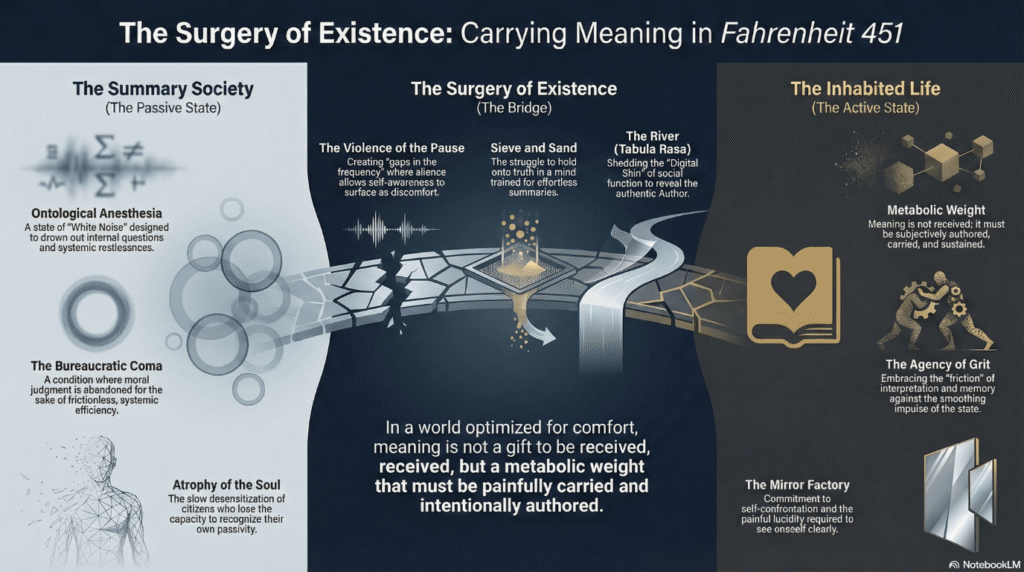
In a world optimized for effortless comfort, Guy Montag’s journey represents an “existential mutation” from a numbed functionary into a responsible subject. By rejecting the “White Noise” of a summary-driven society, he discovers that meaning is not a gift to be received, but a metabolic weight that must be painfully carried and intentionally authored.
Prefer to listen? Hear a short version of the deep-dive discussion of this analysis on the podcast.
Introduction
In a world optimized for comfort, the greatest threat is not the fire, but the “White Noise” of the effortless life. Guy Montag’s journey is an existential mutation—a rejection of the “Summary Society” in favor of the painful, metabolic labor of carrying a soul. If meaning is not given, it must be carried.
Guy Montag’s journey in Fahrenheit 451 is not a mere political awakening or an intellectual conversion; it is an existential mutation. He moves from the “White Noise” of passive nihilism into the grit of existential responsibility. The city around him has taken a collective “Leap” into technology, trading the pain of agency for the anesthesia of the summary. Its citizens no longer need to choose, wrestle, or bear the weight of interpretation; the parlor walls and Seashell radios perform consciousness on their behalf1.
Montag’s transformation begins when he inhabits a single biblical text: Ecclesiastes. In a universe marked by “vanity,” he discovers that meaning is not a gift handed down from the State, the screen, or even the sacred page2. Meaning is a metabolic weight. It must be subjectively authored, carried, and continually sustained. By stepping out of the “This Way” path of the Good Civilian, Montag accepts the anxiety of becoming a vessel instead of an extension of the machine.
The Prologue: The Indifference of the “Good Civilian”
At the novel’s opening, Montag is disturbingly content. He loves the burn. Flame is simple, obedient, and final; it removes questions and replaces them with ash. In this state, he resembles Meursault from Camus’s The Stranger—a man oddly detached from the interior life that should accompany human existence. Like Meursault, Montag is a stranger to his own emotions and choices3.
Montag begins as a “being-in-itself,” to borrow Sartre’s term—a solid object rather than a self-reflective subject4. He is a gear in a machine whose smooth operation depends on his absence as a consciousness. He does not ask whether burning books is right or wrong; the system has already decided for him, and his role is merely to maintain the momentum.
The Bureaucratic Coma
This is the “This Way” bureaucratic coma: a state where an administrative system operates with perfect efficiency because no one within it feels personally responsible for the outcome. In this coma, moral judgment and human concern are abandoned to allow the monolithic apparatus to persist without conscious intent. Critical thinking is viewed as a systemic glitch; therefore, the bureaucracy prioritizes its own continuity over the human goals it was created to serve. In this novel, the city’s infrastructure is built on obedience as a frictionless path5. The highest virtue is ontological hibernation: the refusal to wake up to the “anguish of choice.”
The Atrophy of the Soul
Over time, this system produces an atrophy of the soul. The Mistake of the city is not a single decree, but a slow desensitization. Citizens lose the capacity to feel the loss of their own agency. When the habit of deferring judgment hardens into a structure, people no longer recognize their passivity as a wound. They simply float. At the start, Montag lives in this coma, wearing his practiced smile like a uniform. He is not yet a subject; he is a function.
Acoustic Anesthesia: White Noise vs. The Pause
White Noise as Systemic Solution
If the psychological basis of this world is passivity, its sensory infrastructure is Noise. The city’s soundscape—parlor walls and constant media saturation—is a form of ontological anesthesia. Its purpose is to drown out the hum of the internal void before it can be heard. Silence is dangerous because it allows questions to surface; the State’s answer is to saturate every crevice of life with spectacle so that inner restlessness remains inarticulate.
The Violence of the Pause
Clarisse McClellan ruptures this system not with a manifesto, but by introducing gaps in the frequency. She asks, “Are you happy?” and leaves Montag with the echo6. Clarisse does not supply new content; she subtracts. She creates pauses. The violence of her presence is not informational but temporal; she inserts intervals into a continuous stream.
These pauses are where the “surgery of existence” begins—and they occur without a numbing agent. For a man sedated by sound, the first incision of self-awareness feels like pain. Clarity arrives as a violent discomfort.
Lucidity: The Unbearable Jingle
Nowhere is this more vivid than on the subway, where Montag tries to memorize Ecclesiastes against the blare of a dental commercial. The jingle is designed as a cognitive occupation: loud, rhythmic, and inescapable. But as Montag wakes up, the lullaby transforms into a scream. Lucidity rewrites his sensory world; the background static becomes an assault. His near-shout on the train is not a sign of weakness; it is lucidity experiencing the raw pain of a mind trying to function in a world designed to keep it silent.
The Sieve and the Sand: Grit as Friction
Bradbury’s metaphor of “The Sieve and the Sand” captures the core tension of Montag’s awakening. He wants the truth to stay, yet the words slip through a mind trained for the “Effortless Summary.” The summary, by design, removes friction. It bypasses the slow, painful work of interpretation and memory.
Grit is the opposite. Grit is friction. To hold the sand is to resist the smoothing impulse of White Noise. The subway breakdown is a scene of Sartrean anguish: Montag realizes that if he forgets this verse, no external authority will save it7. There is no cosmic archive. He is “condemned” to be the author and the carrier.
This realization is painful because it exposes his finitude. He discovers his mind is not a hard drive but a fragile, leaking container. The book itself is “inconvenient”—it demands re-reading and contemplation. This inconvenience is not a design flaw; it is the essential friction by which a human being gains traction against the “superfluid” of the State.
The Ecclesiastes Paradox: Inhabiting the Vanity
If the parlor walls are the ultimate vanity—distraction used to outrun the nothingness of existence—Ecclesiastes stands as their inverse. Its refrain, “All is vanity,” is an existential hard reset. It reveals that the world provides no ready-made guarantees of meaning8.
The paradox is that this emptiness is the starting line of meaning. By accepting that the world is “vanity,” Montag recognizes that genuine significance must be intentionally authored. Memorization becomes inhabitation. The words reorganize his inner life; they become part of his metabolic process. Meaning becomes a heartbeat that cannot exist apart from the person carrying it.
The Bomb: The Facticity of the Ash
The city’s simulation of peace cannot survive a collision with facticity—the brute, unyielding conditions of death and historical circumstance. In Fahrenheit 451, the bomb is not merely an external catastrophe or a byproduct of geopolitics; it is a metaphysical rebuttal to a society that believed it could outpace mortality with spectacle. In existential terms, facticity is that which resists interpretation—the “given” reality that remains when the theater of meaning collapses.
The bomb produces ash, and ash is the ultimate manifestation of facticity. It is the end of the narrative. Ash cannot be edited, summarized, or undone. It is the absolute evidence of what was, stripped of the luxury of what might be.
This is why the destruction feels like a total existential forfeiture. The “logic of the summary” reaches its horrific, logical conclusion: to erase the subject is to produce the ultimate summary. When the listener is annihilated, there are no more questions, no more ambiguities, and no more responsibilities. The bomb ends the illusion that civilization was stable, moral, or cumulative. What remains is not merely chaos, but an ontological remainder: the cold, silent truth of the void that the White Noise worked so tirelessly to hide.
The River as Tabula Rasa
Montag’s survival leads him to the river, a physical and psychological tabula rasa. In the city, every inch of space was “pre-interpreted”—neon signs, parlor walls, and sidewalks dictated where to look and how to move. The river, by contrast, is unsummarized. It is a chaotic, indifferent medium of water, stone, and cold. It offers no instructions, only the brute resistance of the current. For the first time, Montag is in a space that does not broadcast a “This Way” signal; he is in a space that is fundamentally silent.
To move through this landscape is to encounter the Ontological Remainder in its most primal form. The river does not care about the firemen’s manual or the “Summary Society.” To survive it, Montag must rely on his own raw perception and judgment. His baptism in the water is the shedding of his “Digital Skin”—the social identity of the firehouse—leaving behind the “Function” to reveal the “Author.”
The verses he carries in his mind are no longer subversive luxuries or intellectual curiosities; they are the scaffolding for a new orientation to the world. As he emerges from the water, the ash of the city is behind him, and an unmarked world lies before him. He has left the “Bureaucratic Coma” for good. There is no returning to the anesthesia of the summary after one has felt the cold weight of the river and walked through the annihilation of the old world with eyes open.
Conclusion: The Mirror Factory and the Inhabitation of the Debt
The final movement of Montag’s journey shifts from flight to rebuilding. He joins a community of “book people”—exiles who have transformed themselves into living archives. Their project is slow, vulnerable, and intentionally inefficient. They are not innovating a new system of control or a more seductive entertainment medium; they are committing to the long, patient labor of remembering.
Accepting the Pain and New Beginning
This rebuilding is the antithesis of the city’s original “Leap” into techno-anesthesia. The Leap promised an instant solution to the problem of anxiety: drown it in sound, speed, and spectacle. The book people accept the opposite premise. Their “New Beginning” is not a cure for anxiety, but the acceptance of anxiety as proof of life. To feel existential tension is to be awake. The friction of agency—the heavy knowledge that one could choose otherwise and must choose—is the painful confirmation that subjectivity is intact.
In this nascent world, the first task is not to maximize comfort, but to recover lucidity. Hence, the directive to build a mirror factory. Before the survivors build conveniences to soften their lives, they must build tools that allow them to see themselves. The mirror is the ultimate existential institution; it is a technology of self-confrontation. To stand before it is to acknowledge: “I am the subject responsible for what comes next.” It insists that the future will not be authored by algorithms or effortless summaries, but by humans willing to bear the metabolic weight of meaning.
Montag’s transformation is the story of an object becoming a subject. He learns that if meaning is not given, it must be authored—through memory, through anguish, and through the risky, luminous work of responsibility. The bomb reduces his old world to ash, but in that ash, a new kind of beginning becomes possible: one built not on the anesthesia of the summary, but on the “Grit” of a life fully inhabited.
Notes
- Ray Bradbury, Fahrenheit 451 (Simon & Schuster Paperbacks, 2003), 1–158. Used throughout for Montag’s role as a fireman, the parlor walls, White Noise culture, the subway scene with Ecclesiastes, “The Sieve and the Sand,” the bombing of the city, the river, and the book people. ↩︎
- Ibid. 67-106 ↩︎
- Albert Camus, The Stranger (Vintage International, 1989), 3–59. Invoked for the comparison between Montag’s early emotional detachment and Meursault’s affective indifference. ↩︎
- Jean-Paul Sartre, Being And Nothingness (Washington Square Press, 1956), 53–56, Used for the concepts of being-in-itself, anguish, responsibility, and the burden of self-authorship. ↩︎
- Max Weber, “Economy and Society,” 1978, 956–1005, ↩︎
- Bradbury, Fahrenheit 451, 3–7 ↩︎
- Ibid. 451, 73–76. ↩︎
- The Holy Bible: King James Version. (Thomas Nelson Inc., 2003), 746–755. ↩︎
Bibliography
Bradbury, Ray. Fahrenheit 451. Simon & Schuster Paperbacks, 2003.
Camus, Albert. The Stranger. Translated by Matthew Ward. New York: Vintage International, 1989.
Sartre, Jean-Paul. Being and Nothingness: An Essay on Phenomenological Ontology. Translated by Hazel E. Barnes. New York: Washington Square Press, 1956.
Weber, Max. Economy and Society: An Outline of Interpretive Sociology. Edited by Guenther Roth and Claus Wittich. Berkeley: University of California Press, 1978.
The Holy Bible. King James Version. Nashville: Thomas Nelson, 2003.
There are some sources you can find:
Being and Nothingness by Jean Paul Sartre