Introduction: What is the Dark Triad?
In modern psychology, a term exists for a trio of unpleasant personality traits known as the Dark Triad. It sounds like the title of a Gothic thriller, but it’s a genuine psychological model introduced by Delroy Paulhus and Kevin Williams in 2002. They identified three socially aversive traits that often overlap: narcissism, Machiavellianism, and psychopathy. These traits aren’t classified as mental illnesses, but they reliably create chaos in relationships, workplaces, and—often—fiction.
To understand why these traits so often disrupt lives—and stories—it helps to unlock each component. Narcissism brings inflated self-importance and an endless hunger for praise; Machiavellianism, named after Machiavelli’s ruthless pragmatism in The Prince, justifies any means to an end; psychopathy is the cold, detached pursuit of goals without empathy.
Long before psychologists named these tendencies, novelists observed them. Jane Austen, in particular, had an uncanny eye for moral manipulation. Her portrayal of Mary Crawford’s charm and cold calculation fits neatly within what psychologists now call the Dark Triad. Of course, Austen never uses terms like “narcissist” or “psychopath.” Through Mary Crawford, Austen sketches a woman whose wit conceals moral emptiness—an embodiment of the Dark Triad, gracefully cloaked in Regency charm. To see this charm for what it is, we must first look at her boundless narcissism.
Narcissism: Charm and Self-Centered Morality
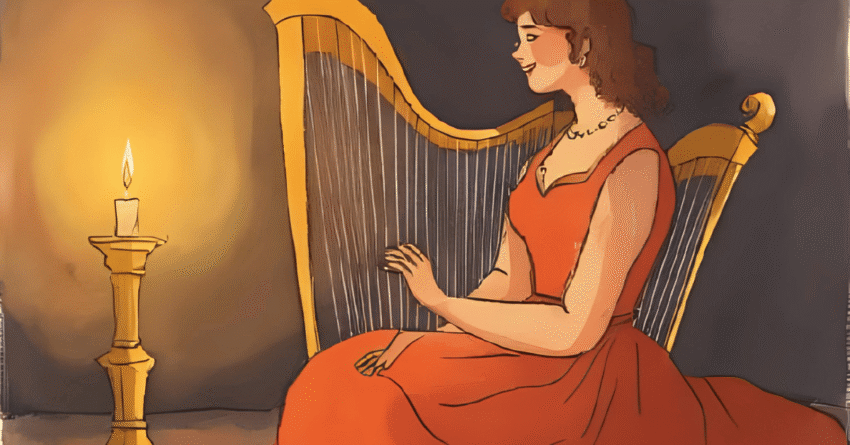
If the Dark Trial reveals the psychology of manipulation, narcissism is where its mask smiles the widest—and no one wears that mask more gracefully than Mary Crawford. When Mary Crawford arrives at Mansfield Park, she doesn’t just walk in—she steals the spotlight, harp and all, dazzling with wit, beauty, and the kind of charm that makes polite society collectively lean in. Mary is someone impossible to ignore. Once her harp finally saunters in from London, she is in full performance mode. Austen writes that Mary plays “with the greatest obligingness,” her music adding polish to her already glowing appeal. Just imagine the scene: sunlight filtering through tall windows, a graceful woman by a gleaming harp, captivating her audience with every elegant note. After all, who would fall under her spell?
Her appearance or social performance is not just natural charisma. It’s strategy in silk slippers—Austen’s quiet reminder that elegance and self-interest often dance together. Benearth her grace lies calculation; Mary’s appeal is less spontaneous delight and more social stagecraft. The harp, her flattery, and her effortless cleverness are all tools of the trade. What she’s performing isn’t just music; it’s the art of self-presentation. For Mary, admiration is not the byproduct of virtue—it is the proof of worth. Modern psychology might call it narcissism; Austen simply shows it, letting charm reveal its moral cost. Her need for admiration doesn’t stop at performance—it shapes her entire moral compass.
Narcissism isn’t all flirtation and harp solos. Mary’s values reveal even more. Consider her reaction to Edmund’s decision to join the clergy. “A clergyman is nothing,” she says breezily, waving away his choice like it’s a bad fashion trend. Where Edmund sees moral purpose, Mary sees missed opportunity. So, she tries to manipulate Edmund to become a lawyer—a profession promising fortune and prestige. For Mary, virtue may be admirable in theory, but social glamour is non-negotiable.
And yet, Austen doesn’t reduce Mary to a flat caricature. Mary is layered. She can be warm, witty, and even generous, especially when it boosts her image. She offers Fanny jewelry for a ball, proposes exciting trips to London, and speaks with affectionate charm. But she is careless and manipulative. Her attentions aren’t free. They are calculated future investments, either as a companion or a potential sister-in-law; Mary’s interest always spikes when the arrangement flatters her future prospects. But when Fanny challenges her plans by rejecting Henry, Mary’s affection cools fast.
In short, Mary Crawford is Austen’s glittering portrait of narcissism, wrapped in elegance, laced with humor, and shadowed by self-interest. She turns heads at every gathering, makes you laugh over tea, and all the while, she’s subtly rearranging the furniture of your future to suit her own design.
If narcissism feeds Mary’s need to be adored, Machiavellianism teaches her how to keep that power. The performer becomes a strategist, charming her audience while quietly directing the play.
Machiavellianism: Passive Aggression and Manipulation
Mary Crawford may smile nicely over a cup of tea and speak warmly to you, but behind that glittering smile is a mind that plays the long game. Her charm isn’t merely ornamental; it’s tactical. While others trade pleasantries, Mary is busy orchestrating outcomes. Every compliment doubles as reconnaissance; every gesture hides intent. If Austen had access to a psychology textbook, she might have flagged Mary as a textbook case of Machiavellianism: the art of manipulation cloaked in civility, all carried out with a calm, calculating hand. For Mary, manipulation isn’t conflict—it’s choreography.
Mary doesn’t shout, threaten, or throw tantrums. That would be far too gauche. Instead, she maneuvers like a dancer on a polished floor, gracefully, silently, always knowing where her next step will land. Her charm is not a reflection of warmth, but a tool for influence. Mary masters the art of passive aggression—veiled jabs and strategic silences that let her wound without appearing unkind. She knows how to smile while pulling strings.
Among her favorite marionettes is her brother Henry, whom she manipulates with teasing precision. At first, she practically dares him to flirt with the Bertram sisters, treating broken hearts like a parlour game. But when Henry’s game turns serious with Fanny Price, Mary instantly pivots—from mischief to matchmaking.
This is how her manipulation is staged. Every shift in tone, every rephrased kindness, is deliberate. On Fanny’s first ball, she hands Fanny a necklace Henry picked out for Mary, ensuring the gift is received without risking Fanny’s rejection of him directly. This is the genius of her manipulation—it’s never overtly cruel, only quietly corrosive. She writes affectionate letters praising Henry, gently suggesting that Fanny might someday “repent” refusing such a fine suitor. It sounds sweet, even caring—until you read between the lines and realize Mary is doing what Machiavellians do best: guiding perception, nudging outcomes, and rearranging the emotional furniture until everyone’s standing where she wants them. Austen never raises her voice about Mary’s schemes; she simply lets civility do the dirty work.
When the rumors start swirling about Henry’s less-than-virtuous behavior, Mary doesn’t skip a beat. “A most scandalous, ill-natured rumor,” she insists, brushing it off like lint from her sleeves. Whether or not she believes her own spin is irrelevant. She spins the story like a practiced diplomat—one whose conscience never interrupts her charm. In Mary’s world, the truth is flexible. What matters is that people believe, and how that belief can be used to her benefit.
But her most remarkable feature comes after Henry’s scandalous affair with Maria Rushworth explodes like a dropped teacup. While most would recoil in horror or at least blush, Mary slips effortlessly into crisis management mode. To Mary, moral collapse isn’t a tragedy—it’s a problem of optics. While Edmund is reeling, she outlines a plan with surgical calm: marry Henry to Maria, stage a few strategic dinners, and reset the narrative. Her tone is cool, logical, and cynical. If society can be distracted with enough good wine and polite laughter, why should a little adultery ruin anyone’s prospects?
Even more astonishing is her advice to Edmund: “Be quiet,” she tells him. Let the situation settle, don’t provoke Henry, don’t upset the optics. She’s not operating from guilt or grief—This is PR, not penance. Mary treats the whole affair like a mismanaged brand that just needs re-strategizing. And that’s exactly what makes her such a fascinating and unsettling character.
Mary’s morality isn’t absent, exactly; it’s just optional.
When she finds out she doesn’t get what she wants, she begins attacking Fanny in passive-aggressive ways by pretending to speak hypothetically, but she’s clearly suggesting that Edmund marry someone else. In true Machiavellian fashion, she measures success not by virtue but by control—how smoothly she can steer perception and silence dissent.
Manipulation may explain Mary’s actions, but not her silences. Her genius lies not only in manipulation, but in the eerie calm beneath it—the untouched heart where empathy should live. But if manipulation is an art for Mary, its true secret lies in what she doesn’t feel. Beneath the polished grace of her mind, something colder waits.
Psychopathy: Coldness and Lack of Empathy
Mary Crawford enters the drawing rooms of Mansfield Park as an elegant social butterfly, radiant, clever, and dressed in verbal silk. Her wit could slice through awkward silences like a rapier’s edge, and her charm seems effortless. Yet, beneath that grace, something is amiss. It isn’t a matter of fashion or wit—it runs deeper, down to something missing at her core. What Mary lacks is empathy, not in a villainous, mustache-twirling kind of way, but in the eerily modern, a kind of emotional detachment psychology now calls psychopathy.
Austen, of course, never diagnoses her; she doesn’t need to. Instead, she offers a razor-sharp portrait in social nuance. Mary isn’t cruel, as Edmund is quick to point out: “Hers is not a cruel nature. I do not consider her as meaning to wound my feelings.” And he’s right. She doesn’t intend harm. She simply doesn’t notice it. What Austen calls ‘blunted delicacy’ is a genteel way of saying Mary’s emotional radar is miscalibrated. Her responses are polished, not heartfelt. Her concern is rehearsed, not real. In that moment, all of Edmund’s illusions collapse. Austen lets Edmund’s clarity dawn slowly—the realization that Mary’s goodness is only social, not moral. Mary doesn’t break hearts with cruelty—she does it with indifference.
Take, for instance, the scandal of Henry and Maria. As the news breaks—threatening reputations, futures, and family honor—Mary barely bats an eyelash. To her, the catastrophe isn’t tragic; it’s a logical hiccup. If only Fanny had agreed to marry Henry, she muses, none of this would have happened. You can almost hear the metaphorical teacup click neatly into its saucer as she delivers her verdict with perfect composure.
This is psychopathy in a velvet glove: Mary sees scandal not as a moral collapse but as a mismanaged opportunity. She doesn’t feel the pain; instead, she calculates the consequences. Even Edmund, idealistic and infatuated, begins to catch the chill in Mary’s warmth. Her response to the affair is not outrage, not even embarrassment, but a practical plan. Marry Henry to Maria as soon as possible. Host a tasteful dinner. Reboot their social image. Problem solved—no guilt required when strategy will do.
The final unraveling comes in a conversation that should have been a reckoning. Edmund pours out his heartbreak and disappointment. Mary listens and responds with a smirk. “You give me a pretty good lecture,” she quips. “You may make a preacher yet.” He bares his soul; she offers a critique of his delivery. The air leaves the room, and with it, the last trace of Edmund’s illusion. Austen doesn’t punish Mary with drama; she leaves her standing amid her own emptiness—a woman perfectly composed and utterly untouched.
Why Mary Crawford Still Feels So Modern
Perhaps the most chilling note of all is that Mary Crawford, with her poise, her polish, and her capacity for charm without feeling, doesn’t belong only to the pages of Austen. She could walk into any room today, flash that brilliant smile, and still leave hearts confused and consciences cold. In the end, Mary feels strikingly contemporary because Austen’s portrait of such a personality is timeless—and still recognizable today. Her type hasn’t vanished with the Regency era; it’s simply traded bonnets for business suits.
People with these traits are often charismatic and hold tremendous social influence. In appearance, they sound moral, nice, and even empathetic, but they attack anyone who would block their way to success in a passive-aggressive way while quoting great philosophers. Truth and morality matter little to them; remorse is a feeling they simply lack. What they care about is getting what they want. We still encounter Mary’s temperament today—in polished boardrooms, curated online platforms, and political stages—where charm is currency and empathy optional. Austen saw these dynamics long before psychology named them.
Austen’s nuanced characterization of Mary still stands as a testament to her psychological insight. When I see Mary Crawford through the Dark Triad lens, I see Austen’s work as an early exploration of moral psychology. Austen shows that virtue and vice in her work are not just black-and-white labels. They are rooted in character traits that eerily prefigure what we now recognize as enduring personality dimensions. Through Mary’s narcissism, Machiavellianism, and psychopathy, Austen contrasts selfish brilliance with principled goodness—and in doing so, anticipates the psychological realism that would shape modern literature.
Conclusion
Seen through the lens of the Dark Triad, Mary Crawford isn’t just Austen’s most glamorous rebel—she’s alarmingly modern. Two hundred years before psychology coined its cocktail party terms—narcissism, Machiavellianism, psychopathy—Jane Austen was already sketching them in ink and irony. She may have used words like “vain,” “artful,” and “unprincipled,” but let’s be honest: she had Mary Crawford pegged before Freud ever picked up a quill.
Austen saw clearly what modern psychology would later confirm: charm can hide a hollow center, that intelligence, wit, even kindness—without empathy—can become weapons in disguise. Mary Crawford reminds us that not all harm is loud, and not every villain wears a scowl. Some wear lace gloves and speak fluently in small talk. Some smile as they preach about virtue or justice, but beneath the performance, it’s only for show. So what Mary teaches us is simple. Wit is not wisdom, and poise is not a principle; someone can be magnetic—and still morally adrift. Mary Crawford is a lesson that holds true today: the most dangerous people in the room are often the ones whose brilliance and wit we mistake for a good heart.