At a Glance
This analysis reframes William Golding’s classic as a brutal laboratory of institutional design, where the failure of the “Conch” is not a moral collapse but a crisis of enforcement. By bridging Hobbesian political theory with trauma psychology, we explore how the “Beast” functions as a sophisticated governing instrument—proving that civilization is not the absence of the “Spear,” but its fragile domestication.
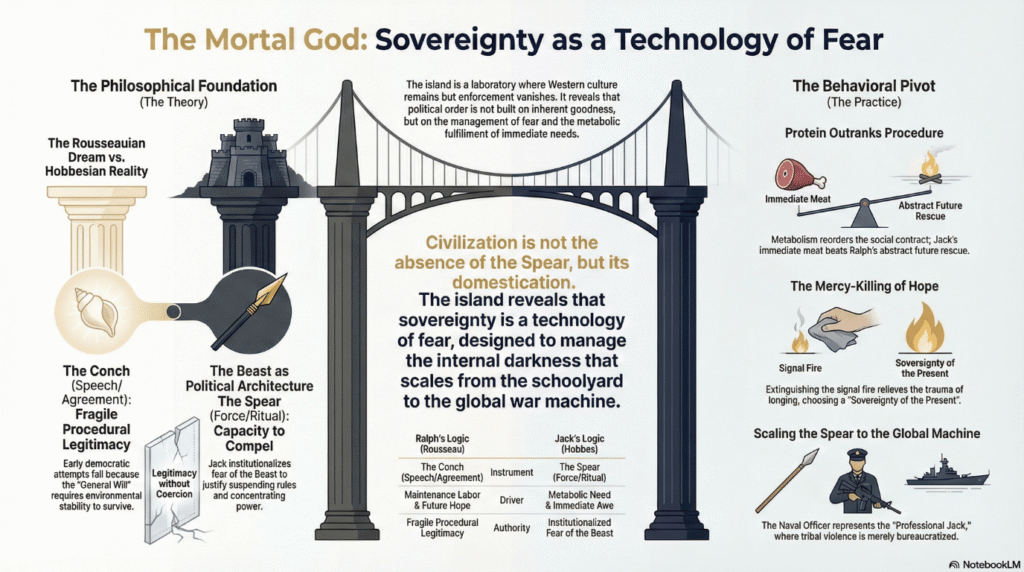
I. Introduction: The Laboratory of De-Enforcement
William Golding’s Lord of the Flies is traditionally read as a parable of moral decay—a descent from the heights of British civility into the depths of primal savagery. Yet, this interpretation relies on a fundamental misconception: that Golding removes culture from the island. He does not. What he removes is enforcement.
The boys are not blank slates (tabula rasa). A group of British boys lands on the beach as high-fidelity products of imperial hierarchy, choir discipline, and parliamentary procedure. These children are “zip files” of Western civic culture—compressed archives of authority waiting for extraction. They do not need to learn how to vote; they already know. They do not need to invent authority; they have spent their lives breathing it.
The Hobbesian Test
In Leviathan, Thomas Hobbes famously argues that the “state of nature” is a condition of perpetual insecurity driven by competition and glory.1 To escape this “war of all against all,” individuals must surrender their autonomy to a Sovereign—a “Mortal God” capable of monopolizing force. For Hobbes, political order is not the fruit of human goodness; it is the product of concentrated power.2
Golding’s island functions as a brutal test of this proposition. Initially, the boys attempt the “Rousseauian Dream”: they elect Ralph, institutionalize speech through the Conch, and rely on procedural legitimacy. For a brief, shining moment, it seems that reason alone might suffice.
The Spear vs. The Conch: A Crisis of Design
However, the island’s trajectory reveals a struggle over sovereignty rather than a collapse into chaos. The central tension is one of Institutional Design3: the conflict between the Conch and the Spear.
- The Conch represents the word: speech, agreement, legitimacy, and collective recognition. It is a covenant without coercion.
- The Spear represents the act: force, enforcement, punishment, and the physical capacity to compel.
The tragedy of the island is the divorce of these two instruments. Ralph possesses the Conch but refuses to command the Spear. Jack eventually seizes the Spear and learns to tether its violence to the “Awe” of a mythic Beast. The resulting order at Castle Rock is not anarchy; it is a rudimentary, functional Leviathan.
Golding’s inquiry is not whether humans are inherently evil, but what happens when Culture persists but the Police disappear. The island is a compressed model of political theology—an accelerated rehearsal of how authority forms, centralizes, and ultimately scales into the global machines of war that eventually “rescue” them.
II. The Rousseauian Dream: The Infrastructure of Hope
The Fragility of the General Will
At first glance, the island offers the perfect Rousseauian laboratory. Stripped of adult hierarchy and coercive institutions, the boys are ostensibly free to rediscover humanity’s “original condition.” Jean-Jacques Rousseau famously posited that humans are naturally good, and that it is the artifice of society—with its unequal competition and rigid structures—that corrupts our innate harmony.4
The boys’ early behavior is an exercise in Rousseauian optimism. They assemble voluntarily, elect a leader, and formalize the Conch as a mechanism for the “General Will”—a collective orientation toward the common good.5 Their shared goal is clear: survival and rescue.
However, the island quickly exposes the material requirements of Rousseau’s theory. Natural goodness, it turns out, requires a stable foundation. In The Social Contract, the General Will functions only when citizens are not consumed by existential terror.6 On the island, caloric and psychological insecurity rapidly intervene. Hunger, exhaustion, and heat erode the cognitive labor required to sustain a democracy. The “General Will” dissolves because the boys lack the “scaffolding” of adulthood—nutrition, stability, and the capacity for deferred gratification. Their collapse is not a failure of character, but a failure of environmental support.
The Signal Fire as a Reopened Wound
The signal fire is more than infrastructure; it is hope materialized. It symbolizes the umbilical cord to the adult world—parents, structure, and home. Yet, in traumatic conditions, hope is not always a comfort. Often, it is an anxiety amplifier.7
To keep the fire burning is to perform a daily ritual of mourning. Every column of smoke rising over the trees is a billboard of abandonment: We are children, we are alone, and we do not belong here. Ralph interprets the fire instrumentally—as a rational necessity—but for the boys, the fire is existentially exhausting. It demands they remain in a state of constant longing. By tending the fire, they are forced to confront their own powerlessness, staring at a horizon that refuses to answer.
The “Mercy-Killing” of Hope: Abolishing the Future
When the fire eventually dies, it is usually framed as a failure of duty. However, from a psychological perspective, extinguishing the fire is an act of mercy-killing.
To abolish the fire is to abolish the future. It closes the wound of “home” and silences the constant reminder of loss. By letting the fire go out, the boys aren’t being lazy; they are engaging in an unconscious act of self-preservation. They are choosing to live in the Sovereignty of the Present.
Jack’s regime succeeds because it replaces the unbearable “waiting” of the future with the visceral “intensity” of the now. Hunting, chanting, and ritualized violence provide an immediate emotional coherence that the abstract hope of rescue cannot. Rousseau’s community depends on a shared orientation toward a common future8, but on the island, the future is too painful to bear. The boys retreat into the present not because they are “savage,” but because they are grieving. The future requires vulnerability; the present offers the illusion of control. Frightened children will choose control every time.
III. The Economics of the Stomach: Meat Now vs. Rescue Later
The Caloric Social Contract: Probabilistic Good vs. Immediate Commodity
On the island, the debate between Ralph and Jack is not merely ideological; it is metabolic. Ralph offers rescue—a future-oriented, probabilistic good. Jack offers meat—a present, tangible commodity.
This friction mirrors Hobbes’s assertion that the social contract is born of material insecurity. In Leviathan, individuals surrender rights in exchange for the primary good of “commodious living” and protection from violent death.9 But Hobbesian security evaporates the moment hunger sets in. Ralph’s project—the signal fire—is an investment in uncertain salvation; it requires a belief in ships not yet seen. Jack’s project produces protein. In conditions of scarcity, the body’s demands reorder political priorities. When the stomach tightens, the time horizon shrinks. Legitimacy shifts not because the boys are “evil,” but because metabolism reorders the contract. Jack feeds them; Ralph instructs them.
Labor Theory: Why Boredom Destabilizes Rule
Ralph’s regime depends on Maintenance Labor: tending the fire, building shelters, and attending meetings. This labor is repetitive, visually unrewarding, and produces no spectacle. It is what Hannah Arendt might call “labor”—the never-ending cycle of biological survival that yields no durable monument.10
Jack’s regime, by contrast, transforms labor into Ritual: the hunt, the chant, the painted face, and the dance.11 Where Ralph creates silence, Jack creates noise. Political theorists have long observed that unstructured idleness is a sovereign’s greatest threat. Ralph asks the boys to wait in a state of high-anxiety boredom; Jack converts that anxiety into kinetic energy. He gives them something to do. In a crisis, the Politics of Stimulation—the visceral noise of the hunt—almost always defeats the Politics of Procedure.
The Producer Beats the Manager: Protein and Authority
The island reveals a harsh political hierarchy: the provider of food commands the loyalty of the hungry. Ralph acts as a Manager, attempting to coordinate a complex, long-term exit strategy. Jack acts as a Producer, delivering a visible, edible result.
In the anthropology of early societies, leadership often crystallizes around hunting prowess or the distribution of surplus.12 Prestige accumulates where survival is most visible. Ralph’s authority is abstract, tied to the “process” of the Conch; Jack’s authority is caloric, tied to the “product” of the Spear. Even in a Hobbesian framework, the Sovereign must secure the “nourishment of the Commonwealth.” Jack understands a reality Ralph refuses to face: sovereignty begins in the stomach. Jack’s legitimacy is metabolically reinforced, proving that in a survival crisis, protein outranks procedure.
But a full stomach is only half the battle. To turn a well-fed mob into a loyal citizenry, Jack needs more than protein; he needs Awe.
IV. Jack as the Hobbesian Architect: The Technology of the Beast
The Mortal God: Awe as Political Foundation
In Leviathan, Hobbes describes the Sovereign as a “Mortal God.”13 This phrase is not merely ornamental; it captures a central political insight: order requires more than agreement—it requires Awe. The Leviathan must not merely govern; it must overwhelm. For Hobbes, citizens obey not because the ruler is kind, but because the ruler embodies a concentrated, unchallengeable force. To ensure peace, the fear of the Sovereign must exceed the fear of one’s neighbors.14
Ralph never achieves this foundation. His authority rests on the Conch—a fragile, mutual recognition of rules. He is visibly fallible, ordinary, and human. Jack, however, intuitively grasps what Hobbes articulated theoretically. He does not merely assert personal dominance; he anchors his power to something larger and more terrifying than himself: The Beast. By positioning himself as the mediator between the boys and this unseen force, Jack elevates his status from a rival schoolboy to the High Priest of a monster. He becomes indispensable because he is the only one who claims to manage the island’s “Mortal God.”
The Monopoly of Fear: Institutionalizing the Beast
Hobbes argues that peace requires the centralization of violence15; the Sovereign must monopolize force to prevent private conflict. Jack performs this maneuver through Psychological Technology. He does not kill the Beast; he institutionalizes it.
The Beast is the perfect governing instrument: omnipresent, undefinable, and perpetually imminent. Its vagueness is its power. Because a shadow cannot be disproven, it requires constant vigilance. By sustaining the Beast as a permanent menace, Jack creates what political theorist Carl Schmitt would call a “State of Exception”16—a condition where ordinary procedures (the Conch) are suspended in the name of survival. Debate is framed as a luxury the boys can no longer afford; urgency justifies the concentration of authority. The Beast, therefore, is not a failure of imagination—it is Political Architecture. Jack monopolizes fear, redirects diffuse anxiety into a centralized narrative, and offers protection in exchange for absolute obedience.
The Necessity of the Monstrous: Authority as Untouchable
Does authority require a touch of the “untouchable” to deter defection? Hobbes’s logic leans toward “yes.” The Sovereign must be formidable enough that rebellion appears not just dangerous, but irrational.17 If authority feels negotiable, obedience becomes optional.
The monstrous dimension of sovereignty creates a necessary distance between the ruler and the ruled. Jack achieves this through Theatrical Terror18: painted faces, rhythmic chants, and the sacrifice of the pig’s head. These rituals transform ordinary boys into “cells” of a larger, darker organism. The regime becomes mythic rather than procedural. While Hobbes imagined a rational, centralized terror, Jack utilizes a ritualized, spectacular terror. Both rely on the same principle: authority must be capable of overwhelming the individual will. The structural danger, however, is clear: if sovereignty is built from the “darkness of man’s heart,” the Leviathan risks becoming indistinguishable from the very Beast it was meant to control. Jack stabilizes the island, but he does so by making the monster the law.19
For this architecture of Awe to stand, it must be protected from the most dangerous substance on the island: The Factual Truth.
V. The Information War: Why Simon (Truth) Must Die
The Threat of Fact: Truth as Treason
Simon’s ascent of the mountain produces the most destabilizing discovery on the island: the Beast is not supernatural. It is a dead parachutist—a casualty of a distant, adult war, its movements mechanically dictated by wind and fabric. Simon grasps what the others cannot: the terror that has reorganized their political authority is founded on a misinterpretation. The fear animating the boys has been projected onto a corpse.
In ordinary political life, fact corrects rumor. In a Fear-State, fact threatens power. For Thomas Hobbes, sovereignty emerges from a shared perception of danger; if that perception collapses, the justification for concentrated authority weakens. Fear must remain credible for the Leviathan to endure.20 Simon’s knowledge is not merely informational—it is structural. If he communicates the truth, the “State of Emergency” that sustains Jack’s power dissolves. In regimes dependent on threat, demystification is equivalent to destabilization. Truth becomes treason.
Protecting the Myth: Narrative Control
Jack’s authority does not rely on brute violence alone; it rests on Interpretive Control. The Beast functions as a shared enemy and a legitimating horizon for action. As Carl Schmitt famously argued, “Sovereign is he who decides on the exception.”21 By defining the emergency, the Sovereign determines when normal rules (the Conch) no longer apply.
On the island, the Beast is the exception. It renders the Conch irrelevant and reframes debate as a dangerous weakness. Simon’s discovery threatens this entire architecture. If the Beast is merely a corpse, the emergency is a misdiagnosis. If the emergency is misdiagnosed, Jack’s extraordinary authority loses its rationale. Simon does not challenge Jack with a spear; he challenges him with an explanation. But explanatory truth is corrosive to mythic sovereignty.22
The Sacrifice of the Fact
Hannah Arendt observed that political movements grounded in ideological coherence often subordinate factual truth to narrative necessity. When a fact contradicts a sustaining myth, the fact is sacrificed to maintain the system’s integrity.23 The boys do not kill Simon because they genuinely mistake him for a monster; they kill him because his information would collapse the “protection narrative” Jack has built.
The ritual violence surrounding Simon’s death is not spontaneous chaos—it is myth-preserving enforcement. By killing the bringer of truth, the tribe re-seals the narrative of the Beast. They choose the safety of a shared lie over the vulnerability of a complex truth. Sovereignty, in this dark iteration, depends not on what the people know, but on what they are forbidden from knowing.
VI. The Sovereignty of Rumor: Managing Shapeless Fear
The Power of Indeterminacy
The Beast’s primary political asset is its ambiguity. Throughout the narrative, it is described variously as a snake, a shadow, a presence in the trees, or a ghost.24 This lack of definition is not a narrative flaw; it is a tactical masterpiece of governance. Its indeterminacy allows for total psychological projection. Every boy on the island contributes his own specific terrors to the Beast’s form, making it a customized monster for every citizen.
Rumor possesses a tactical advantage over fact: it travels without verification, adapts instantly to the current level of anxiety, and resists closure. While a physical predator can be hunted and killed, a rumor is immortal. The less defined the Beast becomes, the more expansive its reach.
Sovereignty as Interpretation
Jack does not attempt to resolve the mystery of the Beast; he sustains it. He performs what might be called “Sovereignty through Rumor.” Thomas Hobbes insisted that for a state to remain stable, the Sovereign must centralize authority over the definition of threats. If every individual decides what to fear, the Commonwealth fragments.25
On the island, Jack becomes the sole Chief Interpreter of Danger. He decides when the Beast is near; he determines which rituals are required to appease it. As long as the fear remains shapeless, the boys’ dependence on Jack persists. If the Beast cannot be pinned down, it cannot be dismissed, forcing the boys to return to Jack for spiritual and physical direction.26 His authority thus becomes both epistemic (defining what is true) and coercive (defining what must be done).
The Elimination of Alternatives
Simon’s clarity would have replaced this profitable rumor with a mundane, physical explanation. However, the discovery of the pig’s head—the “Lord of the Flies”—serves as the psychological confirmation of a darker truth. Here, a vital distinction emerges: the Lord of the Flies is for the soul, but the Beast is for the tribe. While the pig’s head reveals the internal rot to Simon’s spirit, Jack’s Beast serves as the external glue for his political regime. Explanation reduces dependence, and dependence sustains sovereignty. Therefore, the survival of Jack’s regime requires the absolute elimination of interpretive alternatives.
The tragedy of Simon is not merely moral—it is epistemological. Truth cannot survive in a polity whose stability depends on the management of fear. To Jack, Simon is not just a “madman”; he is a biological threat to the narrative architecture of the tribe. By murdering the one boy who could explain the shadow, the tribe chooses a “Sovereignty of Rumor” over a “Democracy of Facts.” They prove that in the face of existential dread, humans often prefer a terrifying story they can follow to a complex truth they must manage alone.
The Looming Shadow of the World
As the Conch shatters and the Spear reigns supreme, we expect the story to end in total, localized darkness. But the impending arrival of the Navy suggests a more chilling conclusion27: the Spear hasn’t just won the island—it has already won the world.
VII. The Fatal Split: When the Conch Shatters
Covenants without Swords: The Paralysis of the Word
The shattering of the Conch marks the definitive institutional death of the island. Piggy falls, the shell explodes, and the age of speech ends. In Leviathan, Hobbes famously observes that “covenants, without the sword, are but words.”28 Agreements—no matter how rational—cannot secure peace without enforceable power. Ralph’s political order rests entirely on a covenant of shared rules and symbolic authority. But he never acquires the sword.
Crucially, Ralph’s failure is also a psychological one: he was grieving while he was governing. His insistence on the fire and the rules was a form of mourning for the world he lost, and this grief sapped his political decisiveness. While Ralph was distracted by the emotional weight of civilization, Jack was busy weaponizing the boys’ survival instincts.
The Conch commands attention but cannot compel obedience. Its authority is performative, not coercive. As fear intensifies and hunger destabilizes loyalty, words alone cannot restrain defection. Hobbes’s grim realism applies here with brutal clarity: without centralized force to back the agreement, the social contract dissolves under pressure.29 The Conch shatters because it never possessed a Spear to defend its legitimacy.
The Domestication of the Spear: Montesquieu’s Missing Architecture
Yet Hobbes is not the final word. While Hobbes insists that peace requires the sword30, Montesquieu warns that the sword must be divided and restrained. For Montesquieu, liberty depends upon the Separation of Powers—legislative, executive, and judicial—so that no single authority monopolizes both rule-making and force.31 The Spear must exist, but it must answer to the Law.
On the island, the fatal flaw is not merely Ralph’s lack of enforcement. It is that no institutional structure exists to bind the Spear to the Conch. Jack captures the Spear entirely, monopolizing hunting, punishment, and ritual violence. There is no mechanism to constrain him once tribal loyalty shifts. Civilization, in this light, is not the absence of the Spear, but its domestication. Ralph fails because he has only rules; Jack becomes a tyrant because he has only force. Neither constructs the institutional restraint necessary to prevent the Spear from redefining the Rule.
The Death of the Intellectual: Why Piggy Must Fall
Piggy is the embodiment of Rational Constitutionalism. He believes in procedure, measurement, and adult norms. He defends the Conch even when the “General Will” has abandoned it. In a fear-based sovereignty, such figures are intolerable. The “Beast-State” rests on Awe and Myth, both of which require total insulation from analysis. Reason is destabilizing because it diminishes the very fear that Jack’s authority requires.
As Hannah Arendt observed, regimes sustained by ideological coherence often eliminate independent thinkers whose presence exposes internal contradictions.32 Piggy’s death33 is not accidental collateral damage; it is a structural necessity. The Constitutionalist must be eliminated before the regime can fully consolidate. As long as Piggy speaks, the Conch retains a ghost of symbolic legitimacy, and the Spear remains contested. The Beast-State destroys the intellectual because Reason rivals Awe, and Awe cannot tolerate rivals.
VIII. The Final Scale-Up: The Naval Officer as a “Professional Jack”
The Fractal Beast: Rescue or Transfer of Custody?
When the Naval Officer appears through the smoke of the burning island, the scene is traditionally read as a rescue—the return of civilization and the restoration of order.34 But the figure who emerges is not a schoolmaster or a parent; he is an armed combatant engaged in a global conflict. The island’s crisis is not interrupted by peace, but by a Larger Leviathan.
In Hobbesian terms, sovereignty has simply been scaled. The boys’ primitive struggle is absorbed into a more organized system of violence. The Officer embodies the “Mortal God”35 on a professional level. He does not eliminate the Beast; he represents its ultimate institutionalization. The island was never outside of history; it was a microcosm. The boys are not being saved from the darkness; they are being transferred from a tribal Beast-State to a bureaucratic one.
The Scale of the Spear: Bureaucratizing the Hunt
The difference between Jack and the Officer is not one of logic, but of magnitude. Jack hunts with a sharpened stick; the Officer commands artillery and battleships. As Max Weber observed, the State is defined by its “monopoly on the legitimate use of physical force.” 36In the adult world, this monopoly is rationalized and routinized. Violence becomes administrative.
Hannah Arendt’s work on the “banality of evil” resonates here: modern bureaucratic systems render violence impersonal, carried out by functionaries37 who execute orders without Jack’s theatrical savagery. The brutality is not diminished—it is proceduralized. The Officer is faintly embarrassed by the boys’ “fun and games,” yet he is a cog in a war machine that dwarfs the island’s body count.38 Jack improvises fear; the State systematizes it.
The Last Tear: Recognizing the Foundation
Ralph’s final weeping for “the end of innocence” and “the darkness of man’s heart” is a realization of continuity. As he looks at the Officer’s uniform and the cruiser anchored offshore, he recognizes that the Beast is not a childhood hallucination—it is a structural substrate.
If Hobbes is correct that political order arises from human fear, then every Leviathan is constructed from the same “darkness.” The island has not been escaped; it has been expanded. The Beast that justified Jack’s sovereignty finds its scaled analogue in the global war waiting across the water. Ralph weeps because he realizes that civilization doesn’t abolish the Beast—it merely builds a more efficient cage around it. The “rescue” is an illusion; they are simply moving from a small war to a total one.
Notes
- Thomas Hobbes, Leviathan (Digireads Publishing, 2014), 73–76. ↩︎
- Ibid, 117. ↩︎
- William Golding, Lord of the Flies, A Perigee Book (Penguin, 2006), 22–23. ↩︎
- Jean-Jacques Rousseau, Discourse On The Origins Of Inequality Among Men, trans. Judith R. Bush (University Press of New England, 1992), 34–35. ↩︎
- Jean-Jacques Rousseau and Donald A. Cress, Basic Political Writings, Nachdr. (Hackett Publ, 2002), 155–56. ↩︎
- Rousseau and Cress, Basic Political Writings, 160–62. ↩︎
- Judith Lewis Herman, Trauma and Recovery: The Aftermath of Violence – from Domestic Abuse to Political Terror, Fourth trade paperback edition (Basic Books, 2022), 47–52. ↩︎
- Rousseau and Cress, Basic Political Writings, 156–59. ↩︎
- Hobbes, Leviathan, 73–76. ↩︎
- Hannah Arendt et al., The Human Condition, Second edition (The University of Chicago Press, 2018), 7–21. ↩︎
- Golding, Lord of the Flies, 183–84. ↩︎
- Elman R. Service, Primitive Social Organizer (Random House, 1968), 94–104. ↩︎
- Hobbes, Leviathan, 74–75. ↩︎
- Ibid, 86. ↩︎
- Ibid, 73–76. ↩︎
- Carl Schmitt et al., Political Theology: = Four Chapters on the Concept of Sovereignity, Second Printing [1985] (MIT Press, 1988), 5–7. ↩︎
- Hobbes, Leviathan, 78. ↩︎
- Ibid, 73–76. ↩︎
- Golding, Lord of the Flies, 167–99. ↩︎
- Hobbes, Leviathan, 78. ↩︎
- Schmitt et al., Political Theology, 5–7. ↩︎
- Golding, Lord of the Flies, 143–44. ↩︎
- Hannah Arendt and Anne Applebaum, The Origins of Totalitarianism (Mariner Book Classics, 2024), 498–517. ↩︎
- Golding, Lord of the Flies, 76–123. ↩︎
- Hobbes, Leviathan, 117. ↩︎
- Golding, Lord of the Flies, 183–99. ↩︎
- Ibid, 200–202. ↩︎
- Hobbes, Leviathan, 74. ↩︎
- Ibid, 78. ↩︎
- Ibid, 74. ↩︎
- Charles de Secondat Montesquieu Baron de, The Spirit of Laws, Revised, trans. Thomas Nugent (The Colonial Press, 1899), 155–56. ↩︎
- Arendt and Applebaum, The Origins of Totalitarianism, 355–59. ↩︎
- Golding, Lord of the Flies, 181. ↩︎
- Ibid, 200–202. ↩︎
- Hobbes, Leviathan, 73–76. ↩︎
- Max Weber, Politics As A Vocation, trans. H. H. Greth and C. Wright Mills (1946; Digital, Oxford University Press, 2014), 3–4. ↩︎
- Hannah Arendt, Eichmann in Jerusalem: A Report on the Banality of Evil, with Amos Elon (Penguin Books, 2006), 19–26.
↩︎ - Golding, Lord of the Flies, 200–202. ↩︎
Bibliography
Arendt, Hannah, Danielle S. Allen, and Margaret Canovan. The Human Condition. Second edition. The University of Chicago Press, 2018.
Arendt, Hannah, and Anne Applebaum. The Origins of Totalitarianism. Mariner Book Classics, 2024.
Arendt, Hannah. Eichmann in Jerusalem: A Report on the Banality of Evil. With Amos Elon. Penguin Books, 2006.
Golding, William. Lord of the Flies. A Perigee Book. Penguin, 2006.
Herman, Judith Lewis. Trauma and Recovery: The Aftermath of Violence – from Domestic Abuse to Political Terror. Fourth trade paperback edition. Basic Books, 2022.
Hobbes, Thomas. Leviathan. Digireads Publishing, 2014.
Montesquieu, Charles de Secondat, Baron de. The Spirit of Laws. Revised. Translated by Thomas Nugent. The Colonial Press, 1899.
Rousseau, Jean-Jacques, and Donald A. Cress. Basic Political Writings. Nachdr. Hackett Publ, 2002.
Rousseau, Jean-Jacques. Discourse On The Origins Of Inequality Among Men. Translated by Judith R. Bush. University Press of New England, 1992.
Service, Elman R. Primitive Social Organizer. Random House, 1968.
Schmitt, Carl, George Schwab, and Carl Schmitt. Political Theology: = Four Chapters on the Concept of Sovereignty. Second Printing [1985]. MIT Press, 1988.
Weber, Max. Politics As A Vocation. Translated by H. H. Greth and C. Wright Mills. 1946. Digital. Oxford University Press, 2014.