I. Introduction
At the galaxy’s crossroads, Trevize found himself haunted by a choice he could neither justify nor fully understand. Was it faith? Was it reason? Or something stranger—an intuition guiding the fate of humanity? So, he decided to seek Earth to find out what truly drives humanity forward: rational determinism or intuitive freedom.
On his journey through space, he encounters Daneel. There, he discovers that Daneel has been tinkering with the Galaxy for the sake of humanity’s survival. Foundation and Earth introduces this debate through two characters, Trevize (free will) and Daneel (pure logical determinism). Asimov isn’t arguing for which side is better, but exploring how freedom and determinism are two halves of the same coin. Humanity endures not by choosing one path, but by learning to walk the paradoxical line between them.
II. Daneel: The Deterministic Architect
Daneel’s character can be viewed as the ultimate expression of determinism and providence. For twenty millennia, he has worked as the unseen hand shaping galactic history, meticulously manipulating events to ensure a stable and prosperous future for humanity. His actions are driven by a complex web of calculations and a long-term plan, echoing the Stoic Logos or Spinoza’s vision of God/Nature, which operates according to immutable laws.
Daneel’s role is the “Unmoved mover” – the ability to initiate change without being directly seen, while his provision for humanity’s future mirrors Augustinian providence, the belief in an unseen divine hand that quietly shapes events, guiding history rather than leaving the Galaxy in a static eternal form. And yet, despite his immense intellect, Daneel proves unable to craft a flawless future. Coldly objective in the way only a robot can be, Daneel nevertheless recognizes his own limitations.
As a robot, he creates solutions from pure logic—but logic alone cannot account for the chaotic, irrational elements of existence—the very things that Trevize embodies. His determinism, though aimed at averting disaster, threatens to produce a future stagnant and lifeless future, similar to the ossified societies of Solaris or Aurora, where they are societies frozen in comfort, hollowed of purpose.
III. Trevize: The Champion of Free Will
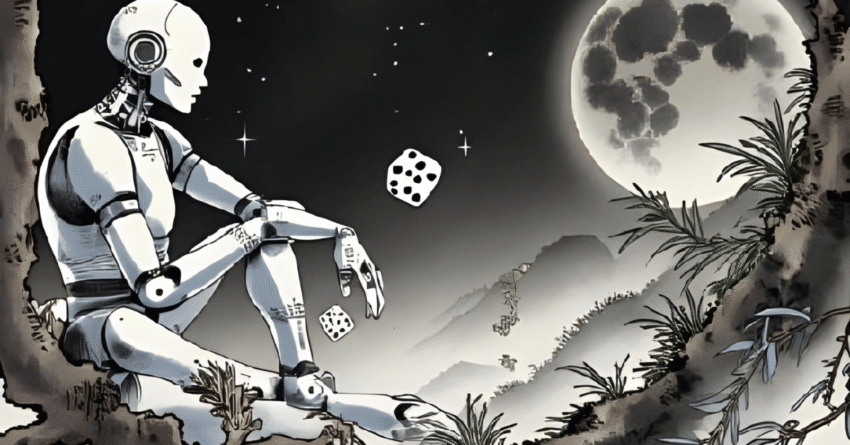
If Daneel, the chess master, acts upon pure logic and determinism, Trevize is his opposite: he is the gambler and the embodiment of free will and the leap of faith. He makes choices by intuition, even against reason. He often acts on impulse, breaking free from the constraints of rational thought. His decisions bypass calculation, guided instead by a profound, almost mystical instinct. He follows his instincts, even when they run counter to reason. Like Kierkegaard’s leap of faith, Trevize acts without certainty—believing that meaning emerges only after the leap, not before. Trevize’s freedom is what allows him to make the choice that Daneel, with all his calculations, couldn’t.
Trevize’s role highlights the idea that true progress and vitality require some degree of risk and unpredictability to move forward. Ironically, predictability brings its own dangers—as seen when a microbe on Alpha nearly killed Trevize. However, without his willingness to trust the unknown, the galaxy would be locked into a society safe but sterile, preserved in glass like a specimen—robbed of the gamble, the risk, the chaos that makes it alive.
IV. The Synthesis: Harmony Between Logic and Intuition
Asimov leaves us with a profound message. Neither side wins; rather, their duet weaves together the strengths of both. With Daneel’s stability, safety, long-term vision, and Trevize’s direction, spontaneity, and the spark of humanity, they could create a better galaxy, a more enduring path for humanity’s survival. Therefore, Asimov suggests, humanity’s flourishing requires both guardrails (determinism) and creativity (free will). In the end, the galaxy’s future is not written by reason alone or by faith alone, but by the duet of chess master and gambler—logic and intuition revolving together like twin stars casting light on the path ahead..
The duet of chess master and gambler may solve the galaxy’s dilemma, but it also mirrors the paradox at the heart of our own existence.
Conclusion
The resolution of Foundation and Earth is not one ideology’s triumph, but the synthesis of both. The galaxy requires both the chess master’s foresight and stability, and the gambler’s daring leap into the unknown. Daneel provides the necessary guardrails and foundational stability, preventing humanity from falling into ruin. Trevize, in contrast, offers direction and purpose, securing a future vibrant and evolving, not sterile and predetermined.
Asimov leaves us with the reminder that our survival—whether in fiction or in life—depends not on choosing one path, but on learning to walk the paradox between them. The strategist’s foresight keeps humanity safe, while the gambler’s leap gives it purpose. Just as Trevize once faced the galaxy’s crossroads, so too does humanity stand between reason and freedom, sustained only by embracing both. In the end, progress is not logic or freedom alone, but the uneasy duet that sustains every human future—two stars locked in orbit, illuminating the path forward.
Want read posting like this?
The Secret Philosophers of Foundation’s Edge