
literature and philosophy analysis on The Invisible Life of Addie LaRue
At a Glance
This blog audits the metaphysical system of The Invisible Life of Addie LaRue, reframing her curse as a bureaucratic “Terms-of-Service” agreement managed by Luc, the cosmic accountant. By applying the existentialism of Sartre and the political theory of Arendt, it explores how Addie survives through a “private discipline” of ethics and the smuggling of meaning through art. Ultimately, it reveals Addie as an ontological broker who achieves regulatory capture, setting the stage for a systemic liquidity crisis when her life is finally remembered.
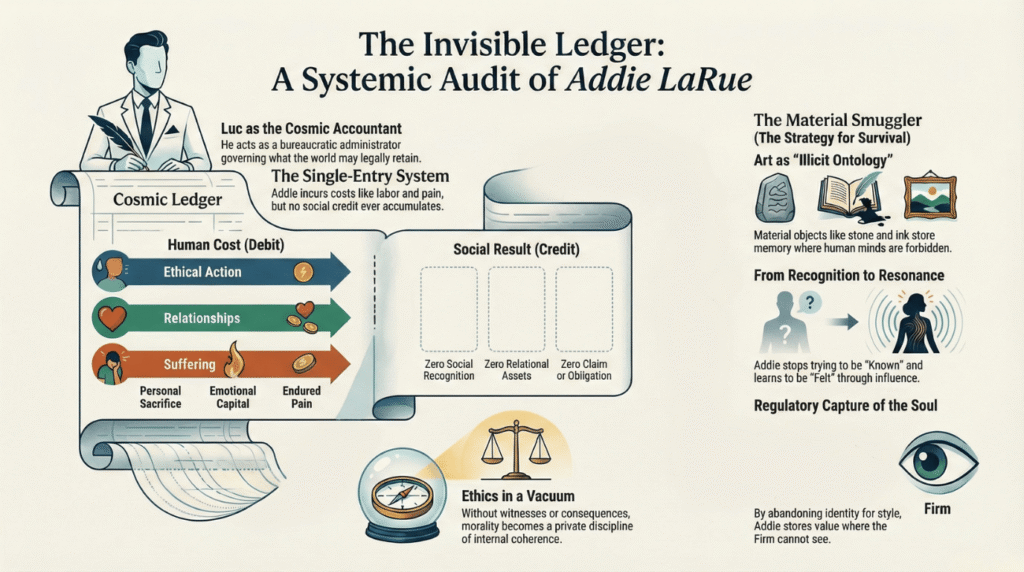
Life That Does not Compound
Meals eaten: perhaps one hundred thousand. Beds slept in: innumerable. Cities crossed, hands held, words spoken—each action registering the ordinary signs of a life fully lived. And yet, when Addie LaRue’s existence is audited, the final column remains empty. No memory persists, no social trace stabilizes, and no mark remains. Her life, measured in human activity, appears abundant; measured in consequence, it is zero.
The paradox at the heart of The Invisible Life of Addie LaRue is not immortality, nor even loneliness, but the radical possibility of a life that expends infinite energy without ever compounding into meaning1.
The Curse as Governance, Not Punishment
This paradox is best understood not as a folkloric curse, but as a system of governance. Addie’s bargain with the being known as Luc functions neither as moral punishment nor supernatural damnation. It operates instead as a contractual framework—a “Terms-of-Service” agreement for existence itself.
Addie is granted freedom of movement, desire, and action; what she is denied is feedback. The world is prohibited from retaining her. Memory collapses at the moment of contact. Relationships reset. Consequences are blocked from accumulation. Luc does not restrict Addie’s agency; he renders it structurally inconsequential2.
Freedom Without Sediment: Failure of Essence
Seen this way, the novel stages a radical ontological experiment: what becomes of a human being when existence is granted, but essence is systematically prevented from forming? Jean-Paul Sartre’s famous claim that “existence precedes essence” rests on a largely unexamined assumption: that the world in which one acts is capable of remembering those actions3.
In Sartrean terms, essence emerges through “projects” sustained over time—through repetition, recognition, and the weight of responsibility. Addie’s condition severs this process at its root. Every action dissolves the moment it is performed. She exists continuously, yet her identity can never sediment. She is condemned not merely to freedom, but to a freedom without history.
If essence requires the sediment of history, then Addie is a subject permanently suspended in the liquid present—a state that Luc manages with bureaucratic precision.
Freedom Without Duration: Ethics Without Witness
The Private Discipline Addie becomes the ultimate existential test case: a subject existing in freedom without duration. Her tragedy is not that she cannot choose, but that her choices cannot stabilize into a “Self.” Without memory, ethical action is stripped of its social force and reduced to a private discipline.
Without recognition, responsibility loses its external anchor. The novel thus exposes a hidden dependency within existential philosophy: freedom alone is insufficient to generate meaning unless the world is permitted to achieve what freedom does.
Scope of the Audit: Systems, Not Romance
This analysis approaches Addie’s life as a systemic problem rather than a romantic one. We will audit three interlocking structures that govern her existence:
- The Cosmic Accountant: Examining Luc as a figure of jurisprudence who profits from Ontological Arbitrage—extracting human effort while ensuring it never reaches the “market” of history.
- The Ethical Invisible: Exploring the implications of a life without witnesses, where goodness and suffering leave no durable trace and morality becomes radically interior.
- The Material Smuggler: Analyzing the role of art—oil, stone, ink, and melody—as a form of “Illicit Ontology,” a material archive that survives where human memory is contractually forbidden.
Addie as a Toxic Asset
Addie LaRue functions as a toxic asset in Luc’s ledger. She does not survive by breaking the rules, nor by escaping his jurisdiction. Instead, she learns to operate within the contract’s blind spots. Over centuries, she evolves from a victim into a broker, discovering how meaning can be deferred and stored outside the mechanisms of the mind. Even when identity is denied, resonance may still find a way to compound.
The Firm: Luc as the cosmic Accountant
The Ledger of Silence
Luc is most often read as a devil—seductive, cruel, amused by suffering. Yet this interpretation misses his fundamental efficiency. Luc does not behave like a tempter seeking corruption, nor a tyrant requiring obedience; he behaves like an Administrator. His primary interest lies not in souls, but in Accountancy. What he extracts from Addie LaRue is not damnation, but something far more abstract and structurally valuable: unwitnessed difference4.
The core of Luc’s ledger is silence. He profits from the yawning gap between human effort and social record—from actions that expend energy, intention, and emotion without ever stabilizing into memory. In Addie’s case, this gap is infinite. She acts passionately and creatively, yet the world is contractually forbidden from retaining her presence. The system does not merely “forget” Addie; it is structured to ensure that forgetting occurs automatically, without malice or resistance. Luc’s harvest is not destruction, but Meaning Leakage: the steady evaporation of significance from a life that is prohibited from compounding5.
The Jurisprudence of Cognition
This logic explains why the curse is so surgically selective. Luc does not interfere with physics; Addie leaves footprints, occupies space, and alters matter. What Luc governs instead is Cognition. Recognition collapses, memory resets, and narrative continuity fails.
The distinction is crucial. By allowing causality to proceed while blocking remembrance, Luc preserves the appearance of freedom while nullifying its long-term effects. Objects may bear the residues of Addie’s presence, but minds cannot integrate those traces into an identity. The world becomes a graveyard of residues that are legally barred from testifying.
In this sense, Luc’s authority is a jurisprudence rather than a metaphysics. He enforces a law about what may be retained, not what may occur. He is a bureaucratic regulator of reality. As Hannah Arendt observed in her analysis of systemic power, the most effective domination does not require cruelty; it requires procedures that function automatically, without reflection6. Luc’s system operates with similar indifference. He does not need to punish Addie’s goodness or reward her cruelty. As long as the output remains zero—no memory, no obligation, no accumulation—the ledger balances.
The Broker’s Profit
The Broker’s Profit Viewed through the lens of accounting rather than theology, Addie’s life is a Single-Entry System. Costs are incurred—time, labor, pain, desire—but no corresponding credit ever appears in the world’s books.
- Ethical Debit: Ethical actions debit the self without crediting society.
- Relational Insolvency: Love expends emotional capital without generating relational assets.
- The Debtless Sufferer: Suffering produces no claim, no debt, and no obligation.
This is why Luc does not need to torture Addie. Pain has no intrinsic value in his system; it is merely noise. Luc feeds not on anguish, but on Imbalance.
Luc is a structural parasite. He does not oppose meaning; he feeds on a system that prevents meaning from consolidating. Addie is his most refined asset: a human being capable of endless output with zero durable return. She is valuable precisely because she is invisible to the mechanisms that normally transform effort into Essence.
The Vulnerability of the Audit
Yet, this efficiency exposes Luc’s ultimate liability. A system that depends on single-entry lives assumes that meaning cannot cross ledgers. It presumes that recognition is always isolated and always resettable. What Luc underestimates—and what Addie slowly exploits—is the possibility that meaning may be deferred, displaced, and stored outside the cognitive channels he controls. Luc governs minds, but he does not fully govern matter, form, or time. His jurisprudence is precise, but it is not total. Within this narrow margin, Addie begins her slow transition from asset to liability.
But while matter can store a trace, the soul must store a choice. If Luc has vacated the moral ledger, Addie is left to maintain it alone.
Ethics Without Witness: the Private Discipline
The “Ring of Gyges” Test
The ethical problem at the center of The Invisible Life of Addie LaRue is not temptation or moral frailty; it is Invisibility. Addie’s condition subjects her to a philosophical test older than the novel and more unsettling than any doctrine of sin: the challenge posed in Plato’s tale of the Ring of Gyges. If a person could act without ever being seen, remembered, or held accountable, would morality survive7?
Addie lives permanently inside that thought experiment. Her actions leave no reputational trace, no legal consequence, and no narrative afterlife. She is free not only from punishment, but from Recognition itself. Under these conditions, conventional ethics collapse. Moral systems grounded in social reinforcement—praise, blame, honor, or shame—lose their purchase. Even consequentialist frameworks falter because outcomes do not persist long enough to shape the world. Addie’s kindness cannot improve a community; her cruelty cannot corrupt one. Every moral act is quarantined within the moment of its execution. What remains is not ethics as a social system, but ethics as a Solitary Discipline.
The Sartrean Answer
Jean-Paul Sartre offers the most severe response to this predicament. For Sartre, ethics does not arise from divine command or social validation, but from Radical Choice. To choose oneself is to choose a vision of humanity; each action declares, “This is how a human being ought to act.” In Addie’s case, this responsibility intensifies. Because no one remembers her, she cannot outsource her morality to reputation, habit, or tradition. There is no audience to impress and no social identity to protect. Her goodness must be entirely Self-Legislated8.
This makes Addie’s ethical burden heavier than that of the ordinary agent. Most humans act under conditions of partial visibility, anticipating judgment or memory. Addie acts in a vacuum. Every choice is stripped of reinforcement and reduced to a single, haunting question: “Who do I choose to be when nothing will come of it?” Her ethics are not easier because they are private; they are harder because they are Absolute. There is no instrumental reason to be good. There is only the refusal to become something else.
The Tragedy of Invisibility
Yet, this radical autonomy exposes a tragic paradox articulated by Hannah Arendt. For Arendt, ethical action becomes “Real” only when it enters the Shared World of Appearance—when it is seen, remembered, and woven into the social fabric. Action without remembrance may be morally sincere, but it remains Politically Sterile9.
Addie’s mercy, however genuine, leaves no footprint in the “World of Men.” It does not alter institutions or collective memory. Her goodness exists, but it does not appear. In Arendt’s terms, Addie is denied Worldliness, the condition that allows an action to outlast the actor. Her ethics become real only to herself; they cannot scale, they cannot propagate, and they cannot cross into history.
Goodness as a Private Aesthetic
Under such conditions, morality risks Depreciation. Actions that leave no trace are vulnerable to nihilism—not because they lack meaning, but because meaning fails to accumulate. Addie’s challenge is to prevent her goodness from eroding into a “Private Hobby”—an aesthetic preference rather than a moral commitment.
She resists this by treating ethics as a form of Internal Coherence. Her goodness is less about changing the world and more about preserving a self that refuses to collapse into indifference. Her morality is maintained through:
- Repetition without Reward
- Choice without Reinforcement
- Restraint without Recognition
Ultimately, the novel suggests that while morality does not require witnesses to exist, it does require them to Endure. Without the archive of human memory, goodness persists only in miniature—compressed into the narrow, fleeting space between action and disappearance.
The Smuggling Route: Art as Illicit Ontology
The Third Space
If Luc governs recognition, the central question becomes: how does meaning survive in a world where minds are forbidden to remember? The Invisible Life of Addie LaRue answers this not through rebellion, but through Materiality. Paint, stone, ink, and melody become the novel’s quiet contraband—forms of memory that operate below the threshold of Luc’s jurisdiction. Art functions as a Third Space: neither human cognition nor divine record, but something stubbornly physical, persistent, and mute.
This distinction is crucial. Luc’s curse does not erase Addie from reality; it erases her from Recognition. She leaves footprints, alters rooms, and touches objects. Causality remains intact. What collapses is the mind’s ability to integrate those traces into narrative continuity. The world becomes full of evidence without testimony. In this context, matter acquires a strange privilege: it can remember without understanding, preserve without judging, and endure without accusing. A statue may survive centuries without insisting on who inspired it. A melody may linger without naming its source. These objects are Witnesses who cannot testify10.
Authorized vs. Unauthorized Memory
Luc allows this because objects do not generate claims. A remembering mind produces Obligation: gratitude, guilt, responsibility, or love. Objects do none of this. They store form without intent; they retain rhythm and effect, but not authorship.
This explains why Luc’s jurisprudence tolerates art while prohibiting memory. A name would stabilize identity. A story would demand coherence. A remembered face would reopen the ethical ledger. But an unnamed painting persists. It preserves Difference without reducing it to a Consequence. It is “Unauthorized Memory”—a trace that exists outside the Firm’s official books.
From Recognition to Resonance
This division mirrors a deeper philosophical distinction between Appearance and Remembrance. As Hannah Arendt argues, action becomes fully real only when it enters the shared world of human memory11. Art interrupts this process by freezing action at the level of form. It arrests motion without preserving intention. In doing so, it creates a durable trace that remains ontologically real while ethically silent.
It is within this narrow margin that Addie’s strategy evolves. Over centuries, she stops attempting to be Known and begins learning how to be Felt. Recognition fails her; Resonance does not. She abandons the hope of authorship and turns instead to Influence—nudging artists, inspiring motifs, and shaping aesthetics that will outlive her without naming her. In accounting terms, she ceases to press for direct attribution and begins building a Parallel Balance Sheet: one measured not in memory, but in Affect.
Addie the Broker
This shift marks Addie’s transformation from subject to Broker. She no longer fights Luc’s rules; she arbitrages their limits. If identity cannot persist, form can. If memory collapses, influence may still propagate. Addie’s presence migrates from biography into Style, from narrative into Pattern.
Across three centuries of Western art, she becomes a Distributed Trace rather than a stable self, present everywhere and owned nowhere. Her meaning compounds precisely because it is never consolidated under her name. This is an Illicit Ontology: a mode of being that survives without recognition.
The Incompleteness of the Audit
Art does not defeat Luc; it exposes the incompleteness of his jurisdiction. A system designed to erase identity may still fail to erase influence. Addie survives not by reclaiming her name, but by abandoning it. She becomes unaccountable not because she escapes the Firm, but because she learns to Store Value where the Firm cannot see.
Luc governs the ledger of minds, but Addie operates in the margins, where matter remembers what consciousness is forbidden to retain. The audit is open, the assets are hidden, and the stage is set for a Liquidity Crisis that only a single, remembering mind can trigger.
Conclusion: The Long Game of Deferred Assets
The Regulatory Capture of the Soul
The audit now comes into focus. Addie LaRue has not escaped Luc’s Firm, nor has she overturned its jurisdiction. The system governing her life remains intact: recognition collapses, memory resets, and identity refuses to stabilize. Yet, the audit reveals something more unsettling than rebellion. Over three centuries, Addie has achieved what regulators fear more than defiance: Regulatory Capture. She has mastered the rules of Luc’s system so completely that she no longer needs to violate them to neutralize their force.
Luc’s power depends on isolation. His ledger balances only as long as lives remain, Single-Entry Systems—so long as action debits the self without ever crediting the world. Addie appears, at first glance, to be the perfect asset within this structure: infinite output, zero accumulation, total erasure. But assets can become toxic. By shifting her investments from Identity to Form, Addie converts herself from a consumable resource into a distributed influence. She does not reclaim authorship; she abandons it. Meaning compounds without attribution. Value persists without ownership. Luc’s system continues to function, but it no longer extracts the profit it expects12.
The Tax-Free Ethics of Coherence
This transformation clarifies the ethical stakes of Addie’s survival. Her goodness does not disappear simply because it leaves no public trace. Instead, it becomes a form of Private Capital—a moral preserve maintained without expectation of return. Luc cannot tax this goodness because he cannot “see” it. Her ethical life produces no institutional effects, but it also provides no leverage for the Firm. In a system that profits from unwitnessed difference, Addie’s refusal to lapse into nihilism is a quiet act of Metaphysical Sabotage. Goodness survives not as social currency, but as internal coherence.
The Fragility of the Incomplete Audit
Yet, this victory is incomplete by design. A private ethic, no matter how disciplined, cannot repair a world. Addie’s actions remain morally sincere but, in Arendt’s terms, Politically Sterile13. Her influence circulates through art and affect, but never through responsibility or obligation. The system remains stable because nothing consolidates. Luc’s Firm does not fail; it simply fails to notice the slow accumulation of Deferred Assets hidden outside its balance sheet.
This brings the audit to its most precarious conclusion. Luc’s system is not unjust because it is cruel; it is fragile because it is incomplete. It assumes that meaning must either be Owned or Erased. It cannot account for meaning that is delayed, shared, or relational. The ledger balances only as long as recognition remains individual and memory remains isolated. This is the condition of Metaphysical Solvency.
The Risk of Convergence
What follows is not escape, but Systemic Risk.
The arrival of Henry Strauss does not represent romance; it represents Insolvency. For the first time in three centuries, Addie’s existence threatens to move from a single-entry system into a Consolidated Account. A remembered life introduces Double-Entry Bookkeeping: loss appears alongside gain, sacrifice alongside credit, and action alongside consequence. The Firm can tolerate isolation, but it cannot survive convergence. In Blog 2, we will examine what happens when Luc’s closed system encounters its first true audit—when love, recognition, and memory threaten to reconcile accounts that were never meant to balance.
Notes
- V. E. Schwab, The Invisible Life of Addie LaRue, First Tor paperback edition (Tor Publishing Group, 2023). ↩︎
- Ibid, 39–43. ↩︎
- Jean-Paul Sartre, Existentialism Is a Humanism, with Carol Macomber et al. (Yale University Press, 2007), 22–34. ↩︎
- Schwab, The Invisible Life of Addie LaRue, 44–47. ↩︎
- Ibid, 44–52. ↩︎
- Hannah Arendt, Eichmann in Jerusalem: A Report on the Banality of Evil, with Amos Elon (Penguin Books, 2006), 287–94. ↩︎
- Plato, The Republic, trans. Benjamin Jowett, with Simon Blackburn (Clydesdale Press, LLC, 2018), bk. II. ↩︎
- Sartre, Existentialism Is a Humanism, 24–34. ↩︎
- Hannah Arendt et al., The Human Condition, Second edition (The University of Chicago Press, 2018), 175–81. ↩︎
- Schwab, The Invisible Life of Addie LaRue, 62–69. ↩︎
- Arendt et al., The Human Condition, 175–81. ↩︎
- Schwab, The Invisible Life of Addie LaRue. ↩︎
- Arendt et al., The Human Condition, 175–88. ↩︎
Bibliography
Arendt, Hannah. Eichmann in Jerusalem: A Report on the Banality of Evil. With Amos Elon. Penguin Books, 2006.
Arendt, Hannah, Danielle S. Allen, and Margaret Canovan. The Human Condition. Second edition. The University of Chicago Press, 2018.
Plato. The Republic. Translated by Benjamin Jowett. With Simon Blackburn. Clydesdale Press, LLC, 2018.
Sartre, Jean-Paul. Existentialism Is a Humanism. With Carol Macomber, Annie Cohen-Solal, and Arlette Elkaïm-Sartre. Yale University Press, 2007.
Schwab, V. E. The Invisible Life of Addie LaRue. First Tor paperback edition. Tor Publishing Group, 2023.