
- Introduction
- Black Sunday and Forced Migration
- The Dust Bowl was a Compound Crisis
- From Laissez-Faire to New Deal
- Literary Memory
- Economic and Ecological Precursor to Disaster
- The Boom-Bust Cycle
- The Debt Trap
- The Triad of Failure
- The Immediate Financial and Agricultural Collapse
- Land Value Collapase
- Loss of Capitalized Wealth
- The Shift from Farmer to Refugee
- The Socio-Economic Shock of Mass Migration
- The “Push” Factor
- The “Pull” Factor
- Competition and Exploitation
- Of Mice and Men: The Economics of Transient Labor
- The Impossible Dream
- Commodity Status and Devaluation
- The Isolation of Exploitation
- Government Intervention and New Deal Policy
- Agricultural Adjustment Act (AAA)
- Soil Conservation Services (SCS)
- Relief Camps
- To Kill a Mockingbird: Localized Poverty and Class Rigidity
- Contrast of Economic Settings
- Economics of Pride
- Poverty and Justice
- Conclusion: Legacy of the Great Dust
- Synthesis of Literary Evidence
- Final Thought
Introduction
Black Sunday and Forced Migration
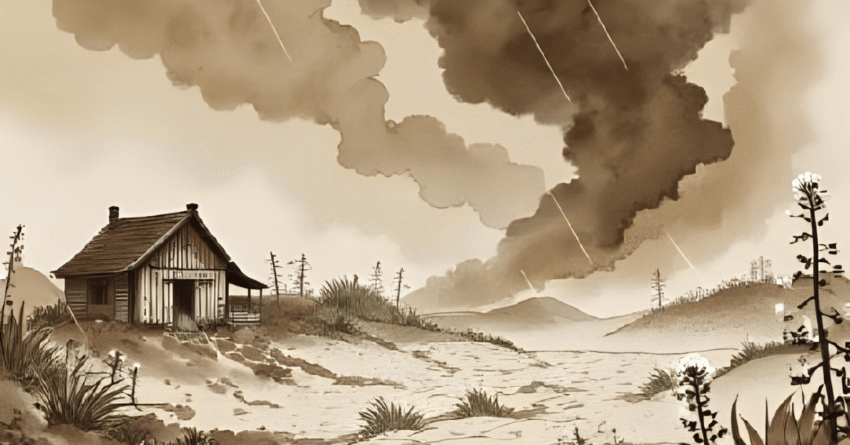
The wind began as a whisper, then slowly sharpened into a howl. No one could have predicted that it would culminate in one of the most catastrophic environmental events in American History. On “Black Sunday” on April 14, 1935, residents of the Great Plains watched in horror as a towering black dust cloud rolled across the horizon, swallowing daylight and choking the air1. Families stuffed wet rags into window cracks and still tasted the soil of their own fields on their tongues. The advancing “black wall” engulfed farms, equipment, livestock, and homes, erasing entire landscapes in minutes.
For many farmers, the storm was not just another hardship. It was a final verdict. Facing land stripped of fertility, rising debts, and collapsing markets, thousands had no choice but to abandon their homes and head west in search of survival, dignity, and hope. Yet upon crossing state lines, these displaced families were derisively labeled “Okies,” a term loaded with prejudice and hostility. The Dust Bowl was more than a meteorological disaster; it marked the end of an entire way of life. Land that once promised independence and modest prosperity, and turned physically and economically hostile. Against the backdrop of the Great Depression, environmental collapse became an economic death sentence.
The Dust Bowl was a Compound Crisis
The Dust Bowl was not a mere weather anomaly but a compound crisis decades in the making. World War I had driven unprecedented wheat demand, encouraging deep plowing of fragile prairie grasslands. After the war, crop prices plunged, and farmers were so desperate to stay afloat.2 They planted more acreage ever, stripping the soil of its natural anchors. When severe drought struck in the early 1930s, the exposed topsoil lifted effortlessly into the air, forming the massive storms that darkened the skies34. Layered atop the wider economic collapse of the Great Depression, the Dust Bowl followed a brutal logic. Those with the least financial cushion endured the greatest losses.
From Laissez-Faire to New Deal
This convergence of ecological and economic catastrophe produced one of the most profound shocks in American history, reshaping agricultural policy and labor structures. The crisis forced a federal shift from laissez-faire ideals5 to New Deal intervention. Policymakers focused on restoring ecological stability and preventing future collapse. The consequences, however, extended far beyond short-term dislocation. They left lasting scars on the American class system and shattered the cherished myth of the self-reliant small farmer whose prosperity was assumed to rest solely on hard work and individual effort.
Literary Memory
These brutal socio-economic effects—including the destruction of the American agrarian dream—are hauntingly captured in literature. John Steinbeck’s portrayal of exploited migrant labor in Of Mice and Men. In Harper Lee’s depiction of entrenched, localized poverty in To Kill a Mockingbird. Though set in different regions and depicting different communities, both novels illuminate the human cost of economic collapse. Together, they anchor the Dust Bowl not just in environmental history but in the enduring cultural memory of class, labor, and justice in the United States.
Economic and Ecological Precursor to Disaster
The Boom-Bust Cycle
The Dust Bowl was set in motion long before the first black storm crossed the plains. Its roots lay in a powerful combination of wartime demand and economic optimism during and after World War I. With European farms devastated by trench warfare, global demand for American wheat surged. U.S. farmers were encouraged—by politicians, bankers, and even agricultural experts—to plow more land and “help win the war.”6 Wheat became not only a patriotic duty but also a seemingly reliable path to prosperity.
New technologies magnified these incentives. Gasoline-powered sand combien harvesters allowed farmers to plow deeper and faster than ever before. Across many parts of the Great Plains, cultivated acreage expanded dramatically as farmers rushed to profit from high grain prices. The logic was simple: more land meant more wheat, and more wheat meant more income. Few paused to consider the ecological cost of eliminating the native grasses that anchored the soil.
Traditional conservation practices—crop rotation, leaving field follow, and contour plowing—were increasingly abandoned. Instead, repeated deep plowing pulverized the sod, breaking apart the root systems that had protected the soil for centuries. What had once been a drought-resistant prairie ecosystem was reduced to fragile fields of exposed topsoil, vulnerable to even the slightest shift in wind or weather.
The Debt Trap
This ecological overreach of the 1920s was inseparable from a financial one. During the boom years, many farmers borrowed aggressively to buy more land and the new gasoline-powered machinery that promised higher yields. These investments made sense only as long as wheat prices remained high. When postwar markets stabilized, global grain prices fell. As profit margin declined, farmers suddenly found themselves burdened with debts they could no longer comfortably service. To meet loan payments, taxes, and basic household needs, many responded by plowing ever more marginal land, hoping that sheer volume would offset the falling wheat prices7. This strategy backfield: overproduction created a surplus that pushed prices down even further, spreading financial ruin across the plains.
The Triad of Failure
By the early 1930s, the Plains were primed for disaster. First, years of over-farming had stripped away the prairie’s natural protections, leaving the soil loose and exposed. Second, a severe drought gripped the Southern Plains, killing crops and turning vast fields into powdery dust vulnerable to the slightest wind. Third, the Great Depression wiped out credit, crashed commodity prices, and eliminated whatever financial margin small farmers once had. These forces—ecological degradation, drought, and economic collapse—did not operate separately. They reinforced one another, creating a cascading crisis that pushed thousands of families toward insolvency and displacement. The Dust Bowl was not merely a freak weather event, but the predictable outcome of agricultural and financial systems built around short-term gain rather than long-term resilience.
The Immediate Financial and Agricultural Collapse
Land Value Collapase
As drought deepened and dust storms intensified, the economic foundation of the Great Plains crumbled at an alarming pace. In high-erosion counties, agricultural land values fell sharply. Estimates suggest declines of up to 28 percent compared with areas less affected by wind erosion. Land was more than a commodity8. It served as a family’s primary store of wealth, its collateral for loans, and the symbolic center of its identity. When land values collapsed, mortgages went underwater, and banks began seizing property. Farms that had been both home and livelihood were suddenly redefined as unprofitable assets to be liquidated.
Loss of Capitalized Wealth
The economic damage extended beyond individual homesteads. The region experienced a massive loss of capital, measured in millions of 1930s dollars.9 Machinery purchased on credit during the boom—tractors, plows, harvesters—was repossessed or sold for a fraction of its cost. Rural banks, heavily tied to farm loans, collapsed in waves, wiping out local savings and cutting off access to whatever credit remained. Each foreclosure deepened the contraction of regional economies. Merchants lost customers, county governments lost tax revenue, and small towns emptied out.
The unraveling followed a familiar debt-trap pattern. Farmers who had borrowed during the prosperous years felt compelled to expand production again as prices fell, attempting to “outproduce” the depression. But with wheat sometimes worth only a penny a bushel, no amount of volume could close the gap. Increasing acreage only worsened the glut, pushing prices even lower. Once the storms arrived, the land itself no longer functioned as a productive asset. It became a liability that could neither grow crops nor command a price.
The Shift from Farmer to Refugee
This transformation—from independent farmer or tenant to landless refugee—was the most brutal shift of all. Losing the farm meant losing more than a source of income. It meant the collapse of a worldview built on self-reliance, property ownership, and generational continuity. Families who had long understood themselves as producers were forced into the role of transient laborers, often carrying debt and encountering hostility wherever they arrived. Economically, they were converted from small-scale capital holders into surplus labor. Personally, they became displaced people, defined not by the land they worked but by the land they had lost, carrying with them memories of a home and an agrarian ideal that had been ground into dust.
The Socio-Economic Shock of Mass Migration
The “Push” Factor
As the soil blew away and foreclosures mounted, the Southern Plains became economically uninhabitable. Between 1930 and 1936, drought, worsened by decades of aggressive plowing, destroyed roughly 100 million acres of farmland.10 Crop failures became routine, banks collapsed, and creditors seized equipment bought on credit. Wheat prices fell from about $1.03 per bushel in 1929 to roughly $0.38 by 1932, making even a successful harvest unprofitable11. For many families, remaining on the land meant facing starvation or insurmountable debt. Under such pressures, migration was not a choice but an economic necessity.
California appeared in the Plains imagination as the opposite of the Dust Bowl: fertile, prosperous, and full of promise. Handbills, newspapers, and word-of-mouth stories advertised steady work picking fruit, cotton, and vegetables in the vast fields of the San Joaquin and Imperial Valleys. Unlike the small family farms of the Southern Plains, California’s agriculture was industrial in scale and dominated by corporate growers who depended on large pools of seasonal labor. To desperate families, this system looked like salvation. If one was willing to work, there would always be crops to pick and wages to earn.
The “Pull” Factor
Yet the economic promise of California was only partly real. John Steinbeck, who reported on migrant labor for the San Francisco News, described how growers deliberately inflated labor demand by circulating handbills advertising far more jobs than existed.12 This ensured that “one job would have a thousand men.” Migrants sold their remaining possessions and spent their last dollars on gasoline to reach California, only to discover that the labor market had been engineered to keep them in a state of perpetual desperation. Work did exist, but not in sufficient quantity—or at wages high enough—to absorb the massive influx of workers.
Competition and Exploitation
The result was a labor market defined by extreme competition and structural exploitation. The new migrants entered—and reshaped—an already diverse workforce that included Mexican and Filipino laborers who had long filled seasonal agricultural jobs. Historian Mae Ngai notes that labor contractors increasingly preferred white migrants because, as citizens. They were easier to recruit, and their desperation made them easier to control.13 Wages in some fields fell to as little as $0.75 to $1.25 per day for exhausting, sunbaked labor.14 That was barely enough for food, and far more than enough to rebuild last stability. Growers routinely recruited more workers than they needed, leaving many unpaid, while those who found work had no power to negotiate conditions.
This new “harvest gypsy” existence, as historian James Gregory calls it, produced a distinct class identity15. Stability gave way to rootlessness; communities dissolved into clusters of tents, cars, and roadside camps along irrigation ditches. The psychological toll of this life was immense. Steinbeck’s characters in Of Mice and Men capture this itinerant precarity. Workers are isolated from family, stripped of bargaining power, moving from and ranch to ranch without ever gaining ground. Harper Lee, though writing about a different region in To Kill a Mockingbird, portrays a parallel truth. When resources shrink, social hierarchies harden, and those already at the margins suffer first and most. Together, these works reveal that the Dust Bowl migration did more than displace people geographically. It altered the American Labor force and deepened the nation’s racial, class, and economic divisions.
Of Mice and Men: The Economics of Transient Labor
The Impossible Dream
In Of Mice and Men, Steinbeck compresses the vast economic forces of Dust Bowl migration into the small, intimate story of George and Lennie. Their dream of “livin’ off the fatta the lan’” is strikingly modest: a few acres, a vegetable patch, and the chance to escape bunkhouses and itinerant labor.16 Yet the simplicity of their ambition exposed how unreachable basic economic security has become. No matter how consistently they work, they cannot save enough to escape their status as transient laborers. Each paycheck is vulnerable—eaten away by low wages, unpredictable expenses, and the constant threat of losing work. The dream farm becomes a central metaphor for the broken American Dream of the 1930s: hard work and moral decency no longer guarantee mobility in a system designed to keep labor cheap, disposable, and permanently insecure.
Commodity Status and Devaluation
Steinbeck portrays the ranch hands as human commodities—workers whose value lies only in their physical strength and obedience. They move from ranch to ranch, hired and dismissed with the same ease as tools. Candy, the aging swamper, becomes the clearest embodiment of economic redundancy. His old dog, once resentful, is now deemed worthless and shot because it no longer serves a purpose. Candy recognizes the parallel: once he is no longer productive, he expects to be discarded just as readily. His desperate desire to join George and Lennie’s dream farm is not only sentimental—it is an attempt to escape the fate of becoming surplus labor in a system that offers no place for the elderly, disabled, or economically “unprofitable.”
Although the novel rarely mentions the Dust Bowl explicitly, the oversupply of desperate migrant labor shapes every interaction on the ranch. The arrival of thousands of “Okies” into California flooded the labor market at precisely the moment when demand remained seasonal and limited. Observers noted that wages had fallen so low that many workers “could not buy the very food they harvested.” Steinbeck’s ranch is just one point in a statewide network of corporate farms that exploited this imbalance between labor supply and demand. Men like George and Lennie remain trapped in a perpetual present. Just like these migrants who were unable to save, unable to plan, and always one missed paycheck away from ruin.
The Isolation of Exploitation
Economic exploitation in Of Mice and Men is inseparable from social isolation. Crooks, the Black stable hand, lives segregated in the harness room. He is necessary to the ranch’s operation yet excluded from its community. Curley’s wife, denied both work and a name, is trapped in a role that offers neither dignity nor agency. Both characters occupy the margins of the ranch hierarchy, and both become outlets for the frustrations of men who are themselves exploited. Those who possess only a slight advantage—white, able-bodied ranch hands—assert dominance over those even further down the ladder, reproducing a predatory social order that mirrors the economic one. Steinbeck reveals how the system of labor exploitation fractures solidarity among the poor, encouraging cruelty, resentment, and isolation rather than collective resistance.
Government Intervention and New Deal Policy
The scale of the Dust Bowl forced the federal government to confront, for the first time in a sustained way, the national costs of agricultural mismanagement and rural poverty. New Deal programs—uneven, controversial, and often contradictory—redefined the relationship between the federal state, agricultural land, and the workers who depended on it. The crisis transformed soil, crops, and farming practices from private concerns into matters of national policy and public welfare.
Agricultural Adjustment Act (AAA)
The Agricultural Adjustment Act (AAA) of 1933 targeted the central economic problem of the Depression-era farm economy: chronic overproduction. By paying farmers to plant fewer acres, the federal government aimed to reduce supply and raise commodity prices, which were disastrously low. Early results were significant—farm incomes rose roughly 50 percent between 1932 and 193517. Yet these gains came with deeply troubling costs. To enforce production cuts, federal agents ordered millions of acres of cotton plowed under and roughly 6 million piglets slaughtered rather than brought to market, a disturbing irony at a time when many Americans struggled to eat18.
The AAA’s benefits also flowed unevenly. Payments went to landowners, not to the tenant farmers or sharecroppers who actually worked the land. Many landlords used federal checks to mechanize their operations, investing in tractors and other equipment that reduced the need for human labor. Instead of protecting the most vulnerable, the program often hastened their eviction. Ironically, the policy added thousands of dispossessed rural families to the growing migrant labor force.
Soil Conservation Services (SCS)
The Soil Conservation Act of 1935 created the Soil Conservation Service (SCS) and marked a major conceptual shift in federal agricultural policy. Congress declared that “the wastage of soil and moisture… is a menace to the national welfare,” reframing soil as a national resource rather than a private commodity. The SCS promoted contour plowing, crop rotation, terracing, shelterbelts, and other conservation practices designed to restore the damaged plains and prevent future erosion19. In contrast to earlier approaches that rewarded output maximization at any cost, the SCS embraced a model that linked ecological sustainability with economic stability. The land, once treated as an endlessly exploitable asset, now requires federal stewardship to safeguard the broader economy.
Relief Camps
Meanwhile, in California, the federal government experimented with more direct humanitarian responses. The Farm Security Administration (FSA) established federally managed relief camps that offered sanitation, clean water, schooling, and a measure of self-governance—conditions far better than the squalid Hoovervilles that lined irrigation ditches and roadside clearings20. Steinbeck drew heavily on these camps in The Grapes of Wrath, contrasting the relative dignity they provided with the harsh exploitation exercised by private growers.
Yet the camps were too few and too small to meet the overwhelming need. Their limited capacity underscored a growing recognition that the federal government bore responsibility not only for stabilizing agricultural markets but also for protecting citizens from the worst consequences of ecological economic disaster. Relief camps did not solve the Dust Bowl migration crisis, but they marked the beginning of a new federal role in safeguarding the welfare of displaced Americans.
To Kill a Mockingbird: Localized Poverty and Class Rigidity
Contrast of Economic Settings
Where Of Mice and Men follows itinerant workers uprooted by Dust Bowl migration, Harper Lee’s To Kill a Mockingbird offers the opposite scenario: a community that stays put. Maycomb, Alabama, is a small Southern town frozen by the Great Depression, where poverty is not temporary but generational. If Steinbeck illustrates the economic violence of displacement, Lee reveals the equally corrosive effects of stagnation—what happens when families remain rooted in a system defined by limited opportunity and rigid social hierarchy.
Economics of Pride
Maycomb’s poor are divided not only by income but by pride, culture, and race. The Cunninghams represent land-based white poverty—impoverished but honorable, determined to pay their debts in hickory nuts or stove wood when cash is scarce. The Ewells, by contrast, occupy the lowest rung of white society. Living “behind the garbage dump,” they are viewed as disreputable, idle, and sustained only by the thin privilege of whiteness. Through both families suffer economic hardship, the town’s unwritten class codes grant even the most reviled white family more credibility than any Black resident could possess.
Poverty and Justice
In Maycomb, economic and legal outcomes mirror each other. The Tom Robinson trial reveals a justice system governed not by evidence but by the town’s racial and class hierarchy. Tom, a black man falsely accused of raping a white woman, enters a courtroom where acquittal is structurally impossible. The Ewells—poor, dishonest, and widely disliked—still wield decisive power because their whiteness positions them as “credible victims” within the town’s racial economy. In this calculus, Tom’s life—and by extension the lives of Maycomb’s Black residents—is valued less than the fragile pride of a destitute white family.
The Finch family occupies a middle space. They are not wealthy, but their education, profession, and moral capital place them above most of Maycomb’s residents. Their relative stability contrasts sharply with Steinbeck’s migrant workers, who lack both institutional support and communal attachment. Yet Lee suggests that even the Finch family’s moral authority has limits. Atticus can defend Tom Robinson, but he cannot overcome the deeply rooted structures that guarantee Tom’s convictions.
Viewed alongside Steinbeck’s migrant West, Maycomb represents another dimension of Depression-era poverty: a place where economic hardship reinforces, rather than disrupts, entrenched hierarchies. Plains farmers are pushed off their land into a migratory underclass, while Maycomb’s poorest remain trapped in a fixed local order where race and class tightly determine one’s future. Together, these texts show how the Dust Bowl and the Depression did not simply reduce material conditions; they reshaped the boundaries of possibility, altering who was allowed to hope and who was condemned to maintain the old order.
Conclusion: Legacy of the Great Dust
The Dust Bowl was more than a bad decade of weather. It was a defining economic and cultural trauma that shattered the illusion of inexhaustible American abundance. The convergence of overuse, severe drought, and the Great Depression exposed the fragility of a system that treated land as endlessly exploitable and labor as endlessly replaceable. In response, the federal government assumed a more active role in agricultural management, soil conservation, and intervention between market forces and human survival. Yet even these reforms, the scars endured: in depopulated towns, eroded prairies, and a newly mobile underclass formed from families forced off the land.
Synthesis of Literary Evidence
Literature preserves these scars and makes their human cost visible. Steinbeck’s Of Mice and Men reveals the brutal logic of labor exploitation, where even the smallest dream becomes unattainable under suppressed wages and constant insecurity. The fates of Candy and Crooks illustrate how age, disability, and race intersect with economic vulnerability, turning the ranch into a miniature model of Depression-era labor dynamics. Harper Lee’s To Kill a Mockingbird,
Though set far from the Dust Bowl, it portrays a complementary reality: a community in which poverty is fixed rather than migratory, and where racial and class hierarchies dictate who receives justice and who is condemned by default. In Maycomb, economic hardship reinforces caste rather than breaking it.
Taken together, these novels suggest that the Dust Bowl’s legacy stretches beyond the 1930s. The crisis catalyzed the development of modern federal agricultural and environmental policy—from soil conservation programs to acreage controls—and solidified the expectation that the government bears responsibility for preventing and mitigating ecological disaster. It asl reshaped American ideas about labor, exposing the dangers of unregulated markets that depend on a surplus of desperate workers to suppress wages. In both Policy and philosophy, the Dust Bowl forced the nation to rethink the balance between land, labor, and the state.
Final Thought
Ultimately, the Dust Bowl forced the United States to confront uncomfortable truths. Land is not inexhaustible. Markets do not necessarily reward virtue or effort. And without collective safeguards, both environments and communities can be destroyed in the pursuit of short-term profit. Though the dust storms have long since faded, their imprint remains—on federal policy, on the class structures, and on the stories Americans tell about fairness, security, and who is allowed to dream. The worlds depicted by Steinbeck and Lee remind us that these questions are far from settled.
You can access the books here.
- EBSCO. “Dust Bowl Devastates the Great Plains | Research Starters | EBSCO Research.” 2023. https://www.ebsco.com.
↩︎ - EBSCO. “Dust Bowl Devastates the Great Plains | Research Starters | EBSCO Research.” 2023. https://www.ebsco.com.
↩︎ - EBSCO. “Dust Bowl Devastates the Great Plains | Research Starters | EBSCO Research.” 2023. https://www.ebsco.com.
↩︎ - Dust Bowl. Always go to Wikipedia. This explains well. See. https://en.wikipedia.org/wiki/Dust_Bowl#:~:text=erosion%20%20under%20certain%20environmental,organic%20nutrients%20and%20surface%20vegetation ↩︎
- EBSCO. “Laissez-Faire | Research Starters | EBSCO Research.” Accessed November 30, 2025. https://www.ebsco.com.
↩︎ - EBSCO. “Dust Bowl Devastates the Great Plains | Research Starters | EBSCO Research.” 2023. https://www.ebsco.com.
↩︎ - EBSCO. “Dust Bowl Devastates the Great Plains | Research Starters | EBSCO Research.” 2023. https://www.ebsco.com.
↩︎ - Farm Security Administration. Report on Migratory Labor Camps. U.S. Government Printing Office, 1938. ↩︎
- See: The damage from the Dust Bowl is estimated at $25 million per day by 1936,equivalent to $570 million in 2024. https://en.wikipedia.org/wiki/Dust_Bowl#cite_note-inflation-US-13 ↩︎
- The Dust Bowl affected 100 million acres (400,000km2 ) mainly the Texas Panhandle and the Oklahoma Panhandle. See: https://en.wikipedia.org/wiki/Dust_Bowl#cite_note-inflation-US-13 ↩︎
- See: Bureau of Agricultural Economics, Prices and Price Indexes (Washington, D.C., 1933) ↩︎
- Steinbeck and Censorship. See: https://scholarworks.calstate.edu/downloads/x633f329w#:~:text=And%20indeed%2C%20bad%20though%20conditions%20are%20in,Their%20Blood%20Is%20Strong%20(The%20Harvest%20Gypsies). ↩︎
- Ngai, Mae. Impossible Subjects: Illegal Aliens and the Making of Modern America. Princeton: Princeton University Press, 2004. ↩︎
- “Mass Exodus From the Plains | American Experience | PBS.” Accessed November 30, 2025. https://www.pbs.org/wgbh/americanexperience/features/surviving-the-dust-bowl-mass-exodus-plains/.
↩︎ - Gregory, James N. American Exodus: The Dust Bowl Migration and Okie Culture in California. New York: Oxford University Press, 1989. ↩︎
- Steinbeck, John. Of Mice and Men. New York: Covici Friede, 1937. ↩︎
- Agricultural Adjustment Act | Relief, Recovery, Reform, Purpose, & Effect | Britannica ↩︎
- The Agricultural Adjustment Act (AAA) ↩︎
- fdrlibrary. “FDR and the Dust Bowl.” Forward with Roosevelt, June 20, 2018. https://fdr.blogs.archives.gov/2018/06/20/fdr-and-the-dust-bowl/.
↩︎ - Oklahoma Historical Society. “Okie Migrations | The Encyclopedia of Oklahoma History and Culture.” Accessed November 30, 2025. https://www.okhistory.org/publications/enc/entry?entry=OK008.
↩︎
-
 The Existential Lobotomy: How Huxley’s World State Cures the Sartrean Soul
 -
The Archive of Eradication: Why Dracula’s Filing Cabinet is Scarier than his Fangs
-
Addie LaRue and Albert Camus: Metaphysical Insolvency & The Absurd
-
 The Invisible Ledger: Existentialism, Memory, and Power in Addie LaRue
 -
 Kafka’s The Trial and Hannah Arendt: Law Without Justice