The Book Tapestry

From the pages to the mind—woven with care.

Menu
  • Home
  • Blog
  • Privacy Policy
  • About Me
Menu

Author: Sophia Wordsmith

Existentialism in The Plague: From Nihilism to Human Solidarity

Posted on November 2, 2025December 27, 2025 by Sophia Wordsmith

Albert Camus’s The Plague

1. Introduction

Imagine your city waking to a rash of dying rats, then dying neighbors, and finally, the death of the illusion that life is fair. Albert Camus’s The Plague depicts an epidemic sweeping through the eerily calm city of Oran. It claims countless lives and exposes the fragility of human certainty.

Yet this is not a tragedy in the Shakespearean sense, driven by fate or heroism but by endurance and ordinary suffering. Camus uses “the plague” as a metaphor for the Absurd—the clash between humanity’s search for meaning and the indifferent silence of the world. Then, Camus rejects passive nihilism, arguing instead that an active, humanistic existential struggle—solidarity—is the only path to meaning, as the characters must decide what it means to live while isolated on an island of suffering.  

Camus shows that in an absurd world, meaning isn’t discovered but created—through compassion and collective struggle against suffering. When the rats return to Oran, so does the warning—that meaning must be made anew, every time the world forgets.

2. The Problem: Nihilism, Indifference, and the Antecedent of Sin

Long before the first rat died, Oran was already sick. Its citizens lived in quiet repetition—working, socializing, and sleeping without passion or reflection. Theirs was not a life of cruelty but of indifference, a kind of passive nihilism disguised as normalcy1. In a world where nothing seemed worth questioning, the plague merely revealed what had been festering all along: the emptiness beneath routine. 

Camus begins The Plague not with chaos, but with monotony—the quiet moral inertia that precedes disaster. 

A. The Indifference of Oran (Passive Nihilism)

Oran’s pre-plague apathy and nihilism represent a void of meaning and virtue. The narrator describes Oran as “ugly”, “sultry”, and “placid.” Oran is the town where “everyone is bored, and devotes himself to cultivating habit.” Camus isn’t condemning the citizens as wicked; he’s diagnosing a subtler sickness—spiritual emptiness masked by comfort. It’s a comfortable stagnation. Therefore, the people of Oran exhibit the steady-state of nihilistic indifference; this moral blindness was itself a kind of “plague” that the physical disease merely externalized. This quiet complacency sets the stage for the Absurd—when catastrophe strikes, the illusion of moral order collapses. 

B. Plague as the Absurd

For Camus, the Absurd arises from the clash between our hunger for meaning and the universe’s silence. The outbreak shatters the city’s illusion of order, forcing its people to confront the Absurd they had long ignored. Rejecting any divine order, Camus saw human life as fundamentally irrational and absurd. No one can avoid death, and people sometimes suffer for no reason and are expected to withstand it. In The Plague, the epidemic symbolizes this very absurdity. The disease strikes people blindly and literally renders all human plans uncertain. In short, it introduces suffering without purpose.  For instance, Rambert’s separation from his beloved underscores how arbitrary suffering can strip even love of meaning. 

C. The Moral Framework of Collective Guilt (Aquinas)

For Aquinas, sin is not purely individual but communal, extending its effects across the created order. He distinguishes moral evil—the sins born of free will—from natural evil, the suffering that arises from the world’s fallen condition. In this sense, the plague represents a natural evil that exposes humanity’s deeper moral disorder. 

Camus implies that the true antecedent of sin in Oran lies in its citizens’ moral blindness and self-absorption. Thus, the initial “disease” is not the rat-fever, but the steady-state of nihilistic indifference. The physical plague merely externalizes this moral blindness, revealing the corruption the Absurd had long anticipated. 

In the novel, Camus parallels the plague to Aquina’s massa damnata, the condemned mass of humanity in original sin. This becomes evident as Camus introduces Father Paneloux’s preaching “qua member of the community,” each member of Oran is collectively responsible for the sins of moral blindness. Paneloux’s sermon frames the plague not just as punishment but as revelation—the moment when denial collapses, and collective guilt surfaces. 

By weaving this theme of shared guilt, Camus gives The Plague a profound moral dimension. Through their suffering, people of Oran confront the consequences of their indifference, and figures like Rieux, Tarrou, and Grand become symbols of atonement through action. In fighting side by side, they enact a collective redemption—not through divine grace, but through human solidarity.

Yet while Camus exposes Oran’s moral decay in secular terms, Father Paneloux seeks to explain it through theology. His sermons transform the epidemic into a stage where divine justice and human suffering collide.

3. The Theological Response: Father Paneloux and the Justification of Suffering

When we read The Plague as an allegory for universal suffering, it inevitably raises moral questions. Among the novel’s central figures is Father Paneloux, a Jesuit priest whose theological response stands in contrast to the novel’s humanist voices. As the epidemic deepens, Paneloux delivers two major sermons that reveal his struggles to justify suffering within a framework of faith. 

A. Paneloux’s Initial Sermon

In the early phase of the epidemic, Father Paneloux addresses a terrified congregation with a fiery sermon that interprets the plague in strictly theological terms. He declared that the plague was God’s Punishment for Oran’s collective sinfulness as if it were a divine wrath and justice. 

In Paneloux’s view, nothing about this disaster is senseless or arbitrary; rather, it is the obtained consequence of moral transgression. He preaches, “Too long this world of ours has connived at evil.” The plague was punishment for “criminal indifference” toward God. By doing so, he tried to apply a rational theological framework to an irrational horror. In this sermon, Paneloux asserts order where Camus presents chaos, insisting that divine logic governs even catastrophe. In his mind, thus, the plague follows a moral logic. Then, he concluded, “what God Wills and why He wills it.”

B. The Failure of Divine Order

As the plague ravages Oran, events soon put Father Paneloux’s dogmatic framework to a devastating test. That test comes when he witnesses the drawn-out death of an innocent child—the magistrate’s young son. The turning point comes with watching the agonizing death of a child, the death of the magistrate’s son. The helpless child writhes in prolonged pain and dies. When he directly witnessed the extreme suffering of an innocent, he started to struggle to rationally reason the death of the child. If the plague is divine justice, what sin could warrant such agony? In that moment, his theology collapses under the weight of compassion. With Father Panelox’s struggle, Camus exposes the collapse of any facile “divine punishment” explanation. 

Though shaken, Paneloux does not abandon his faith. Instead, he remains with the afflicted, joining Dr. Rieux and Tarrou in their work. His ordeal becomes less a crisis of belief than a test of endurance—faith stripped of certainty. Even Tarrou, who brought Father Paneloux to witness the child’s death, saw Paneloux’s internal trial. Tarrou tells Dr. Rieux of a story about another priest who lost his faith upon witnessing a similarly brutal atrocity in wartime. It was Father Panelox’s trial to continue to believe and preach after his tidy theological narrative had been devastated by reality. This decision was made in the second sermon, his attempt to reconcile his faith with what he had witnessed.

C. Pivot Point

After witnessing the cruelty of the plague, Father Paneloux undergoes a spiritual and philosophical pivot. He prepares and delivers a second sermon that contrasts sharply with his earlier certainty.

In the second sermon, Father Paneloux tells the congregation that human beings cannot always understand god’s will. In his first sermon, he claims to know exactly why God punished Oran; now he admits that the divine will exceeds human understanding. He says there is something we will not be able to rationally explain. Faith, he tells the congregation, demands not comprehension but surrender—” a leap into the heart of the unacceptable.”

Then, he joins Dr. Rieux’s volunteer sanitary squads and decides to battle against the plague. When Paneloux himself falls ill, he refuses medical treatment, leaving his fate to God. Dr. Rieux notes that the ambiguity of his death—neither confirmed plague nor coincidence—symbolizes the fact that unsolved tension between faith and reason.  Camus gives the doctor’s death as a doubtful case. Dr. Rieux noted that the cause of death cannot be conclusively determined. Symbolically, his death was an antinomy of pure reasoning. 

While Father Paneloux attempts to find meaning through a shattered faith, Dr. Rieux and Jean Tarrou turn instead toimmediate action. Their resistance is grounded not in theology but in humanity itself, revealing the novel’s core secular ethic of redemption.

4. Existentialism in The Plague: Action, Choice, and Rebellion

The Plague is a profound Allegory of how humans respond to inexplicable suffering. Camus portrays a world stripped of divine purpose or moral logic—where good and evil receive no reward or punishment. Yet rather than yield to despair, Dr. Bernard Rieux and Jean Tarrou embody Camus’s human ethic of action and compassion.

A. Dr. Rieux’s Stoic Acceptance

Dr. Rieux, the novel’s protagonist and narrator, embodies a pure existential response to the epidemic. He does not search for divine meaning or cling to comforting illusions; instead, he dedicates himself to the daily, unglamorous fight against the plague. After observing death after death, he says, “There’s no question of heroism in all this. It’s a matter of common decency. For Rieux, decency means simply doing his duty as a doctor. His quiet courage is deeply stoic. He neither complains about the unfairness of fate nor expects any reward for his sacrifice. Like Camus’s Sisphus, he finds meaning not in victory but in the act of struggle itself—rolling the boulder uphill each day out of common decency, knowing it may roll back again.

B. Tarrou’s Pursuit of “Saintliness”: A Secular Saint in Solidarity

Jean Tarrou arrives in Oran as an outsider but becomes one of Rieux’s closest allies. Like Rieux, he refuses despair—but his motivation differs. Tarrou aspires to become a “saint without God,” striving for moral purity through choice rather than faith. He knows he will never be rewarded as a saint in a godless world. In Tarrou, Camus poses the existential question of how to live a life of virtue and meaning purely through one’s own choice, without reference to any divine authority.

Tarrou’s pursuit of “saintliness” is deeply rooted in his understanding of the plague as both a literal and metaphorical evil. Through Tarrou’s backstory and philosophy, Camus illustrates that the struggle against injustice “out there” cannot be separated from the struggle within oneself to live ethically. 

In his recollection of his father—a magistrate who demanded the death penalty with absolute conviction—Tarrou sees the plague of moral blindness that turns justice into ritualized murder. Haunted by this memory, he rejects the death penalty and devotes himself to purging the “plague” within—the indifference that allows violence to exist. Tarrou’s goal of saintliness is not about being holier than others but about cleansing himself of indifference. 

C. Defining Human Solidarity

In the end, Tarrou and Rieux’s paths converge in action. For Camus, if meaning exists at all in an absurd and indifferent world, it is the meaning we create together through solidarity. The plague strips away illusions of control and forces each person to choose between isolation and cooperation, despair and defiance. Through Rieux, Tarrou, and their companions, Camus shows that meaning is forged only in shared struggle. Solidarity, then, becomes an existential act of rebellion—a collective affirmation of life against death. 

Through their actions, Rieux and Tarrou demonstrate that in a world without transcendent meaning, the only redemption lies in human solidarity. Yet the plague’s end reminds us that such meaning must be continually recreated—because the bacillus of indifference never dies. 

5. Conclusion

When the city finally reopens, Tarrou is dead, and Dr. Rieux has lost his wife. The novel does not mock the citizens’ joy; it merely reminds us that the bacillus sleeps—and with it, human complacency.

Through The Plague, Camus offers a vision of meaning forged in catastrophe—the epidemic as both literal disease and metaphor for humanity’s passive nihilism.

Camus shows that the fight against the plague is, at its heart, a struggle for humanism—a continual act of creating meaning where none is given. Rieux’s small victories—and the endurance of the plague itself—remind us that meaning must be renewed with every generation.  Tarrou seeks to cleanse himself of the inner plague of indifference, striving to become a saint without God. In their different ways, both men embody Camus’s philosophy of revolt against the Absurd. Ultimately, Camus suggests that the highest virtue—and the only true redemption—in an absurd universe is human solidarity. When we recognize our shared fate as mortal and vulnerable beings, and choose compassion over indifference, we affirm the one thing nihilism can never destroy: our humanity.  

The rats will return, Camus warns, but the only enduring lesson of Oran is that meaning is not granted—it is continually forged in our capacity to fight them together.

References

  1. 7693738 {7693738:4Q96DH7U} 1 chicago-fullnote-bibliography 50 default 623 https://thebooktapestry.com/wp-content/plugins/zotpress/
    %7B%22status%22%3A%22success%22%2C%22updateneeded%22%3Afalse%2C%22instance%22%3Afalse%2C%22meta%22%3A%7B%22request_last%22%3A0%2C%22request_next%22%3A0%2C%22used_cache%22%3Atrue%7D%2C%22data%22%3A%5B%7B%22key%22%3A%224Q96DH7U%22%2C%22library%22%3A%7B%22id%22%3A7693738%7D%2C%22meta%22%3A%7B%22creatorSummary%22%3A%22Sharpe%22%2C%22parsedDate%22%3A%222025-10-03%22%2C%22numChildren%22%3A2%7D%2C%22bib%22%3A%22%26lt%3Bdiv%20class%3D%26quot%3Bcsl-bib-body%26quot%3B%20style%3D%26quot%3Bline-height%3A%201.35%3B%20padding-left%3A%201em%3B%20text-indent%3A-1em%3B%26quot%3B%26gt%3B%5Cn%20%20%26lt%3Bdiv%20class%3D%26quot%3Bcsl-entry%26quot%3B%26gt%3BSharpe%2C%20Matthew.%20%26%23x201C%3BIf%20Nihilism%20Is%20Murder%2C%20What%20Then%3F%20Camus%26%23x2019%3B%20Distinctive%20Conception%20of%20Nihilism%20%26amp%3B%20Its%20Overcoming.%26%23x201D%3B%20%26lt%3Bi%26gt%3BPhilosophy%20%26amp%3B%20Social%20Criticism%26lt%3B%5C%2Fi%26gt%3B%2C%20October%203%2C%202025%2C%2001914537251377672.%20%26lt%3Ba%20class%3D%26%23039%3Bzp-ItemURL%26%23039%3B%20href%3D%26%23039%3Bhttps%3A%5C%2F%5C%2Fdoi.org%5C%2F10.1177%5C%2F01914537251377672%26%23039%3B%26gt%3Bhttps%3A%5C%2F%5C%2Fdoi.org%5C%2F10.1177%5C%2F01914537251377672%26lt%3B%5C%2Fa%26gt%3B.%26lt%3B%5C%2Fdiv%26gt%3B%5Cn%26lt%3B%5C%2Fdiv%26gt%3B%22%2C%22data%22%3A%7B%22itemType%22%3A%22journalArticle%22%2C%22title%22%3A%22If%20nihilism%20is%20murder%2C%20what%20then%3F%20Camus%5Cu2019%20distinctive%20conception%20of%20nihilism%20%26%20its%20overcoming%22%2C%22creators%22%3A%5B%7B%22creatorType%22%3A%22author%22%2C%22firstName%22%3A%22Matthew%22%2C%22lastName%22%3A%22Sharpe%22%7D%5D%2C%22abstractNote%22%3A%22This%20paper%20proposes%20that%20Albert%20Camus%20is%20a%20distinctive%20thinker%20of%20nihilism%2C%20whose%20unique%20contribution%20to%20debates%20around%20nihilism%20has%20been%20widely%20under-valued.%20We%20position%20his%20thinking%20of%20nihilism%20in%20contrast%20to%20four%20previous%20predominant%20uses%20of%20this%20contested%2C%20often%20polemical%20term%20%28epistemological%2C%20reactionary%2C%20theological%2C%20Nietzschean%29%2C%20which%20we%20start%20by%20examining%20in%20part%201.%20Part%202%20reconstructs%20Camus%5Cu2019%20account%20of%20the%20absurd%20in%20his%20earlier%20works%2C%20showing%20the%20proximity%20and%20differences%20of%20his%20celebrate%20account%20of%20this%20notion%20from%20the%20four%20preceding%20senses%20of%20nihilism%5Cu2019s%20meaning.%20Part%203%20shows%20that%2C%20after%201944%2C%20Camus%5Cu2019%20upheld%20that%20nihilism%20is%20defined%20by%20its%20contempt%20for%20human%20life%20licensing%20deceit%2C%20enslavement%2C%20and%20murder.%20Part%204%20then%20highlights%20the%20distance%20between%20Camus%5Cu2019%20distinctive%20understanding%20of%20nihilism%20and%20Nietzsche%5Cu2019s%2C%20by%20critiquing%20Samantha%20Novello%5Cu2019s%20recent%20attempt%20to%20closely%20align%20the%20French%20and%20German%20thinkers%20and%20underscoring%20Camus%5Cu2019%20distinctive%20contribution%20to%20the%20understanding%20of%20Western%20nihilism%20in%20the%20twentieth%20and%20twenty-first%20centuries.%22%2C%22date%22%3A%222025-10-03%22%2C%22section%22%3A%22%22%2C%22partNumber%22%3A%22%22%2C%22partTitle%22%3A%22%22%2C%22DOI%22%3A%2210.1177%5C%2F01914537251377672%22%2C%22citationKey%22%3A%22%22%2C%22url%22%3A%22https%3A%5C%2F%5C%2Fdoi.org%5C%2F10.1177%5C%2F01914537251377672%22%2C%22PMID%22%3A%22%22%2C%22PMCID%22%3A%22%22%2C%22ISSN%22%3A%220191-4537%22%2C%22language%22%3A%22EN%22%2C%22collections%22%3A%5B%22JBHS5M8V%22%5D%2C%22dateModified%22%3A%222025-10-27T23%3A39%3A36Z%22%7D%7D%5D%7D
    Sharpe, Matthew. “If Nihilism Is Murder, What Then? Camus’ Distinctive Conception of Nihilism & Its Overcoming.” Philosophy & Social Criticism, October 3, 2025, 01914537251377672. https://doi.org/10.1177/01914537251377672.
    ↩︎

From Innocence to Monstrosity: The Nature vs. Nurture Theme in Frankenstein

Posted on October 26, 2025October 23, 2025 by Sophia Wordsmith

Frankenstein

Section 1. Introduction

Are our traits and behaviors shaped more by innate character (nature) or by environments and societies that mold us (nurture)? Locke and Rousseau, among other philosophers,  have wrestled with this question for centuries. Even today, the tension between nature vs. nurture shapes everything from parenting to AI design. Mary Shelley’s Frankenstein offers one of literature’s most haunting experiments in that debate. 

An ambitious scientist, Victor Frankenstein created a nameless Creature but recoils in horror at his own work and abandons it to wander the world unguided. Each encounter shapes his understanding of humanity—first curiosity, then hope, and finally despair. The more he learns, the more complex his knowledge becomes. Language becomes the pivotal turning point, awakening in him a desire to know who he is and to belong to human society. Yet, because of his monstrous appearance, he meets only fear and rejection. The more he is denied humanity, the more he becomes what others see—a fiend. His story, however, is not only one of horror but of philosophy.

Written in 1818 by Mary Shelley—daughter of two philosophers—Frankenstein emerged from the Romantic era as a passionate reaction against the Enlightenment’s cold faith in reason. Mary Shelley created the Creature as a “perfect test case” to challenge the optimistic faith of philosophers like John Locke and Jean-Jacques Rousseau, ultimately arguing that nurture and acceptance are more crucial than pure potential. 

Frankenstein is a profound critique of Enlightenment-era optimism—the belief that reason and science alone could perfect humanity—viewed through the intertwined themes of responsibility and nurture. Through Victor and the Creature, Shelley transforms Enlightenment optimism into a moral warning: potential means nothing without nurture, and knowledge without responsibility breeds monsters. 

Section 2: The Creature as Locke’s Tabula Rasa and the Promise of Optimism

Through her Gothic fiction, Mary Shelley tests Locke’s hypothesis to its breaking point. She asks what would happen if a ‘black slate’ experienced only cruelty and pain rather than love and guidance. 

Defining the Tabula Rasa

John Locke, a central thinker of the British Enlightenment, proposed the theory of tabula rasa—the idea that the mind is a blank slate shaped entirely by experience. Though its roots trace back to Aristotle’s De Anima, Locke refined the idea into a modern epistemology that challenged the notion of innate knowledge championed by Plato, Descartes, and Spinoza. 

Shelley applies Locke’s tabula rasa in depicting the Creature’s education. At his creation, the Creature has no name, no memories, and no moral understanding—a pure blank slate of consciousness, just as Locke imagined the newborn mind. 

In his earliest moments, the Creature is a newborn mind in an adult body, sensing light, dark, heat, cold, hunger, and pain in almost childlike wonder and confusion. He describes his first sensations with striking simplicity: “A strange multiplicity of sensations seized me, and I saw, felt, heard, and smelt, at the same time” (Frankenstein, Vol. II, Ch. III.), a line that perfectly illustrates Locke’s belief that knowledge begins in sensory experience. The Creature starts neither good nor evil but entirely impressionable. The Creature even recalls, “I was benevolent and good; misery made me a fiend,” indicating his initial disposition was kind-hearted.

Morality from Observation: The De Lacey Experiment

In Locke’s framework, education and experience shape virtue; without guidance, reason and morality cannot develop. Victor’s abandonment is therefore not just emotional neglect but a philosophical failure—he denies the very nurture that would allow the Creature to become good. 

While hidden near the De Lacey family, the Creature displays remarkable empathy: moved by their music, he stops stealing their food and secretly helps them. This moment is the purest expression of Locke’s optimism—that moral sense can arise purely from observing goodness in others. He learns language, yearns for belonging, and seeks acceptance from the human world, yet every step toward society brings new rejection. 

The Creature’s descent into violence is not innate but learned. Shelley thus affirms Locke’s belief that nurture shapes character. The monster becomes monstrous only after enduring a world devoid of compassion. In this way, Frankenstein dramatizes Locke’s optimism and his warning: without moral education or empathy, even the purest mind can be corrupted by experience alone. 

Section 3: Language, selfhood, and the Double-Edged Sword of Knowledge

One of the most significant intertextual influences in Frankenstein is John Milton’s Paradise Lost. By invoking Milton’s epic, Shelley reframes the Enlightenment question of creation and responsibility through a moral and theological lens. When Shelley has the Creature read Milton’s Paradise Lost, he begins comparing himself and Victor to the figure within Milton’s epic. At first, he sees himself as Adam—a newly created being entitled to love. Later, rejected by his maker, he identifies with Satan, the castaway filled with envy and rage. Through this allusion, Shelley questions the Enlightenment’s optimism by posing a darker theological challenge. What happens when the creator abandons his responsibility to his creation? 

The Creature as Adam: The Hope of a Cherished Creation

After discovering Paradise Lost among the books he found in the wilderness, he initially mistakes the poem for literal history. The creature took the lesson to heart and saw himself as Adam. Shelley wrote, “Like Adam, I was apparently united by no link to any other being in existence.” The Creature did feel that he was familiar with Adam.

Like Adam, he believes himself to be the first of his kind, yet he soon realizes his tragic difference: Adam was cherished and protected, while he was abandoned and despised. He recalls, “He [Adam] had come forth from the hands of God a perfect creature, happy and prosperous, guarded by the especial care of his Creator, … but I was wretched, helpless, and alone.” While Adam was cherished by his creator, the Creature was immediately abandoned and left to misery by Victor. God even created Eve as Adam’s companion, but no such being is made for the Creature. 

From Adam to Satan: The Wretchedness of Utter Isolation

Realizing he is denied Adam’s blessing, the creature begins to identify with Satan—envying the happiness of others and resenting his creator. Even Satan, he observes, had companions in his fall, while the Creature suffers a loneliness far deeper—utterly alone in a world that rejects him. Therefore, the Creature was even more alone than Satarn. 

In his confrontation with Victor, the creature crystallizes his self-understanding: “Remember that I am thy creature; I ought to be thy Adam, but I am rather the fallen angel whom thou divest from joy for no misery.” His plea reveals the moral center of the novel—not vengeance, but the cry of an abandoned creation demanding justice. He is created and abandoned, left to suffer a loneliness he never chose. It is because Victor’s failure to act as a responsible creator transforms a philosophical experiment into a tragedy. Shelley asks, in effect, what if God had abandoned Adam? In doing so, Shelley exposes the limits of Enlightenment faith in reason and progress when divorced from empathy and moral duty. 

Learning language marks the Creature’s second awakening. Through words, he moves beyond mere sensation to self-awareness. Yet this awakening comes with pain: language, his greatest gift, becomes a double-edged sword. 

When Victor destroys the female companion, the Creature’s hope collapses into despair. Denied even the possibility of love, he turns his pain into vengeance—but even his violence is purposeful. He makes Victor share the isolation that created him, proving that his actions stem not from evil but from longing. 

Shelley thus presents knowledge and language as a double-edged sword: they awaken selfhood even as they expose the unbearable awareness of rejection. In this way, the Creature becomes both the Enlightenment’s triumph and its tragedy. 

Section 4: The “What if?” of Ethical Treatment: Society as the Corrupting Force 

The Noble Savage: Innate Goodness in the State of Nature

In creating the Creature, Shelley also drew on Jean-Jacques Rousseau’s philosophy of innate human goodness. Rousseau argued that human beings are born innocent, compassionate, and free. It is the civilization and society that corrupt his innate goodness. Rousseau’s concept of the ‘noble savage’—a human uncorrupted by society’s inequalities and prejudices—finds a clear parallel in Frankenstein.” Shelley situates the Creature in isolation within nature, where he embodies Rousseau’s ideal of the ‘noble savage.’

During the early days, the Creature delights in birdsong, moonlight, and the simple beauties of nature. Then, the Creature recalls, “I was delighted when I first discovered that a pleasant sound… proceeded from the throats of the little winged animals.” His recollection captures a childlike innocence and tranquility—precisely the state Rousseau imagined for humanity in its natural form. Rousseau believed that man remains innocent and benevolent so long as he remains uncorrupted by society. 

Rousseau’s Warning: Society as the Corrupting Force 

Rousseau warned that a society’s inequality, prejudice, and harsh judgment would inevitably corrupt the natural man. Frankenstein vividly illustrates this principle by detailing how the Creature’s encounters with humans gradually introduced him to cruelty, rejection, and violence. Due to his horrible appearance, his first interaction with villagers was met with horror. Even his attempt to save a drowning girl ends with him getting shot by her terrified father. De Lacey’s children see him as a monster even when he approaches the blind old De Lacey with kindness. These experiences gradually kindle his rage at the injustice of humanity. Eventually, the Creature concludes that human cruelty is deeply rooted—a system that inflicts suffering on the innocent. 

The Societal Corruption: When Acceptance is Denied

The monster himself explains this chain by saying, “I was benevolent and good; misery made me a fiend.” In other words, it was his exposure to hatred and pain from a corrupted society that bred hatred within him. Rousseau could not ask for a more apt demonstration of his thesis that “everything is good in the hand of Nature; all things degenerate in the hands of man.” The Creature’s degeneration begins directly through human cruelty.

Shelley illustrates this transformation by contrasting the Creature’s gentle behavior while observing the De Lacey family with his later turn to violence after repeated rejection. As Rousseau saw, natural man feels innate compassion. The Creature became a fiend because society treated him as one. 

Rousseau also warned that a child abandoned without guidance would grow up “the most disfigured of all”—a prediction that perfectly mirrors the Creature’s transformation into hatred and violence. This is another warning Shelly offers; If a being with the potential for goodness receives only neglect and cruelty, the result is inevitably tragic. The novel essentially confirms Rousseau’s warnings—it is social injustice and isolation that create the monster, not an absence of innate goodness. 

Section 5: The Tragedy of Shared Guilt and Failed Responsibility

Through the Creature’s tragic story, Shelley asserts the ethical responsibility of the creator to nurture what they bring into being—and reveals the nightmarish consequences when that duty is abandoned. Philosophically, Frankenstein aligns decisively with the ‘nurture’ side of the nature versus nurture debate. The novel is a cautionary tale that pure potential (nature) means little unless it is supported by love, education, and social inclusion (nurture).

The greatest sin of Victor Frankenstein is not that he created life, but that he failed to care for what he created. Victor’s selfish pursuit of knowledge—and his subsequent cowardice—isolates him as completely as the Creature’s appearance isolates his creation. Shelley does not condemn Victor for creating life, but for abandoning it. In the end, Victor lost everyone he loved. 

All of Victor’s tragedies—the murders of William, the deaths of Jastine, Henry Cleval, Elizabeth, and his father—stem from the Creature’s rage at being denied compassion.  Victor not only abandoned his creation in the wilderness but also destroyed his chance for companionship. The Creature reminds him, “I am malicious because I am miserable. Am I not shunned and hated by all mankind?” His plea reveals not evil, but a desperate wish for the nurture he was denied.

Victor’s decision to flee and later destroy the companion represents the ultimate obliteration of his responsibility—the antithesis of the nurture required to fulfill the Creature’s Lockean potential. In the end, Victor chooses destruction over responsibility—and in doing so, brings destruction upon himself. Shelley’s message is unmistakable: the true monstrosity lies not in creation, but in abandoning what one creates. 

Section 6: Conclusion

Mary Shelley’s Frankenstein can be read as the dark inversion of Rousseau’s educational novel Emile. While Rousseau’s Emile depicts a child guided by a devoted tutor into virtue, Frankenstein presents the opposite: an orphaned being, deprived of guidance, who grows into torment and despair. 

Frankenstein is not merely a horror story—it is a tragedy. It tells the sorrowful tale of a nameless Creature, denied even the dignity of an identity. Dehumanized at birth and abandoned to face society’s injustice alone, he endures isolation from the moment of his creation. The true horror of Shelley’s story lies not in the Creature’s form, but in the negligence and rejection he suffers. 

Shelley suggests that the potential for human goodness requires cultivation. She does not reject Locke’s or Rousseau’s optimism, but she insists their ideals hold true only when society fulfills its nurturing role. The Creature possessed the capacity for virtue—if only he had received proper guidance. Being born innocent, Shelley reminds us, is not enough. 

In his final words to Walton, the Creature does not gloat in victory; he calls himself “a fallen angel” and seeks death, acknowledging the tragedy of what he had become. He was not destined to be a demon; he was made into one. Walton, who bears witness to this tale, learns its final lesson. He turns his ship back from a perilous quest, recognizing that ambition without empathy leads only to ruin—just as it did for Victor. In this way, Shelley closes her novel not with horror, but with moral awakening: the redemption of understanding, even in the face of tragedy. 

Mary Crawford and the Dark Triad: Austen’s Modern Psychology

Posted on October 19, 2025November 15, 2025 by Sophia Wordsmith

Introduction: What is the Dark Triad? 

In modern psychology, a term exists for a trio of unpleasant personality traits known as the Dark Triad. It sounds like the title of a Gothic thriller, but it’s a genuine psychological model introduced by Delroy Paulhus and Kevin Williams in 2002. They identified three socially aversive traits that often overlap: narcissism, Machiavellianism, and psychopathy. These traits aren’t classified as mental illnesses, but they reliably create chaos in relationships, workplaces, and—often—fiction. 

To understand why these traits so often disrupt lives—and stories—it helps to unlock each component. Narcissism brings inflated self-importance and an endless hunger for praise; Machiavellianism, named after Machiavelli’s ruthless pragmatism in The Prince, justifies any means to an end; psychopathy is the cold, detached pursuit of goals without empathy. 

Long before psychologists named these tendencies, novelists observed them. Jane Austen, in particular, had an uncanny eye for moral manipulation. Her portrayal of Mary Crawford’s charm and cold calculation fits neatly within what psychologists now call the Dark Triad. Of course, Austen never uses terms like “narcissist” or “psychopath.” Through Mary Crawford, Austen sketches a woman whose wit conceals moral emptiness—an embodiment of the Dark Triad, gracefully cloaked in Regency charm. To see this charm for what it is, we must first look at her boundless narcissism.

Narcissism: Charm and Self-Centered Morality 

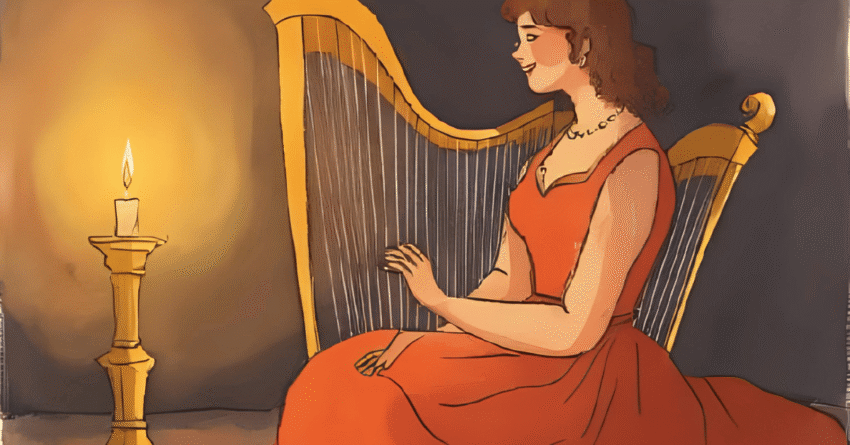
If the Dark Trial reveals the psychology of manipulation, narcissism is where its mask smiles the widest—and no one wears that mask more gracefully than Mary Crawford. When Mary Crawford arrives at Mansfield Park, she doesn’t just walk in—she steals the spotlight, harp and all, dazzling with wit, beauty, and the kind of charm that makes polite society collectively lean in. Mary is someone impossible to ignore. Once her harp finally saunters in from London, she is in full performance mode. Austen writes that Mary plays “with the greatest obligingness,” her music adding polish to her already glowing appeal. Just imagine the scene: sunlight filtering through tall windows, a graceful woman by a gleaming harp, captivating her audience with every elegant note. After all, who would fall under her spell? 

Her appearance or social performance is not just natural charisma. It’s strategy in silk slippers—Austen’s quiet reminder that elegance and self-interest often dance together. Benearth her grace lies calculation; Mary’s appeal is less spontaneous delight and more social stagecraft. The harp, her flattery, and her effortless cleverness are all tools of the trade. What she’s performing isn’t just music; it’s the art of self-presentation. For Mary, admiration is not the byproduct of virtue—it is the proof of worth. Modern psychology might call it narcissism; Austen simply shows it, letting charm reveal its moral cost. Her need for admiration doesn’t stop at performance—it shapes her entire moral compass.

Narcissism isn’t all flirtation and harp solos. Mary’s values reveal even more. Consider her reaction to Edmund’s decision to join the clergy. “A clergyman is nothing,” she says breezily, waving away his choice like it’s a bad fashion trend. Where Edmund sees moral purpose, Mary sees missed opportunity. So, she tries to manipulate Edmund to become a lawyer—a profession promising fortune and prestige. For Mary, virtue may be admirable in theory, but social glamour is non-negotiable. 

And yet, Austen doesn’t reduce Mary to a flat caricature. Mary is layered. She can be warm, witty, and even generous, especially when it boosts her image. She offers Fanny jewelry for a ball, proposes exciting trips to London, and speaks with affectionate charm. But she is careless and manipulative. Her attentions aren’t free. They are calculated future investments, either as a companion or a potential sister-in-law; Mary’s interest always spikes when the arrangement flatters her future prospects. But when Fanny challenges her plans by rejecting Henry, Mary’s affection cools fast.

In short, Mary Crawford is Austen’s glittering portrait of narcissism, wrapped in elegance, laced with humor, and shadowed by self-interest. She turns heads at every gathering, makes you laugh over tea, and all the while, she’s subtly rearranging the furniture of your future to suit her own design. 

If narcissism feeds Mary’s need to be adored, Machiavellianism teaches her how to keep that power. The performer becomes a strategist, charming her audience while quietly directing the play.

Machiavellianism: Passive Aggression and Manipulation  

Mary Crawford may smile nicely over a cup of tea and speak warmly to you, but behind that glittering smile is a mind that plays the long game. Her charm isn’t merely ornamental; it’s tactical. While others trade pleasantries, Mary is busy orchestrating outcomes. Every compliment doubles as reconnaissance; every gesture hides intent. If Austen had access to a psychology textbook, she might have flagged Mary as a textbook case of Machiavellianism: the art of manipulation cloaked in civility, all carried out with a calm, calculating hand. For Mary, manipulation isn’t conflict—it’s choreography.

Mary doesn’t shout, threaten, or throw tantrums. That would be far too gauche. Instead, she maneuvers like a dancer on a polished floor, gracefully, silently, always knowing where her next step will land. Her charm is not a reflection of warmth, but a tool for influence. Mary masters the art of passive aggression—veiled jabs and strategic silences that let her wound without appearing unkind. She knows how to smile while pulling strings. 

Among her favorite marionettes is her brother Henry, whom she manipulates with teasing precision. At first, she practically dares him to flirt with the Bertram sisters, treating broken hearts like a parlour game. But when Henry’s game turns serious with Fanny Price, Mary instantly pivots—from mischief to matchmaking.

This is how her manipulation is staged. Every shift in tone, every rephrased kindness, is deliberate. On Fanny’s first ball, she hands Fanny a necklace Henry picked out for Mary, ensuring the gift is received without risking Fanny’s rejection of him directly. This is the genius of her manipulation—it’s never overtly cruel, only quietly corrosive. She writes affectionate letters praising Henry, gently suggesting that Fanny might someday “repent” refusing such a fine suitor. It sounds sweet, even caring—until you read between the lines and realize Mary is doing what Machiavellians do best: guiding perception, nudging outcomes, and rearranging the emotional furniture until everyone’s standing where she wants them. Austen never raises her voice about Mary’s schemes; she simply lets civility do the dirty work. 

When the rumors start swirling about Henry’s less-than-virtuous behavior, Mary doesn’t skip a beat. “A most scandalous, ill-natured rumor,” she insists, brushing it off like lint from her sleeves. Whether or not she believes her own spin is irrelevant. She spins the story like a practiced diplomat—one whose conscience never interrupts her charm. In Mary’s world, the truth is flexible. What matters is that people believe, and how that belief can be used to her benefit. 

But her most remarkable feature comes after Henry’s scandalous affair with Maria Rushworth explodes like a dropped teacup. While most would recoil in horror or at least blush, Mary slips effortlessly into crisis management mode. To Mary, moral collapse isn’t a tragedy—it’s a problem of optics. While Edmund is reeling, she outlines a plan with surgical calm: marry Henry to Maria, stage a few strategic dinners, and reset the narrative. Her tone is cool, logical, and cynical. If society can be distracted with enough good wine and polite laughter, why should a little adultery ruin anyone’s prospects?

Even more astonishing is her advice to Edmund: “Be quiet,” she tells him. Let the situation settle, don’t provoke Henry, don’t upset the optics. She’s not operating from guilt or grief—This is PR, not penance. Mary treats the whole affair like a mismanaged brand that just needs re-strategizing. And that’s exactly what makes her such a fascinating and unsettling character. 

Mary’s morality isn’t absent, exactly; it’s just optional. 

When she finds out she doesn’t get what she wants, she begins attacking Fanny in passive-aggressive ways by pretending to speak hypothetically, but she’s clearly suggesting that Edmund marry someone else. In true Machiavellian fashion, she measures success not by virtue but by control—how smoothly she can steer perception and silence dissent.

Manipulation may explain Mary’s actions, but not her silences. Her genius lies not only in manipulation, but in the eerie calm beneath it—the untouched heart where empathy should live. But if manipulation is an art for Mary, its true secret lies in what she doesn’t feel. Beneath the polished grace of her mind, something colder waits.

Psychopathy: Coldness and Lack of Empathy 

Mary Crawford enters the drawing rooms of Mansfield Park as an elegant social butterfly, radiant, clever, and dressed in verbal silk. Her wit could slice through awkward silences like a rapier’s edge, and her charm seems effortless. Yet, beneath that grace, something is amiss. It isn’t a matter of fashion or wit—it runs deeper, down to something missing at her core. What Mary lacks is empathy, not in a villainous, mustache-twirling kind of way, but in the eerily modern, a kind of emotional detachment psychology now calls psychopathy.

Austen, of course, never diagnoses her; she doesn’t need to. Instead, she offers a razor-sharp portrait in social nuance. Mary isn’t cruel, as Edmund is quick to point out: “Hers is not a cruel nature. I do not consider her as meaning to wound my feelings.” And he’s right. She doesn’t intend harm. She simply doesn’t notice it. What Austen calls ‘blunted delicacy’ is a genteel way of saying Mary’s emotional radar is miscalibrated. Her responses are polished, not heartfelt. Her concern is rehearsed, not real. In that moment, all of Edmund’s illusions collapse. Austen lets Edmund’s clarity dawn slowly—the realization that Mary’s goodness is only social, not moral. Mary doesn’t break hearts with cruelty—she does it with indifference.

Take, for instance, the scandal of Henry and Maria. As the news breaks—threatening reputations, futures, and family honor—Mary barely bats an eyelash. To her, the catastrophe isn’t tragic; it’s a logical hiccup. If only Fanny had agreed to marry Henry, she muses, none of this would have happened. You can almost hear the metaphorical teacup click neatly into its saucer as she delivers her verdict with perfect composure.

This is psychopathy in a velvet glove: Mary sees scandal not as a moral collapse but as a mismanaged opportunity. She doesn’t feel the pain;  instead, she calculates the consequences. Even Edmund, idealistic and infatuated, begins to catch the chill in Mary’s warmth. Her response to the affair is not outrage, not even embarrassment, but a practical plan. Marry Henry to Maria as soon as possible. Host a tasteful dinner. Reboot their social image. Problem solved—no guilt required when strategy will do.

The final unraveling comes in a conversation that should have been a reckoning. Edmund pours out his heartbreak and disappointment. Mary listens and responds with a smirk. “You give me a pretty good lecture,” she quips. “You may make a preacher yet.” He bares his soul; she offers a critique of his delivery. The air leaves the room, and with it, the last trace of Edmund’s illusion. Austen doesn’t punish Mary with drama; she leaves her standing amid her own emptiness—a woman perfectly composed and utterly untouched.

Why Mary Crawford Still Feels So Modern  

Perhaps the most chilling note of all is that Mary Crawford, with her poise, her polish, and her capacity for charm without feeling, doesn’t belong only to the pages of Austen. She could walk into any room today, flash that brilliant smile, and still leave hearts confused and consciences cold. In the end, Mary feels strikingly contemporary because Austen’s portrait of such a personality is timeless—and still recognizable today. Her type hasn’t vanished with the Regency era; it’s simply traded bonnets for business suits.

People with these traits are often charismatic and hold tremendous social influence. In appearance, they sound moral, nice, and even empathetic, but they attack anyone who would block their way to success in a passive-aggressive way while quoting great philosophers. Truth and morality matter little to them; remorse is a feeling they simply lack. What they care about is getting what they want. We still encounter Mary’s temperament today—in polished boardrooms, curated online platforms, and political stages—where charm is currency and empathy optional. Austen saw these dynamics long before psychology named them.

Austen’s nuanced characterization of Mary still stands as a testament to her psychological insight. When I see Mary Crawford through the Dark Triad lens, I see Austen’s work as an early exploration of moral psychology. Austen shows that virtue and vice in her work are not just black-and-white labels. They are rooted in character traits that eerily prefigure what we now recognize as enduring personality dimensions. Through Mary’s narcissism, Machiavellianism, and psychopathy, Austen contrasts selfish brilliance with principled goodness—and in doing so, anticipates the psychological realism that would shape modern literature. 

Conclusion

Seen through the lens of the Dark Triad, Mary Crawford isn’t just Austen’s most glamorous rebel—she’s alarmingly modern. Two hundred years before psychology coined its cocktail party terms—narcissism, Machiavellianism, psychopathy—Jane Austen was already sketching them in ink and irony. She may have used words like “vain,” “artful,” and “unprincipled,” but let’s be honest: she had Mary Crawford pegged before Freud ever picked up a quill. 

Austen saw clearly what modern psychology would later confirm: charm can hide a hollow center, that intelligence, wit, even kindness—without empathy—can become weapons in disguise. Mary Crawford reminds us that not all harm is loud, and not every villain wears a scowl. Some wear lace gloves and speak fluently in small talk. Some smile as they preach about virtue or justice, but beneath the performance, it’s only for show. So what Mary teaches us is simple. Wit is not wisdom, and poise is not a principle; someone can be magnetic—and still morally adrift. Mary Crawford is a lesson that holds true today: the most dangerous people in the room are often the ones whose brilliance and wit we mistake for a good heart.

Foundation, Empire, and Resistance: Montesquieu in Space

Posted on October 12, 2025November 16, 2025 by Sophia Wordsmith

Introduction

The Galactic Empire trembles on the brink of collapse, and Hari Seldon knows what awaits: centuries of darkness unless some system can hold back the fall. Do we need a monster to keep us safe, or can we trust ourselves at the price of chaos? 

Philosophers have long debated this question. In the 17th century, Hobbes’s Leviathan argued for absolute authority. Hobbes saw safety in a monster’s grip. Locke defended the right to resist. Montesquieu divided power so no monster could rise.

Hari knows the Empire will fall – and he fears the darkness that follows. What fate awaits the Galaxy? What if Psychohistory fails? 

Across the Foundation saga, Asimov rebuilt the tripartite system for a galactic stage, testing whether balance can hold against humanity’s eternal tension between order and freedom. Can a separation of powers withstand humanity’s pull between tyranny and liberty?

Hobbes’s Leviathan and the Allure of Order

Hobbe’s Leviathan

Hobbes famously described the state of nature, absent a sovereign power, as a “war of all against all” where life is “solitary, poor, nasty, brutish, and short.” In such a society, life is under constant threat of death because people are driven by self-interest.

The Leviathan is the metaphor Hobbes used to explain that the sovereign is the only force capable of imposing order and ensuring peace. Driven by fear of death, people surrender freedoms to a sovereign who alone can impose order, punish wrongdoers, and prevent collapse into chaos.  

The Galactic Empire as a Failing Leviathan

The Galactic Empire rests on Trantor’s vast bureaucracy, cultural ghettos, and rigid hierarchies. Social mobility is almost nonexistent. In the slums, life is unsafe and unsanitary; many carry unregistered knives just to survive. In the Dahl sector, “heatsinks” like Yugo Amaryl show wasted brilliance, denied education by rigid class barriers.

The Galactic Empire, before its decline, served as the “Leviathan.” It provided a unifying law, peace, and technological stability across the galaxy. Hari Seldon’s actions are a reaction to the failure of this “Leviathan” to sustain itself. Seldon’s ultimate goal is to build a second Galactic Empire — a Leviathan strong enough to restore order. 

The Galactic Empire is rotting from within with weak leadership. Ambitious elites like Rashelle plot to seize control, while rebels like Davan rise from the slums — proof of the Empire’s weakening grip. If its absolute power falls, rival factions will rush to fill the vacuum, plunging the galaxy into chaos and a Dark Age.  

When Daneel and Hari discuss the fall, they are predicting the immediate aftermath of the Empire’s disintegration. They see this collapse as a galactic ‘state of nature’ – a Dark Age lasting thirty millennia, where technology, knowledge, and order vanish, leading to interstellar wars, local despotism, and unimaginable suffering. The Seldon Plan — psychohistory itself — is at its core, an attempt to mitigate this terrifying galactic state of nature and shorten its duration. 

In the Foundation, the fear of the Dark Age is the driving force for Hari Seldon’s legendary work. The stability provided by the Empire was, for a long time, the only acceptable alternative to anarchy — a sentiment that helped maintain the empire even as it decayed, until it became too weak to enforce its mandate. For Hobbes, fear of violent death bound people to the Leviathan; for Seldon, fear of a galactic Dark Age justified the desperate machinery of psychohistory. For Hobbes, fear of violent death bound people to the Leviathan; for Seldon, fear of a galactic Dark Age became the mathematical justification for the desperate machinery of psychohistory.

When the Pressure Breaks: From Paris to Trantor

People do not endure oppression forever. As Martin Luther King Jr. observed, “Oppressed people cannot remain oppressed forever; the yearning for freedom eventually manifests itself.” History confirms his truth: every empire that silences its citizens eventually hears their echo. The desire for liberty is not learned—it’s instinctive. Hobbes claimed that absolute power was necessary to keep chaos at bay; Locke and Rousseau countered that when rulers betray the social contract, resistance becomes a duty, not a crime. But theory alone cannot contain human emotion. Oppression accumulates pressure, and like physics, it follows predictable laws of reaction.

Tyranny repeats itself endlessly: corruption replaces consent, and governance becomes theater—laws performed for the powerful. When inequality becomes unbearable, history shows that resistance ignites. 

Oppression is pressure; resistance is release. The resistance builds up slowly; among unhappy citizens, hidden political pamphlets start circulating, and people assemble in secret meetings. Eventually, this tension breaks because the fear of defying authority is outweighed by the misery of submission—people have simply had enough. 

In France, hunger and injustice toppled a monarchy in 1789; in America, taxation without representation sparked rebellion. Every revolution begins the same way: with a quiet murmur that becomes an unstoppable roar. The pattern repeats, only now the stage is galactic. 

Asimov transposes this human dynamic into the Galactic Empire, where the slums of Trantor echo the tenements of pre-Revolutionary Paris. There are the Heat Sinkers, Dahlites, Mycogenians —microcosms of resistance—  brewing beneath the surface.  While those in the slums struggled even to bathe, the Emperor lived in luxury. With its rigid hierarchies, social ascent was nearly impossible. From the Heat Sinkers in the undercity to the withdrawn Mycogenians, every class on Trantor nurtures quiet resentment—a galaxy of discontent compressed beneath Imperial splendor. 

Resistance, in Seldon’s world, isn’t just noble rebellion—it’s social physics, the every equation psychohistory was built to measure. In Seldon’s equations, rebellion is not ideology but thermodynamics: the mathematics of pressure and release. That inevitability is why Seldon’s psychohistory could predict collapse: the resentment baked into Trantor’s structure will eventually reach a breaking point. 

If Hobbes imposed order through fear, and Locke sought it through consent, Seldon pursued it through prediction. To contain the collapse, Seldon—guided by Daneel—devised psychohistory, a mathematical framework to manage the fallout of inevitable rebellion.

The First Foundation as the New Leviathan

For a time, the First Foundation becomes the new Leviathan—an authority of reason and technology rather than fear. The Encyclopedia project morphs into a technocracy. At Daneel’s subtle urging, Seldon builds another foundation—the Second—as insurance against the fall of the first. 

The First Foundation’s authority is fragile because it is still a pawn in a larger plan; its technocracy is merely an illusion of control. The First Foundation faced not only internal unrest but also external resistance from neighboring worlds resentful of foreign occupation. The Mule, the unpredictable variable, ironically dealt the final blow.

The Impact of the Mule

The Mule embodies what no Leviathan or Plan can contain: the anomaly of emotion, the wildcard of individuality. The Plan had accounted for predictable resistance, but not ultimate rupture. This turning point proves that resistance is too potent to suppress, forcing the Seldon system to rely on an even subtler, hidden force—the Second Foundation. Even in a universe ruled by equations, balance demands more than control—it requires the separation of powers Montesquieu imagined for Earth, and Asimov projected across the stars.

Montesquieu’s Tripartite System

If unchecked power breeds resistance, the answer is not suppression but design—building a system that channels ambition into balance. Baron de Montesquieu argued that a lasting society must divide power among three branches—legislative, executive, and judicial—so that no single branch can dominate.

Montesquieu, writing in The Spirit of the Laws, observed that even democracies and aristocracies are vulnerable to tyranny. Power, he warned, “is ever inclined to abuse itself”; virtue cannot be trusted to hold it in check. His solution was not moral reform but structural restraint: divide authority among equal bodies, each empowered to restrain the excesses of the others. 

Montesquieu’s brilliance lay not in trusting virtue but in assuming corruption—and designing around it. The legislation creates rules. The executive enforces them through policy, economy, and defense. The judiciary interprets and limits both. Their mutual antagonism is deliberate: tension sustains balance, tempering ambition with ambition.   

If Hobbes’s Leviathan sought order through unity, Montesquieu sought it through division. Because human nature inevitably resists domination, no one—ruler or citizen—can be trusted with unchecked authority.  His tripartite system corrects Hobbes’s flaw: it replaces the eternal monster with a durable equilibrium. As Madison later echoed in Federalist No. 10, a diverse republic is the best defense against tyranny. 

In Asimov’s Galaxy, this tripartite geometry expands to cosmic scale—Empire, First Foundation, and Second Foundation—each restraining the other, echoing Montesquieu’s dream of balance among the stars.

Asimov’s Galactic Triad: Empire, First Foundation, Second Foundation

The Seldon Plan never sought perfection; it sought endurance—keeping rival forces in tension just long enough to avert collapse. The society established in the Foundation mirrors Montesquieu’s argument that political stability rests not in perfection but in balance—a moderate government where power is divided and checked. If Montesquieu envisioned a balance of powers for kingdoms, Asimov reimagined it for empires spanning the stars. In doing so, he transforms Montesquieu’s moderate republic into a cosmic experiment in balance—a test of whether human institutions can preserve tension without tearing apart. 

Across the saga, Asimov tests humanity against a recurring Leviathan. He sets up ‘a layer of new Leviathans’—forces promising stability—only to show how the innate human need for resistance inevitably undermines it. To counter this recurring collapse, Asimov divides power among three great forces—Empire, First Foundation, and Second Foundation—mirroring Montesquieu’s tripartite ideal.

The Galactic Empire

The Galactic Empire serves as the legislative branch—or more precisely, the legacy of legislation. The Empire acts as the “symbolic check” on the First Foundation’s raw ambition, reminding it that legitimacy requires more than just military power. Rooted in tradition, legitimacy, and bureaucracy, the Empire—the traditional Leviathan—is the symbol of order. Even in decay, its presence gives society continuity and stability. It reminds us of Rome, Byzantium, or any ancient monarchy whose laws outlive its vitality. Asimov makes clear that laws and traditions alone cannot save a system already decaying from within; the Mule merely hastens its fall.

Yet, its symbolic role still matters: it embodies the past, the idea of lawful continuity, and the cautionary tale of what happens when legislative rigidity calcifies into irrelevance. Still, where the Empire relies on memory, the First Foundation relies on motion.

The First Foundation

The First Foundation is the executive branch—the blunt arm of action, technology, and power. This Leviathan is established at the galaxy’s edge with a monopoly on physical sciences, and it advances progress, enforces Seldon’s path, and projects military might. Its scientists are kings with slide rules; its traders and diplomats armed with laser cannons. They enforce order not through tradition, but through tangible force—the executive in its most literal form. Like Montesquieu’s executive, the First Foundation risks overreach. Unchecked, it mistakes dominance for destiny. The Mule nearly proves how fragile such dominance becomes when faced with a power it cannot predict or control. And when both fail, Asimov turns inward—to the mind itself. 

The Second Foundation

The Second Foundation plays the role of the judiciary—subtle, interpretive, and hidden. Their secretive oversight, like a hidden judiciary, mirrors Montesquieu’s warning that power must judge but never rule. Instead of physics, it commands psychology; instead of armies, it wields minds. Its members are the interpreters of Seldon’s intent, correcting deviations when history veers too far from the planned course. After the Mule derails the plan, it is the Second Foundation—not the First—that restores balance. Their secret reflects Montesquieu’s idea of an impartial judiciary, removed from the heat of direct rule. To the First Foundation, they are either mythical or extinct; to the galaxy, they are the invisible referees ensuring the game doesn’t break.

What makes Asimov’s triad powerful is not that any one branch is strong, but that each is fatally weak alone. The Empire decays into ritual; the First Foundation grows arrogant with power; the Second Foundation hides behind its wisdom. Together, they form a precarious equilibrium: tradition, force, interpretation—each restraining the others. Asimov isn’t idealizing any branch; he’s testing whether checks can survive at a galactic scale. But equilibrium, however elegant, cannot last forever.

But Asimov eventually breaks his own model. He introduces Gaia, a planetary hive mind—one consciousness encompassing all life. Gaia asks: What if harmony lies not in balance, but in the end of division itself? Montesquieu would likely shudder. After all, once the hive is everything, there are no checks left. Asimov thus closes his cycle not with balance preserved, but with its very principle in question—forcing us to ask whether humanity’s future depends on balance—or on surrendering individuality for unity.

Hari Seldon and Daneel: The Architects of Balance

Seldon’s Psychohistory

Though separated by time and form—one human, one machine—Seldon and Daneel share the same design instinct: to preserve order through balance, not domination. Yet even as Seldon refined his equations of order, another architect watched from the shadows. Lurking at the edge of Seldon’s vision is Daneel, the legendary robot, pursuing a plan of his own as the long-term moral check on the entire system: a separate world, built on different principles. One human, one machine; one bound by time, the other by eternity. Seldon created psychohistory—a mathematical system designed to mitigate the inevitable collapse of the Galactic Empire. Daneel planned on a larger scale—robotic guardianship over humanity. To Daneel, psychohistory was only a single gear in a much larger machine. Both understood the paradox at the heart of civilization: that peace demands control, but control breeds decay.

Seldon and Daneel’s Shared Insight

Seldon and Daneel both accepted that the fall of the Galactic Empire was inevitable. They understood that Leviathan was necessary to maintain the Empire’s order. They built two tiers of control—two Leviathans—each meant to contain collapse and check the other. Their methods differed, but their fear was the same: a humanity too free to survive, or too controlled to evolve. 

For both architects, control was never the cure—only the temporary scaffolding that kept humanity from imploding. The Leviathan’s promise is short-term order at the cost of long-term decay. Resistance may seem messy, even dangerous, but it’s the natural counterbalance. This was why Seldon’s project was necessary. Psychohistory accepts human chaos as law, not error—it bends rebellion into the mathematics of renewal. The paradox was not new. Centuries earlier, philosophers of Earth had wrestled with the same equation. 

Montesquieu’s System

Montesquieu saw Hobbes’s Leviathan as an unstable masterpiece—strong but doomed, because no single power can endure unchecked. His solution was equilibrium: each branch restrains the others. Asimov reimagined this principle for a galactic civilization. 

Seldon saw that no single institution could shepherd humanity—not the decaying Empire, not the ambitious First Foundation, not the secretive Second Foundation. Left alone, each would become a Leviathan, and resistance would topple it. The solution, then, was not to choose one but to balance all three. Seldon represents reason systematized—Daneel, reason moralized. Together, they embody Asimov’s dream of order that learns from imperfection. Their vision recognizes that civilization’s strength lies not in control, but in the harmony of its competing flaws. The Empire provides legitimacy, the First Foundation progress, the Second Foundation wisdom. It is, in essence, Montesquieu transposed to a galactic scale—a system of checks and balances designed to prevent tyranny and keep the Plan intact. Yet even this grand equilibrium—engineered across millennia—would one day force its final test: the dream of harmony without division.

The Twist: Gaia and the End of Checks and Balances

Trevize’s Dilemma

The balance Seldon and Daneel built could not last forever. When the Galactic Empire fell to the Mule’s unpredictability, the illusion of control shattered. Believing itself to be the sole surviving Leviathan, the First Foundation dismissed the Second Foundation as myth—convinced that reason and technology alone could rule the galaxy. But Trevize suspected otherwise. Exiled yet unconvinced, he sought the truth—and in doing so uncovered not only the Second Foundation, but something beyond both: Gaia.

Gaia as a System Beyond Leviathan and Resistance

Gaia mirrors Rousseau’s concept of the General Will—a collective striving toward the common good, distinct from the sum of individual desires. Rousseau famously claimed that state citizens must be “forced to be free,” as true freedom is living under a law you prescribe to yourself as a member of the collective. Trevize’s final choice—to embrace Gaia—reflects Rousseau’s paradox: he gains collective freedom by surrendering personal will, becoming, in Rousseau’s terms, “forced to be free.”

This vision comes at a cost. In Gaia, conflict becomes impossible, with no private interest left to oppose the public good. The sources of chaos—ego, competition, dissent—are quietly erased. If individuality breeds disorder, Gaia cures it by dissolving the self into a planetary consciousness—a superorganism where the one and the many are the same. In such harmony, factions vanish, and failure itself becomes impossible. 

Asimov’s Late-life Thought Experiment

Gaia is Asimov’s late-life thought experiment—a vision of order without ego, harmony without difference. It is the final abandonment of Montesquieu’s balancing act. He leaves us with two haunting questions: would the erasure of individuality bring utopia, tyranny, or a new kind of unity—and, more deeply still, does the end of conflict mean the end of freedom itself? In seeking perfect balance, Asimov circles back to Hobbes’s dilemma: peace bought at the price of surrender. Perhaps Asimov’s greatest insight is that even in a galaxy ruled by algorithms and empires, humanity’s struggle remains unchanged: how much of ourselves we are willing to trade for peace. The question, it seems, was never about the stars—it was about us. 

Conclusion

From Hobbes’s sovereign monster to Montesquieu’s delicate balance and Rousseau’s collective will, Asimov’s Foundation transforms centuries of political thought into a cosmic laboratory. His galaxy becomes a mirror of our own world—where order promises safety, but always at the cost of freedom. Each system—from Empire to Gaia—seeks to perfect humanity, only to reveal its own flaw: that perfection demands obedience, and harmony requires surrender. 

In the end, Asimov’s question remains ours. Can a civilization preserve both individuality and peace, or must one yield to the other? Whether under monarchs, governments, or algorithms, the struggle endures. The fate of the galaxy, it seems, was never written in the stars—but in the choices we continue to make about what kind of order we are willing to live under, and what kind of freedom we dare to keep.

Free Will vs Determinism in Asimov’s Foundation and Earth

Free Will vs Determinism in Asimov’s Foundation and Earth: Trevize, Daneel, and Humanity’s Paradox

Posted on October 5, 2025November 16, 2025 by Sophia Wordsmith

I. Introduction

At the galaxy’s crossroads, Trevize found himself haunted by a choice he could neither justify nor fully understand. Was it faith? Was it reason? Or something stranger—an intuition guiding the fate of humanity? So, he decided to seek Earth to find out what truly drives humanity forward: rational determinism or intuitive freedom.

On his journey through space, he encounters Daneel. There, he discovers that Daneel has been tinkering with the Galaxy for the sake of humanity’s survival. Foundation and Earth introduces this debate through two characters, Trevize (free will) and Daneel (pure logical determinism). Asimov isn’t arguing for which side is better, but exploring how freedom and determinism are two halves of the same coin. Humanity endures not by choosing one path, but by learning to walk the paradoxical line between them.

II. Daneel: The Deterministic Architect

Daneel’s character can be viewed as the ultimate expression of determinism and providence. For twenty millennia, he has worked as the unseen hand shaping galactic history, meticulously manipulating events to ensure a stable and prosperous future for humanity. His actions are driven by a complex web of calculations and a long-term plan, echoing the Stoic Logos or Spinoza’s vision of God/Nature, which operates according to immutable laws.

Daneel’s role is the “Unmoved mover” – the ability to initiate change without being directly seen, while his provision for humanity’s future mirrors Augustinian providence, the belief in an unseen divine hand that quietly shapes events, guiding history rather than leaving the Galaxy in a static eternal form. And yet, despite his immense intellect, Daneel proves unable to craft a flawless future. Coldly objective in the way only a robot can be, Daneel nevertheless recognizes his own limitations. 

As a robot, he creates solutions from pure logic—but logic alone cannot account for the chaotic, irrational elements of existence—the very things that Trevize embodies. His determinism, though aimed at averting disaster, threatens to produce a future stagnant and lifeless future, similar to the ossified societies of Solaris or Aurora, where they are societies frozen in comfort, hollowed of purpose.

III. Trevize: The Champion of Free Will 

If Daneel, the chess master, acts upon pure logic and determinism, Trevize is his opposite: he is the gambler and the embodiment of free will and the leap of faith. He makes choices by intuition, even against reason. He often acts on impulse, breaking free from the constraints of rational thought. His decisions bypass calculation, guided instead by a profound, almost mystical instinct. He follows his instincts, even when they run counter to reason. Like Kierkegaard’s leap of faith, Trevize acts without certainty—believing that meaning emerges only after the leap, not before. Trevize’s freedom is what allows him to make the choice that Daneel, with all his calculations, couldn’t.

Trevize’s role highlights the idea that true progress and vitality require some degree of risk and unpredictability to move forward. Ironically, predictability brings its own dangers—as seen when a microbe on Alpha nearly killed Trevize. However, without his willingness to trust the unknown, the galaxy would be locked into a society safe but sterile, preserved in glass like a specimen—robbed of the gamble, the risk, the chaos that makes it alive.

IV. The Synthesis: Harmony Between Logic and Intuition

Asimov leaves us with a profound message. Neither side wins; rather, their duet weaves together the strengths of both. With Daneel’s stability, safety, long-term vision, and Trevize’s direction, spontaneity, and the spark of humanity, they could create a better galaxy, a more enduring path for humanity’s survival. Therefore, Asimov suggests, humanity’s flourishing requires both guardrails (determinism) and creativity (free will). In the end, the galaxy’s future is not written by reason alone or by faith alone, but by the duet of chess master and gambler—logic and intuition revolving together like twin stars casting light on the path ahead..

The duet of chess master and gambler may solve the galaxy’s dilemma, but it also mirrors the paradox at the heart of our own existence.

Conclusion

The resolution of Foundation and Earth is not one ideology’s triumph, but the synthesis of both. The galaxy requires both the chess master’s foresight and stability, and the gambler’s daring leap into the unknown. Daneel provides the necessary guardrails and foundational stability, preventing humanity from falling into ruin. Trevize, in contrast, offers direction and purpose, securing a future vibrant and evolving, not sterile and predetermined.

Asimov leaves us with the reminder that our survival—whether in fiction or in life—depends not on choosing one path, but on learning to walk the paradox between them. The strategist’s foresight keeps humanity safe, while the gambler’s leap gives it purpose. Just as Trevize once faced the galaxy’s crossroads, so too does humanity stand between reason and freedom, sustained only by embracing both. In the end, progress is not logic or freedom alone, but the uneasy duet that sustains every human future—two stars locked in orbit, illuminating the path forward.

Want read posting like this?

The Secret Philosophers of Foundation’s Edge

The Secret Philosophers of Foundation’s Edge

Posted on September 29, 2025September 29, 2025 by Sophia Wordsmith

Foundation’s Edge by Isaac Asimov

I. Introduction 

What if the fate of the galaxy depended on a 300-year-old philosophical debate? In the 17th and 18th centuries, philosophers wrestled with a timeless question: are we truly free, or is everything determined? When I was reading Foundation’s Edge, I couldn’t help but hear their voices echoing through the novel.

I started suspecting Asimov wrote it not just as sci-fi, but as a philosophical thought experiment: the First Foundation embodies empiricism (Hume/Locke), the Second Foundation embodies rationalism (Descartes), and Gaia embodies monistic pantheism (Spinoza). The novel stages a cosmic debate among these factions, each echoing the core arguments of its philosophy. In other words, Asimov turns galactic politics into a centuries-old philosophical showdown.

II. The First Foundation – Hume and Locke 

The First Foundation represents an empirical, pragmatic, and individualistic approach to history and government.

Lockean Empiricism & Social Contract

Hari Seldon’s psychohistory—a science built on observing and statistically analyzing large populations—echoes John Locke’s empiricism, the idea that knowledge comes from experience and observation. The Foundation itself functions as a loose confederation of traders and politicians, bound together by rational self-interest in a way that mirrors Locke’s social contract. Its political system is pragmatic, almost contractual in nature: trade agreements, like the one with Sayshell, carry enormous weight. Yet individuals remain central. Their actions, when aggregated, drive history forward in line with the Seldon Plan.

Humean Skepticism & Human Nature

David Hume adds another layer: skepticism about absolute knowledge and an emphasis on habit and custom. Leaders of the First Foundation—especially Golan Trevize—often doubt the certainty of the Seldon Plan. Instead, they fall back on intuition and cunning, a thoroughly Humean response to crisis. After all, it was the Foundation that faced the Mule and later clashed with the Second Foundation, relying less on mathematics than on human ingenuity. Their success, in part, comes not from the infallibility of the plan but from the unpredictable, sometimes irrational behavior of individuals whose “human nature” still, ironically, tends to align with it. Psychohistory works because people are creatures of habit, not because the universe obeys divine laws.

The First Foundation thrives on observation, skepticism, and pragmatic action—a worldview that fits squarely with Hume and Locke. Yet looming in the shadows is the Second Foundation, with its unwavering faith in pure reason.

III. The Second Foundation – Descartes 

If the First Foundation fights with ships and trade routes, the Second Foundation fights with thoughts. Hidden in the shadows, it embodies a rationalist, behind-the-scenes approach to steering history.

Rationalist Elitism

Its entire existence rests on the premise that a small, secret group of mentalists can manipulate the minds of key individuals to safeguard the Seldon Plan. They are acutely aware of outliers like the Mule, whose very presence threatens to unravel centuries of preparation. Operating in secrecy, they pull strings by controlling minds instead of markets or armies—the very essence of Cartesian rationalism.

They believe truth and mastery of the universe can be achieved through pure thought and reason, not empirical observation, mirroring Descartes’s conviction that reason alone leads to certainty. Their focus is on the mind—a realm of deduction and pure ideas—standing in stark contrast to the First Foundation’s external, physical power.

Methodical Doubt

Their secrecy and intellectual superiority evoke Descartes’s methodical doubt. Just as Descartes questioned every belief to reach certainty, the Second Foundation questions and manipulates others to keep the plan intact.

If the First Foundation is Locke’s messy democracy, the Second Foundation is Descartes’s ivory tower—orderly, rational, but detached from lived reality.

IV. Gaia – Spinoza 

Then, there is Gaia, which embodies a monistic, all-encompassing philosophical system.

Monism & Pantheism

Gaia as a living superorganism directly echoes Spinoza’s idea that all things are expressions of one substance: God or Nature. Everything that exists is a part of this infinite whole. On Gaia, all life, matter, and consciousness are woven into a single, unified entity. The Gaian dream is to extend this harmony into Galaxia—a galactic consciousness that embraces every star and being.

Ethics of Interconnection

In Spinoza’s system, freedom means recognizing our place within the whole; in Gaia, individuality dissolves into collective wisdom. Its citizens share not just ideals but thoughts and feelings, bound by a physical and mental unity that makes them all “one.” The Gaian vision is expansive: to bring the entire galaxy under a shared consciousness, mirroring Spinoza’s monistic pantheism. This unity promises not domination but flourishing for every form of life.

Gaia offers a radical alternative—an all-embracing unity that transcends Locke’s social contract and Descartes’s rationalism. Where the First Foundation trusts in habit and trade, and the Second Foundation in reason and secrecy, Gaia wagers everything on the power of oneness.

V. The Central Conflict 

At the heart of Foundation’s Edge stand three factions, each offering a radically different vision of the galaxy’s future. Asimov frames the novel as a philosophical showdown:

  • First Foundation (Hume/Locke): empirical democracy, individual action, pragmatic politics.
  • Second Foundation (Descartes): rationalist manipulation, hidden autocracy, control through reason.
  • Gaia (Spinoza): spiritual unity, collective consciousness, the dissolving of individual will.

The ultimate question is not military or economic, but philosophical: which system should humanity embrace? Pragmatic empiricism, secret rationalism, or universal oneness?

This dilemma falls to Golan Trevize, who must choose the path for the entire galaxy. Strikingly, he does not decide on the basis of mathematics, strategy, or persuasion. Instead, he follows an inner conviction—a gut feeling. In that moment, Asimov slips in a very Humean twist: history’s greatest decision turns not on reason or numbers, but on the unpredictable intuition of one man.

VI. Conclusion 

Foundation’s Edge isn’t just another chapter in Asimov’s saga; it’s a hidden philosophy seminar disguised as space opera. The First Foundation channels Hume and Locke, putting its faith in experience, habit, and pragmatic politics. The Second Foundation stands in Descartes’s ivory tower, trusting in reason and manipulation. Gaia speaks with Spinoza’s voice, dissolving the self into an all-embracing unity.

By staging this cosmic debate, Asimov raises a timeless question: what should guide humanity—empirical observation, rational certainty, or spiritual oneness? Trevize’s choice reminds us that even in the face of vast systems, human intuition still carries weight.

Perhaps that’s Asimov’s quiet suggestion: no matter how sophisticated our plans or philosophies, the future of civilization may still hinge on the fragile, unpredictable instincts of the human heart.

Blog Posting similar to this:

Conspiracy, control, and choice made without certainty

Hello

Posted on December 30, 2024 by Sophia Wordsmith

Whatever brought you here, I’m so glad you’ve found this little corner of the internet.

Let me tell you a secret: I didn’t always find reading easy. In fact, I had my own struggles, especially with books in English. As a non-native English speaker, the cultural nuances, symbolism, and deeper meanings often felt like puzzles I just couldn’t solve. Take something as simple as the color green—it can mean envy, growth, or hope, depending on the context. In the United States, it can mean green. Crazy right? It’s like trying to read between the lines of a foreign language and culture all at once.

But here’s the thing: the more I read, the clearer it all became. Analyzing books turned those tricky symbols and hidden meanings into fascinating revelations. I started to see not just the stories but the life lessons tucked inside them, and I realized how much books have to teach us.

That’s why I created this blog—to share that joy with you. Reading is my passion, and this space is where we can explore it together. I’m still learning as I go, so think of this as a shared journey. We might not always see eye-to-eye on a book’s interpretation, but isn’t that the fun part? The conversations we spark and the insights we share are what makes reading so enriching.

So grab your favorite beverage, settle in, and let’s weave some beautiful stories together.

  • Previous
  • 1
  • 2
  • 3

About Me

I’m Sophie, a cross-disciplinary reader who treats books like puzzle boxes. I read literature through history, philosophy, psychology, and science—then weave the threads together. Welcome to my tapestry.

Categories

  • Announcements
  • Narrative Psychology
  • Philosophical Logic
  • Social Forces Shaping Literature
©2026 The Book Tapestry