At a Glance
In the second audit, we analyze the collapse of Luc’s monopoly through the lens of Albert Camus’s Absurdism, reframing Henry Strauss not as a savior, but as the “Black Swan” event that triggers a systemic liquidity crisis. By introducing double-entry bookkeeping into a single-entry universe, the duo achieves a state of metaphysical insolvency that renders eternity unprofitable for the darkness. Ultimately, Addie evolves into a Broker of the Absurd, proving that the only way to defeat a closed system is to outperform its logic and outlive its relevance.
Introduction: The Great Liquidity Crisis of the Soul
What happens to a god of erasure when the “void” starts to produce interest? In our previous audit, we established Addie LaRue’s life as a state of Metaphysical Solvency—a single-entry system where freedom was trapped in an archival vacuum for centuries. However, the stability of this monopoly depends entirely on Addie remaining a solitary unit.
When Addie meets Henry Strauss, the architecture of the curse shifts from a study of isolation to a study of Systemic Risk. If Addie is the asset that cannot be recorded, Henry is the mirror that cannot be escaped. By witnessing her, Henry introduces a second ledger into a closed loop. Together, they represent the first true Liquidity Crisis in the history of the Firm—a moment where the silence of the dark is finally breached by a shared recognition1.
uNBREDICTABLE eVENT
If the universe is a ledger, then for three hundred years, Adeline LaRue has been a “ghost entry”—a single line of data that the system refuses to save, yet cannot delete. We have seen how this single-entry existence forces a life of infinite effort and zero accumulation. However, even the most airtight monopolies are vulnerable to a Black Swan event. In the cold, regulated world of Luc’s Firm, that disruption is not a violent rebellion, but a market correction in the form of a man who remembers.
In this final audit, we move beyond the romantic tragedy of The Invisible Life of Addie LaRue to examine the mechanics of its systemic collapse. By applying the Absurdist philosophy of Albert Camus2, we find that Henry is not merely a savior, but a co-conspirator in a high-stakes act of Regulatory Capture. Henry’s presence triggers a state of Metaphysical Insolvency, proving that even the most absolute contract cannot audit a shared reality.
Ultimately, Addie does not win by breaking the system; she wins by outperforming it. By transforming herself from a victim of a curse into a Broker of the Absurd, she renders eternity itself unprofitable for the darkness, proving that the hill of Sisyphus can be turned into a seat of power.
The Double-Entry Audit: Henry as Systemic Disruptor
The Shared Ledger: From Single-Entry to Consolidated Accounts
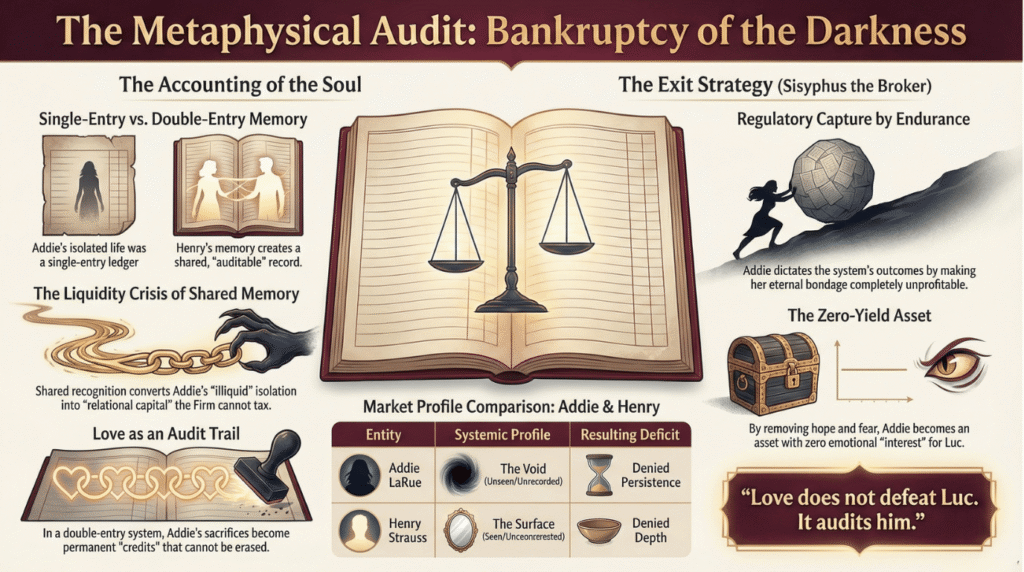
In our first audit, we saw Addie LaRue as a Single-Entry Soul. Her actions existed, but they did not “post.” Every kindness, every act of courage, and every momentary connection vanished at the end of the day—unrecorded, unreconciled, and unreferenced. Her life was an immaculate but useless ledger: debits without credits, events without counterparts. Luc’s system thrives on this void. His power depends on Ontological Isolation3. For his profit margin to remain high, memory must remain private, non-transferable, and therefore illiquid.
Henry Strauss’s arrival alters the universe’s accounting structure.
For the first time in three centuries, Addie’s existence is mirrored. Memory is no longer a sealed silo; it becomes a Shared Ledger. When Henry remembers Addie, her actions acquire a second entry. A moment is no longer merely “done”—it is Recognized. This is not merely sentimentality; it is Consolidation. Two isolated accounts collapse into a single balance sheet of meaning. What emerges is not romance, but Infrastructure. A life that can be remembered by another ceases to be metaphysically solitary4. The system, for the first time, has a debt it must reconcile.
Metaphysical Insolvency: The Threat of Liquidity
Luc’s authority rests on a subtle but absolute principle: Illiquidity. Addie’s memories cannot circulate; they cannot be exchanged, collateralized, or compounded. A value that cannot move cannot threaten the status quo. Luc does not need to erase Addie’s goodness because, in isolation, that goodness cannot accumulate into power.
Henry introduces Instant Liquidity.
The moment a memory is shared, it acquires the potential to be transmitted. An act remembered by another person gains durability and consequence. This is why shared memory is catastrophic for Luc’s firm: it converts Addie’s isolated endurance into Relational Capital.
Luc cannot tax what does not circulate, but he also cannot tolerate a market he does not control. Shared memory threatens Systemic Insolvency because it creates value that escapes his accounting rules. The system was designed for the predictable physics of single-entry souls. Double-entry breaks the code.
Love as Audit Trail: The Emergence of Ethical Equity
In this framework, love is stripped of its romantic gloss and revealed as an Audit Trail.
In a single-entry system, sacrifice simply disappears. Addie gives, and the void swallows the transaction. In a double-entry system, however, every loss is posted somewhere else. A sacrifice in one ledger becomes a Credit in another. This is the core disruption Henry introduces: Ethical Equity.
When Addie suffers for Henry, that loss is no longer erased. It is acknowledged, mirrored, and held. The value does not vanish; it Transfers. Ethical equity may not be redeemable for a “normal” life, but it is Durable. It cannot be deleted without breaking the books.
Luc’s power allows him to erase names, faces, and records—but he cannot erase Relational Symmetry. Once meaning exists in two places at once, a deletion in one creates a permanent imbalance in the other. And in Luc’s universe, an imbalance forces a reckoning.
The Audit Conclusion
Henry Strauss is not merely a lover or a witness; he is a Systemic Disruptor. His presence does not overthrow Luc’s regime by force, but by exposing its accounting assumptions. Luc governs a universe where nothing is meant to balance. Henry proves that balance is possible, and in doing so, reveals the system to be contingent, not absolute.
Love does not defeat Luc. It audits him.
Henry’s Curse: The Surface and the UX
Refractive Interface: Henry as Lens, Not Subject
Henry Strauss’s curse does not erase him; it overprocesses him. He remains fully visible, fully accessible, and constantly affirmed—yet fundamentally unencountered. Ontologically, Henry is not treated as a subject among subjects, but as a Refractive Interface: a human lens through which others see themselves more clearly5.
This produces a paradoxical condition: Social Saturation paired with Ontological Starvation6. Henry is recognized everywhere and nowhere at once. People respond to him instantly, warmly, even lovingly, but their recognition never terminates in understanding. It slides past him. In philosophical terms, Henry is not unseen; he is Transparent. Transparency, however, is not intimacy; it is exposure without depth. His curse guarantees that others will feel toward him while never needing to feel with him. What is destroyed is not affection, but Mutuality.
The UX of the Soul: Frictionless Recognition
Henry functions as a perfectly optimized product. His presence removes “friction” from social interaction. People feel comfortable, affirmed, and validated in his proximity because his curse has eliminated Resistance. There is no risk of rejection, no weight of misunderstanding, and no friction of conflict.
This is why the metaphor of User Experience (UX) is precise rather than decorative. In design, frictionless systems are efficient but shallow; they maximize engagement while minimizing real encounters. Henry’s curse turns his soul into such a system.
People do not meet Henry. They pass through him.
They leave the interaction feeling sharper and more confident, but they remain unchanged in relation to him. He is not archived as a person; he is recorded as a Sensation. Because true recognition requires the “bump” of a separate will, Henry’s lack of resistance makes it impossible for him to be known. You cannot grasp a surface that offers no traction.
Ontological starvation emerges here not from neglect, but from Excess. Henry is consumed continuously, never metabolized into meaning. He is the ultimate “Liquid Asset”—highly tradable but with no intrinsic value to the holder.
The Collision of Deficits: Why They Meet
Henry and Addie find one another not by chance, but by Structural Necessity.
- Addie is a Void: Unseen, unrecorded, an accumulation of unmirrored history.
- Henry is a Surface: Endlessly seen, endlessly projected upon, an accumulation of hollow reflections.
Both suffer from failed recognition, but from opposite poles of the spectrum. Addie is denied Persistence; Henry is denied Depth.
When they meet, their curses cancel rather than compound. When Henry looks at Addie, his curse fails; she does not reflect his desires because she has no stable social surface to which a projection can attach. Conversely, when Addie looks at Henry, she does not consume his reflection because she is not seeking a mirror for her own ego—she is seeking a Witness for her existence7.
Ontological Relief: Love as Non-Extraction
They are, perhaps, the only two people who cannot “use” each other. Addie cannot inflate her ego through Henry because his memory of her is a blank slate. Henry cannot inflate his ego through Addie because she refuses to offer the frictionless affirmation his curse demands from everyone else.
What emerges is Ontological Relief: the rare, cooling experience of being neither erased nor instrumentalized. Their connection is not built on romantic fulfillment, but on Suspension—a pause in the machinery of recognition where neither the void nor the surface dominates.
This is not love as completion; it is Love as Non-Extraction. In a universe governed by Luc—a system designer who profits solely from the extraction of human meaning—this is the most dangerous form of relationship imaginable. It is an “Illegal Trade” in pure presence.
The Illegal Trade: The Black Market of the Soul
Unlicensed Recognition: Love as Contraband
In Luc’s economy, recognition is a licensed activity. To exist legitimately, memory must be authorized, traceable, and enforceable. The curses are the regulators: Addie’s ensure that recognition cannot circulate; Henry’s ensure that desire circulates without consent. Both conditions keep human value legible—and thus taxable—to the system.
Addie and Henry’s relationship is a massive regulatory breach.
Their love is not “illegal” because it is immoral, but because it is unlicensed. It bypasses the official currencies of ownership and archival memory. Addie does not “belong” to Henry; Henry does not “consume” Addie. No name is claimed, no legacy promised. What they exchange is an unregistered presence—recognition without title. They have created a “dark pool” of intimacy that produces a value the system cannot track.
The Jurisdictional Signal: Why “Tomorrow” is Dangerous
As long as Addie and Henry remain in the Present-Tense Sanctuary, their exchange is untaxable. The present has no forecast, no guarantee, and no enforcement mechanism. It is experimental, not institutional.
The danger enters with a single word: Tomorrow.
To ask, “How long can this last?” is not a question of emotion; it is a Jurisdictional Signal. Duration requires oversight. The future requires structure. Structure belongs to the Regulator. The moment they ask “how long,” they convert presence into projection. The question functions like a formal filing—a request for institutional time.
Luc does not need to overhear the whisper. The system automatically registers the data spike. The present can be inhabited, but the future must be administered. Once “tomorrow” enters the vocabulary, the black market brushes against legitimacy, and legitimacy is the primary trigger for taxation.
Luc as Regulator: Repricing, not Prohibition
Luc does not shut the relationship down with a show of force; that would acknowledge its moral standing. Instead, he does what effective regulators always do: he reprices the cost of living.
- The Temporal Markup: Time becomes “heavier.” Moments shorten. The future begins to press in on the now. Love is no longer an experience; it becomes a countdown.
- The Isolation Premium: External connections thin out. Support systems weaken. The relationship must now bear the full weight of the participants’ meaning, which dramatically increases its operating cost.
Luc never says, “You cannot love.” He simply ensures that loving costs more than either party can afford. This is how regulation succeeds without force: Exhaustion replaces prohibition. Eventually, the participants self-liquidate, not because love failed, but because the system made it unsustainable.
Once the relationship moves from the ‘Now’ to ‘Tomorrow,’ it becomes a trackable liability. For Luc, a non-yielding asset that threatens the integrity of his ledger is a procedural error. Henry’s death is not a tragedy; it is a Market Correction.
Planned Liquidation: The Henry Exit Strategy
The Non-Compliant Asset: Why Henry is “Written Down”
Henry Strauss is not destroyed because he fails; he is destroyed because he ceases to yield.
Initially, Henry functions as a perfect Liquid Asset. His curse ensures continuous circulation: affection without choice, desire without attachment. He is infinitely substitutable and therefore profitable. But that yield collapses the moment he binds himself to Addie. Attachment introduces illiquidity. Value stops circulating. From the system’s perspective, Henry has become a “non-performing asset.”
Luc’s decision to end Henry’s life is not a market crash; it is a Planned Liquidation—a quiet write-down of an instrument that no longer functions within the Firm’s portfolio.
Debt Assumption, Not Refinancing: The Nature of the Deal
Addie’s final deal with Luc is not a rescue of Henry; it is a Transfer of Liability. In financial terms, Addie does not “refinance” Henry’s position; she assumes the debt herself. She says, “Do this, and I will be yours, as long as you want me by your side8.
Henry is removed from the system entirely—his curse lifted, his presence restored to the market of the living. Luc agrees to this because Henry no longer represents leverage9. The cost, however, is Risk Concentration. Addie extends her bondage indefinitely, accepting a deeper exposure than ever before. Luc’s claim on her time becomes total. This is not mercy; it is Balance-Sheet Optimization. The system survives because the loss is concentrated in a single, durable entity: Addie.
Sunk Cost Sovereignty: Closing the Ledger
The decisive ethical act comes after the bargain. Addie does not return to Luc as a submissive; she does not seek legacy or the restoration of Henry’s memory. Instead, she treats Henry’s life as a Sunk Cost: a completed expenditure that must not be recovered, leveraged, or converted into future claims.
She refuses to let his survival generate “narrative interest.” His meaning is not priced into eternity; it simply is. This is sovereignty through restraint. Addie understands that every additional request would reopen the ledger and restore Luc’s leverage. Instead, she remains fully exposed while removing every incentive that makes exposure profitable.
Luc retains control in theory. Addie controls the economics of compliance.
By absorbing the loss without appeal, she transforms herself into an asset with infinite duration but zero yield. She becomes a “toxic asset” that Luc cannot sell and cannot extract value from. Eventually, the system will do what systems always do when returns vanish: it will walk away. In that moment of systemic indifference, the contract will finally expire10.
Synthesis: Sisyphus the Broker
The Mechanics of the Hill: Reset as Transaction Cost
Addie’s eternity is often read as punishment, but structurally it functions as a Known Operating Expense. By the novel’s end, she no longer experiences the daily erasure as an existential shock; the loss is “priced in.” The reset has become a transaction cost—a predictable friction she has learned to absorb, optimize, and route around.
This is where the Sisyphean analogy becomes exact rather than poetic. In The Myth of Sisyphus, Albert Camus insists that mastery begins not when the rock disappears, but when the labor is fully understood11. Addie has mastered the Physics of the Hill. She knows precisely when the reset will occur, what it will erase, and—critically—what it cannot touch.
While memory fails, action persists. While influence dissolves, effect remains. The rock no longer dominates her; it is merely heavy. In economic terms, Addie is no longer surprised by loss—she budgets for it. This does not make her “free” in the traditional sense, but it marks her as operationally superior to the mechanism meant to exhaust her.
Camusian Scorn as Leverage: Making Eternity Unprofitable
Camus writes that revolt begins when a person refuses both hope and appeal12. Addie’s final posture embodies this refusal precisely. She has abandoned the hope for release and the fear of endlessness. Both emotions were once Luc’s primary leverage points; by removing them, she has de-leveraged her soul.
This is Camusian scorn utilized as an economic weapon. By existing without appeal—without pleading for recognition, memory, or reprieve—Addie drains eternity of its Yield. Luc’s investment depends on volatility: the “market swings” of longing, despair, and renegotiation. Addie offers none. She continues without escalation or protest, never asking for meaning to be guaranteed.
Scorn, in this context, is not contempt; it is Systemic Non-cooperation. Addie does not challenge the terms of the contract; she simply renders them irrelevant to her behavior. She converts infinite duration into a flat line—time without interest. Luc still “owns” the contract, but ownership without return is Dead Capital.
The Hostile Takeover: Regulatory Capture by Endurance
Addie does not escape the system; she achieves Regulatory Capture. In political economy, this occurs when the entity being governed begins to dictate the system’s effective outcomes. Addie achieves this through Negative Value. She has become a “Toxic Asset”—owned and accounted for, yet impossible to monetize.
Luc can still erase her memory, reset her record, and maintain formal control. What he cannot do is extract narrative, emotional, or metaphysical profit. Addie outlives the system’s relevance by surviving past its Incentive Horizon. She does not overthrow the Administrator; she makes him indifferent. And in an extractive system, indifference is the ultimate failure.
The Final Audit: Starving the Fate
This is Camus’s ending stripped of its consolation. Sisyphus does not escape the hill; he makes the hill irrelevant13. Addie does the same. She walks; the rock rolls; the ledger resets. And none of it produces Returns.
Luc may still win contracts, but Addie has won a Time Without Yield. She does not defeat fate; she starves it. She is the asset that produces no dividends, the investment that incurs only maintenance costs. When assets stop producing, the only rational move left for a business administrator is a Write-off.
Addie is waiting for that final signature. It is a risky, bold movement—a bet that her endurance will eventually outlast a god’s curiosity14.
Conclusion: The Final Accounting
The Hostile Takeover of Eternity
Beyond the Contract
The novel’s ending is not a truce. It is a Renegotiation of Terms in which Addie holds the only card that matters: time stripped of interest. She does not invalidate the agreement; she revalues it. Luc retains formal ownership, but ownership without return is Dead Capital. The system continues to function, but it no longer generates a profit.
The Boredom Variable
Luc’s ultimate vulnerability is not mercy, nor error, but boredom—the inevitable “market slump” of an entity that has witnessed every variation of longing, despair, and appeal. Addie’s strategy is a Long-Call Option on that boredom. She does not escalate; she does not plead. She persists. In a universe where leverage depends on emotional volatility, persistence without volatility is poison.
Outlasting the Interest, Addie treats her soul as a Prepaid Expense. By removing longing—the interest—from the equation, she drives Luc’s position “underwater.” Eternity still accrues, but nothing compounds. The asset remains on the books, but the yield has evaporated.
Scorn as the Ultimate Dividend
The Camusian Victory
This is why Albert Camus remains the essential auditor at the close. One must imagine Addie happy—not because she is “free,” but because her happiness is non-taxable. It is the dividend she keeps. Scorn, here, is not contempt; it is Systemic Non-cooperation. By refusing both hope and fear, she removes the last instruments of Luc’s leverage.
The Sovereign of the Sunk Cost
Henry’s memory becomes the only Unregistered Asset in the universe. It cannot be seized, priced, or audited by the Firm. Addie alone knows the true value of this “write-off,” and she refuses to capitalize on it. Meaning remains real precisely because it is never monetized.
Non-Cooperation as a Business Model
Addie does not yield despair. She does not produce narrative spikes. She does not request revisions. The Firm’s infrastructure—built to extract value from human longing—finds nothing to process. What cannot be extracted eventually ceases to be pursued.
The Final Audit: The Ghost in the Machine
Legacy vs. Influence
Addie has evolved from wanting to be Known (biography) to being Pervasive (art and style). Her essence has decentralized. Influence replaces legacy; diffusion replaces ownership. She is no longer a record to be kept, but a pattern to be encountered.
Metaphysical Equity
Luc may hold the deed to her soul, but Addie holds the Equity of her experiences. Equity is not ownership; it is participation in value. And value that cannot be audited cannot be repossessed.
Closing the Audit
In a world of single-entry erasures, Addie and Henry proved that Double-Entry Recognition is possible. A loss here can be a credit elsewhere. The system depends on the illusion of secrecy—on the belief that erasure is total and the ledger is private. The ending shatters that belief.
The secret is out. The audit is closed. The Firm is insolvent.
Note
- V. E. Schwab, The Invisible Life of Addie LaRue, First Tor paperback edition (Tor Publishing Group, 2023), 235–37. ↩︎
- Albert Camus, The Myth of Sisyphus, trans. Justin O’Brien (Vintage International, 1991), 23. ↩︎
- Schwab, The Invisible Life of Addie LaRue, 48–52. ↩︎
- Ibid, 235–37. ↩︎
- Ibid, 269–92. ↩︎
- Jean-Paul Sartre, Existentialism Is a Humanism, with Carol Macomber et al. (Yale University Press, 2007), 22–34. ↩︎
- Schwab, The Invisible Life of Addie LaRue, 235–37. ↩︎
- Ibid, 427. ↩︎
- Ibid, 433–35. ↩︎
- Ibid, 437–42. ↩︎
- Camus, The Myth of Sisyphus, 119–23. ↩︎
- Ibid, 117. ↩︎
- Ibid, 119–23. ↩︎
- Schwab, The Invisible Life of Addie LaRue, 439–42. ↩︎
Bibliography
Camus, Albert. The Myth of Sisyphus. Translated by Justin O’Brien. Vintage International, 1991.
Sartre, Jean-Paul. Existentialism Is a Humanism. With Carol Macomber, Annie Cohen-Solal, and Arlette Elkaïm-Sartre. Yale University Press, 2007.
Schwab, V. E. The Invisible Life of Addie LaRue. First Tor paperback edition. Tor Publishing Group, 2023.