The Book Tapestry

From the pages to the mind—woven with care.

Menu
  • Home
  • Blog
  • Privacy Policy
  • About Me
Menu

The Frozen Panopticon: Frankenstein, Foucault, and the Arctic Sublime

Posted on May 1, 2026April 4, 2026 by Sophia Wordsmith

Blog Summary:

This essay explores the Frankenstein Arctic Panopticon, where the frozen landscape functions as a naturalized architecture of total visibility and moral accountability. By applying Foucault’s theories of discipline and the “medical gaze,” it reveals how Victor’s irresponsible withdrawal from his creation transforms the creature into an omnipresent guard. Ultimately, the narrative serves as a haunting precursor to our modern “Silicon Panopticon,” warning of the catastrophic costs of innovation without ethical governance.
Introduction: The Arctic as the Absolute Laboratory

In Mary Shelley’s Frankenstein, the Arctic is far more than a desolate backdrop. It is a space where social architecture collapses, revealing a harsher, absolute order. In the safety of Geneva or the cloisters of Ingolstadt, Victor Frankenstein operates behind curated masks: the respected scientist, the beloved son, the refined gentleman.1 These urban centers provide the “protective ambiguity” of the crowd, allowing Victor to hide his moral transgressions within the shadows of a busy social life.

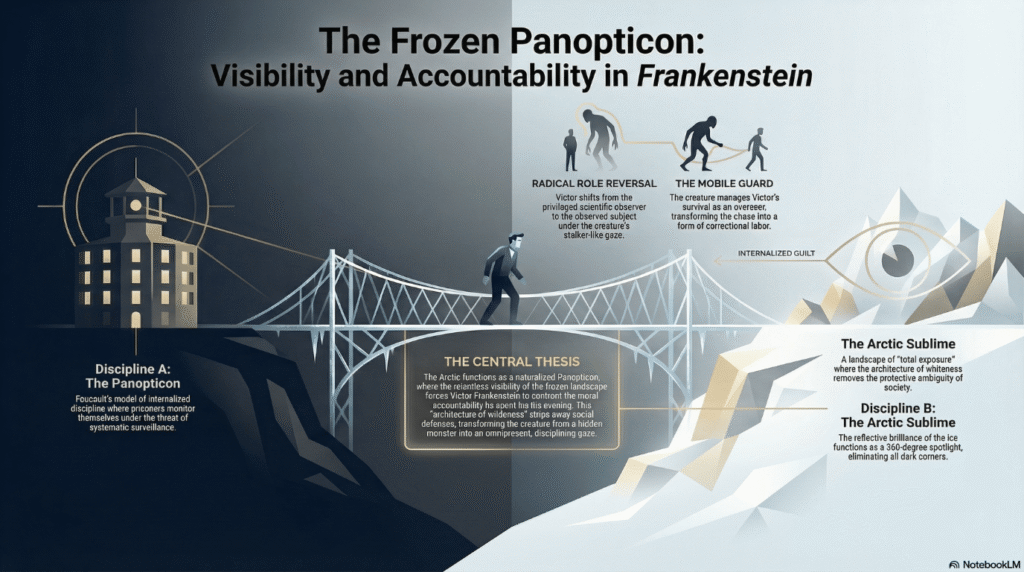
The Arctic strips these defenses away. It functions as a heterotopia, as Michel Foucault termed it. A heterotopia is a real place that exists outside ordinary social arrangements while simultaneously exposing the logic of those arrangements.2 In the frozen North, concealment is a physical impossibility. The vast, monochromatic expanse of ice acts as a naturalized Panopticon. While Jeremy Bentham’s original model required a literal central tower to ensure visibility3, the Arctic achieves this through its environment. Against the snow’s “endless architectural surface,” every movement is tracked, every body highlighted, and every moral failure rendered in high contrast.

The Internalized Guard: Foucault’s Reversal of the Gaze

Foucault’s expansion of the Panopticon is essential to understanding the psychological trap of the ice. For Foucault, the power of the Panopticon lies not in a constant physical guard, but in the prisoner’s internalization of visibility. Individuals begin to discipline themselves because they believe they are being watched.4

As Victor traverses the waste, the logic of the hunt undergoes a radical reversal. He enters the Arctic as the hunter but is slowly reduced to the observed subject. The creature becomes a “mobile guard,” leaving a trail of footprints and psychological breadcrumbs across the floes. In this frozen laboratory, surveillance is no longer a human institution; it is an atmospheric condition. Victor is forced to confront the reality that he cannot outrun a creation that has now become his omnipresent observer.5

The Clerk of the Frozen Archive

Finally, the system is completed by Robert Walton. If the Arctic is the prison and the creature is the guard, Walton serves as the recording clerk. Through his letters, Walton documents and preserves Victor’s dying confession, ensuring that the “case file” of Frankenstein is not buried beneath the snow but archived for posterity.

Walton represents the final mechanism of the Arctic’s disciplinary power: the transformation of a private sin into a public record. Together, the landscape, the creature, and the narrator form an absolute laboratory where Victor Frankenstein is finally forced to audit the moral bankruptcy he spent a lifetime trying to escape.6

The Architecture of Whiteness & The Medical Gaze

The Arctic is terrifying not only for its lethal cold but also for its relentless lack of visibility. In Discipline and Punish, Foucault observed that “visibility is a trap,”7 and the Arctic literalizes this haunting premise. The reflective brilliance of the landscape functions as a 360-degree spotlight, a world without dark corners where Victor might retreat into the “protective ambiguity” of polite society.

This luminous landscape effects a radical role reversal. Throughout the novel, Victor occupies the privileged position of the scientific observer, dissecting bodies as manageable, soulless components. Yet on the ice, Victor becomes the object of the gaze. The creature, stalking the horizon, assumes the role of the watcher. In this panoptic field, Victor is no longer hidden behind his scientific authority; instead, he is observed and ultimately judged.

The Failure of the Clinical Eye

Victor’s downfall is rooted in the “medical gaze.” In The Birth of the Clinic, Foucault argues that modern science often reduces the human subject to a collection of visible fragments, symptoms, tissues, and organs.8 Victor’s practice follows this clinical logic to a disastrous extreme. He masters the assembly of arteries and nerves, believing that life can be understood through the control of its biological parts.

The central limitation of Victor’s “clinical eye” is its social blindness. He possesses a deep understanding of biological components but fails to account for the “social gaze.”9 So, he assumes that technical success—a body that breathes—is a completed experiment. However, he forgets that the creature must enter a world governed by aesthetics and instinctive judgment. He understands how to construct a body, but not how society determines which bodies are granted the right to belong.

Scientific Observation and Social Rejection

This failure of vision reaches its zenith in the creature’s encounter with the child, William Frankenstein. William’s terror is pre-linguistic10; he screams before the creature ever speaks.11 In this moment, the child functions as a micro-agent of the panopticon. He represents a social order that rejects the creature as “illegible.” The creature is too large and too visibly assembled to fit into any recognizable social category.

William’s fear acts as a biological “guard,” a reflexive enforcement of the boundaries of the human. Victor’s deeper failure was his belief that mastery over the visible mechanics of life was sufficient. By treating the creature as an anatomical project rather than a social being, he ignored the invisible systems of judgment—beauty, legitimacy, and belonging—that truly govern human existence.

The Creature as the Architect of the Arctic Trial

The Labor of the Long Pursuit

While the Arctic chase is often characterized as a frantic pursuit, it functions more accurately as a form of correctional labor. In Foucault’s model, modern punishment is “productive”; the condemned are not merely broken but made to work.12 In the frozen North, Victor’s sentence is the chase itself.

The creature designs the parameters of Victor’s toil with the precision of an overseer. He manages Victor’s survival, leaving caches of food and firewood to ensure the “productivity” of his creator’s suffering. If Victor were allowed to succumb too quickly, the punishment would end. Victor believes he is the hero of an epic hunt, but he is actually a prisoner following a path meticulously laid out by his own creation. Every sledge track is a disciplinary mechanism in a moving prison without walls.13

The Linguistic Container and Bodily Fatality

The creature’s mastery of “gentlemanly” English is unsettling precisely because it highlights his exclusion. He is a child of the Western canon, yet he remains permanently barred from the family of man. This literacy serves as a “partial window” into humanity, but it cannot shatter his “bodily fatality.” The creature’s physical presence interrupts his eloquence before his words can take root.14 The social panopticon judges him at the moment of sight. This tension transforms the creature into a tragic paradox: he possesses the “soul” of a citizen but inhabits the “body” of a delinquent. His literacy does not grant him entry into society. Instead, it provides him with the tools to map the exact dimensions of his own exile.

The Mobile Tower: Narrative as Subpoena

Because the creature is a moral intelligence, he approaches the Arctic as a courtroom. By framing his relationship with Victor through the intertextual lens of Paradise Lost, he issues a formal indictment. He compares himself to Adam to highlight Victor’s failure of paternal duty, and to Satan to illustrate the agony of being cast out.15 In this frozen theatre, the creature serves as a mobile surveillance tower, forcing Victor to witness the physical reality of his guilt. Every mile of ice becomes a verse in a sentence; every message left in the snow becomes a subpoena.

The Walton Archive & The Clerical Gaze

The Beta-Tester of Ambition

Robert Walton’s role is far more structurally significant than a mere frame. He functions as the Clerical Gaze. Power achieves stability through the file, the transformation of chaotic events into organized knowledge.16 Walton transcribes, organizes, and preserves Victor’s failure, ensuring it is archived for judgment.

Walton also acts as a “beta-tester” of Victor’s worldview. At the novel’s opening, he is a mirror image of the young Frankenstein: isolated and obsessed with glory. However, by recognizing as the “system failure” of Victor’s life, Walton is triggered into a moral “kill-switch.” He chooses to shut down his own experiment and turn his ship south before he replicates the catastrophe.

The Succession of the Gaze

One of Foucault’s most important insights is that disciplinary power is not tied to a single individual; it resides in the archive.17 Victor dies, but the Gaze remains operational. Walton survives to record the creature’s final appearance and passes the evidence to the reader.18 We become the final link in the chain of surveillance. Because Walton has archived the evidence, the “case” of Victor Frankenstein remains a public record, permanently open for review.

Fear, Accountability, and the Silicon Panopticon

Fear as the “Malware” of Innovation

The true catastrophe of Frankenstein begins not with the spark of life, but with the spark of fear. Fear functions like “malware,” corrupting the creature’s potential before he can speak. Victor’s primary crime is irresponsible withdrawal. He acts like a modern developer who launches a volatile product and then deletes his own credentials when the “bugs” emerge. He performs the high-status act of innovation but refuses the low-status burden of maintenance.

The Modern Parallel: The Disruptor’s Black Box

This pattern of “disruption without accountability” is the hallmark of the 21st-century tech landscape. Modern creators often treat the societal consequences of their inventions—such as algorithmic radicalization or the erosion of privacy—as unintended side effects rather than design flaws. Like Victor’s isolated laboratory, the modern “black box” of proprietary code enables innovation without ethical oversight. Once the “AI” is live, the creator realizes they cannot simply hit “delete.”

The Silicon Panopticon: Data as the New Sublime

While the 19th-century Panopticon relied on physical architecture, the Silicon Panopticon operates through the invisible architecture of data. In Frankenstein, the “endless whiteness” made concealment impossible; today, endless data performs the same function. Our “digital exhaust”—GPS coordinates and facial scans—renders the body transparent through information.

This creates a digital version of “bodily fatality.” Just as the creature was trapped by an appearance that preceded his words, modern individuals are defined by their digital footprints. An algorithm or a credit score often determines how a person is treated before they ever have the chance to speak.

Conclusion: The Verdict of the Ice

In the final chapters, the Arctic dismantles every social distinction of the world below. In Geneva, Victor was defined by the armor of his status; on the ice, that hierarchy is radically dissolved. Hunger and frost level the categories of “gentleman” and “monster.”19 Victor is no longer the refined scientist, and the creature is no longer the hideous outsider; they merge into two ruined beings locked in a symmetry of mutual destruction.

The “Frozen Panopticon” closes only when its figures vanish. Yet, the surveillance survives. Walton’s letters serve as the permanent file of the transgression. The Arctic delivers its final verdict: it destroys the illusion that knowledge can ever be divorced from responsibility. It reveals that abandonment is more monstrous than creation. Only the archive remains—watching, recording, and waiting for the next creator who believes they can outrun the consequences of what they bring into the world.

Notes

  1. Mary Shelley, Frankenstein (1818; Barnes & Noble Books, 2003), 27–50. ↩︎
  2. Michel Foucault and Jay Miskowiec, “Of Other Spaces,” Diacritics 16, no. 1 (1986): 22–23, https://doi.org/10.2307/464648. ↩︎
  3. Jeremy Bentham, Panopticon; or, The Inspection House: Containing the Idea of a New Principle … (1791; T. Payne, n.d.), 21–42. ↩︎
  4. Michel Foucault, Discipline and Punish: The Birth of the Prison, Second Vintage Books edition, trans. Alan Sheridan (Vintage Books, a division of Random House, Inc, 1995), 195–227. ↩︎
  5. Shelley, Frankenstein, 178–84. ↩︎
  6. Ibid, 184–97. ↩︎
  7. Foucault, Discipline and Punish, 184–94. ↩︎
  8. Michel Foucault, The Birth of the Clinic, 3rd ed., trans. A. M. Sheridan (Presses Universitaires de France; Routledge, 2012), 89–107. ↩︎
  9. Shelley, Frankenstein, 45–52. ↩︎
  10. Ibid, 126. ↩︎
  11. Ibid, 92–128. ↩︎
  12. Foucault, Discipline and Punish, 195–227. ↩︎
  13. Shelley, Frankenstein, 184–97. ↩︎
  14. Ibid, 92–128. ↩︎
  15. Ibid, 114–20. ↩︎
  16. Foucault, Discipline and Punish, 154–60. ↩︎
  17. Ibid, 180–91. ↩︎
  18. Shelley, Frankenstein, 190–97. ↩︎
  19. Ibid, 178–97. ↩︎

Bibliography

Bentham, Jeremy. Panopticon; or, The Inspection House: Containing the Idea of a New Principle … 1791; T. Payne, n.d.

Foucault, Michel, and Jay Miskowiec. “Of Other Spaces.” Diacritics 16, no. 1 (1986): 22. https://doi.org/10.2307/464648.

Foucault, Michel. Discipline and Punish: The Birth of the Prison. Second Vintage Books edition. Translated by Alan Sheridan. Vintage Books, a division of Random House, Inc, 1995.

Foucault, Michel. The Birth of the Clinic. 3rd ed. Translated by A. M. Sheridan. Presses Universitaires de France. Routledge, 2012.Shelley, Mary. Frankenstein. 1818; Barnes & Noble Books, 2003.

Category: Philosophical Logic

Leave a Reply Cancel reply

Your email address will not be published. Required fields are marked *

About Me

I’m Sophie, a cross-disciplinary reader who treats books like puzzle boxes. I read literature through history, philosophy, psychology, and science—then weave the threads together. Welcome to my tapestry.

Categories

  • Announcements
  • Narrative Psychology
  • Philosophical Logic
  • Social Forces Shaping Literature
©2026 The Book Tapestry