The Book Tapestry

From the pages to the mind—woven with care.

Menu
  • Home
  • Blog
  • Privacy Policy
  • About Me
Menu

Animal Farm and Foucault: The Architecture of the Invisible Cage

Posted on April 24, 2026April 4, 2026 by Sophia Wordsmith

Blog Summary

In this cross-disciplinary deep dive, we peel back the layers of George Orwell’s Animal Farm using the philosophical lens of Michel Foucault. While the story is often read as a simple allegory of the Soviet Union, we explore how the pigs’ real power lies not in their whips, but in their control over truth, biology, and language.

Key Insights:

  • The Scientific Alibi: How Squealer uses “expert knowledge” to move the distribution of resources from the realm of ethics to the realm of technical necessity, making inequality appear rational.
  • The Liquid Archive: A look at the barn wall as a living, shifting database where the past is constantly “patched” to serve the present.
  • Biopower & Docile Bodies: How Napoleon’s management of the farm transitions from the “right of the sword” to the programming of life itself—transforming the puppies into automated instruments of the state.
  • The Ritual of Sincerity: Why the public confessions are not about discovering guilt, but about forcing the animals to narrate their own submission into the regime’s moral framework.
  • The Spectrum of Subjects: An analysis of Boxer (the true believer) and Benjamin (the cynical subject) as two different but equally effective outcomes of manufactured obedience.

The Takeaway: The ultimate victory of the pigs was not the seizure of power, but the erasure of the animals’ capacity to verify reality. By the end, the “invisible cage” is built not of chains, but of accepted explanations.
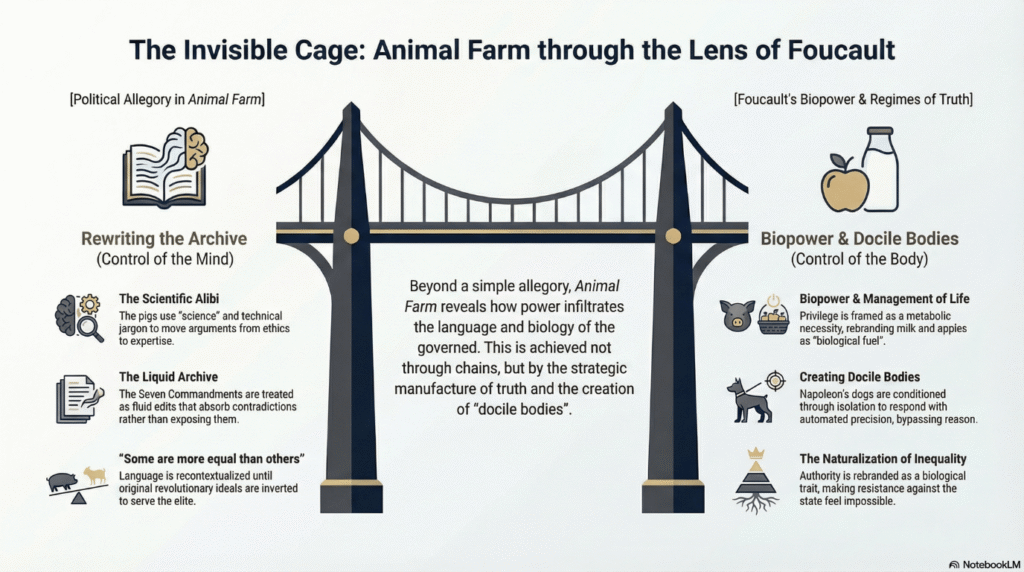
Introduction: The Farm as a  “Regime of Truth”

The Scientific Alibi: Power as “Expert” Truth

The first fracture in the farm’s moral universe does not appear through physical force, but through explanation. When Squealer justifies the pigs’ exclusive consumption of milk and apples, he avoids appealing to desire or class privilege; instead, he invokes a clinical authority: “Science has proved.”

This rhetorical shift is decisive. The question is no longer whether the distribution is fair, but whether it is necessary. By introducing technical jargon such as “substances” and “well-being,” the pigs shift the argument from the realm of ethics to the domain of expertise.1 What cannot be debated morally becomes nearly impossible to challenge intellectually.

The Foucault Frame: Power via Knowledge

This maneuver exemplifies what Michel Foucault describes as the fusion of power and knowledge.2 Here, authority no longer legitimizes itself through external coercion; it does so by producing its own “truth.” The pigs do not merely seize the milk; they construct a cognitive framework in which taking the milk appears rational, even indispensable. In doing so, they establish themselves as the sole interpreters of the farm’s biological and intellectual needs.3

More critically, this moment introduces a foundational mutation in the farm’s governing logic. Equality is not openly rejected; it is conditionally suspended. The pigs present their privilege as a temporary exception necessary for the collective’s survival. This transforms inequality from a violation of the system into its hidden engine. What begins as a localized justification becomes a governing principle: some must consume more so that others may endure. The “archive of truth” is not destroyed; it is quietly edited until inequality no longer appears as injustice, but as a heavy responsibility.

Once the pigs establish that truth is a matter of technical expertise, they require a ledger to record this shifting reality, a place where the past can be systematically updated to serve the present.

Language as the “Liquid Archive”

On Animal Farm, language does not merely record reality; instead, it actively reshapes it. The Seven Commandments,4 painted on the barn wall, function as what Foucault would call an archive: a living system that defines what can be said, remembered, and accepted as true. At first glance, these commandments appear fixed and sacred. Yet, their true nature is fluid.5 They are not inscriptions in stone but “liquid” edits subject to strategic alteration.

The “Scientific Patch”

The “milk and apples” incident marks the first decisive intervention into this archive. It is not an overt erasure but a discursive edit. It is a subtle insertion that alters the meaning of equality without explicitly contradicting it. By invoking “science,” the pigs introduce a new interpretive layer: equality remains the guiding principle, but “exceptions” become permissible under technical justification. Language becomes the mechanism through which contradiction is absorbed rather than exposed.

This is the birth of the liquid archive. The commandments do not collapse; they evolve. Each modification appears minor and reasonable, yet cumulatively, they invert the original revolutionary ideal. “All animals are equal” does not disappear; it is gradually recontextualized until it can coexist with its eventual, infamous inversion: “Some animals are more equal than others.”6

Squealer’s Taxonomy

Central to this process is Squealer’s linguistic taxonomy. He replaces “trigger” terms like privilege or advantage with neutral, even virtuous, descriptors. The pigs do not “take”; they “require.” They do not “dominate”; they “serve” the stability of the farm against the return of Mr. Jones.7 Through this renaming, inequality is not only justified but also moralized. The wall remains intact, but its meaning is hollowed out. Truth has not been erased; it has been rewritten in place.

But the pigs’ control extends beyond the written word on the barn wall; it moves from the external ‘archive’ of the law into the very biology of the animals themselves.

Biopower: The Programming of Life and the “Hidden Syllabus”

Beyond the manipulation of language lies a more visceral form of control: the management of bodies and the institutionalization of “natural” hierarchy. On Animal Farm, the pigs do not merely occupy the intellectual center; they colonize it, teaching the collective that “pig intelligence” is not a political claim, but a biological reality.8

This is the introduction of a hidden syllabus. Through the repetitive insistence that pigs alone perform the essential “brainwork,” leadership is stripped of its status as a communal role and rebranded as an inherent, biological trait. The other animals begin to internalize a devastating conclusion: authority is not something one earns or debates, but it is something one is born with.

The Architecture of Biopower

This dynamic reflects what Foucault termed biopower: the transition from the “right of the sword” to the management of life, bodies, and populations through systems of knowledge.9 The pigs do not govern solely through the threat of violence; they govern by claiming that their physiology is fundamentally distinct.

In this framework, resources like milk and apples cease to be simple nutrition. They are rebranded as “biological fuel” reserved exclusively for the high-functioning “organic hardware” of the pig brain. Power is thus anchored in the body itself. By framing their privilege as a metabolic necessity, the pigs make inequality appear to be a law of nature rather than a choice of the state.

The Production of “Docile Bodies”

The most chilling application of this programming is Napoleon’s isolation of the puppies. By removing them from the communal environment, he subjects them to a specialized, exclusionary education designed to bypass reason entirely.10

The puppies are transformed into what Foucault calls docile bodies: entities trained, disciplined, and conditioned to respond with automated precision to the needs of authority.11 Their loyalty is not a moral choice or a revolutionary commitment; it is a manufactured reflex. They represent the ultimate triumph of biopower, the human (or animal) being reduced to a programmable instrument of the state.12

The Naturalization of Inequality

The tragedy of the farm lies in the animals’ eventual surrender to this “expert” logic. Once the pigs are viewed as biologically superior, resistance becomes intellectually and psychologically fraught. When inequality is successfully framed as a natural fact rather than a political artifice, it becomes invisible.

The struggle for liberation is no longer a fight against a tyrant; it is a fight against “science” itself. In the eyes of the overworked, the hierarchy is no longer an injustice. It is simply the way the world is built.

If Biopower conditions the body to serve, and the Archive conditions the mind to believe, it is the public ritual that ensures no private doubt ever survives the light of day.

The Ritual of the Confessional: From Teeth to Voice

As Napoleon’s hegemony matures, the mechanics of control shift from visible violence to internalized obedience. While the dogs remain essential as symbols of latent force, their physical intervention is increasingly redundant. Their presence alone suffices to maintain order.13

This transition mirrors the evolution of power that Foucault identifies in modern society: the movement from spectacular punishment (the public display of the sovereign’s wrath)14 to disciplined self-regulation.15 In the early days of the rebellion, power was found in the dog’s teeth; in the established regime, power is found in the animal’s own voice. The spectacle is no longer the execution, but the confession.

The Script of Sincerity

The public confessions on Animal Farm are not spontaneous eructations of guilt; they are meticulously structured performances. The accused do not merely admit to a crime; they narrate themselves into the regime’s specific moral vocabulary. They confess to impossible conspiracies with Snowball and admit to “hidden” disloyalties that align perfectly with the pigs’ current political needs.16 In this theater of the barnyard, guilt is not discovered, but it is manufactured through language.

This process highlights a dark paradox of “sincerity.” A confession is only validated as “true” if it mirrors the framework established by the state. The animal must not only say “I was wrong,” but rather, “I was wrong according to your definition of the truth.” This transforms the act of speaking into a ritual of total submission. By confessing, the subject participates in their own condemnation, effectively signing a contract confirming the legitimacy of the system about to destroy them.

The Liturgy of “Spontaneous” Loyalty

The Spontaneous Demonstrations serve as the rhythmic counterpart to the confessional. Despite their name, these events are highly ritualized performances of collective loyalty.17 These organized outbursts, complete with chants, songs, and processions, function as a social pressure valve, releasing communal tension before it can solidify into resistance.

Through these repetitions, propaganda is transmuted into habit, and habit eventually hardens into belief. If the dogs guard the perimeter of the farm, this linguistic liturgy guards the perimeter of the mind. By the end of the narrative, the animals no longer require external force to ensure their compliance. They have been taught how to narrate their own obedience, becoming both the prisoner and the guard.

The Spectrum of Manufactured Subjects: Faith and Resignation

By the final chapters of Animal Farm, Napoleon’s regime has achieved something far more profound than mere political control: it has engineered a new taxonomy of subjects. Through the intersection of manipulated language, biological essentialism, and ritualized confession, the farm produces specific psychological profiles designed to sustain tyranny. The tragedy is not merely that the pigs have become tyrants, but that the other animals have been transformed into the very instruments of their own subjugation.

The True Believer: Labor as Liturgy

Boxer represents the ultimate success of the regime’s hidden syllabus. He does not resist because he has completely internalized the state’s script, merging his identity with his utility. His dual maxims, “I will work harder” and “Napoleon is always right,” demonstrate how power can be embedded directly into the act of labor.18

For Boxer, external coercion is no longer necessary; he is a self-disciplining subject. His sincerity is his undoing. He interprets every systemic failure not as evidence of the pigs’ corruption, but as proof of his own inadequacy. In Boxer, we see the docile body at its peak: a being that views its own exploitation as a moral necessity.

The Cynical Subject: The Trap of Passivity

In contrast, Benjamin represents the cynical subject. Unlike Boxer, Benjamin is cognitively liberated; he sees the erasures on the barn wall and recognizes the pigs’ descent into human vice. However, his intellectual clarity does not translate into resistance.19

Benjamin’s cynicism functions as a different form of manufactured obedience. By adopting the belief that all systems are inherently corrupt and that change is impossible, he renders himself politically inert. His silence is a sanctuary that accidentally protects the status quo.20 While Boxer serves the system through blind faith, Benjamin serves it through the paralysis of resignation.

The Final Victory of Perception

The convergence of these two paths, faith and fatalism, leads to the narrative’s famous closing image: the “pig-to-man” transformation. At this climax, the animals looking through the window can no longer distinguish the oppressor from the liberator, or the revolution from the restoration.

This is the final victory of the liquid archive. The animals’ internal moral compasses have been so thoroughly recalibrated by Squealer’s taxonomy and Napoleon’s biopower that their own memories can no longer be trusted. The external truth produced by the regime has become more durable than their lived experience. They are not just governed; they are colonized. The archive has finally become stronger than the mind.

This machinery of control, linguistic, biological, and ritualistic, does not affect every inhabitant in the same way. Rather, it produces a spectrum of subjects tailored to the regime’s needs.

Conclusion: The Invisible Cage

The ultimate tragedy of Animal Farm is not merely the sight of the pigs walking on two legs or the chilling realization that they have become indistinguishable from their former oppressors.21 The deeper horror lies in the erasure of the animals’ capacity to verify reality. By the novel’s end, the inhabitants of the farm no longer possess an independent language through which to question, compare, or resist.

When the commandments are rewritten, confessions ritualized, and privilege rebranded as sacrifice, the animals find themselves lacking the vocabulary to even describe their own dispossession. They are trapped in a closed semiotic loop in which truth is manufactured externally and internalized without friction.

The Architecture of Consent

This is why Foucault’s analysis of power remains so startlingly relevant. He reminds us that power does not survive solely through the right of the sword or crude censorship; it thrives by defining the boundaries of what appears rational, scientific, and necessary.22

On Animal Farm, inequality is sanitized through the jargon of brainwork, and the hoarding of resources is framed as a “heavy responsibility.” The animals are not merely forced to comply; they are conditioned to interpret their own exploitation as a form of protection. The regime’s greatest achievement is not the wall around the farm, but the conceptual fence around the animals’ minds.

Modern Resonance: The Expert’s Shield

The contemporary echoes of Orwell’s barnyard are difficult to ignore. Modern institutions frequently lean on bureaucratic terminology and specialized rhetoric to insulate policy from public scrutiny. Terms like “security,” “optimization,” “efficiency,” and “expert consensus” can function as discursive shields, reframing profound moral questions as mere technical adjustments.23

Once a social or political issue is presented as a complexity that only “specialists” can navigate, the public is encouraged to surrender its judgment. In this silence, the “Scientific Alibi” finds its modern home, allowing power to operate behind a veil of objective necessity.

Final Thought: The Chains of Explanation

The invisible cage is not forged from iron, but from accepted explanations. True power does not just demand obedience; it convinces the subject that obedience is in their own best interest. The final victory of the pigs was not the theft of the milk and apples—it was the moment the other animals learned to thank them for taking them.

Notes:

  1. George Orwell, Animal Farm, 1st ed (AEONS CLASSICS, 2004), 35–36. ↩︎
  2. Michel Foucault, Discipline and Punish: The Birth of the Prison, Second Vintage Books edition, trans. Alan Sheridan (Vintage Books, a division of Random House, Inc, 1995), 183–84. ↩︎
  3. Orwell, Animal Farm, 36. ↩︎
  4. Ibid, 24–25. ↩︎
  5. Michel Foucault, Archaeology of Knowledge, Routledge Classics (Tavistock Publications Limited, 1972; 2nd ed, Taylor and Francis, 2013), 94–97. ↩︎
  6. Orwell, Animal Farm, 134. ↩︎
  7. Ibid, 35–36. ↩︎
  8. Ibid, 15–44. ↩︎
  9. Michel Foucault, The History of Sexuality, 1st American ed, trans. La Volonte de savoir, Social Theory, 2nd Edition (Pantheon Books, 1978), 92–102. ↩︎
  10. Orwell, Animal Farm, 53. ↩︎
  11. Foucault, Discipline and Punish, 135–37. ↩︎
  12. Orwell, Animal Farm, 35–36. ↩︎
  13. Ibid, 53–54. ↩︎
  14. Foucault, Discipline and Punish, 45–51. ↩︎
  15. Ibid, 135–37. ↩︎
  16. Orwell, Animal Farm, 82–89. ↩︎
  17. George Orwell and Erich Fromm, 1984 (Signet Classics, 2017), 1–104. ↩︎
  18. Orwell, Animal Farm, 61. ↩︎
  19. Ibid, 68. ↩︎
  20. Hannah Arendt et al., The Human Condition, Second edition (The University of Chicago Press, 2018), 24–29. ↩︎
  21. Orwell, Animal Farm, 136–41. ↩︎
  22. Michel Foucault and Colin Gordon, Power/Knowledge: Selected Interviews and Other Writings 1972-1977, Nachdr. (Pearson Education, 2010), 194–209. ↩︎
  23. Foucault and Gordon, Power/Knowledge, 198–209. ↩︎

Biography

Arendt, Hannah, Danielle S. Allen, and Margaret Canovan. The Human Condition. Second edition. The University of Chicago Press, 2018.

Foucault, Michel. Discipline and Punish: The Birth of the Prison. Second Vintage Books edition. Translated by Alan Sheridan. Vintage Books, a division of Random House, Inc, 1995.

Foucault, Michel. Archaeology of Knowledge. Routledge Classics. Tavistock Publications Limited, 1972. 2nd ed. Taylor and Francis, 2013.

Foucault, Michel. The History of Sexuality. 1st American ed. Translated by La Volonte de savoir. Social Theory, 2nd Edition. Pantheon Books, 1978.

Foucault, Michel, and Colin Gordon. Power/Knowledge: Selected Interviews and Other Writings 1972-1977. Nachdr. Pearson Education, 2010.

Orwell, George, and Erich Fromm. 1984. Signet Classics, 2017.Orwell, George. Animal Farm. 1st ed. AEONS CLASSICS, 2004.

Category: Philosophical Logic

Leave a Reply Cancel reply

Your email address will not be published. Required fields are marked *

About Me

I’m Sophie, a cross-disciplinary reader who treats books like puzzle boxes. I read literature through history, philosophy, psychology, and science—then weave the threads together. Welcome to my tapestry.

Categories

  • Announcements
  • Narrative Psychology
  • Philosophical Logic
  • Social Forces Shaping Literature
©2026 The Book Tapestry