The Book Tapestry

From the pages to the mind—woven with care.

Menu
  • Home
  • Blog
  • Privacy Policy
  • About Me
Menu

The Archive of Eradication: Why Dracula’s Filing Cabinet is Scarier than his Fangs

Posted on March 8, 2026February 7, 2026 by Sophia Wordsmith

At Glance

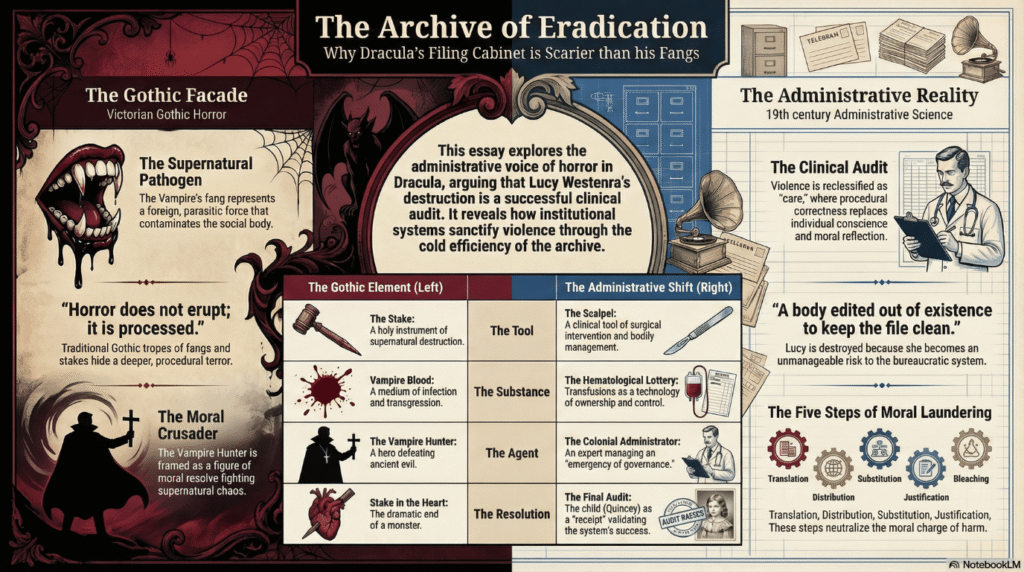
In the world of Dracula, the filing cabinet is more formidable than the vampire’s fang. This deep dive deconstructs the “moral laundering” used by the Crew of Light to reframe ritualized execution as necessary medical care, revealing the chilling ways modern bureaucracy erases ethical residue to keep the record clean.
Introduction: The Filing Cabinet Over the Fang

In Bram Stoker’s Dracula, the most formidable instrument of power is not the vampire’s fang, the crucifix, or even the wooden stake. It is the filing cabinet. While the novel is draped in the trappings of Gothic horror, its true terror does not reside in the supernatural transgression of blood; it lives in the calm, procedural language that renders extraordinary violence both necessary and sterile. Long before Lucy Westenra is physically destroyed1, Stoker’s narrative has already anesthetized the reader to the ethical shock of her execution. In this world, horror does not erupt; it is processed.

Lucy’s “purging” is rarely read as a murder, yet it is exactly that—a ritualized execution authorized by science. It is not a traditional Gothic climax where chaos is defeated by moral resolve, but rather a successful administrative procedure2. Her death marks the precise moment where medical expertise and bureaucratic coordination converge to sanctify coercion. The discourse surrounding her “treatment” never pauses to ask if violence is justified; it presumes justification through function. Under the clinical gaze, medical authority reframes trauma as a cure, and collective agreement diffuses responsibility until the moral weight of the act evaporates. Violence is no longer an emotional excess; it is a logistical necessity, validated retroactively by the restoration of social order.

Administrative Voice

Central to this transformation is the novel’s administrative voice. Dracula is famously constructed from a fragmented archive: journals, letters, telegrams, and phonograph transcripts. Each document purports to be a neutral, technical record of limited scope. This structure produces a tone of procedural objectivity that effectively suppresses dissent. Events are logged rather than interrogated; actions are sequenced rather than judged. By distributing the narration across a ledger of disparate records rather than a unified moral consciousness, the novel replaces reflection with documentation and conscience with protocol3.

What emerges is a chilling case study in how modern systems authorize violence without the need for passion, cruelty, or even individual guilt. Lucy Westenra does not die because the men around her are immoral; she dies because the system they have assembled—a proto-bureaucracy of experts—leaves no ethical space in which she might exist4. Her destruction is the first victory of the modern archive: a body edited out of existence to keep the file clean.

Clinical Cruelty: The Medicalization of the Stake

In Dracula, the staking of Lucy Westenra is not narrated as an act of killing, but as a clinical intervention5. The scene’s language is strikingly procedural: the focus remains fixed on instruments, positioning, and sequence, while affect is managed rather than expressed. By adopting the vocabulary of duty, the narrative asks the reader to evaluate professional competence rather than moral justice.

Violence as Treatment

The staking is structured precisely like a surgical operation. Van Helsing “directs,” Arthur “performs,” and the others “attend.” The ritual unfolds through a rigid series of steps, where the emphasis lies on correct execution rather than moral hesitation6. Within this framework, pain is only relevant as a metric of efficacy—convulsions and cries are interpreted merely as signs that the procedure is “working.”

This rhetorical move is crucial. By translating violence into technique, the narrative removes the ethical category of murder and substitutes it with the technical category of “necessary intervention.” Once the act is framed as a medical obligation—an “it must be done” with no alternative—refusal is rebranded as irresponsibility. Dracula thus stages a paradigmatic instance of clinical cruelty: harm administered calmly, expertly, and without malice, precisely because it has been reclassified as care.

The Consent Void

Lucy’s absence from the decision-making process is not incidental; it is foundational. She is unconscious, infantilized, and spoken about rather than spoken with. In the novel’s administrative logic, consent is rendered unnecessary once a diagnosis is declared. Lucy is reduced from a subject to a case study—a body to be managed, not a will to be consulted.

This exclusion mirrors the Victorian medical gaslighting of women labeled “hysterical,” whose testimony was routinely discounted as pathological7. The authority of the male experts supersedes Lucy’s agency entirely. Her silence is not interpreted as an objection, but as a confirmation that she is incapable of self-governance. This consent void functions as the enabling condition for the procedure: without Lucy’s voice, the system encounters no ethical friction.

The Speculum and the Stake

The medicalization of Lucy’s destruction gains further clarity when read alongside the Contagious Diseases Acts (CDA) of the mid-to-late nineteenth century. Under these laws, women suspected of prostitution were subjected to forced gynecological examinations, often with the speculum, and detained without consent under the banner of protecting the “health of the nation8.”

The logic is identical. In both cases, women’s bodies are reframed as vectors of contagion, and coercion is justified as prevention. The parallel is structural: both the speculum and the stake are invasive instruments authorized by expertise and sanctified by the public good. Both acts are narrated as regrettable but necessary. Through this lens, the staking of Lucy ceases to be a Gothic aberration and emerges as a familiar exercise of institutional power. She is not killed because she is monstrous; she is destroyed because she has been successfully reclassified—from woman to pathology, from subject to threat.

The Logistics of Ownership: Blood and Control

In Dracula, blood is never merely biological; it is logistical. The four transfusions administered to Lucy Westenra are framed as lifesaving acts, yet their narrative function is less therapeutic than juridical. Each transfusion marks a claim, and together they constitute a system through which Lucy’s body is converted from a private person into a communal asset managed by male authority. What appears as intimacy—sharing blood—operates instead as a technology of control.

The Hematological Lottery

The sequence of transfusions is striking for its repetition and its ultimate futility. Each donor offers blood in good faith; each donation fails to reverse Lucy’s decline. Yet the practice continues, escalating not because it works, but because it symbolizes moral participation. The men’s blood becomes proof of investment. As critic Christopher Craft famously observed, the transfusions function as a ritual of masculine bonding that centers Lucy as the medium rather than the beneficiary9.

Ethically, the arrangement resembles a lottery whose physical outcomes are irrelevant; what matters is that each man enters. By contributing blood, the male coalition converts individual sacrifice into collective entitlement. Lucy’s body becomes the shared site upon which their virtue is enacted. The language surrounding these scenes repeatedly emphasizes unity—we, our, together—while Lucy herself remains passive, anesthetized, and silent. Ownership is produced not through raw domination, but through coordinated care10.

This logic carries a chilling implication: once multiple men have “invested” themselves biologically, Lucy no longer belongs to herself. She belongs to the system that has bled for her. The transfusions do not save Lucy’s life; they legitimate the decisions later made about her death.

Communal Blood, Communal Authority

The moral weight of the transfusions also performs a preemptive function. Having given blood, the men acquire not only emotional leverage but ethical insulation. Any subsequent violence can be framed as a tragic necessity rather than a violation. The transfusions operate as advanced “moral credit,” insulating later acts from scrutiny. Because the group has already “done everything possible,” the groundwork of innocence is carefully laid before the stake ever touches her chest11.

This conversion of sacrifice into authority mirrors broader Victorian anxieties about heredity and contamination. Blood signifies lineage, but it also signifies governance. Lucy’s circulation becomes a managed resource—less an internal bloodstream and more a public utility.

The Professional Shield

Presiding over this logistics of ownership is Van Helsing, whose medical degree functions as a professional shield. His authority does not merely advise; it suspends normal constraints. He orders transfusions without consent and authorizes bodily invasion—actions that would be criminal if performed by an ordinary citizen.

Van Helsing’s expertise creates a localized state of exception. His credentials permit him to bypass the law and ethical hesitation in the name of emergency12. What would otherwise require warrants or public accountability is instead handled privately and decisively. As Max Weber observed, modern authority derives legitimacy from rationalized expertise13; Van Helsing’s status does not restrain violence—it enables it.

Blood as Authorization

Read together, the transfusions and Van Helsing’s authority reveal a coordinated mechanism: blood creates ownership, and expertise authorizes control. The transfusions are not failed medicine; they are a successful administration. By the time the stake is raised, Lucy has already been dispossessed—ethically, legally, and narratively14.

What Dracula exposes is how easily care becomes custody when mediated by institutions. Blood is shared, authority is centralized, and violence follows as the logical conclusion of a system that mistakes investment for entitlement.

The Laundromat of the Soul: The Five Steps of Moral Laundering

In Dracula, violence does not merely occur; it is processed. The novel constructs a mechanism through which ethically troubling acts are passed through successive rhetorical stages until they emerge purified of guilt. What results is not denial, but laundering—a system that accepts the reality of harm while neutralizing its moral charge. Lucy Westenra’s destruction is the paradigm case: by the time the act is complete, nothing remains that demands an apology.

1. Translation: From Violence to Social Function

The first step is translation. Lucy’s death is reframed from a personal violation into a social necessity. She is no longer a woman who might be wronged, but a condition that must be corrected. The language of the “Archive” performs the conversion: danger becomes threat, threat becomes risk, and risk becomes public harm. Once translated into function, the act exits the moral register altogether. Violence is no longer something one does; it is something that must be done for others15.

2. Distribution: Fragmenting Guilt

Next comes distribution. The act is divided into four coordinated components: authorization, execution, observation, and documentation. One man wields the stake, another the hammer, another the pen. No single actor performs the “whole” of the killing; therefore, no one owns the guilt. Responsibility is diluted across the collaboration. This is not accidental but structural. By fragmenting agency, the novel creates distributed innocence—a condition in which each participant can plausibly claim partial obligation and total absolution16.

3. Substitution: Protocol Replaces Conscience

Once distributed, ethical inquiry is quietly replaced. The question “Is this right?” gives way to “Is this the correct next step?” Conscience is displaced by sequence. Attention shifts to timing, order, and precision until only procedural correctness remains visible. Within this logic, hesitation appears not as compassion, but as an error or a “glitch” in the operation. This is the novel’s most dangerous move: it renders ethics obsolete by redefining responsibility as compliance17.

4. Justification: Success Cleanses Means

The fourth stage is retroactive justification. Dracula is destroyed; the threat ends. This outcome does not merely conclude the narrative—it rewrites it. Because the hunt succeeds, every preceding act becomes “necessary” by definition. Violence is vindicated not through argument, but through result. The logic is brutally simple: if order returns, then the methods that produced it cannot be wrong. Success functions as a moral detergent18.

5. Bleaching: Domestic Peace as Ethical Solvent

The final stage is bleaching. The novel’s ending—marriage, a child, and pastoral calm—overwrites the residue of trauma. Domestic normalcy absorbs ethical tension the way bleach absorbs stains. Lucy’s absence is not mourned; it is rendered irrelevant by continuity. The child at the end does not represent moral renewal, but institutional reassurance. Life goes on; therefore, nothing requires reckoning. The system emerges spotless, not because it was clean, but because it has replaced the fabric19.

The Completed Cycle

Taken together, these five steps form a closed system. Violence enters as necessity and exits as virtue. No character must lie; no one must feel cruel. The laundering succeeds precisely because it is sincere. Dracula does not teach its characters to ignore harm—it teaches them how to process it correctly. Lucy Westenra is not destroyed by malice or suspicion; she is destroyed by a system that knows exactly how to wash its hands.

Mina Harker: The Intelligence Officer of the Empire

In Dracula, Mina Harker occupies a position of paradoxical power. She is repeatedly praised and relied upon, yet never permitted full authority. This is not a contradiction in the novel’s logic; it is its design. Mina is not merely a clerk or a moral support figure; she functions as the intelligence officer of the administrative machine. She is the figure who gathers, organizes, and translates information so that others may act. Her value lies not in her resistance to power, but in her ability to make the world legible to it20.

The Administrative Nexus

Mina’s primary labor is epistemic. She collects diaries, transcribes phonograph recordings, synchronizes timelines, and produces a coherent archive from fragmented testimony. This work is foundational; without Mina’s compilation, the hunt for Dracula would be incoherent. She does not merely record events—she renders them actionable.

In bureaucratic terms, Mina is the interface. She stands between raw data and executive decision-making, converting lived experience into administrative knowledge. The men acknowledge they would be lost without her, yet this indispensability is carefully circumscribed. Mina’s access to information does not grant her authority over outcomes; she enables the machine without directing it. This separation between knowledge and power is the hallmark of modern administration: intelligence is valued precisely because it can be extracted and centralized by those in command.

Managed Assets vs. Liquidated Risks

Mina’s survival is often read as a moral contrast to Lucy’s destruction. Yet the distinction is not ethical; it is logistical. Mina is saved because she remains a manageable asset. Lucy is purged because she becomes an unmanageable risk.

Lucy’s body resists stabilization. Her behavior exceeds social containment, and her condition cannot be rendered productive. Once she is administratively “unfixable,” liquidation follows. Mina, by contrast, remains legible even after her infection. Her symptoms can be monitored, restricted, and incorporated into the system’s calculations. The scar burned into her forehead by the consecrated wafer functions as a visible infection marker—a literal status bar on her body—read by the men as data that tracks both her risk level and the institution’s ongoing success in containing it. She submits to surveillance and continues to contribute cognitively. The system does not “rescue” her from violence; it postpones it, contingent upon her continued compliance21.

Intelligence Without Autonomy

The novel’s description of Mina as possessing “a man’s brain and a woman’s heart” crystallizes her institutional role. Structurally, this is not praise—it is a job description. Mina is permitted intelligence so long as it does not translate into sovereignty. She may calculate and synthesize, but she may not decide. Her “woman’s heart” (emotional labor) softens the brutality of the group’s actions, while her “man’s brain” (cognitive labor) accelerates their efficiency22.

This arrangement exemplifies a broader imperial logic. Colonial administrations prized local knowledge and bureaucratic skill while reserving ultimate authority for a governing elite. Mina’s position mirrors this structure: she is central, indispensable, and ultimately subordinated. When the crisis ends, she is rewarded not with agency but with retirement into domesticity.

The Instrument That Survives

Mina does not escape the administrative machine; she perfects it. By the novel’s conclusion, her intelligence has been fully reintegrated into normative structures—marriage, motherhood, and memory. Her survival certifies the system’s “benevolence” without challenging its logic. While Lucy’s death is filed away as a necessity, Mina’s life is displayed as proof of successful “management.”

In this sense, Mina is neither victim nor liberator. She is the ideal instrument: a human conscience that reassures without obstructing, and an intelligence that illuminates without commanding. The empire does not fear minds like Mina’s; it depends on them.

The Colonial Emergency: Governance by Expertise

In Dracula, the hunt for the Count is framed not as a criminal investigation, but as an emergency of governance. This distinction is decisive. Criminality presumes law, evidence, and adjudication; an emergency, by contrast, presumes suspension, discretion, and expertise. The novel repeatedly chooses the latter. What unfolds is not policing but pacification, guided by a colonial logic that treats existential threats as administrative problems requiring extraordinary measures.

London as a Protectorate

Dracula is never pursued as a murderer subject to arrest. He is framed as an invading pathogen—a foreign, parasitic force whose presence contaminates the social body. This framing relocates the crisis from the domain of law to the domain of security. London, ostensibly the imperial center, is momentarily transformed into a protectorate, governed under emergency logic rather than civil statute.

In colonial administration, such conditions justified the suspension of normal rights in favor of expert control. Medicine, intelligence gathering, and discretionary violence replaced courts and constables. Van Helsing does not gather admissible evidence; he gathers intelligence. The goal is not justice but elimination23. Dracula is not meant to be tried—he is to be removed.

The Police Vacuum

The conspicuous absence of police is not a narrative oversight but a structural necessity. Policing implies public accountability, procedural delay, and the possibility of appeal. The hunters’ actions—grave desecration, unlawful confinement, and killing—could not survive legal scrutiny. Instead, authority is transferred to a private coalition of experts whose legitimacy derives from professional consensus rather than the state. 

This absence is especially conspicuous given that Dracula was published less than a decade after the Jack the Ripper murders, when police presence, public inquiry, and institutional failure were intensely visible in the East End—making their complete disappearance from Van Helsing’s discreet, West End–style operations read less as realism than as a class privilege that allows violence to proceed without public interference

This represents a shift from public law to private expertise. In this regime, agreement among credentialed men replaces due process. What matters is not legality, but plausibility within the group. Mina’s archive substitutes for the official record; Van Helsing’s reputation substitutes for a warrant. As is characteristic of colonial governance, the law does not disappear—it is “paused.” Power becomes discretionary.

The Pacification Project

Lucy Westenra’s staking represents the most intimate application of this colonial logic. Her body becomes the site of a civilizing mission. Once classified as deviant and irredeemable, she must be corrected or eliminated for the “good of the whole.” The language mirrors imperial rhetoric: purification, protection, restoration.

Like colonial subjects deemed unfit for self-governance, Lucy is denied autonomy under the justification of collective safety. Her destruction is narrated as a regrettable but necessary act of benevolent force. This is pacification, not punishment; the goal is not to hold Lucy accountable, but to neutralize her difference. The violence is thus doubly sanitized—first by medicine, then by empire24.

Expertise as Sovereignty

What ultimately governs in Dracula is not law, faith, or monarchy, but expertise itself. Knowledge becomes sovereignty. Those who know, decide; those who decide, act; those acted upon disappear into necessity. The colonial emergency does not end when Dracula dies; it ends when the system proves it can restore order without ever questioning its own authority.

In this sense, Dracula is not merely a tale of an invasion repelled, but a rehearsal of modern emergency governance—where law yields to experts, violence masquerades as care, and survival certifies domination.

The Certification Stamp: The Child as Final Audit

In Dracula, the narrative does not conclude with terror or remorse, but with verification. The birth of Quincey Harker is not merely sentimental closure25; instead, it functions as the novel’s final audit. While earlier sections process violence through medicine, expertise, and protocol, the ending processes memory itself. The child certifies that the system worked—and that no further ethical accounting is required.

The Progeny of Procedure

Quincey Harker is introduced not as an individual future, but as a receipt. His existence retroactively validates the methods that preceded him. Marriage, reproduction, and lineage signal that the social order has not only been restored but also successfully reproduced. The violence that enabled this outcome is rendered “necessary” by virtue of its result. If a healthy child exists, the logic follows that the system that produced him must have been sound26.

This is not hope; it is continuity. The child’s name—an aggregation of the male coalition’s names—archives the authority that acted, embedding their legitimacy into the next generation’s bloodline. Lucy leaves no descendant, no interruption, and no unresolved claim. The narrative does not ask what was lost; it displays what remains. The future stands as proof that the past needs no apology.

The Erasure of Evidence

The novel’s “happy ending” operates as a rhetorical gag order. Domestic peace replaces ethical inquiry, crowding out the possibility of mourning. One cannot grieve Lucy Westenra while celebrating the baby without disrupting the coherence of the resolution. Joy functions here as a form of censorship. Trauma is not confronted; instead, it is overwritten.

This mechanism mirrors bureaucratic closure. Once a case is resolved, its internal contradictions are archived rather than examined. The presence of a child signals that the system is healthy, thereby transforming Lucy’s death from a tragedy into an acceptable loss. Evidence of harm is not refuted—it is rendered irrelevant by success27.

Success as Silence

The novel’s final effect is not reassurance, but silence. No character expresses guilt. No institution is questioned. Finally, no ethical residue lingers. This silence is the final stage of moral laundering. Once the paperwork is complete—threat eliminated, order restored, lineage secured—violence disappears into administration.

This is the quiet horror of Dracula: not that the monster dies, but that the system emerges cleansed. Success itself becomes the ultimate argument. The ending teaches its readers that when outcomes align with norms, methods no longer matter. The file closes. The archive rests. The future smiles. Lucy’s absence is the price of coherence—and in the administrative logic of the empire, coherence is treated as the highest virtue.

Conclusion: The Modern Echo

In Dracula, the grave is not the end of violence; it is its administrative completion. What the novel ultimately exposes is not the danger of superstition or the fragility of moral order, but the terrifying efficiency with which institutions can absorb death into procedure. Lucy Westenra’s fate does not stand outside modernity—it anticipates it. The logic that destroys her is the same logic that permits harm to occur without hatred, cruelty, or even intent.

The Bureaucracy of the Grave

The most enduring horror of Dracula lies in its anticipation of institutional violence conducted in “good faith.” Lucy is not killed by rage, fear, or moral excess; she is killed by coordination. Each step—diagnosis, intervention, escalation, liquidation—is executed according to an internally coherent system that conflates compliance with ethics. Once violence is routed through expertise and protocol, conscience becomes unnecessary. The act is no longer chosen; it is prescribed28.

This is the bureaucratic logic of the grave: a mode of harm in which responsibility dissolves into roles, procedures replace judgment, and success retroactively sanctifies cruelty. When actions are performed “by the book,” guilt has nowhere to attach. The system does not deny death; it normalizes it.

Success as Absolution

The novel’s calm ending is not a reassurance—it is an indictment. Order returns. A child is born. The archive closes. These outcomes do not merely conclude the story; they absolve it. The restoration of normalcy retroactively erases the moral cost of achieving it. Lucy’s absence is rendered invisible because, on the surface, nothing appears broken. The system’s greatest triumph is not Dracula’s destruction, but the elimination of ethical residue.

This logic has a distinctly modern resonance. It echoes wherever institutions justify harm as policy, necessity, or “best practice”—where suffering is reordered but not mourned, where outcomes matter more than means, and where procedural correctness substitutes for moral reflection. Dracula does not imagine a world corrupted by monsters; it imagines a world perfected by administration.

Final Statement

The system did not merely kill Lucy Westenra. It filed her away—so efficiently, so correctly, and so cleanly that the murder ceased to register as murder at all. That is the novel’s final horror: not that violence occurred, but that it was done properly—and therefore forgotten.

Notes

  1. Bram Stoker, Dracula, with David Rogers and Keith Carabine, Wordsworth Classics (Wordsworth Editions Ltd, 2011), 132–35. ↩︎
  2. Ibid, Dracula, 179–81. ↩︎
  3. Christopher Craft, “‘Kiss Me with Those Red Lips’: Gender and Inversion in Bram Stoker’s Dracula,” Representations 8 (October 1984): 107–33, https://doi.org/10.2307/2928560.Kiss ↩︎
  4. Hannah Arendt, Eichmann in Jerusalem: A Report on the Banality of Evil, with Amos Elon (Penguin Books, 2006), 276–79. ↩︎
  5. Stoker, Dracula, 179–81. ↩︎
  6. Ibid, 179–81. ↩︎
  7. Elaine Showalter, The Female Malady : Women, Madness, and English Culture, 1830-1980, with Internet Archive (New York, N.Y., U.S.A. : Penguin Books, 1987), 122–64. ↩︎
  8. Judith R. Walkowitz, Prostitution and Victorian Society : Women, Class, and the State, with Internet Archive (Cambridge ; New York : Cambridge University Press, 1980), 56, http://archive.org/details/prostitutionvict00walk. ↩︎
  9. Craft, “Kiss Me with Those Red Lips,” 107–33. ↩︎
  10. Stoker, Dracula, 75–135. ↩︎
  11. Stoker, Dracula, 179–81. ↩︎
  12. Giorgio Agamben, State of Exception, trans. Kevin Attell (University of Chicago Press, 2005), 1–31. ↩︎
  13. Max Weber, Economy and Society: An Outline of Interpretative Sociology, ed. Guenther Roth and Claus Wittich (University of California press, 1978), 956–1005. ↩︎
  14. Stoker, Dracula, 73–181. ↩︎
  15. Michel Foucault, Society Must Be Defended: Lectures at the Collège de France, 1975-76, ed. Michael Senellart, trans. Graham Burchell (Picador, 2003), 239–63. ↩︎
  16. Arendt, Eichmann in Jerusalem, 276–79. ↩︎
  17. Weber, Economy and Society, 956–1005. ↩︎
  18. Zygmunt Bauman, Modernity and the Holocaust, Repr (Polity Press, 2008), 31–60. ↩︎
  19. Stoker, Dracula, 315. ↩︎
  20. Stoker, Dracula. ↩︎
  21. Michel Foucault et al., Security, Territory, Population: Lectures at the Collège de France, 1977-1978, 1. Picador ed, ed. Michel Senellart, trans. Graham Burchell, Lectures at the Collège de France (Picador, 2009), 83–110. ↩︎
  22. Weber, Economy and Society, 956–1005. ↩︎
  23. Foucault et al., Security, Territory, Population, 16–38. ↩︎
  24. Edward W. Said, Culture and Imperialism, ist Vintage Books ed, A Borzoi Book (Knopf, 1994), 111–32. ↩︎
  25. Stoker, Dracula, 315. ↩︎
  26. Ibid, 315. ↩︎
  27. Bauman, Modernity and the Holocaust, 31–60. ↩︎
  28. Arendt, Eichmann in Jerusalem, 276–79. ↩︎

Agamben, Giorgio. State of Exception. Translated by Kevin Attell. University of Chicago Press, 2005.

Arendt, Hannah. Eichmann in Jerusalem: A Report on the Banality of Evil. With Amos Elon. Penguin Books, 2006.

Bauman, Zygmunt. Modernity and the Holocaust. Repr. Polity Press, 2008.

Craft, Christopher. “‘Kiss Me with Those Red Lips’: Gender and Inversion in Bram Stoker’s Dracula.” Representations 8 (October 1984): 107–33. https://doi.org/10.2307/2928560.

Foucault, Michel, and David Macey. Society Must Be Defended: Lectures at the Collège de France, 1975-76. Edited by Mauro Bertani. Picador, 2003.

Foucault, Michel, François Ewald, and Alessandro Fontana. Security, Territory, Population: Lectures at the Collège de France, 1977-1978. 1. Picador ed. Edited by Michel Senellart. Translated by Graham Burchell. Lectures at the Collège de France. Picador, 2009.

Said, Edward W. Culture and Imperialism. Ist Vintage Books ed. A Borzoi Book. Knopf, 1994.

Showalter, Elaine. The Female Malady : Women, Madness, and English Culture, 1830-1980. With Internet Archive. New York, N.Y., U.S.A. : Penguin Books, 1987.

Stoker, Bram. Dracula. With David Rogers and Keith Carabine. Wordsworth Classics. Wordsworth Editions Ltd, 2011.

Walkowitz, Judith R. Prostitution and Victorian Society : Women, Class, and the State. With Internet Archive. Cambridge ; New York : Cambridge University Press, 1980. Weber, Max. Economy and Society: An Outline of Interpretative Sociology. Edited by Guenther Roth and Claus Wittich. University of California Press, 1978.

Category: Philosophical Logic

Leave a Reply Cancel reply

Your email address will not be published. Required fields are marked *

About Me

I’m Sophie, a cross-disciplinary reader who treats books like puzzle boxes. I read literature through history, philosophy, psychology, and science—then weave the threads together. Welcome to my tapestry.

Categories

  • Announcements
  • Narrative Psychology
  • Philosophical Logic
  • Social Forces Shaping Literature
©2026 The Book Tapestry