
The Book Tapestry

From the pages to the mind—woven with care.

Menu
  • Home
  • Blog
  • Privacy Policy
  • About Me
Menu

Kafka’s The Trial and Hannah Arendt: Law Without Justice

Posted on February 15, 2026March 2, 2026 by Sophia Wordsmith

At a Glance

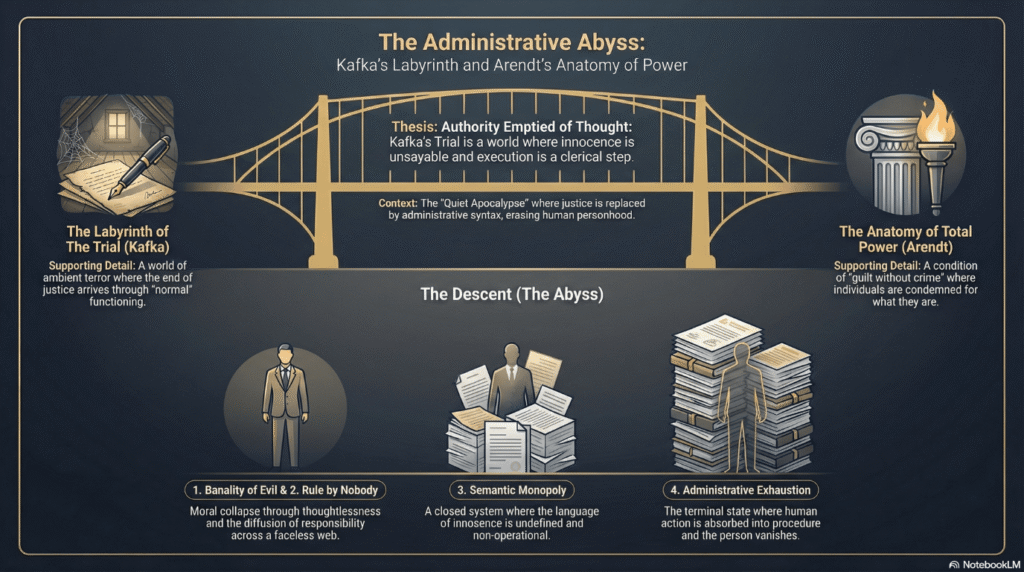
Kafka’s The Trial is not a nightmare of corrupt judges, but a chilling preview of authority emptied of thought, where law outlives justice and procedure replaces conscience. Through the lens of Hannah Arendt, this essay explores how Josef K. is dissolved by a “Rule by Nobody”—a world where innocence is linguistically unsayable and execution is merely the final clerical step in an administrative process.
Introduction: The Quiet Apocalypse

Loud Tyranny and Quiet Terror

Our political imagination is historically trained on the spectacle of tyranny: the shouting dictator, the marching uniform, the violence that announces itself with a crash. In these regimes, terror is an event. Cruelty is visible, and the villains are unmistakable. Resistance, at least in principle, knows exactly where to aim.

Franz Kafka’s The Trial offers a far more disturbing vision. Its terror is not theatrical; it is ambient. It unfolds through the dry scratching of pens, the murmured instructions of ushers, and the stifling air of attic courtrooms tucked away in ordinary apartment buildings. In this world, no one screams. No one panics. Yet, by the time Josef K. recognizes the danger, the trap has already been sprung. Kafka imagines an apocalypse without fire—an end of justice that arrives not through the destruction of the system, but through its perfect, “normal” functioning.

Guilt Without Crime: The Rosetta Stone

This quiet catastrophe becomes legible through Hannah Arendt’s political thought. Arendt identified a chilling modern condition she termed “guilt without crime.” It is a state where individuals are condemned not for what they have done, but for what they are—or rather, what they are presumed to be—within a system that no longer requires a transgression to justify a punishment1.

This concept serves as the Rosetta Stone for Josef K.’s ordeal. He is arrested without charge, prosecuted without accusation, and executed without judgment2. Within this framework, the absence of a crime is not a flaw in the machine; it is a fundamental feature. The court does not ask what K. has done; it asks only how he responds to the fact of his own existence.

Authority After Thought

What Kafka depicts is a world where authority has been emptied of thought. Here, law has outlived justice, and procedure has replaced conscience. Meaning survives only as administrative syntax. In this vacuum, guilt is not discovered—it is a baseline assumption. Innocence is not “denied” in the traditional sense; it is simply non-operational, a word without a function in the system’s vocabulary.

What follows is not a miscarriage of justice, but its evaporation. Under the gaze of the Bureau, speech becomes evidence and action becomes procedure. Life itself is reduced to a case file awaiting the finality of a stamp. Execution, when it finally arrives, is not a punitive act of passion3. It is the last clerical step in a process that began long before Josef K.’s arrest—arguably, at the moment of his birth.

Kafka’s warning is not that the tyrant may return. It is that, eventually, the tyrant may no longer be necessary.

The Banality of the Gavel: Evil Without Malice

The Clerk as Executioner

Hannah Arendt famously coined the “banality of evil” to describe a form of wrongdoing that refuses to roar. It does not arise from the depths of sadism or the heat of ideological fanaticism; instead, it emerges from thoughtlessness—a profound failure to reflect on the moral weight of one’s own actions. In her study of Adolf Eichmann, Arendt dismantled the comforting myth that great crimes require demonic monsters. She found instead an ordinary bureaucrat who facilitated extraordinary horror by simply “doing his job.” In this paradigm, evil does not announce itself with a snarl; it arrives in a briefcase and expresses itself through the faithful processing of paperwork4.

This insight is unsettling because it suggests that the most destructive systems do not require “evil” people. They merely require people who have abdicated their conscience in favor of routine, obedience, and procedural correctness.

Kafka’s Court: The Indifference Machine

In The Trial, Kafka provides a dramatization of this vacuum that is both surreal and uncannily precise. The judicial apparatus that ensnares Josef K. is not animated by fervor or vengeance. No character expresses personal hostility toward him; in fact, the officials are often disturbingly polite or pathologically tired.

The horror of the Court lies in its mundane details. The warders who arrest K. casually eat his breakfast. The clerks are defined by their chronic fatigue rather than their cruelty. The judges remain distant, tethered to an “administrative calm” that feels more like a weather pattern than a legal standing. The Court is not sadistic; it is merely functional. It doesn’t hate Josef K.; it simply has no operational reason to care about him5. By removing emotional investment from the machinery of accusation, Kafka makes the system nearly impossible to resist. One can fight a villain, but how does one fight a department?

Thoughtlessness as Structural Power

Arendt argues that moral collapse occurs the moment an individual stops asking, “What am I doing?” and begins asking, “What is required of me?”6 Kafka’s officials are the embodiment of this transition. Each participant, the thrasher, the lawyer, the usher, performs a narrow, specialized function without ever grasping the systemic whole. Responsibility is endlessly deferred upward, sideways, or into the ether of “The Law.” This fragmentation of labor creates a terrifying paradox: the more efficient the system becomes, the less accountable it is. No single actor commits an obvious crime, yet the cumulative outcome is the total annihilation of the accused. Josef K. is not crushed by a hammer; he is dissolved by a thousand papercuts of indifference7.

Kafka’s warning, later echoed by Arendt, is that bureaucratic indifference is more dangerous than ideological zeal. Fanatics can be exposed and confronted, but a vacuum of ethical reflection presents itself as something far more resilient: necessity.

The Gavel Falls by Default

Fanaticism is loud. It demands belief, loyalty, and a hot-blooded commitment to a cause. Moral emptiness, by contrast, requires nothing but compliance. Kafka’s Court does not ask its servants to believe in the righteousness of their work; it only asks them to continue the motion. This makes the system remarkably durable. When evil wears no face and speaks no slogans, it becomes a part of the architecture—impossible to name, let alone uproot.

Josef K.’s tragedy is his initial expectation of a traditional enemy. He prepares for a battle of wits and a contest of facts, expecting an adversary motivated by hostility. Instead, he encounters a structure that operates without intention, where his destruction is an “emergent property” of ordinary behavior. In the end, the gavel falls not because a judge wills it, but because no one in the long chain of command has the moral imagination to stop it. Kafka exposes a modern nightmare that Arendt would later diagnose in the real world: a world where the most efficient killing machines are powered by the quiet, tireless refusal to think.

But if this moral vacuum is powered by the indifference of the individual, it is anchored by the facelessness of the structure itself. To understand why a clerk can work without a conscience, we must look at a system designed to operate without an author.

The Rule by Nobody: Authority Without Authorship

The Ghost in the Machine

Hannah Arendt identified “rule by nobody” as perhaps the most insidious form of modern domination. Unlike classical tyranny, where power is concentrated in a visible sovereign who can be named, confronted, or overthrown, bureaucratic domination disperses authority across a vast web of procedures, offices, and roles. In such a system, no single individual claims authorship over a decision, yet the system governs with absolute, life-altering force.

Arendt warns that this is not the absence of power, but its maximal diffusion. When responsibility is spread across every desk in a department, it ultimately belongs to no one. What masquerades as “impersonality” or “procedural neutrality” is, in fact, a structure that has rendered human accountability impossible8.

Kafka’s Labyrinth: The Receding Horizon

The Trial stages this facelessness as both a spatial and psychological nightmare. Josef K.’s search for the “higher judges” is a journey defined by perpetual deferral. Every authority figure he encounters points elsewhere—up another staircase, into another attic, behind another heavy door. Power recedes the moment it is pursued.

The Court does not reside in monumental, imposing buildings that command respect; instead, it is embedded in the rot of tenements, the backrooms of workshops, and the cramped corridors of apartment buildings. Authority inhabits the everyday. It “leaks” into domestic and social life like a pervasive dampness. Yet, despite its omnipresence, K. never encounters a sovereign figure who can explain, justify, or reverse his fate. Kafka constructs a world where power is architectural rather than personal. The law is not embodied; it is ambient.

The Injustice of the Vacuum

Arendt argues that under the “rule by nobody”, injustice becomes uniquely unbearable because it offers no interlocutor9. One cannot petition a vacuum. Josef K.’s tragedy is not merely that he is accused, but that he has nowhere to direct his protest. Every official he meets is simultaneously authoritative and powerless—capable of enforcing a minute procedure but entirely unable to alter the final outcome.

This creates a structural deadlock. Revolt requires a target: a ruler, an ideology, or a command center. Kafka’s system denies all three. The accused is trapped in a web where every strand exerts pressure, yet no single strand can be cut without leaving the rest of the web intact. The result is a total domination without drama. Power does not strike like a lightning bolt; it circulates like a virus.

From Vertical Command to Horizontal Circulation

Traditional political power operates vertically: commands flow downward, and responsibility flows upward. Such systems, however brutal, retain a logic of confrontation. Kafka’s Court represents a different configuration: horizontal circulation. Authority moves laterally through clerks, warders, files, and rumors. No single node controls the whole, yet the whole controls everyone10.

This shift explains why Josef K.’s resistance repeatedly misfires. He behaves as if he were facing a vertical hierarchy—seeking explanations, fairness, and “higher” judgment—when he is actually entangled in a network that does not recognize those categories. He is using an old political grammar in a world that has rewritten the rules. Kafka’s brilliance lies in exposing what Arendt would later diagnose: a modern condition defined by violence without intention and law without justice. The most terrifying aspect of this system is not that it forbids revolt, but that it renders the very concept of revolt obsolete.

Once authority becomes a faceless, horizontal fog, the struggle for justice shifts from the courtroom to the dictionary. When there is no sovereign person to confront, the battlefield becomes the very language we use to assert our innocence.

Law as Language: The Semantic Monopoly

The Linguistic Trap: Grammar vs. Code

In The Trial, the law does not function as a rulebook to be consulted, interpreted, or strategically navigated. It functions instead as a closed semantic system—a language with its own internal grammar, rigid assumptions, and limited permissible utterances. Josef K.’s fundamental error is his attempt to treat the Law as a “code” to be cracked.

A code allows for external reference; one can point to a rule and argue compliance from the outside. A language, however, precedes and envelops the speaker. In Kafka’s Court, meaning is not negotiated; it is pre-structured. To speak at all is to submit to the system’s syntax. The Court does not evaluate the truth of an argument; it merely evaluates whether the speech conforms to its own internal, circular logic.

Arendt’s Lexis: The Murder of the “Who”

Hannah Arendt placed speech (lexis) at the very center of political life. In The Human Condition, she argues that speech and action together disclose the “who” of a person—not their social role or their “case file” status, but their singular, irreplaceable identity. For Arendt, speech is revelatory: it introduces the individual into a shared world where meaning is co-created through recognition and debate11.

However, Arendt’s vision presupposes a public space capable of receiving that speech. Kafka’s Court preserves the outward form of speech while annihilating its function. It allows K. to talk, but it refuses to listen.

Kafka’s Inversion: The “Divide-by-Zero” Error

Josef K. speaks constantly. He explains, protests, clarifies, and reflects with exhaustive energy. Yet none of this speech produces intelligibility. The problem is not that the Court rejects his claims of innocence; it is that the language of innocence does not exist within the Court’s semantic universe12.

Innocence is not “denied”—it is undefined. The system has no grammatical position for it. Much like a “divide-by-zero” operation in mathematics, the term “Innocent” cannot be processed by the Court’s hardware. Consequently, every attempt to assert it collapses into noise, or worse, is automatically translated into “evidence of concealment.” Kafka constructs a legal order where meaning is a monopoly: only certain utterances are legible, and every legible utterance presupposes guilt. Silence is seen as suspicious; explanation is seen as manipulative; protest is seen as a procedural complication.

The Semantic Monopoly: Translation as Domination

The Court’s greatest power lies in its ability to translate all resistance into confirmation. This is domination at the level of meaning. The Law does not argue; it re-encodes. Every emotional reaction becomes behavioral data; every clarification becomes a new entry in a growing file. Josef K. does not lose because he speaks poorly; he loses because the system has assigned a “guilty” value to his speech before he even opens his mouth.

Kafka anticipates a terrifying modern condition where authority no longer needs to silence dissent—it simply reclassifies it. In Arendtian terms, K. is denied the possibility of appearing as a “who.” His speech reveals nothing because the system recognizes only “case material.” The Law, in its infinite narcissism, listens only to itself.

Innocence as a Semantic Impossibility

Kafka’s most devastating insight is that a system need not explicitly condemn innocence to destroy it; it only needs to remove the word from circulation. When innocence cannot be spoken meaningfully, guilt becomes the default ontology. Existence itself becomes incriminating.

Josef K.’s endless talking is not a form of resistance, but a form of acceleration. Each word deepens his entanglement in a language designed to absorb and neutralize him. The Court does not need to lie to K.; it only needs to own the dictionary. And in Kafka’s universe, the definitions have already been written in a language that K. can speak, but never truly own.

If the language of the Law has no operational slot for innocence, then every movement made by the accused within that language serves only to tighten the knot. In this semantic cage, the capacity to act, ‘new beginning’—is transformed into its opposite: administrative entrapment.

The Death of Action: Activity Without Agency

Arendt’s Praxis: The Joy of the Beginning

In her philosophical architecture, Hannah Arendt distinguished action (praxis) as the highest and most fragile of human activities. Unlike labor (the repetitive cycle of biological survival) or work (the creation of enduring objects), action is the capacity to initiate something genuinely new. To act is to interrupt the crushing weight of necessity with a “new beginning.” It is unpredictable, plural, and revelatory, disclosing the actor not as a mere functionary, but as a “who.13“

For Arendt, genuine action is the heartbeat of politics because it introduces novelty into the world. It resists calculation. However, once action is reduced to routine or “outcome management,” it ceases to be action and becomes mere administration. It is here that Kafka’s Court reveals its most sinister function: it is a machine designed specifically to neutralize beginnings.

Kafka’s Entropy: The Procedural Absorption

In The Trial, Josef K. is a whirlwind of activity. He investigates, consults lawyers, delivers impassioned speeches, and formulates elaborate strategies for reform. Yet, despite this constant motion, nothing changes. Activity proliferates, but agency evaporates.

Kafka exposes a system that does not need to suppress action outright; instead, it simply reclassifies it. Every initiative K. takes is instantly absorbed into a procedure. His anger becomes a “noted behavioral trace”; his explanation becomes a “submitted report”; his withdrawal becomes a “procedural posture.” Action no longer interrupts the system; it feeds it. The Court does not care what K. does—it only records how predictably he does it. This is the law of entropy: K. is burning immense amounts of energy, but he is doing zero work.

Condemned for Coherence

Perhaps Kafka’s most chilling insight is that Josef K. is not condemned for a crime, but for his legibility. His greatest liability is his commitment to reasonableness. He explains himself clearly, organizes his thoughts, and seeks a fair hearing. In doing so, he supplies the system with exactly what it craves: structured data.

In this world, innocence and guilt are secondary to “processability.” K.’s coherence becomes metadata—evidence not of wrongdoing, but of his compatibility with bureaucratic extraction. His speeches are not evaluated for their truth, but mined for their consistency, tone, and responsiveness. In Arendtian terms, K.’s actions fail because they never achieve the status of praxis. They do not initiate; they merely “comply in motion.” He is a man behaving like a machine in hopes that the machine will recognize his humanity.

Activity Without Agency: The Administrative Exhaustion

Arendt warned that when action is absorbed into necessity, human beings become predictable and, therefore, controllable14. Kafka’s Court operationalizes this warning. K.’s relentless activity provides a cruel illusion of resistance while guaranteeing its impossibility. Each effort narrows his “range of appearance” until the man disappears and only the “case” remains15.

This explains the profound sense of exhaustion that permeates the novel. K.’s speeches are not acts of self-assertion, but acts of self-drainage. His vitality is converted into paperwork. The more he speaks, the thicker his file grows, and the smaller he becomes within it. The system does not need to silence Josef K.; it simply lets him talk himself into a state of total administrative exhaustion.

The Shrinking of the Actor

Kafka stages a brutal reversal of Arendt’s political hope. Instead of action generating new beginnings, it accelerates entrapment. By the time K. nears his end, his movements no longer even feel like choices; they are reflexive, pre-encoded responses to a system that has already anticipated them.

Kafka reveals a distinctively modern catastrophe: a world humming with activity, efficiency, and motion, yet entirely devoid of “action” in the political sense. It is a world where human beings are endlessly, frantically busy, and yet, in the eyes of the Law, nothing ever truly happens.

When action is reduced to mere activity, and the actor is stripped of their power to begin, they reach a terminal state of systemic obsolescence. They cease to be a protagonist in their own story and become a redundant variable—a ‘superfluous man’ waiting for disposal.

The Superfluous Man: Objective Guilt and the End of Personhood

The Final Status: Arendt’s Superfluousness

In the final arc of her analysis in The Origins of Totalitarianism, Hannah Arendt identifies superfluousness as the terminal condition of modern domination. The most radical form of power, she argues, does not merely exploit or oppress; it renders the individual unnecessary. A superfluous person is not an enemy to be defeated or a criminal to be punished; they are an administrative redundancy16.

This marks the total collapse of personhood. Once a human being is no longer required by the system—economically, politically, or even symbolically—their removal becomes a matter of logistics rather than justice. In this state, violence no longer requires a moral justification; it requires only a schedule and an efficient method of disposal.

Objective Guilt: Existence as Liability

By the final chapters of The Trial, Josef K.’s guilt has hardened into an “objective condition.” He is no longer guilty because of anything he has done; he is guilty because he is. His existence has become a glitch in the system’s smooth operation—a variable that the machine can no longer compute.

This inversion is the pivot upon which the entire novel turns. Traditional law begins with an act and ends with a judgment. Kafka’s Court reverses the sequence: guilt precedes the action, and action merely confirms the baseline assumption. Josef K.’s entire life is mined for evidence retroactively. The case does not need to be “proven” in any sense we would recognize; it simply needs to be closed. In Arendt’s terms, this is the moment the “right to have rights” vanishes17. Rights require a recognized personhood within a political order. Once K. is fully processed into “case material,” there is no longer a “who” to which those rights could attach.

The “Dog-Like” Death: Execution as Administration

Josef K.’s death is famously described as being “like a dog.18” While often read as a moment of emotional shame, the deeper cruelty is structural. The execution is not punitive; there is no righteous condemnation or moral climax. Instead, the killing functions as a clean-up operation—the final clerical step in a completed process.

The men who lead K. to the quarry do not hate him. They do not judge him. They are simply carrying out a task with the practiced indifference of movers or janitors. The system does not “punish” the superfluous; it merely removes them. The language of crime is replaced by the language of disposal. Arendt warned that once human beings are reduced to superfluousness, death loses its moral weight. It becomes a technical solution to an administrative problem19. Kafka stages this with chilling, hushed restraint.

The End of Personhood

At the moment of his death, Josef K. has been fully translated from a “who” into a “what.” He is a procedural remainder, an inefficiency finally resolved. This is the Court’s ultimate success: it has not merely killed a man, but it has erased the very conditions under which his killing could be understood as an injustice.

Kafka thus exposes the terminal danger of a world governed by objective guilt. When existence itself is the liability, resistance becomes meaningless, innocence becomes unspeakable, and death becomes banal. Human beings vanish not in a flare of terror, but in a quiet cloud of compliance. Arendt feared this condition because it represents a world where moral language no longer applies—where we can be eliminated without cruelty, hatred, or even intent. Kafka shows us that world from the inside.

The story ends, fittingly, without a judgment. Because in a world of pure procedure, judgment is the one thing the system can no longer afford to give.

Conclusion: The Warning

Semantic Control and the Evaporation of Justice

Neither Kafka nor Arendt warns us primarily of villains. There are no monsters in The Trial, no tyrants issuing blood-soaked decrees, and no ideologues demanding fanatical devotion. What they expose instead is a distinctly modern danger: semantic control coupled with proceduralism. They describe a world in which meaning is monopolized, and human action is endlessly absorbed into process.

In this world, justice does not collapse through corruption or overt cruelty; it evaporates through “normal” operation. Forms are filed correctly. Procedures are followed. Language functions smoothly. And yet, amidst this perfect functioning, nothing just ever occurs. What disappears is not legality, but the legibility of the human being as a moral subject. Arendt warned that when a system no longer requires judgment, responsibility dissolves into roles and law becomes detached from ethics. Kafka shows us how this detachment feels from the inside: exhausting, confusing, and eerily calm. The system does not fail loudly; it succeeds quietly.

The Final Image: Disappearance by Administration

Kafka’s final image is not one of chaos, but of tidiness. Josef K.’s death is not a dramatic climax; it is an administrative closure. One more case resolved. One more anomaly removed. Power leaves no fingerprints because it no longer needs hands.

This is the ultimate warning. A society need not abandon the law to become unjust; it needs only to replace meaning with procedure and speech with classification. When systems no longer ask who you are, but only how you function, personhood becomes optional. In such a landscape, the individual is not a citizen, but a data point—a variable to be optimized or an error to be deleted.

Josef K. does not lose because he is guilty. He loses because he is fluent—fluent in reason, explanation, coherence, and participation. He speaks a language that offers no word for innocence and no grammar for escape. The more clearly he speaks, the more completely he is translated into his own disappearance.

Kafka and Arendt do not ask us to fear evil men. They ask us to fear a world where the machine is so perfect that no one needs to be evil anymore.

Footnotes

  1. Hannah Arendt and Anne Applebaum, The Origins of Totalitarianism (Mariner Book Classics, 2024), 296–97. ↩︎
  2. Franz Kafka, The Trial, with Sunil Kumar (WilcoPublishing House, 2022), 2–3. ↩︎
  3. Hannah Arendt, Eichmann in Jerusalem: A Report on the Banality of Evil, with Amos Elon (Penguin Books, 2006), 276–79. ↩︎
  4. Ibid, 276–79. ↩︎
  5. Kafka, The Trial. ↩︎
  6. Hannah Arendt, The Life of the Mind: One/Thinking, Two/Willing, one-vol.ed, trans. J.B. Leishman and Stephen Spender, A Harvest Book (Hartcourt, 1976), 11. ↩︎
  7. Kafka, The Trial, 62–67. ↩︎
  8. Hannah Arendt, Crises of the Republic: Lying in Politics; Civil Disobedience; on Violence; Thoughts on Politics and Revolution (Harvest Book ; Harcourt Brace & Company, 1972), 137–40. ↩︎
  9. Arendt and Applebaum, The Origins of Totalitarianism, 503–6. ↩︎
  10. Kafka, The Trial, 33–41, 82–90. ↩︎
  11. Hannah Arendt et al., The Human Condition, Second edition (The University of Chicago Press, 2018), 175–81. ↩︎
  12. Kafka, The Trial, 42–48, 130–110. ↩︎
  13. Arendt et al., The Human Condition, 175–81, 206–7. ↩︎
  14. Hannah Arendt, Between Past and Future, trans. Denver Lindley., with Jerome Kohn (Penguin Publishing Group, 2006), 60–63. ↩︎
  15. Kafka, The Trial, 145–52. ↩︎
  16. Arendt and Applebaum, The Origins of Totalitarianism, 457–59. ↩︎
  17. Ibid, 298. ↩︎
  18. Kafka, The Trial, 273. ↩︎
  19. Arendt, Eichmann in Jerusalem, 276–79. ↩︎

Bibliography

Arendt, Hannah. Eichmann in Jerusalem: A Report on the Banality of Evil. With Amos Elon. Penguin Books, 2006.

Arendt, Hannah. The Life of the Mind: One/Thinking, Two/Willing. One-vol.Ed. Translated by J.B. Leishman and Stephen Spender,. A Harvest Book. Hartcourt, 1976.

Arendt, Hannah. Crises of the Republic: Lying in Politics; Civil Disobedience; on Violence; Thoughts on Politics and Revolution. Harvest Book ; Harcourt Brace & Company, 1972.

Arendt, Hannah, Danielle S. Allen, and Margaret Canovan. The Human Condition. Second edition. The University of Chicago Press, 2018.

Arendt, Hannah. Between Past and Future. Translated by Denver Lindley. With Jerome Kohn. Penguin Publishing Group, 2006.

Arendt, Hannah, and Anne Applebaum. The Origins of Totalitarianism. Mariner Book Classics, 2024.Kafka, Franz. The Trial. With Sunil Kumar. WilcoPublishing House, 2022.

Category: Philosophical Logic

Leave a Reply Cancel reply

Your email address will not be published. Required fields are marked *

About Me

I’m Sophie, a cross-disciplinary reader who treats books like puzzle boxes. I read literature through history, philosophy, psychology, and science—then weave the threads together. Welcome to my tapestry.

Categories

  • Announcements
  • Narrative Psychology
  • Philosophical Logic
  • Social Forces Shaping Literature
©2026 The Book Tapestry