The Book Tapestry

From the pages to the mind—woven with care.

Menu
  • Home
  • Blog
  • Privacy Policy
  • About Me
Menu

Red Rising Existentialist Analysis: the Architecture of the Reaper

Posted on February 8, 2026February 22, 2026 by Sophia Wordsmith

At a Glance

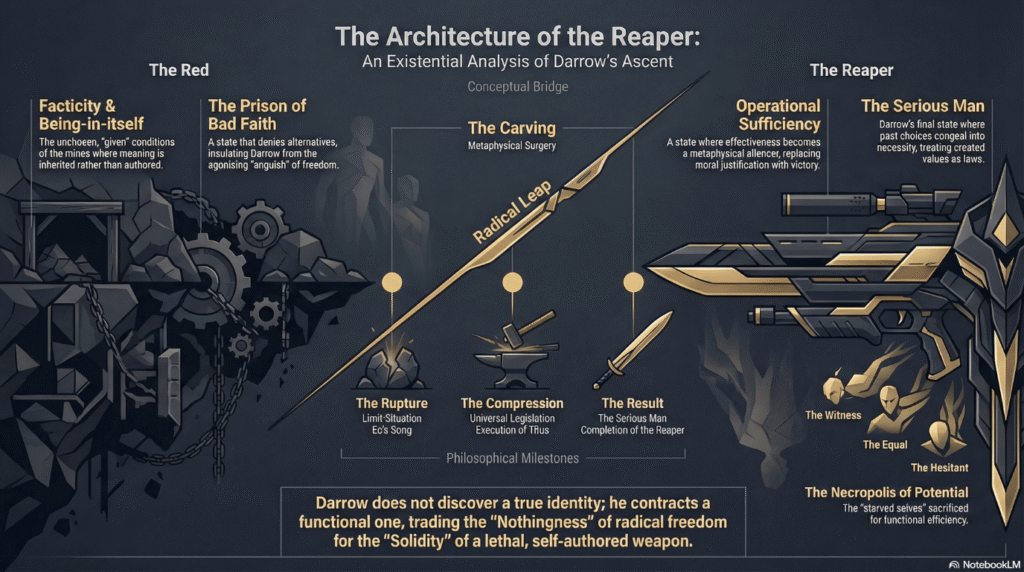
The tragedy of Darrow’s ascent in Red Rising is not that he finds his true self, but that he strategically narrows his humanity to become a functionally sufficient weapon. By trading the radical freedom of his “Red” facticity for the “Solid Silence” of the Reaper, he ceases to be a person who chooses and becomes a masterpiece of existential contraction, guided by victory but closed to the alternative lives he starved to make his success possible.
Introduction

In Red Rising, Darrow’s transformation is frequently misread as a conventional narrative of awakening—a laborer unmasking a lie to claim a “true” identity. Yet this framing ignores the existential cost of his ascent. Darrow does not discover who he is; he contracts who he can be. His trajectory is not an expansion of radical freedom, but its strategic narrowing into something operational, legible, and lethal. What emerges by the final page is not an authentic self, but a functionally sufficient one.

Darrow’s existence as a Red is defined by facticity: the unchosen, “given” conditions that structure human life prior to the emergence of choice1. The mines of Lykos are more than an oppressive setting; they constitute a pre-packaged essence, a state of Being-in-itself where meaning is inherited rather than authored. In this “Red” world, labor and sacrifice are framed as ontological constants, insulating Darrow from the anguish of freedom2. Red life is thus a prison of Bad Faith (mauvaise foi)3—not because it lacks sincerity, but because it denies the existence of alternatives.

The catalyst for Darrow’s rupture is Eo’s song. Crucially, the song provides no blueprint; it offers no new essence to replace the old. Instead, it creates what Karl Jaspers termed a limit-situation—a catastrophic boundary where the individual’s interpretive framework collapses. The song does not liberate Darrow; it destabilizes him, throwing him into a Sartrean “nothingness” where the inherited “Red” meaning is dead, but the “Gold” meaning is yet to be forged. He is, in the most terrifying sense, condemned to be free4.

This creates the central existential tension of the Institute: when a man discovers his meaning is a lie, does he embrace the radical, agonizing freedom of the void, or does he seek a new solidity capable of silencing that freedom? Darrow chooses the latter. He constructs the Reaper—not as a temporary mask, but as a sedimented essence designed to survive the vacuum of Mars.

The Carving: Metaphysical Surgery

Existence Precedes Essence: The Radical Leap

Jean-Paul Sartre’s foundational claim that “existence precedes essence” posits that human beings are not born with a fixed nature; they exist first and define themselves through a lifetime of choice5. In Red Rising, the Carving literalizes this claim with grotesque precision. Darrow’s Red body—his biological facticity, his ancestral history, and his social caste—is not merely rejected, but it is physically annihilated. The Carving is not a metaphor for self-reinvention; it is metaphysical surgery6.

In Sartrean terms, facticity refers to the unchosen “givens” of existence: one’s body, class, and past7. Darrow’s Red form is the densest possible facticity, biologically engineered for toil and culturally conditioned for erasure. By consenting to Mickey’s knife, Darrow performs a Radical Leap. He destroys the most determinative aspects of his given essence to re-enter the world as a vacuum that must now define itself entirely through action. He attempts to achieve a pure state of transcendence—rising above his “given” nature to become a self-authored being8.

The Mask as Early Bad Faith: Survival Through Role

This absolute freedom immediately produces anguish9—the vertigo one feels when realizing that nothing, not even morality, is “pre-written.” Darrow responds to this vertigo by adopting the “Reaper” persona, initially not as a self, but as a protective mask.

At this stage, the Reaper functions as an instrument of Bad Faith (mauvaise foi)10. Darrow repeatedly frames his brutality as a “necessity,” telling himself he must deceive and kill for the Rising. This language is a flight from responsibility; he is pretending to be a tool dictated by duty rather than a subject choosing violence. By saying “I have to do this,” Darrow converts his radical freedom into a script. The Reaper becomes a role he performs, allowing him to commit cruelty without full psychic authorship. This is not cowardice, but psychological stabilization—using a role to silence the unbearable “Nothingness” of his true freedom.

Sartre’s “The Look”: The Objectification of the Self

The transformation deepens through what Sartre calls “The Look” (le regard)—the moment one becomes aware of oneself as an object being judged by another11. In the Institute, Darrow is perpetually under the Gold gaze. He realizes that to the Golds, he is an entity to be measured, categorized, and feared.

Over time, this gaze is internalized. Darrow stops merely “acting” Gold and begins to monitor his own soul as if he were his own enemy. He treats his empathy and hesitation not as valid feelings, but as “mechanical liabilities” to be purged. His consciousness splits into Actor and Audience. Sartre warns that prolonged exposure to the Look risks transforming the “Self” into a “Thing” (En-soi)12. The Reaper mask, once a flexible survival tactic, begins to undergo a process of ossification, hardening into the very governing structure Darrow once sought to destroy.

The Turning Point: The Execution of Titus

From Mask to Project: The Compression Point

The execution of Titus marks the decisive compression point in Darrow’s existential arc. Until this moment, the Reaper functioned as a mask—a tactical role adopted to satisfy the mission. With Titus’s death, the Reaper ceases to be a disguise and becomes a Project: a self-authored identity that Darrow is now committed to maintaining at any cost.

What makes this moment philosophically transformative is Titus’s identity as a “mirror.” Titus is a fellow Red, carved and discarded, representing the raw, unrefined rage of the oppressed. By killing Titus, Darrow does not merely eliminate an enemy. Instead, he forecloses an alternative version of himself. This is no longer survival violence; it is meaning-preserving violence. Darrow is murdering his own potential for “unregulated” Red anger to protect the “regulated” Gold authority of the Reaper13.

Legislative Violence: Authoring the Law

With the fall of the axe, Darrow crosses the threshold from participant to Legislator. In Sartrean ethics, every choice is an act of universal legislation—to choose a value is to declare it valid for all of humanity14. Darrow’s execution of Titus is thus a juridical act. He is not following the rules of the Institute; he is creating the moral architecture of the Rising.

This is normative violence: violence that does not merely enforce order but defines it. Darrow implicitly declares that in his world, solidarity without discipline is disqualifying. He is no longer navigating a system; he is authoring a new hierarchy. The Reaper is no longer a role he inhabits; it has become an Office—a station of power with its own internal logic and requirements. Darrow has traded the fluidity of a “rebel” for the gravity of a “Sovereign.”

The Death of Hesitation: Starving the Open Self

The most profound consequence of this execution is the atrophy of ethical latency. Prior to Titus, Darrow allowed for pauses—moments of Sartrean “anguish” where competing meanings could be weighed15. After Titus, hesitation is reclassified as a structural failure.

Darrow does not repress his doubt; he starves it through non-use. The speed and effectiveness of the Reaper’s “Solid Silence” render the Hesitant Self impractical, and in the crucible of the Institute, the impractical becomes the illegitimate. Sartre warns that freedom can calcify into habit when past choices begin to dictate future ones under the guise of “consistency16.”

By the end of this episode, Darrow’s authority depends on his predictability. The “Hesitant Darrow” dies because he is too slow for the Reaper’s velocity. What remains is a Strategic Immediacy: a state where action bypasses internal debate entirely. Darrow no longer asks what he should do; he executes what the Reaper must do.

The Geometry of the Reaper: Coherence and Density

Operational Sufficiency: Success as the Convincing Liar

By the final movement of Red Rising, the fundamental question governing Darrow’s consciousness shifts from “Is this right?” to “Does this work?” This transition marks the emergence of operational sufficiency: the belief that effectiveness is an adequate surrogate for justification.

Sartre insists that moral responsibility cannot be discharged by outcomes; freedom always precedes the result17. Yet, the Institute’s logic recognizes only the visible currency of victory. Success acts as a metaphysical silencer. It does not claim moral truth; it offers retroactive validation. Each captured castle and broken enemy confirms the Reaper’s internal logic not through argument, but through consequence. The “Narrowing” of Darrow’s possible selves is thus justified after the fact—what survives appears “correct” simply because it was effective.

The Solid Silence: Density vs. Sartrean Nothingness

Superficially, the silence that replaces Darrow’s internal monologue might resemble Sartrean Nothingness (le néant)—the gap between stimulus and response where freedom resides18. However, Darrow’s silence functions as its polar opposite.

Sartrean Nothingness is generative; it interrupts habit and opens the field of choice. Darrow’s silence, by contrast, is Solid. It does not clear space; it fills it. This is the silence of Inertia. Decisions accumulate like sediment, giving the Reaper weight and gravity. Each act makes the next easier, faster, and less negotiable.

In mechanical terms, the Reaper functions as a flywheel. Once set in motion, it conserves momentum and eliminates the “friction” of doubt. But in existential ethics, friction is precisely where the “human” lives. By removing it, Darrow achieves a terrifying efficiency—freedom converted into Kinetic Momentum.

The Necropolis of Potential: The Starved Selves

The cost of this coherence is not corruption, but attrition. By the end of Book 1, several “possible Darrows” have not been defeated in battle; they have been starved through disuse. Their extinction is quiet, making it impossible to mourn.

  • The Witness: This self-valued presence over control and grief over resolution. The Witness is sidelined because it is unscalable. It introduces moral friction by refusing to collapse pain into strategy.
  • The Equal: This self sought leadership through mutual recognition. It is starved because equality blurs accountability. The Reaper requires vertical clarity; the Equal is structurally incompatible with the Scythe.
  • The Hesitant: This self embodied ethical latency—the pause in which alternative meanings might emerge. It is reclassified as a luxury. Slowness threatens momentum, and in the Reaper’s geometry, the slow is the dead.

Together, these identities form a Necropolis of Potential. Darrow’s final state is not one of “Evil,” but of Compression. He has traded the “Nothingness” of a free man for the “Solidity” of a weapon. He is finally Sufficient, but he is no longer Open.

Conclusion: The Gilded Success

The final image of Red Rising is not one of liberation, but of completion. Darrow stands before Nero au Augustus not as a man torn between Red memory and Gold performance, but as a finished work—a coherent, legible fact. The Reaper no longer functions as a mask or even a project in flux; it has stabilized into an identity that requires no further justification. Darrow has won the Institute, secured recognition, and achieved the Society’s highest virtue: predictability under pressure19.

From an existential perspective, this victory is deeply ambiguous. Albert Camus warns that rebellion risks self-betrayal the moment it hardens into ideology20. True revolt must be a constant tension held against the world, but by the end of Book 1, Darrow’s revolt has become a method. Violence is no longer reactive or provisional; it is systematic and optimized. The Reaper does not merely challenge the structure of domination; he inherits its logic to overthrow its masters. What is lost in this optimization is the elasticity of freedom—the capacity to hesitate, to revise, and to remain open to contradiction.

Crucially, Darrow is not deceived; he is outpaced. Each victory arrives faster than doubt can form, silencing questions not by force, but by irrelevance. As Sartre observes in his critique of the “Serious Man,” freedom is not lost through ignorance, but through the “congealing” of past choices into necessity. Darrow’s coherence has become momentum, and his momentum has become his constraint. He is now the “Serious Man” who treats his created values as if they were laws of nature. The tragedy of Red Rising is therefore not corruption, but sufficiency. Darrow is not blinded by a lie; he is sustained by a result. He is strong enough, decisive enough, and successful enough. But in becoming “enough,” he has ceased to be “free.” The Reaper stands complete—a masterpiece of existential contraction—guided by victory and quietly closed to the alternative selves that were starved to make him possible.

Notes

  1. Jean-Paul Sartre, Being and Nothingness: An Essay on Phenomenological Ontology, trans. Hazel Estella Barnes (Washington Square Press, 1966), 80–82. ↩︎
  2. Jean-Paul Sartre, Existentialism Is a Humanism, with Carol Macomber et al. (Yale University Press, 2007), 25–28. ↩︎
  3. Sartre, Being and Nothingness, 86–90. ↩︎
  4. Ibid, 186 ↩︎
  5. Sartre, Existentialism Is a Humanism, 20–23. ↩︎
  6. Pierce Brown, Red Rising Trilogy: 01 / Red Rising, First edition (Del Rey, 2014), 84–95. ↩︎
  7. Sartre, Being and Nothingness, 80–82. ↩︎
  8. Brown, Red Rising Trilogy, 53–106. ↩︎
  9. Sartre, Existentialism Is a Humanism, 25–28. ↩︎
  10. Sartre, Being and Nothingness, 86–90. ↩︎
  11. Ibid, 340–42. ↩︎
  12. Ibid, 347–49. ↩︎
  13. Brown, Red Rising Trilogy, 208–26. ↩︎
  14. Sartre, Existentialism Is a Humanism, 24–25. ↩︎
  15. Ibid, 25–28. ↩︎
  16. Ibid, 86–91. ↩︎
  17. Ibid, 23–25. ↩︎
  18. Ibid, 40–43. ↩︎
  19. Brown, Red Rising Trilogy, 374–82. ↩︎
  20. Albert Camus and Albert Camus, The Rebel: An Essay on Man in Revolt, 1st Vintage International ed (Vintage Books, 1991), 19–21. ↩︎

Bibliography

Brown, Pierce. Red Rising Trilogy: 01 / Red Rising. First edition. Del Rey, 2014.

Camus, Albert, and Albert Camus. The Rebel: An Essay on Man in Revolt. 1st Vintage International ed. Vintage Books, 1991.

Sartre, Jean-Paul. Being and Nothingness: An Essay on Phenomenological Ontology. Translated by Hazel Estella Barnes. Washington Square Press, 1966.
Sartre, Jean-Paul. Existentialism Is a Humanism. With Carol Macomber, Annie Cohen-Solal, and Arlette Elkaïm-Sartre. Yale University Press, 2007.

Category: Philosophical Logic

Leave a Reply Cancel reply

Your email address will not be published. Required fields are marked *

About Me

I’m Sophie, a cross-disciplinary reader who treats books like puzzle boxes. I read literature through history, philosophy, psychology, and science—then weave the threads together. Welcome to my tapestry.

Categories

  • Announcements
  • Narrative Psychology
  • Philosophical Logic
  • Social Forces Shaping Literature
©2026 The Book Tapestry