Introduction
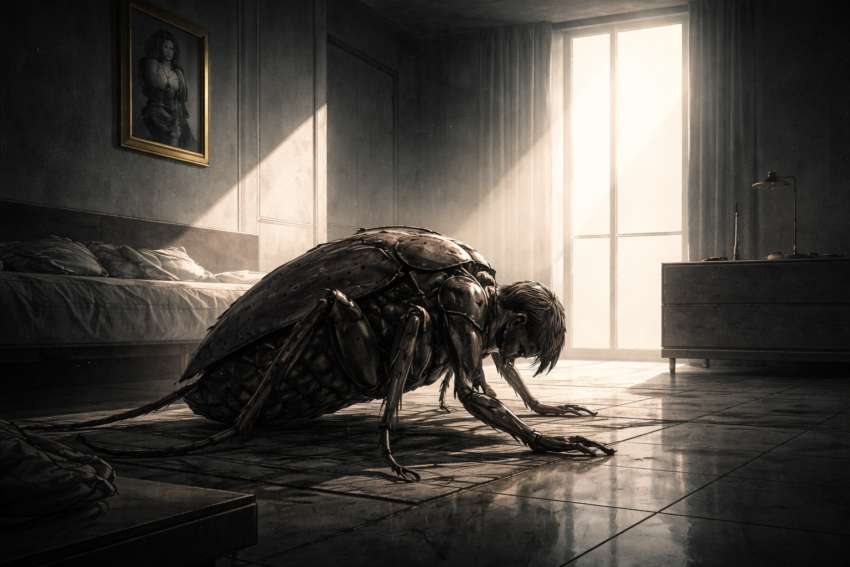
Franz Kafka’s The Metamorphosis opens with the rattle of steel. An alarm clock—mechanical, punctual, and disciplinary—jolts Gregor Samsa into an obligation his body can no longer fulfill. Even as he realizes he is trapped within a hardened, chitinous, and alien shell, his first instinct is to answer the call of the office, attempting to coordinate his new limbs with the morning train schedule1.
The novel closes not with a release into the sublime, but with a different kind of steel: the white, clinical intensity of sunlight flooding the apartment after Gregor’s death. This light does not console; it sanitizes. Between the opening alarm and the final sun, a single, continuous logic stretches: optimization without mercy.
Gregor’s situation is more than a tragedy of physical mutation; it is a literalization of Max Weber’s stahlhartes Gehäuse—the “steel-hard housing” often translated as the “Iron Cage2.” For Weber, this cage was never merely architectural or economic; it was formative, a rationalized enclosure that reshaped the very contours of human subjectivity. Kafka radicalizes this insight by making the cage biological and linguistic. Gregor does not merely work within a rational system; he is re-engineered by it.
Ultimately, Gregor Samsa fails as a “Hero of the Absurd.” Unlike Camus’s Sisyphus, who finds dignity in his struggle against an external rock,3 Gregor’s burden is an internal annexation. His “Leap of Faith” is merely a “Static Leap4“—a desperate pressure against an “Internal Gold” that the “Steel” world of management and procedure eventually bleaches out. Kafka’s true horror lies not in the violent denial of the soul, but in its quiet, efficient housing—until nothing remains that needs to be denied at all.
The Anatomy of the Cage: From Labor to Biology
Max Weber’s famous metaphor of the “iron cage”5 sounds deceptively soft in English. In the original German, Weber wrote of a stahlhartes Gehäuse—a steel-hard housing or shell. The imagery suggests something far more intimate than prison bars; it evokes an exoskeleton. It is no longer a room that confines the subject from the outside; it is a structure that hardens around the subject, dictating the very form of the life within6.
This is precisely the fate of Gregor Samsa. His transformation does not introduce alienation; it completes it. Gregor’s insect body is the rationalized worker made literal: optimized for endurance, stripped of expressive freedom, and reduced to pure function. He does not rebel against the change; he attempts to adapt to it. His new specialization is no longer productivity; it is obstruction. He becomes, with tragic efficiency, a managed nuisance—a “glitch” in the family and societal machinery.
The Architecture of Constraint
Gregor’s confinement operates through a “stacked” enclosure, where each layer of the cage reinforces the next:
- Chitin (The Biological Cage): The final form of rationalization. Gregor’s exoskeleton is opaque, armored, and unresponsive. While his inner life persists, it is surgically sealed off from expression.
- The Bedroom (The Architectural Cage): A holding cell within the family economy. Doors are locked, not out of malice, but procedure. The lock symbolizes an administrative reflex rather than a moral judgment.
- Debt (The Financial Cage): Gregor’s labor exists solely to service his parents’ obligations. Even in his incapacity, the debt remains the household’s organizing principle. His worth was never intrinsic; it was ledger-based.
- The City (The Societal Cage): The urban grid of schedules, trams, and offices hums on without him. His disappearance produces no rupture, only a reallocation of resources7.
Together, these layers form a system in which escape is not violently prevented, but structurally inconceivable. Kafka radicalizes Weber’s sociology by rendering it corporeally: the bureaucratic subject no longer lives inside the shell; he is the shell.
The Absence of Scorn: Gregor vs. Sisyphus
This intersection of biology and bureaucracy is where Kafka diverges sharply from Albert Camus. In The Myth of Sisyphus, Camus’s hero achieves dignity through lucidity. Sisyphus recognizes the futility of his condition, rejects transcendental meaning, and claims ownership of his labor. The rock is absurd, but as Camus famously notes, “the struggle itself toward the heights is enough to fill a man’s heart8.”
Gregor, however, never reaches this summit. The structure of his cage prevents even the birth of rebellion. His consciousness remains trapped in a fog of obligation, shame, and confusion. He does not scorn the system that consumes him; he apologizes to it.
Where Sisyphus stands upright and conscious before the absurd, Gregor lies on his back, legs twitching in the air, unable even to right himself. Sisyphus owns his punishment; the shell owns Gregor. That difference—the distance between lucidity and fog—is the distance between an existential revolt and a quiet extinction.
The Gult Frame: The Sovereignty of “Internal Gold”
In the gray, high-utility world of The Metamorphosis, Kafka introduces objects that aggressively resist instrumental explanation. Principal among these is the “Lady in Furs” and the gilt (gold-plated) picture frame that houses her9. These objects are, by the standards of Gregor’s world, entirely useless. They do not feed, transport, calculate, or optimize. They exist simply to be seen—and to be remembered.
The Symbolism of Gold: The Economically Irrational
In this context, Gold functions as the “economically irrational.” It represents beauty, desire, and memory that serve no productive end. Within the Weberian “Iron Cage,” such objects are anomalies. Weber describes modern life as a machine governed by calculability and efficiency—values that subordinate all things to function. Gold violates this order. It is reflective, symbolic, and excessive; it cannot be justified by a spreadsheet.
The Lady in Furs is not merely a pin-up or a sexual object. She represents a world where value is derived from presence rather than labor output. She is a reminder of a life lived for reasons other than obligation—an alluring ghost of a world before the disenchantment of the cage.
The Act of Framing: A Sanctuary Against Utility
The gilt frame is not a decorative afterthought; it is a profound act of resistance. To frame an object is to isolate it from circulation. It is a declaration: this does not belong to the system of use.
Gregor’s backstory as a traveling salesman makes this contrast sharper. His work required no craft mastery, only endurance and compliance. In contrast, the “fretsaw” he once used to carve the frame represents artisanal skill—labor chosen for its intrinsic satisfaction rather than imposed necessity. By building the frame, Gregor created a protected zone where Weber’s rules do not apply. Inside the frame, time does not optimize, and value does not depreciate. Gregor clings to the picture during his transformation not because it helps him, but because it preserves a fragment of a self that was never meant to be “specialized.”
Desire vs. Function: Commanding Rather than Obeying
The Lady in Furs represents a form of life that commands rather than obeys. She does not respond to schedules, debits, or productivity metrics. She is not a worker, a servant, or a cog. Her posture and gaze assert her right to occupy space without apology.
This distinction is the heart of Gregor’s tragedy. His entire existence is structured around obedience—to the firm, the timetable, and the family debt. Even as a monster, he worries about missed trains and disappointed superiors. The Lady in Furs stands outside this logic. She does not justify her existence; she simply exists. Gold, in this sense, is not “wealth.” It is value without reason—desire without function, memory without profit.
And that is precisely why it must be framed. In a world of steel, the only way to save the gold is to seal it away.
The Static Leap: Pressure vs. Transcendence
In The Metamorphosis, one of the most visceral moments occurs when Gregor presses his “hot belly” against the glass of the gilt-framed picture. This is the only scene in which Gregor initiates direct bodily contact with his remaining “Gold”—the beauty and memory that persist outside his economic function.
The Glass Barrier: Contact Without Passage
The emphasis on heat is vital. Beneath the chitinous carapace, Gregor is still metabolically human, still capable of desire. Yet, the contact is mediated. He does not touch the image; he touches glass. His warmth meets a surface designed to remain cool, smooth, and unmoved. Kafka stages desire here as proximity without access10. This is not a moment of transcendence; it is friction without transfer.
The Anti-Leap: Why the Moment Fails
At first glance, this looks like an existential breakthrough—a “Leap of Faith.” However, it fails the rigorous tests of both Søren Kierkegaard and Albert Camus.
- Against Kierkegaard’s Leap11: A Kierkegaardian leap is a decisive commitment that reorders existence through risk and paradox. Gregor’s act, by contrast, is silent and entirely interior. No new mode of being is inaugurated; the system does not flinch, and Gregor does not escape. It is aesthetic clinging rather than an ethical or religious leap. It soothes him, but it does not transform him.
- Against Camus’s Revolt12: For Camus, revolt must be lived daily; it is a sustained, lucid posture against absurdity. Gregor’s act is non-repeatable and static. He does not say “no” to his condition; he curls into a fragment of his past. Where Sisyphus walks back down the mountain to begin again, Gregor is pressed flat and immobilized.
The Cruel Medium: Glass as Bureaucratic Transparency
The true cruelty of this scene lies in its medium. Glass is the quintessential surface of modernity—the material of the office, the display case, and administrative architecture. It promises visibility while enforcing distance.
In this sense, glass serves as a symbol of bureaucratic transparency. It allows Gregor to see what he values while structurally preventing him from claiming it. The system does not destroy his “Gold” outright; it simply places it behind a neutral, hygienic, and reasonable surface. This is Kafka’s sharpest irony: the barrier is not opaque; it is polite.
The glass completes the Weberian world. It does not imprison through violence; it separates through efficiency. Gregor’s body presses forward in a desperate search for meaning, but the glass remains still. That stillness is the sound of the system working perfectly.
The Apple: The Blunt “No” of Normalized Authority
The moment Gregor’s father hurls apples at him13 is among the most disturbing in the text, precisely because of its lack of overt, “theatrical” violence. There is no blade, no gun, no specialized tool of execution. Instead, the father reaches for nourishment—an object synonymous with care, domesticity, and the hearth. Kafka transforms this ordinary fruit into what can only be described as “steel in civilian clothing.”
The Ballistics of the Ordinary
The apple’s power lies not in its lethality, but in its legitimacy. Because it belongs in the household, it does not announce itself as a hostile force. This is the hallmark of modern systemic violence: coercion that requires no justification because it appears “reasonable.” The father is not merely punishing a son; he is restoring the “rational” order of the home. It is a form of violence that wears the mask of normalcy.
The Wound as Policy: Neglect as Administration
Crucially, the apple does not kill Gregor instantly. Instead, it becomes lodged in his back and begins to rot14. This detail is essential to the bureaucratic metaphor: the wound is never treated, removed, or even formally acknowledged. It simply becomes permanent.
In this sense, the apple functions as a No-Response Protocol. The system does not escalate or “finish the job” through a clean execution. Instead, it allows the condition to persist as an “ongoing situation.” In Weberian terms, Gregor’s injury is managed through inaction rather than resolved through intervention. This is the quiet enforcement of boundaries: Gregor has crossed a line, and the response is not expulsion, but abandonment. He is left exactly as he is—and in a rationalized world, that is a death sentence by policy15.
The Infection of Gold: Embedded Consequence
The final cruelty of the apple lies in its afterlife. As it decays inside Gregor’s body, it poisons him from the inside out. This rot symbolizes how the “Iron Cage” handles what it cannot assimilate: it embeds consequence directly into the flesh.
Earlier, Gregor’s “Internal Gold”—his memory and desire—remained intact but inaccessible behind glass. The apple changes the physics of the tragedy. The “Steel” of the system finally penetrates the self, corrupting the inner world. Gregor does not lose his humanity through an ideological defeat or a grand debate; he loses it through biological exhaustion caused by institutional neglect.
Kafka anticipates a world where power is exercised through maintenance rather than spectacle. The system does not need to refute Gregor’s worth or argue against his “Gold.” It only needs to make his continued existence unstable. The apple remains; the self weakens. The outcome arrives, as always, on schedule.
Grete and the Professionalization of Betrayal
In The Metamorphosis, Grete Samsa’s transformation is often read as a coming-of-age story. More precisely, it is a professionalization. She does not necessarily become cruel; she becomes competent. Kafka stages this betrayal not as an emotional rupture, but as an administrative transition from care to management.
Initially, Grete tends to Gregor out of familial affection. She experiments with his diet and acts as a mediator. Yet over time, her movements lose their improvisational, human quality. They become routine, delegated, and eventually strategic. What began as care ends as coordination. This is not a moral failure; in the eyes of the “Iron Cage,” it is an organizational success.
From Sister to Administrator: The Displacement of Compassion
Grete’s role shifts from emotional proximity to logical oversight. She becomes the household’s informal manager: negotiating space, assessing the “Gregor situation,” and ultimately proposing the solution for his removal.
This evolution mirrors Max Weber’s observation that rational systems inevitably replace personal bonds with functional roles. Authority no longer arises from kinship, but from efficiency and role-clarity. Grete does not hate Gregor; she outgrows him institutionally. In bureaucratic systems, compassion is rarely eliminated; it is simply outcompeted by the demands of the “ledger.”
Linguistic Liquidation: Bureaucracy Begins with Pronouns
The pivotal moment in this professionalization occurs when Grete stops calling Gregor by his name and begins calling him “it.16” This linguistic shift is an act of ontological downgrading.
Names imply history and obligation; pronouns—especially impersonal ones—imply function or dysfunction. By replacing a proper name with a neutral placeholder, Grete performs linguistic liquidation. Gregor is not defeated in an argument; he is reclassified. This anticipates the logic of Hannah Arendt’s “banality of evil17,” where systems of domination rely less on hatred than on administrative language that strips away individuality. Once a being becomes an “it,” ethical hesitation dissolves, and procedures may proceed without guilt. Bureaucracy does not begin with violence; it starts with grammar.
The Efficiency of Grief: Procedural Continuity
After Gregor’s death, the family does not engage in traditional mourning. Instead, they write. They sit down to compose three letters of excuse—to employers, landlords, and authorities—explaining their absences. This act is not heartless; it is the ultimate ritual of the “Iron Cage.”
Kafka’s insight is devastating: nothing is real until it is documented. Grief without paperwork is a social malfunction. The letters do not deny Gregor’s existence; they neutralize it by absorbing it into administrative continuity. The family does not pause history; they resume the process. Gregor’s death does not disrupt the system; it stabilizes it. The casket is finally sealed not by emotion, but by correspondence18. The tragedy is not that the family forgets Gregor, but that they remember him correctly: as a closed case.
The Final White-Out: Steel Light and the Anti-Absurd
The final scene of The Metamorphosis unfolds not in the shadows of a mourning room, but in brilliant, aggressive sunlight. While often misread as a symbol of hope or renewal, Kafka’s irony is far sharper. This sun does not warm; it exposes. It functions as a solar panopticon—a field of total visibility where nothing anomalous is permitted to remain hidden.
The Sunny Ending: Sunlight as Disciplinary Illumination
Unlike natural warmth, this light lacks intimacy. It resembles what Michel Foucault describes as “disciplinary illumination”: a state where visibility is a tool of control rather than care. The family’s relief is not emotional closure, but hygienic completion19. The apartment has been scrubbed of the “insect” and the “gold” alike. The system can now breathe because the anomaly has been purged. This is not a new beginning; it is a successful clearance.
The Bloom of the System: Grete’s Stretch as a “Power-On” Test
In this same sunlight, Grete stretches her young body20—a gesture traditionally interpreted as a sign of fertility or promise. However, within the logic of the Iron Cage, the movement is purely functional.
Grete’s stretch is a final diagnostic check: flexibility confirmed, energy available, future labor assured. Having completed her transition from sister to administrator, she now prepares to become the next high-value, productive unit. The parents’ attention shifts seamlessly from the discarded “It” to the viable daughter. This aligns perfectly with Max Weber’s account of the rationalized life cycle, where individuals are valued based on capacity, efficiency, and replaceability. Gregor’s body failed its final function test; Grete passes hers. The system does not mourn; it reallocates.
The Death of Inwardness: Beyond the Absurd
This ending marks Kafka’s most radical move. Unlike the Absurd Heroes of Albert Camus, Gregor does not revolt, affirm, or even despair with lucidity. By the final pages, inwardness itself has been rendered obsolete.
Camus’s philosophy of the Absurd requires a tension—a confrontation between human longing and an indifferent universe. Kafka’s world eliminates that tension. Meaning is not denied or refuted; it is simply irrelevant. The family does not argue about Gregor’s worth; the proceedings simply proceed without reference to him.
This is the Anti-Absurd: a world so optimized that it no longer needs to negate meaning. It operates beyond the “Why?” There is no rebellion because there is no longer an interlocutor to hear it. The machine hums. The light stays on. The Steel does not need to debate the Gold; it simply reflects until nothing else is visible.
Conclusion: The Debugging of the Soul
The true tragedy of Gregor Samsa is not that he turns into a monster, but that his metamorphosis fails to produce an Absurd Hero. Unlike Sisyphus, Gregor never claims his burden as his own; unlike Camus’s protagonists, he never achieves the “lucid scorn” necessary to surmount his fate. Instead, his subjectivity is gradually absorbed by an environment of “Steel” procedures that encircle and bleach out every trace of his “Inward Gold.”
Gregor’s Iron Cage is not merely external, like the physical chains of a factory worker. It is an internal, annexing force that reclaims him layer by layer:
- His Body: Transmuted into an exoskeleton of useless specialization.
- His Space: Converted into an architecture of surveillance and storage.
- His Morality: Bound to a financial horizon of debt and duty.
- His Identity: Liquidated into a neutral pronoun—an “it” to be filed away.
His one great “leap” toward transcendence—pressing his body against the Lady in Furs—remains static and suffocated behind glass. It satisfies neither Kierkegaard’s passion nor Camus’s revolt; it is a gesture the system absorbs without disruption. The apple burrows into his flesh not as a theatrical punishment, but as a low-maintenance administrative policy. Grete’s linguistic shift completes his erasure, and the family’s letters of excuse finally write him out of the world.
In this sense, Gregor is not simply a victim; he is an anomaly successfully debugged. The system identifies the “bug,” contains it, and continues without ever needing to understand what it has erased. No cosmic trial or final monologue is required. There is only the bright morning, the stretching daughter, and the promise of a more efficient life.
Kafka’s Warning: The Triumph of the Ordinary
Kafka’s warning is less about horror than about normalization. The danger is not the monstrous intrusion into the ordinary, but the ordinary’s quiet triumph over anything it cannot use. Gold is not burned in bonfires; it is stored in frames, then quietly forgotten. What begins as a nightmare of mutation ends as a progress report on a household’s successful adjustment.
In a world of steel efficiency, the deepest tragedy is that an Absurd Hero never quite appears. The sunlight that follows Gregor’s removal shines not upon liberated meaning, but upon a surface where meaning is no longer required. The “Gold” of inwardness, beauty, and irrational desire has not been philosophically refuted; it has simply been sidelined, ignored, and erased from the ledger in the name of a brighter, cleaner, and more manageable day.
Notes
- Franz Kafka, The Metamorphosis, with Sunil Kumar (A Wilco Book, 2024), 1–5. ↩︎
- Max Weber, The Protestant Ethic and the Spirit of Capitalism, trans. Talcott Parsons, with University Of California (Charles Scribner’s Sons, 1930), 181. ↩︎
- Albert Camus, The Myth of Sisyphus, trans. Justin O’Brien (Vintage International, 1991), 119–23. ↩︎
- Soren Kierkegaard, Fear and Trembling. With Linked Table of Contents, Kindle, trans. Alastair Hannay (Wilder Publications, Inc., 2014), 61. ↩︎
- Weber, The Protestant Ethic and the Spirit of Capitalism, 181. ↩︎
- Peter Baehr, “The ‘Iron Cage’ and the ‘Shell as Hard as Steel’: Parsons, Weber, and the Stahlhartes Gehäuse Metaphor in the Protestant Ethic and the Spirit of Capitalism,” History and Theory 40, no. 2 (2001): 153–69, https://doi.org/10.1111/0018-2656.00160. ↩︎
- Kafka, The Metamorphosis, 3–7. ↩︎
- Camus, The Myth of Sisyphus, 119–23. ↩︎
- Kafka, The Metamorphosis, 1. ↩︎
- Ibid, 38. ↩︎
- Kierkegaard, Fear and Trembling. With Linked Table of Contents, 61. ↩︎
- Camus, The Myth of Sisyphus, 54–55. ↩︎
- Kafka, The Metamorphosis, 42–43. ↩︎
- Ibid, 44–49. ↩︎
- Max Weber, Economy and Society: An Outline of Interpretative Sociology, ed. Guenther Roth and Claus Wittich (University of California press, 1978), 956–1005. ↩︎
- Kafka, The Metamorphosis, 57. ↩︎
- Hannah Arendt, Eichmann in Jerusalem: A Report on the Banality of Evil, with Amos Elon (Penguin Books, 2006), 363. ↩︎
- Kafka, The Metamorphosis, 63. ↩︎
- Michel Foucault, Discipline and Punish: The Birth of the Prison, Second Vintage Books edition, trans. Alan Sheridan (Vintage Books, a division of Random House, Inc, 1995), 196–227. ↩︎
- Kafka, The Metamorphosis, 65. ↩︎
Bibliography
Arendt, Hannah. Eichmann in Jerusalem: A Report on the Banality of Evil. With Amos Elon. Penguin Books, 2006.
Baehr, Peter. “The ‘Iron Cage’ and the ‘Shell as Hard as Steel’: Parsons, Weber, and the Stahlhartes Gehäuse Metaphor in the Protestant Ethic and the Spirit of Capitalism.” History and Theory 40, no. 2 (2001): 153–69. https://doi.org/10.1111/0018-2656.00160.
Camus, Albert. The Myth of Sisyphus. Translated by Justin O’Brien. Vintage International, 1991.
Foucault, Michel. Discipline and Punish: The Birth of the Prison. Second Vintage Books edition. Translated by Alan Sheridan. Vintage Books, a division of Random House, Inc, 1995.
Kafka, Franz. The Metamorphosis. With Sunil Kumar. A Wilco Book, 2024.
Kierkegaard, Soren. Fear and Trembling. With Linked Table of Contents. Kindle. Translated by Alastair Hannay. Wilder Publications, Inc., 2014.
Weber, Max. Economy and Society: An Outline of Interpretative Sociology. Edited by Guenther Roth and Claus Wittich. University of California press, 1978.Weber, Max. The Protestant Ethic and the Spirit of Capitalism. Translated by Talcott Parsons. With the University Of California. Charles Scribner’s Sons, 1930.
Here are some internet books you can access to.
Economy and Society by Max Weber
The Protestant ethic and the spirit of Capitalism by Max Weber
