Introduction
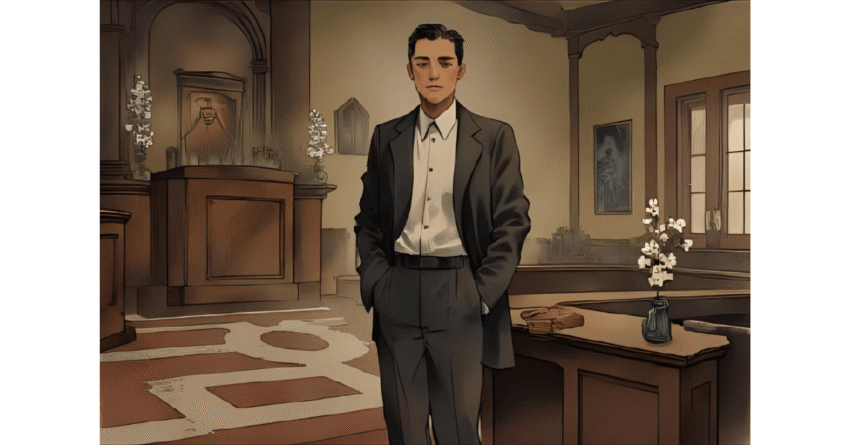
Atticus Finch is a man of quiet habits, raising two children in the American South of the 1930s—a landscape where racial discrimination was not merely a social custom but a structural pillar of the legal system. In Maycomb, Alabama, systemic injustice is treated as an atmospheric fact: normal, unquestioned, and inevitable. Against this backdrop, Atticus accepts the appointment to defend Tom Robinson, a Black man falsely accused of rape. He does so with a chillingly clear realization: the case is almost certainly unwinnable.
What Atticus confronts is the Absurd. Albert Camus defined the Absurd as the divorce between humanity’s relentless search for meaning and the “unreasonable silence” of a cold, indifferent universe1. The Absurd Hero is the individual who recognizes this tension and refuses both the false consolation of hope and the paralysis of despair. Atticus Finch functions as this hero: one who recognizes irrationality, revolts against it without illusion, and sustains dignity in the face of inevitable defeat.
The Absurd World of Maycomb
Atticus is no naive optimist. He is an architect of truth entering a structure designed to bury it. Maycomb’s legal and social systems are not broken; they are functioning exactly as intended—to fail Tom Robinson.
The Recognition of Futility Atticus explicitly acknowledges the hopelessness of the trial. Speaking to his brother, Jack, he notes that being legally correct is insufficient when the jury’s judgment is poisoned by “Maycomb’s usual disease. Atticus explains to Jack that legal correctness alone is insufficient; a lawyer must persuade a jury already shaped by Maycomb’s prejudices2. Here, the obstacle is not a lack of evidence, but an immovable mindset. By acknowledging this, the trial ceases to be a strategic gamble for victory and becomes a moral necessity—an act grounded in integrity rather than the expectation of success.
The Internal Moral Law When the external world offers no justice, meaning must be defined internally. Atticus explains to Scout that his decision to take the case is a prerequisite for self-respect: “…before I can live with other folks, I’ve got to live with myself. The one thing that doesn’t abide by majority rule is a person’s conscience.3” This aligns precisely with the Camusian hero: in a world of “majority rule” and irrational prejudice, the hero finds his North Star within his own conscience.
The Revolt: The Trial as Sisyphian Task
For Sisyphus, the rock is literal; for Atticus, the rock is his commitment to justice in a society built to reject it. Camus rejects “escape”—through religion or false hope—as intellectual dishonesty4. Atticus chooses Revolt.
The Solitary Stand The scene at the jailhouse serves as a physical manifestation of this revolt. Sitting alone under a single lightbulb, reading a newspaper as a lynch mob approaches, Atticus’s calm presence is an affront to their fury5. He does not use bravado; he uses presence. This is the Absurd Hero’s refusal to succumb to the “mob” of an irrational universe.
Fidelity to Procedure Atticus’s revolt is characterized by a “Sisyphian commitment to rationality.6” Through the methodical cross-examination of the Ewells and the presentation of medical testimony, Atticus proves the physical impossibility of the crime7. He honors a legal process that is destined to betray him. His defiance lies in his fidelity to the truth, forcing the jury to witness the summit of logic before they inevitably let the rock roll back down.
Freedom and Passion: The Legacy
Once the hope of “cosmic justice” is abandoned, a paradoxical freedom emerges. Camus writes that the absurd man no longer asks whether life has meaning, but how honestly it can be lived.
“One Must Imagine Sisyphus Happy” Camus’s famous conclusion suggests that Sisyphus’s victory occurs in the moment he turns back toward the plain to retrieve his rock. His fate belongs to him; his rock is his thing. Similarly, Atticus’s freedom emerges from his refusal to anchor his worth to the jury’s verdict. By claiming ownership of the struggle, he transforms a legal defeat into an existential victory8.
The Witness of the Children This revolt is not performed for an audience, yet it creates a legacy. Jem’s heartbreak is the necessary “awakening” to the Absurd—the realization that the world is not fair. Scout, however, learns the lesson of Amor Fati—the love of one’s fate9. Her ability to stand on the Radley porch and see the world through another’s skin is the internalization of Atticus’s code.
The silent tribute from the balcony—”Stand up, your father’s passin'”10—validates Atticus’s “passion.” It is an external recognition of a man who has looked into the face of the Absurd and refused to blink.
Conclusion: The Eternal Return to the Rock
Through the lens of existential philosophy, Atticus Finch becomes more than a virtuous man in a racist town. He embodies the core tenets of the Absurd Hero: he recognizes the irrationality of his world, he revolts through a doomed defense, and he finds freedom in his code.
However, to truly understand the depth of Atticus’s heroism, we must apply one final test: Friedrich Nietzsche’s Eternal Return11. Nietzsche challenged us to imagine a life that recurs infinitely, exactly as it is. He asked: Would you crave this repetition, or would you be crushed by it?
For many, repeating the Tom Robinson trial—the heat, the hatred, and the inevitable verdict—would be a source of despair. But Atticus Finch suggests a different answer. By grounding his actions not in the hope of victory, but in a moral law that exists entirely in the present, Atticus achieves Amor Fati. He does not expect to fix the system, but he refuses to surrender his soul to it. He pushes his rock anyway. And because he does so with such complete integrity, we can imagine him willing to push that same rock for all eternity.
He teaches us that in an absurd universe, human dignity is found in the persistence of the effort. We must imagine Atticus—and Sisyphus—happy.
Note
- Albert Camus, The Myth of Sisyphus, trans. Justin O’Brien (Vintage International, 1991), 23. ↩︎
- Harper Lee, To Kill A Mockingbird, Digital Edition (HarperCollins Publishers Inc., 2021), 85–113, www.harpercollins.com. ↩︎
- Ibid, 121. ↩︎
- Camus, The Myth of Sisyphus, 28–41. ↩︎
- Lee, To Kill A Mockingbird, 172. ↩︎
- Camus, The Myth of Sisyphus, 121–23 ↩︎
- Lee, To Kill A Mockingbird, 199–201. ↩︎
- Camus, The Myth of Sisyphus, 121–123. ↩︎
- Friedrich Nietzsche, The Gay Science, trans. Thomas Common. (Dover Publications, Inc, 2020), 138, §276. ↩︎
- Lee, To Kill A Mockingbird, 240. ↩︎
- Nietzsche, The Gay Science, 176. ↩︎
Bibliography
Lee, Harper. To Kill A Mockingbird. Digital Edition. HarperCollins Publishers Inc., 2021. www.harpercollins.com.
Camus, Albert. The Myth of Sisyphus. Translated by Justin O’Brien. Vintage International, 1991.Nietzsche,
Friedrich. The Gay Science. Translated by Thomas Common. New York: Dover Publications, 1967.