The Book Tapestry

From the pages to the mind—woven with care.

Menu
  • Home
  • Blog
  • Privacy Policy
  • About Me
Menu

The Black Market, The Great Gatsby, and the Corrupted American Dream

Posted on December 7, 2025November 23, 2025 by Sophia Wordsmith

The History & Economics in Literature: Prohibition and The Great Gatsby

Introduction

The Roaring Twenties were a decade of glittering contradiction. America attempted to legislate virtue through Prohibition, implemented the 18th Amendment1, and the Volstead Act2. Yet the decade throbbed with jazz, speculation, and rebellion against restraint. It was an age that preached purity but practiced indulgence, creating a moral landscape as unstable as the stock market itself. 

Prohibition aimed to uplift society by eliminating alcohol. Instead, it boosted demand, pushing drinking underground and turning an ordinary consumer good into the engine of a fast-growing criminal marketplace. Far from cultivating discipline, it trained the public to work around the law rather than respect it. In this hidden economy, a new American figure emerged: the Prohibition gangster. Men like Al Capone symbolized the unintended consequences of moral legislation—profiting from the very vice that government sought to eliminate. 

Prohibition Era and The Great Gatsby

Prohibition failed to enforce moral order. Instead, by forcing alcohol into an unregulated black market, it ironically reshaped the American Dream into something faster, riskier, and murkier. Gatsby’s world shows how criminality and aspiration began to fuse during the 1920s. By following the logic of supply and demand, tracing Gatsby’s implied bootlegging operations, and examining the violence and corruption surrounding him, we can see how Prohibition distorted both markets and morals.  Gatsby’s tragedy ultimately reveals a larger truth. When moral laws ignore economic reality, they rarely cure social problems. Instead, they simply push those problems underground—where they gather force and become far more destructive. 

Within this landscape of easy money and shifting morals, F. Scott Fitzgerald’s The Great Gatsby becomes more than a novel—it becomes diagnostic. Gatsby, with his lavish parties and enigmatic income, reads like an idealized version of Prohibition’s underground titans. His meteoric rise, his carefully crafted persona, and his shadowy business connections all point to a man shaped by Prohibition’s illicit economy. Gatsby doesn’t merely live in the Jazz Age—he embodies its contradiction. 

The Historical and Economic Roots of Failure

The Moral Impulse vs. The Reality

Prohibition did not emerge in a vacuum. It grew out of a long-standing temperance movement that intertwined genuine social concern with deep cultural and political anxieties. For decades, reformers—many of them middle-class, Protestant, and particularly women associated with organizations like the Woman’s Christian Temperance Union (WCTU)—argued that alcohol was the root of poverty, domestic violence, and moral decay. It was also a source of tension as society shifted toward emerging social norms. There was a tension between rural traditional values and urban progressive values. Saloon culture was perceived as eroding the family, wasting wages, and encouraging vice. Legally banning alcohol was seen as a way to purify a morally fallen society—a product of religious revivalism and the Progressive Era optimism. 

Yet the “dry” movement was also entangled with nativism and wartime nationalism. During and after World War I, anti-German sentiment intensified across the United States. Many of the country’s largest breweries were owned or operated by German Americans, and temperance advocates strategically exploited this association. Supporting beer was the same as supporting the enemy in the rhetoric of the time. Some Americans believed, or were encouraged to believe, that there was a symbolic link between breweries and Kaiser Wilhelm II, casting alcohol consumption itself as unpatriotic3. In this way, moral reform fused with xenophobia. And, restricting alcohol became a way to discipline immigrant communities associated with saloons. It was the way to assert a particular vision of “true” American identity. However, moral motives alone couldn’t overcome economic forces. 

The inevitable Black Market

At first glance, Prohibition appeared to “work.” Historical estimates indicate that total national alcohol consumption fell sharply in the early 1920s. Looking at the wider period, estimates suggest that per capita alcohol consumption dropped by around 20 percent between the prewar years 1911-1914 and the late 1920s. For supporters, this seemed to confirm that the law was achieving its intended purpose. However, this decline was neither complete nor permanent. Drinking did not disappear; it hid in the black market. Consumption gradually rose again after the initial shock, as people found ways around the law through smuggling, home brewing, medicinal prescriptions, and, most notably, the expanding criminal networks.

From an economic perspective, the core problem was simple: the government tried to eliminate supply without truly eliminating demand. The sale, production, and transportation of alcohol became illegal. Still, the desire to drink—and even the legal right to consume alcohol already possessed—remained. In terms of basic supply and demand. Prohibition shifted the supply curve to the left, leading to a sharp contraction in legal supply. In the black market, the price of liquor skyrocketed not because of a shortage, but due to the risk premium in selling it. Legal producers exited, breweries closed, and legitimate saloons vanished. But the demand curve, after a brief dip, remained relatively resilient. People still wanted alcohol, and many were willing to pay more for it—especially in a decade defined by cultural modernity, rebellion, flappers, and speakeasies. 

Applying the Supply & Demand Model

When supply is sharply restricted while demand persists, the market does not simply vanish. It reorganizes into an illegal, risk-driven structure. The legal supply vanished, but an illegal supply emerged at a much higher per-unit black-market cost, reflecting not only scarcity but also the additional “risk premium” for producing and distributing contraband. Those who were willing to take on that risk—bootleggers, smugglers, and organized crime syndicates—could earn enormous profits. 

Black Market in the 1920s in Gatsby’s World

This is where the logic of Prohibition collided with market reality. By making alcohol illegal but still desired, the government inadvertently created a criminalized, high-profit market that rewarded those most willing to break the law and use violence. This economic environment is what produced figures like Al Capone in history and Jay Gatsby in literature. Gatsby’s world, with its extravagant parties and whispered rumors of criminal fortune, is not just stylistic. It is economically rooted in the Prohibition black market emerging directly from this transformed economic landscape. 

Jay Gatsby: The Embodiment of Illegal Riches

Gatsby’s Vocation

Within The Great Gatsby, Fitzgerald never offers a straightforward account of Gatsby’s vocation. Instead, the novel deliberately surrounds him with hints, rumors, and contradictions. The narrative’s vagueness mirrors the uncertainty and speculation of a society that distrusted sudden wealth as people tried to make sense of the rapid fortunes emerging during Prohibition. Gatsby is variously said to be an Oxford man, a war hero, a relative of Kaiser Wilhelm, a man who “killed a man,” and, crucially, a bootlegger. The multiplicity of these stories reflects not only the unreliability of the narrator and gossip around him, but also the social anxiety surrounding new wealth acquired from dubious sources. 

As the novel slowly unfolds, the pieces fall into place for the reader. Gatsby’s association with Meyer Wolfsheim. Wolfsheim is the man Nick learns “fixed the World Series back in 1919,” which strongly situates Gatsby in the world of organized crime and illicit finance. Wolfsheim is a fictionalized version of the real-life gambler and racketeer Arnold Rothstein. Arnold Rothstein was associated with both bootlegging and large-scale corruption. By linking Gatsby’s rise to a figure like Wolfsheim, Fitzgerald ties the character’s mysterious income to the very criminal networks that flourished under Prohibition.

Connecting the Two Worlds

The economic incentives of the era make this connection plausible. Historical accounts of bootlegging operations reveal the extraordinary profits that black-market liquor could generate. 

As Jeff Nelson explains in a 2022 Saturday Evening Post article4, bootlegging is a profitable operation. Prohibition-era bootleggers sometimes authorized withdrawals of up to 1,500 cases of alcohol per week, often through “legitimate” pharmaceutical fronts or other shell companies. One illustrative breakdown of a bootlegger’s quarterly figures might look like this. An original graft payment of $17,500, legitimate drugs to maintain the front costing $1,500, and office expenses and guards adding another $9,000, for a total of $28,000 in operating costs. Against this stood gross receipts of roughly $175,500 over 13 weeks. Subtracting the $28,000 in expenses leaves net profits of $147,500 for a single quarter. It was a sum that would translate into roughly $2.5 million in 2022 purchasing power. These margins reveal why prohibition was such fertile ground for rapid, illicit fortunes. 

Gatsby’s Bootlegging Operation

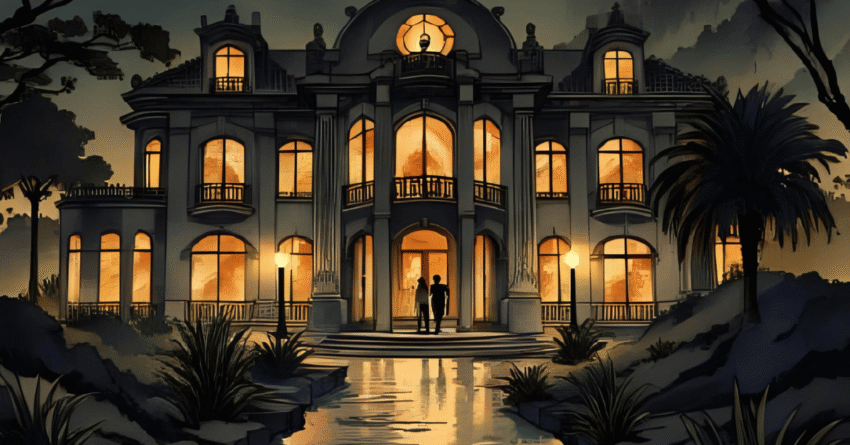
Gatsby fits this pattern of sudden wealth almost too perfectly. He emerges from nowhere. He reappears in West Egg society with a colossal mansion, imported clothes, and a constant flow of guests. His income is deliberately vague, his business partners are suspicious, and his operations are opaque. These are precisely as one would expect from someone profiting from a black market. Because the novel’s narration is filtered through Nick Carraway and a layer of rumor, we are never given a neat confession or confirmation. Instead, evidence accumulates indirectly—through people like Wolfsheim, shady references to drugstores that “sold grain alcohol over the counter,” and hints that Gatsby is also involved in illegal bond trading. The unreliability of the narrative is not a weakness but a reflection of how criminal wealth operates. Its effects are evident long before its mechanisms are understood. 

Gatsby’s success also embodies a distorted version of the American Dream. In principle, the Dream promises that anyone, regardless of background, can achieve prosperity through talent and hard work. In the black market of the 1920s, bootlegging appeared to offer a seemingly “quick and equal opportunity” to achieve that dream. As one historian, Thomas Reppetto, suggests about the Prohibition gangster, the combination of high demand, weak enforcement, and enormous profits created an apparently open path for ambitious individuals to rise. Gatsby, as a self-made man who reinvents himself from James Gatz of North Dakota to Jay Gatsby of West Egg, is the romanticized version of this criminal success story. Instead of earning respect through genuine self-improvement and moral worth, Gatsby’s reinvention produced only mystery, rumor, and spectacle. He did not cultivate character; he cultivated appearance—a self-invention geared toward material display rather than inner substance. 

The Party as Economic Proof

His parties provide the most vivid economic evidence of his fortune in the absence of official records. Night after night, Gatsby’s mansion overflows with music, food, and, crucially, illegal liquor. Most guests arrive uninvited, consume vast quantities of alcohol, and leave without ever meeting their host. The sheer volume of contraband flowing through these gatherings testifies to the scale of his operation and the sheer liquidity of his untaxed income. These parties are not merely social events; they are displays of what the black market can buy. 

Moral Compromise

Yet at the heart of Gatsby’s wealth lies a profound moral compromise. His ultimate goal is not power for its own sake but the romantic dream of winning back Daisy Buchanan and erasing years that have passed between them. In that sense, his motivation is tragically idealistic. Gatsby naively believes that money is the only way to belong to Daisy’s social class. The urge to rise into Daisy’s class pushes Gatsby toward the black-market fortunes Prohibition makes possible.

Gatsby needs fast, colossal wealth to compete with Tom’s established, inherited money. It is a kind of wealth the legal world could never generate quickly enough. However, the means he chooses are illegal enterprises that rely on violence, corruption, and deception. His choice has a cost. It is the cost of pursuing the American Dream in a Prohibition-shaped economy. Gatsby’s dream is pure in feeling but corrupt in execution, showing how Prohibition forced even “romantic” strivers into morally compromised paths to success. 

The Dark Underside: Violence and Corruption Under Prohibition

Escalation of Violence 

When markets move underground, they do not become more moral; they become more dangerous. One of the most visible unintended consequences of Prohibition was the escalation of violence. In legal markets, ideally, disputes are resolved through contracts, courts, and regulation. In black markets, where the law itself becomes the enemy, those tools vanish. As some economists and historians have argued, Prohibition-era alcohol markets replaced legal protection with private enforcement—guns instead of lawyers, gangs instead of regulators.5 The cost of providing that “protection” was folded into the price of illegal liquor, increasing profits for those who could maintain territory and discouraging peaceful competition. 

Although The Great Gatsby is not primarily a gangster novel in the mold of Little Caesar or The Godfather, the shadow of violence hangs over it. Gatsby’s connection to figures like Wolfsheim places him in a world where fixing the World Series is conceivable and lives can be ruined or ended with impunity. The careful politeness of Gatsby’s manner and the elegance of his parties conceal an undercurrent of menace: these luxuries are sustained by an economy in which someone, somewhere, may be willing to kill to protect shipments, silence informants, or intimidate rivals. The novel’s climactic acts of violence—Myrtle’s death, Gatsby’s murder—do not directly involve bootlegging disputes. Still, they occur within a moral universe destabilized by the normalization of lawbreaking and the erosion of trust in institutions. 

Institutional Corruption

Institutional corruption was another inevitable byproduct of the black market. Once liquor distribution became illegal and yet remained popular, police, judges, and politicians faced immense pressure—both financial and social—to look the other way. In the novel, this culture of corruption surfaces in small but telling scenes: Gatsby casually assures Nick that a speeding ticket can be taken care of because he once did a favor for the police commissioner. This offhand comment implies a network of favor trading and bribery that ensures Gatsby’s operations can continue with minimal interference. Similarly, Wolfsheim’s proud claim that he “fixed the World Series” points to an era when even America’s pastime, sacred national institutions like baseball, could be bought and manipulated by money flowing from illicit activities. 

Historically, such corruption was widespread enough to undermine public faith in Prohibition itself. Journalists like H. L. Mencken mocked the hypocrisy of a society that criminalized drink yet enthusiastically consumed it, and they exposed scandals involving officials who drank privately while enforcing public abstinence. 6The scandal-ridden reality of enforcement—raids that targeted small operators while major syndicates thrived, routine bribe-taking, selective prosecutions, and raids that targeted small operators—played a major role in turning public opinion against Prohibition. Fitzgerald’s world, in which powerful people evade consequences while the vulnerable suffer, reflects this lopsided distribution of risk and punishment.

The Revenue Crisis Under Prohibition

The economic costs extended beyond violence and corruption into public finance. Before Prohibition, alcohol taxes were a major source of government revenue. Estimates suggest that between 30 and 40 percent of federal income came from taxes on alcohol sales7. When the legal market vanished, so did this revenue stream. At the same time, the government’s expenditures skyrocketed as it tried to enforce the Volstead Act: funding agents, Coast Guard patrols, and court proceedings8. Thus, the state not only failed to eliminate drinking but also relinquished a substantial portion of its budget, relying on it with costly enforcement efforts. 

This financial burden did not fall on bootleggers; it fell on the taxpayers. Ordinary citizens, ironically, many of whom still drank, now had to pay for the expensive machinery of enforcement through other forms of taxation, while organized crime reaped untaxed profits. In economic terms, Prohibition shifted the benefits of alcohol consumption from a taxed, regulated market to a private criminal enterprise, while shifting the costs from drinkers and breweries to society at large. 

Moral Blindness

In The Great Gatsby, this moral and economic imbalance surfaces most clearly in the behavior of the elite. Throughout the novel, Tom and Daisy Buchanan, Jordan Baker, and their social circle drink illicit alcohol freely and often. They casually consume illegal alcohol without acknowledging the violent and corrupt chain of criminal activity required to deliver it to their tables. Their lives are insulated by wealth and social status; they suffer few direct consequences for their lawbreaking, just as they evade implications for the emotional and physical harms they cause. They are, as Nick famously concludes, “careless people” who smash up things and creatures and then retreat into their money. Their moral blindness toward the violence and corruption that underpins their luxuries mirrors the broader public’s willingness to enjoy speakeasies and cocktails while assuming the costs of the law fall on someone else. 

Beyond Prohibition: Learning from Market Intervention

The Misdirected Solution

By the early 1930s, the United States had begun to learn—through violence, corruption, and lost tax revenue—that Prohibition was a misdirected solution. Instead of addressing the deeper social problems associated with alcohol—addiction, domestic violence, poverty, and alcohol-induced crime—the law focused narrowly on eliminating supply. Proponents assumed that eliminating production and sale would straightforwardly eliminate consumption—and therefore its harms. But as both economic theory and historical experience reveal, demand cannot be legislated out of existence. 

A Costly Lesson

Jay Gatsby’s life and death can be read as tragic proof of the economic distortions created by Prohibition. The extreme government intervention of Prohibition created a market in which ambitious individuals could, almost overnight, become fabulously wealthy by ignoring the law. Gatsby seized that opportunity, driven not by malice or a desire to destabilize society but by a desperate wish to reclaim an idealized past with Daisy. The very law meant to safeguard moral order pushes him into moral compromise. His glittering mansion and parties are monuments to what happens when aspiration collides with illegality. In Gatsby’s world, the American Dream—rather than promising honest upward mobility— becomes entangled with fraud, smuggling, and corruption. 

Alternative Approaches

In retrospect, critics of Prohibition have since proposed alternative approaches that might have addressed alcohol-related harms more effectively—without creating a massive black market. Rather than a sweeping supply-side ban, policymakers could have focused, for example, on education about the risks of heavy drinking, public health interventions, and robust support systems for those struggling with addiction. Demand management—through social campaigns, age restrictions, and licensing requirements—could have reduced consumption without outright criminalization. At the same time, stricter and more consistently enforced penalties for crimes committed under the influence—such as drunk driving or assault—would have targeted the actual harms associated with alcohol, rather than the substance itself. 

These alternatives highlight just how blunt an instrument Prohibition was. By ignoring fundamental market dynamics and human behavior, the law attempted to impose moral virtue by force, only to create a thriving economy of vice. 

Conclusion

Prohibition was meant to uplift American life, yet its real legacy was the corruption of law, values, and the American Dream itself. By driving alcohol into the shadows, the Eighteenth Amendment and the Volstead Act created a thriving black market where violence and inequality grew unchecked. In this world, success depended less on virtue than on a willingness to break the rules. Jay Gatsby—with his mysterious wealth, extravagant parties, and fragile hope for Daisy—embodies this contradiction.

Economically, Prohibition sharply restricted supply while demand remained strong, creating the perfect conditions for high-profit, high-risk markets. Bootleggers and organized crime syndicates flourished, while the public bore the costs through lost tax revenue, soaring enforcement expenses, and a growing culture of disregard for the law. Fitzgerald captures this reality through atmosphere rather than policy: Wolfsheim’s criminal confidence, the Buchanans’ carelessness, Gatsby’s glittering mansion, and the moral emptiness beneath East and West Egg.


The lasting lesson, both from history and Fitzgerald’s novel, is clear. Moral laws that ignore economic incentives and human behavior risk producing the very harms they aim to prevent. Prohibition sought purity but bred corruption; it tried to create order but fueled disorder. Long after the law’s repeal—and long after the green light dims—its caution remains: when society tries to regulate desire without understanding its forces, the results can become far more destructive than the problem itself.

  1. “U.S. Constitution – Eighteenth Amendment | Resources | Constitution Annotated | Congress.Gov | Library of Congress.” Accessed November 23, 2025. https://constitution.congress.gov/constitution/amendment-18/.
    ↩︎
  2. National Archives. “The Volstead Act.” August 15, 2016. https://www.archives.gov/education/lessons/volstead-act.
    ↩︎
  3. PBS Wisconsin. “World War I Turned Milwaukee’s Germans And Their Beer Into Targets.” Accessed November 21, 2025. https://pbswisconsin.org/news-item/world-war-i-turned-milwaukees-germans-and-their-beer-into-targets/.
    ↩︎
  4. See Nilsson, Jeff. “So You Want to Be a Bootlegger.” The Saturday Evening Post, May 10, 2022. https://www.saturdayeveningpost.com/2022/05/so-you-want-to-be-a-bootlegger/.
    ↩︎
  5. Livingston, B. (2016). Murder and the black market: Prohibition’s impact on homicide rates in American cities. International Review of Law & Economics, 45, 33–44. https://doi.org/10.1016/j.irle.2015.09.001 ↩︎
  6. Mencken, H. L. Quoted in “Nation Welcomes Prohibition,” Alcohol Problems and Solutions website, timeline entry under “Hypocrisy,” ↩︎
  7. Bishop-Henchman, Joseph. “How Taxes Enabled Alcohol Prohibition and Also Led to Its Repeal.” Blog. Tax Foundation, October 5, 2011. https://taxfoundation.org/blog/how-taxes-enabled-alcohol-prohibition-and-also-led-its-repeal/.
    ↩︎
  8. Mark, Thornton. “Alcohol Prohibition Was a Failure.” Cato Institute, July 17, 1991. https://www.cato.org/policy-analysis/alcohol-prohibition-was-failure.
    ↩︎

Category: Social Forces Shaping Literature

Leave a Reply Cancel reply

Your email address will not be published. Required fields are marked *

About Me

I’m Sophie, a cross-disciplinary reader who treats books like puzzle boxes. I read literature through history, philosophy, psychology, and science—then weave the threads together. Welcome to my tapestry.

Categories

  • Announcements
  • Narrative Psychology
  • Philosophical Logic
  • Social Forces Shaping Literature
©2026 The Book Tapestry