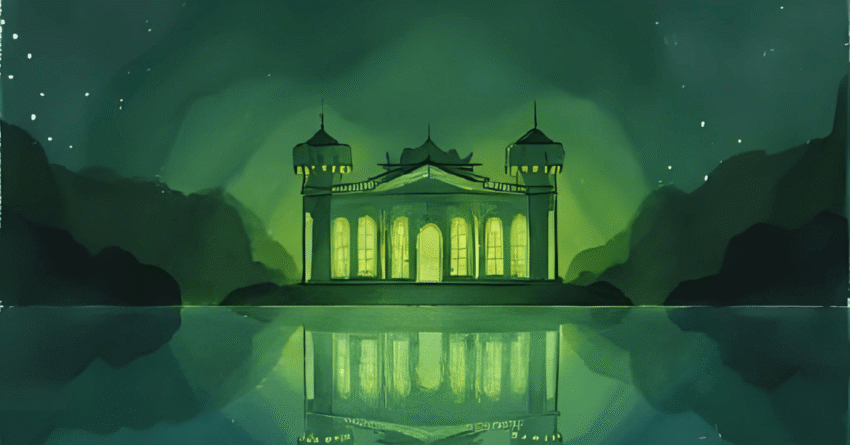
Philosophical Analysis of The Great Gatsby
Introduction
The Great Gatsby endures because it turns the American Dream into an existential riddle: we are free to invent ourselves, yet the world greets our inventions with silence. Amid champagne towers and yellow cars, the Dream itself collapses—not from scarcity, but from excess. Jay Gatsby, born James Gatz, is modernity’s emblem and victim. He makes himself from scratch as if identity were a crafty project, a man who turns love into a destiny and parties into performance. The result is dazzling—and doomed.
Gatsby’s quest embodies the modern struggle between illusion and authenticity; his self-creation and collapse expose the futility of forging meaning in a hollow world built on spectacle. Through the lenses of Sartre, Camus, and Nietzsche, Gatsby’s life becomes not merely a personal tragedy but a philosophical parable—a fall from radical freedom into self-imposed illusion, from the creation of values to the quiet recognition of absurdity. What begins as the affirmation of possibility ends as a meditation on the cost of mistaking light for life—the illusion forever flickering across the bay.
Sartre’s Radical Freedom and Gatsby’s Self-Creation
Sartre’s maxim that “existence precedes essence1” finds vivid expression in F. Scott Fitzgerald’s tragic hero, Jay Gatsby. Gatsby invents his own essence through self-creation—he is nothing other than what he makes of himself, fully embodying Sartre’s vision of freedom. Sartre declares that humans are born without a fixed nature or purpose; they exist first, and through their choices, define what they become. In this radical freedom, every individual bears full responsibility for shaping their own essence.
Gatsby’s Self-Invention: James Gatz Becomes Jay Gatsby
Gatsby’s metamorphosis from James Gatz to Jay Gatsby is the Jazz Age’s purest act of existential authorship. On Dan Cody’s yacht and in the quiet of his own notebooks, Gatz drafts a blueprint for self—a polished vision meant to outshine the rawness of the boy who began with nothing. He chooses a name, a wardrobe, a diction, a set of rituals—he chooses a horizon—the green light—and binds his waking hours to its glow. Crucially, this choice does not merely decorate an essence; it produces one. Gatsby’s accent, parties, and silences are not symptoms of an inner truth but instruments for composing it.
Here lies the terrifying glory of Sartrean freedom. He envisions an ideal self—and commits entirely to its realization. He refuses to be defined by origin, poverty, or the inertia of other people’s expectations. In that refusal, he exemplifies the grandeur of self-making. In this, Gatsby becomes existentialism’s boldest dream—a man who accepts that meaning is not found but forged.
Sartrean Bad Faith and Jay Gatsby
Sartre: Freedom and the Temptation of Bad Faith
The same freedom that enables Gatsby’s ascent also breeds a subtler danger: bad faith2. Sartre defined bad faith as the self-deception by which a person mistakes themselves for a fixed role or object, bound by past determinations that conveniently excuse them from the burden of new choices. It is comfort disguised as identity. In fleeing this freedom, one still cannot escape it—Sartre reminds us that we are “condemned to be free.3”
Gatsby’s Denial of the Past
Gatsby’s case highlights the dual nature of Sartrean freedom. On one hand, his self-creation is glorious: he achieves wealth, status, and an all-consuming purpose. On the other hand, Gatsby’s self-creation calcifies into a prison of illusion rather than an authentic engagement with reality. Without a given essence, Sartre warns, we are “condemned to be free.” We must bear the weight and anxiety that comes with self-fashioning.
But this freedom turns inward; Gatsby’s radical self-fashioning into Daisy’s idealized lover hardens into prison, exemplifying the Sartrean tragedy of denying one’s ongoing freedom. Gatsby’s refusal to acknowledge the five lost years, his obsession with Daisy’s voice and idealization of her, and his demand that Daisy leave Tom are examples of the manifestation of bad faith that ultimately lead to his downfall. Gatsby is, in effect, declaring that he cannot change; paradoxically, this denial is itself a choice freely made in bad faith. Instead of embracing the freedom to imagine a new future, he confines his meaning to a single immovable dream.
In denying reality, Gatsby confines his will to what he cannot control. The tragedy of Gatsby is that his extraordinary freedom to define himself becomes its own prison. From an existential view, Gatsby’s downfall stands as a warning of bad faith—the tragedy of a man who mistook illusion for essence.
Camus: The Sisyphean Labor of Spectacle
In The Great Gatsby, Fitzgerald turns the Jazz Age into a glittering stage where spectacle masks despair. Gatsby’s opulent parties, colossal mansion, and self-fashioned myth embody this clash. Gatsby longs for clarity and fulfillment in a world that remains indifferent—if not hostile—to his dream. In Camusian terms, Gatsby is like Sisyphus, who endlessly pushes his rock uphill only to have it tumble back down. His parties and reinventions become Sisyphean labors—repetitive, dazzling, and ultimately futile. Gatsby’s spectacle is an absurd attempt to impose meaning on reality, mirroring Sisyphus’s eternal, pointless toil.
Camus’s Concept of the Absurd
Albert Camus opens The Myth of Sisyphus by describing the absurd as human beings’ desperate search for meaning colliding with a world that offers none. Camus writes, “longing for happiness and for reason. The absurd is born of this confrontation between the human need and the unreasonable silence of the world.”4 The absurd arises from the collision between our hunger for meaning and the universe’s silence.
Camus illustrates the Absurd with the Greek myth of Sisyphus, who is condemned by the gods to push a massive boulder up a mountain only to watch it roll back down, eternally. Sisyphus’s plight is a perfect metaphor for human life: one labors endlessly, hoping for triumph or meaning, yet every apparent victory is lost and every ascent resets to zero.
Camus’s Absurd framework thus captures a fundamental existential tension. We want meaning, but we face a mute cosmos. This tension is the ground of tragedy in The Great Gatsby. Gatsby yearns for meaning in Daisy and the past, yet his dream meets an uncaring reality. Just as Sisyphus toils toward an unreachable summit—his dream of love and status—Gatsby pours meaning into a world that offers none in return.
The Sisyphean Struggle and Final Collapse
Gatsby’s end drives home the grim parallel. Sisyphus does not die; his punishment is to live forever in repetition. Yet Camus insists that we must imagine him happy, for he accepts the absurdity of his fate. Gatsby, by contrast, dies—shot in his pool by George Wilson while Daisy retreats into the safety of Tom’s world. In literal death, the rock slips from his hand one final time. Nick observes a universe indifferent to the tragedy: after Gatsby’s murder, nobody from the parties comes to his funeral. Fitzgerald thus leaves us with an image of Gatsby’s spectacle—beautiful, tireless, and empty—as endless as Sisyphus’s climb.
Camus: The Moment of Absurd Consciousness
The Great Gatsby reveals the Jazz Age’s glittering pursuit of happiness as a hollow spectacle.
Through Jay Gatsby, a man consumed by love and Self-created illusion, Fitzgerald exposes a world where spectacle disguises emptiness.
Camus uses the myth of Sisyphus as an image of futile labor. Camus writes, “The workman of today works every day in his life at the same tasks, and his fate is no less absurd.” Like Sisyphus, people labor at repetitive, purposeless tasks, forced to invent meaning within that absurdity. Gatsby’s endless parties and glittering displays of wealth become his rock, rolled up the hill of longing night after night. His life becomes the absurd cycle itself—labor without resolution, longing without end.
Conscious Knowledge of Condition
Camus suggests that Sisyphus becomes tragic the moment he recognizes his own condition. He “is tragic only at the rare moment when it becomes conscious,”—the instant he realizes the futility of his toil yet chooses to continue.
Gatsby’s labor is similarly tragic because he can scarcely face its emptiness. Despite the lavish parties he hosted, Nick observes, “if that was true he must have felt that he had lost the old world, and paid a high price for living too long with a single dream.” Gatsby sacrifices reality for a dream of the past. Yet, Camus warns that such relentless labor offers no salvation—only the repetition of desire without fulfillment, a cycle Gatsby cannot escape.
Nietzsche: the Green Light as corrupted Übermensch Ideal
The Great Gatsby illustrates a modern tragedy of will and ambition. Set in an age when Traditional faith was warning, Gatsby seeks to impose his own meaning on life through sheer force of will. In Nietzschean terms, Gatsby aspires to become an Übermensch—a self-created man who forges his own values and transcends conventional morality.
The most vivid symbol of Gatsby’s self-created ideal is the green light at the end of Daisy’s dock. In a Godless world where old values have crumbled, Gatsby has the green light as his god. He focuses all his energy on his newly created deity of desire. His dream is born not from self-mastery but from resentment—from envy and nostalgia. His value is a nostalgic revenge against earlier humiliations rather than an affirmative creation of the new. This is where Gatsby fails to become Nietzsche’s Übermensch.
Nietzsche’s “God is Dead” and Übermensch
In Nietzsche’s Philosophy, the declaration “God is dead5” signals a profound crisis of values. With the old religious-moral framework vanished, humanity must “become gods themselves by creating new values.” Nietzsche’s Übermensch is the ideal figure who does this. In his book Thus Spoke Zarathustra, Nietzsche proclaims, “I teach you the overman. Man is something that shall be overcome.” The overman sets his own goals in life, an affirming existence without appeal to any higher power. The Overman actively imposes meaning, embodying the will to power—not domination over others, but mastery of the self and the shaping of one’s destiny.
Gatsby’s Self-Creation and the Green Light
Gatsby is, in every sense, self-made. Gatsby creates himself as if crafting a character in pursuit of a higher ideal. This strongly echoes Nietzsche’s call to “give style to one’s character.” Gatsby’s extravagant persona and lifestyle reflect a grand “artistic plan,” tailoring even his flaws into an alluring image. This reflects Nietzsche’s call for the “Übermensch” to survey his own strengths and weaknesses and fit them into an artistic whole.
The green light itself symbolizes the ultimate object of Gatsby’s will. Since “God is dead” in Fitzgerald’s modern world, Gatsby effectively makes the green light on Daisy’s dock his god. The light becomes the focal point of all his shapes, a shimmering ideal beyond reach that keeps his will alive. Nietzsche would recognize this as an example of imposing personal meaning. The green light is Gatsby’s self-created ideal, a shimmering goal beyond reach that keeps his will alive.
Gatsby’s green light itself holds multiple layers of meaning. On one hand, it is his personal “Daisy-light”; on the other, it symbolizes the broader American Dream—success pursued in a godless age. Gatsby fervently believes the green light is his newly created value, and reaching it will justify his life.
Nietzsche: Failure Rooted in Resentment
Nietzsche also warns of resentment—the moral poison of envy disguised as virtue. When an extraordinary individual arises, herd morality protects itself from the strong and independent few. It is a system of values created by a weak majority; over time, society came to praise humility, pity, obedience, and self-sacrifice—not because these traits are inherently good, but because they safeguard the herd from the powerful and creative.
Reunion with Daisy
The most revealing moment of Gatsby‘s failure as an Übermensch comes in the long-awaited meeting with Daisy. Here, Gatsby’s resentment, which is built on his envy and clinging to the past, is fully on display. From the moment he opens himself to her, Gatsby tries to reshape reality. At their reunion, Gatsby becomes anxious to be perceived as Daisy’s equal—or her superior. Yet five empty years stretch between them, an abyss Gatsby refuses to acknowledge. Despite Nick’s efforts to temper Gatsby’s expectations, he refuses to accept the finality of it. Instead, he determines to undo the past. In Nietzschean terms, this longing to reclaim the “old warm world” reflects slave morality—a will turned backward, seeking redemption rather than creation. An Übermensch would not delude himself into believing the past can simply be undone.
Ultimately, Gatsby’s reunion with Daisy does not elevate him. Instead, it exposes his dependency and his hollow divinity—a false idol sustained by illusion. An Ünbermensh would neither hinge his destiny on another person nor grieve a lost past. Fitzgerald makes clear that Gatsby’s greatness is delusional. Nick admires not Gatsby’s value, but his unwavering faith in the American Dream. Gatsby tragically resembles Nietzsche’s Last Man: he seeks comfort and the “old warm world” rather than the creative struggle of forging new meaning. In the end, Gatsby’s boundless energy flows into a mirage—his will exhausted in pursuit of an illusion.
Conclusion
Gatsby’s death completes the tragedy of will and illusion. After Myrtle’s murder, which Gatsby accepts blame for out of duty to Daisy, he lies in his pool waiting for Daisy’s call that never comes. At dawn, he is killed by Wilson, and the hope of a green light dies with him. Gatsby dies alone, and his green light behind him is now meaningless.
Gatsby alone had tried to give the world meaning, while others drifted with the current. In Nietzsche’s terms, Gatsby failed as an Übermensch because he never truly “said yes” to life’s reality; instead, he insisted on rewriting it. His will was vast, but it was misdirected by resentment and his bad faith.
The green light fades, the parties end, and the valley of ashes stands as a monument to the moral vacuum they leave behind. In a godless age, Gatsby’s heroic will becomes Nietzsche’s warning: no future can be built on illusion.
Through The Great Gatsby, Fitzgerald paints the American Dream as an absurd endeavor—a Sisyphean labor of spectacle against an indifferent universe.
In the novel’s melancholy ending, Gatsby is a tragic hero of the futile dream: he sought to impose order and love on a world that offered neither. Nick’s final reflection—that we are “boats against the current, borne back ceaselessly into the past” —echoes Camus’s insight that humanity persists, defiant even in defeat. In Gatsby’s fall, Fitzgerald captures the modern soul’s eternal struggle—to dream, to defy, and to find meaning in a silent world.
- See: Maden, Jack. “Existence Precedes Essence: What Sartre Really Meant | Philosophy Break.” August 2023. https://philosophybreak.com/articles/existence-precedes-essence-what-sartre-really-meant/.
↩︎ - See: Reynolds, Jack, and Pierre-Jean Renaudie. “Jean-Paul Sartre.” In The Stanford Encyclopedia of Philosophy, Fall 2024, edited by Edward N. Zalta and Uri Nodelman. Metaphysics Research Lab, Stanford University, 2024. https://plato.stanford.edu/archives/fall2024/entries/sartre/. ↩︎
- See: Çolak, Pelin Dilara. “Man Is Condemned to Be Free….” Philosophiser Co, March 5, 2024. https://medium.com/philosophiser-co/man-is-condemned-to-be-free-33c80ae56d26. ↩︎
- See: The New Philosophy. “Camus on the Absurd.” November 22, 2023. https://www.thenewphilosophy.com/camus-on-the-absurd/.
↩︎ - See: Philosophy, The Living. “‘God Is Dead’ — What Nietzsche Really Meant.” December 9, 2021. https://www.thelivingphilosophy.com/p/god-is-dead.
↩︎
This content is restricted to site members. If you are an existing user, please log in. New users may register below.