While reading The Name of the Rose, I kept wondering why the monks were so obsessed with the Book of Revelation.
At first, I did not have enough background knowledge to understand what was happening. So I decided to go back to the source material itself and read parts of the Bible, including:
- Genesis (creation and knowledge)
- Ecclesiastes (vanity and meaning)
- Revelation (apocalyptic structure)
The more I read, the more I realized that Revelation is not simply a strange prophecy. It provides a key to understanding many of the themes hidden inside Umberto Eco’s novel.
Why Are the Monks So Obsessed with Revelation?
In the 14th century, many Christians believed they might be living near the end of history. The Book of Revelation was seen as:
- A vision of God’s final judgment
- A warning against corruption
- A promise that evil would eventually be defeated
- A source of hope for the poor and oppressed
This matters immensely because many Franciscans in the novel were arguing about poverty and corruption within the Church.1 Some radical Franciscans even believed that the Church had become wealthy and corrupt. They believed that Christ and the Apostles lived in poverty; thus, God would soon judge the corrupt Church.
That is why Revelation keeps appearing in the background of this book. For characters like Jorge, Revelation is terrifying. For others, it is hopeful. The same text produces completely different interpretations, which is one of the central themes of the novel.
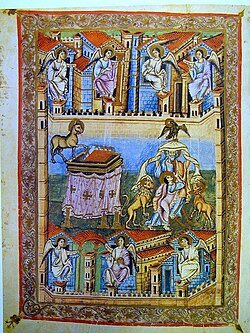
The New Jerusalem
At the end of Revelation, there is a discussion of the New Jerusalem. It is the perfect city that descends from heaven after the evil empire has been defeated.2 In Revelation, history moves through a specific progression:
- Corruption
- Tribulation
- Judgment
- Destruction
- New Jerusalem
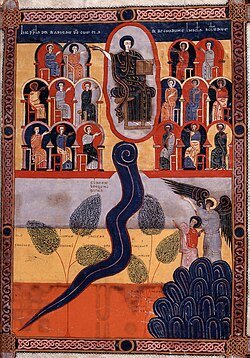
Surprisingly, many medieval people viewed history through this lens. Eco deliberately contrasts this heavenly city with the abbey.
At a glance, the abbey appears orderly and holy. However, beneath the surface, it contains murder, deception, political intrigue, and hidden knowledge. The abbey is almost an anti-New Jerusalem. Instead of preserving truth, it hides it.
The Seven Murders and the Seven Trumpets
I wanted to investigate the seven murders and the seven trumpets in the Book of Revelation. Adso and the monks themselves are interpreting the murders through the lens of Revelation. While the pattern is not exact, it is still close enough that the characters believe it is. I took it more symbolically.
| Revelation | The Abbey |
| Seven trumpets | Series of deaths |
| Divine signs | Mysterious murders |
| Apocalyptic fear | Panic among monks |
| Final destruction | Burning library |
William eventually realizes something important: the murders are not actually following Revelation. What is happening is that the monks are forcing Revelation onto events. This is one of Eco’s biggest themes.
Humans desperately want patterns.
Jorge understands this tendency and exploits it. William, however, continues searching for rational explanations even as the situation becomes increasingly chaotic.
Why Numbers Matter: Seven, Twelve, and Cultural Symbolism
Seven and twelve are probably the two most important numbers in biblical symbolism. Seven represents completion.
Examples of Seven:
- Seven days of Creation
- Seven seals
- Twelve foundations of the New Jerusalem
In short, seven represents the completion of divine action.
Twelve represents God’s people.
Examples of Twelve:
- Twelve tribes of Israel
- Twelve apostles
- Twelve gates of the New Jerusalem
- Twelve foundations of the New Jerusalem
In Revelation, the New Jerusalem is full of the number twelve. The number symbolizes the complete community of God’s people.
What fascinated me was that symbolic numbers are not unique to Christianity. Many cultures assign meaning to particular numbers.
East Asia considers the numbers 5, 12, and 60 important. They represent the foundational numerical cycle that governs time, space, the elements, and the immortal condition.
In Chinese cosmology, there are five states of nature: wood, fire, earth, metal, and water. In Japanese mythology, groups of deities are often organized symbolically as well, reflecting broader patterns found throughout East Asian cosmology.
The number 12 represents the Earthly Branches and the Zodiac. It takes 12 years to complete one cycle. When we have 5 cycles of 12 years, which equals 60, that becomes the grand unifying metric of East Asian concepts of time.
So, in every culture, there is a symbolic number.
Death and Hades: A Familiar Name from Greek Mythology
Next, I found the phrase “Death and Hades” in Revelation. As someone who loves Greek mythology, Hades triggered my curiosity. I suspected the word “Hades” came from Greek myth, where Hades is the god of the underworld who kidnaps Demeter’s daughter, or represents the underworld itself.
However, when Revelation was written in Greek, the word “Hades” was used to translate the Hebrew concept of the realm of the dead. So Revelation says:
“Death and Hades were thrown into the lake of fire.”
This does not mean Zeus and Apollo were running around Revelation. Instead, Hades simply refers to the place of the dead. It seems Christianity absorbed many Greek words because the New Testament was written in Greek.
The Dragon: East Meets West
I noticed there was a Dragon. In Revelation, the dragon is explicitly identified as Satan. The text says: “that ancient serpent, who is called the devil and satan.” The dragon is not merely a monster; instead, it represents chaos, evil, and rebellion against God.
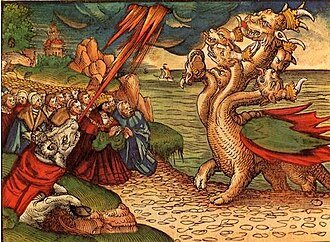
This image became enormously influential to the Western world. Many fantasy dragons ultimately trace part of their ancestry to Revelation. Not all fantasy dragons come from Revelation, though. They also draw from:
- Greek monsters
- Norse dragons
- Germanic traditions
- Medieval bestiaries
For example, the dragon in the poem Beowulf owes more to Germanic traditions than to Revelation. But medieval Christian imagery strongly shaped later fantasy dragons.
Interestingly, though, in East Asia, we perceive dragons as benevolent, wise, and auspicious. They are often associated with the elements of water. The Japanese believed that rivers contain Suijin-sama, the river dragon. While the dragon is associated with evil and sin in the Bible, in East Asia, it is seen as a symbol of imperial power, good fortune, and prosperity. It is interesting, eh?
The Four Living Creatures
In Revelation, John sees:
- A lion
- An ox (or calf)
- A man
- An eagle
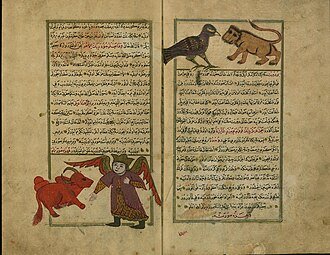
Figure 4. The Second Two Carriers of the Firmament (Lion and Vulture), attributed to Muhammad ibn Muhammad Shakir Ruzmah-‘i Nathani, after Zakariya al-Qazwini. While Christian readers looked to the creatures of Revelation and Ezekiel, Islamic scholars developed their own symbolic visions of the cosmos. Across cultures, animals often served as a bridge between the visible world and deeper spiritual realities. Public domain.
These creatures actually come from an earlier vision in the Book of Ezekiel. Early Christians connected them with the four Gospel writers:
| Creature | Gospel |
| Man/Angel | Gospel of Matthew |
| Lion | Gospel of Mark |
| Ox | Gospel of Luke |
| Eagle | Gospel of John |
This symbolism became incredibly common in medieval manuscripts. When you see a medieval illustration with a winged lion, an eagle, an ox, or a winged man, you are usually looking at symbols of the four Evangelists. That is exactly why the abbey in The Name of the Rose contains so many references to them.
While researching Revelation, I realized that I was uncovering something much larger. I was beginning to understand how deeply the Bible shaped Western culture itself.
The Bible’s Influence on Western Culture
For someone like me, coming from outside the Christian world, this question was quite interesting. It appears the Bible was not simply a religious text. Japan has the Kojiki, a book that describes how the world was created, but it was not widely read until the Edo Period.
For centuries, the Bible served as history, philosophy, ethics, literature, political theory, inspiration for art, and a common cultural vocabulary. A medieval monk might know the Psalms better than a modern person knows pop song lyrics.
The Bible’s Influence on Literature
Once I started noticing how influential the Bible is, I began to see it appear everywhere. It became even more obvious after I read Genesis, Ecclesiastes, and Revelation.
For example:
- Paradise Lost is essentially an expansion of Genesis.
- Moby-Dick is filled with biblical language and symbolism.
- The Grapes of Wrath takes its title from Revelation.
- East of Eden is built around Cain and Abel.
- The Scarlet Letter makes little sense without understanding Puritan biblical culture.
- The Great Gatsby contains subtle biblical imagery, including judgment, false gods, and resurrection-like motifs.
- Frankenstein draws heavily from Paradise Lost.
I even started thinking that the eyes of Doctor T.J. Eckleburg function almost like a distorted, modern version of an all-seeing divine observer.
The Bible’s Influence on Art
Many famous paintings become easier to understand once you know biblical stories. Artists assumed viewers already knew the Bible. Without that background, details in depictions of Adam and Eve, Noah, Moses, David and Goliath, the Crucifixion, and Revelation seem mysterious.
The Bible’s Influence on Language
You probably use biblical expressions without realizing it. Examples include:
- “The writing on the wall”
- “Good Samaritan”
- “Prodigal son”
- “Forbidden fruit”
- “Scapegoat”
- “By the skin of your teeth”
- “A thorn in the flesh”
These all entered English through biblical translations.
Revelation as a Book of Hope
Among biblical books, Revelation had an unusually large cultural influence because it is so visual. It gives us vivid imagery like:
- The Four Horsemen
- The Beast and the Dragon
- The Mark of the Beast
- Armageddon
- The New Jerusalem
- The Seven Seals and the Last Judgment
These images appear constantly in literature, movies, games, paintings, and political rhetoric. Even people who have never read Revelation often recognize its imagery.
As I mentioned, the dragon has a completely different meaning in East Asian culture. We do not perceive the dragon as a symbol of sin or Satan. Do you remember the water dragon that appeared in Spirited Away? They are symbols of nature’s greatness, guardians, or spirits.
Revelation Was Written During a Crisis
The Book of Revelation is a particularly good example of crisis literature. It was written when Christians were facing tremendous pressure and persecution from the Roman Empire. So, when you read it, the underlying message feels like:
“Do not be afraid. Evil empires will not last forever.”
The author of Revelation is sending a message: do not be afraid of the Roman Empire. It looks invincible, its corruption looks powerful, and its violence against Christians looks permanent. But in the end, evil loses, justice wins, and a new world emerges.
Can you imagine worshipping a forbidden God under an empire as powerful as the Romans? In that time, the author’s message to the reader was to fear God rather than the empire. I think the book was written so that Christians would have hope for their future. That is why Revelation ends not with destruction, but with the New Jerusalem.
Eventually, the Roman Empire itself adopted Christianity. Yet, like every empire before it, Rome also passed into history.
Jorge, William, and Two Ways of Understanding Reality
As you continue reading Revelation alongside The Name of the Rose, watch for this central tension: What happens when people become more interested in decoding symbols than seeking the truth? Almost every major character answers that question differently:
- Jorge believes symbols reveal an absolute, unchangeable truth.
- The spiritual Franciscans believe symbols reveal God’s upcoming future.
- The inquisitors use symbols as tools to identify heretics.
- William uses symbols as clues, but remains fundamentally skeptical.
This is one of the deepest conflicts in the novel. Jorge reads Revelation and sees judgment, punishment, and certainty. William reads the world differently. He looks for evidence, secondary causes, and human motives. In many ways, their conflict represents two competing ways of understanding reality: symbolic certainty versus rational investigation.
Eco clearly admires medieval learning, but he also warns readers about something: symbols can illuminate reality, but they can also become a prison.
What fascinated me is that Eco does not completely dismiss either side. William’s rationality helps him solve mysteries, but even he admits that reason has its limits. This reminded me of Aquinas, whose writings are deeply systematic and rational, yet repeatedly acknowledge that human understanding can only go so far.
I sometimes wonder whether Eco presents Jorge’s worldview as a kind of empire itself—not a political empire like Rome, but an intellectual empire built on the belief that truth must be controlled. Yet Eco does not seem interested in attacking the Church or the Pope directly. Instead, he presents competing viewpoints within the monastery and allows them to clash.
In the end, the novel never provides a perfectly satisfying answer about who is entirely right or entirely wrong. That ambiguity may be intentional. The book leaves us somewhere between faith and reason, certainty and doubt, curiosity and authority.
Final Thought
I have spent nearly two months following references from The Name of the Rose back to their sources. Reading the Bible, Augustine, Aquinas, medieval history, and church politics has shown me just how many layers Eco built into this novel.
Looking back, I also began to see Adso differently. As a young novice, he struggles with desire and confusion. Yet by old age, he dedicates himself to preserving fragments of knowledge and memory. In some ways, his journey reminded me of Augustine’s spiritual development: the passionate young man gradually becomes a reflective old scholar.
This book appeared on a required reading list for one of my undergraduate history courses. At the time, I read it mainly as a mystery. Today, I understand why it was assigned. I wish I had studied more classical philosophy and medieval theology while I was in university; I suspect I would have noticed even more hidden connections.
Notes
- Umberto Eco, The Name of the Rose, trans. Richard Dixon (Gruppo Editoriale, 1983; repr., HarperCollins Publisher, 2014), 273. ↩︎
- The Holy Bible, English Standard Version (with Cross-References) (Crossway., 2016), 5391, Kindle ed. ↩︎
Bibiography
Eco, Umberto. The Name of the Rose. Translated by Richard Dixon. Gruppo Editoriale, 1983. Reprint, HarperCollins Publisher, 2014.
The Holy Bible, English Standard Version (with Cross-References). Crossway., 2016. Kindle ed.
This content is restricted to site members. If you are an existing user, please log in. New users may register below.