~ Knowledge, Power, and the Fear of Laughter
In previous posts, I explored how medieval books were made and why certain texts were considered dangerous. However, the more I studied medieval libraries, the more I realized that books were never viewed as neutral objects. So, I started to see books as the means of preserving knowledge, challenging authority, spreading heresy, or reshaping society itself. That brings me back to one of the most fascinating elements of Umberto Eco’s The Name of the Rose: the poisoned book.
At first glance, the novel appears to be a medieval murder mystery. Yet beneath the detective story lies a much deeper question:
What happens when knowledge becomes dangerous?
The answer unfolds through a series of deaths that slowly transform the abbey into an apocalyptic landscape.
Reading Reality Through Revelation
The murders in the abbey are not random.
As Brother William investigates, he notices that the deaths appear to follow patterns associated with the Book of Revelation. The connection is never perfectly literal, and Eco intentionally leaves room for doubt. Nevertheless, many of the monks become convinced that they are witnessing signs of the apocalypse.
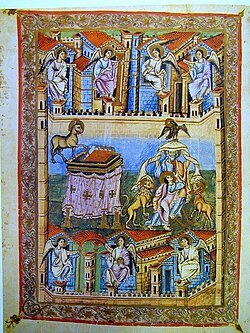
This creates one of the novel’s central tensions. Are the deaths truly part of a divine prophecy? Or are people forcing events into a symbolic framework because they desperately want the world to make sense?
The question reflects a broader medieval mindset. Medieval people often interpreted disasters, plagues, wars, and unusual events through a religious lens. Catastrophes were rarely viewed as random. They were signs, warnings, or messages from God.
Eco uses this tendency brilliantly. The abbey gradually becomes trapped inside its own interpretation of reality. The more the monks search for meaning, the more they become prisoners of the symbols they create.
The Poisoned Book
The mysterious book at the center of the murders is supposedly the lost second book of Aristotle’s Poetics, a work devoted to comedy and laughter.
Jorge of Burgos, the blind librarian, considers the text profoundly dangerous. To prevent anyone from reading it, he poisons the pages. Readers naturally moisten their fingers while turning pages. The poison enters their bodies gradually, killing them after prolonged exposure.
While researching historical assassination methods, I discovered many examples of poison being used against political enemies. However, I could not find a historical murder that closely resembles Eco’s poisoned manuscript. That made me suspect that the method itself is primarily symbolic.
The victims are not simply poisoned.
They are:
- Consuming forbidden knowledge
- Dying through interpretation
- Being destroyed by curiosity
In Eco’s hands, reading becomes physically dangerous.
The book transforms into a powerful metaphor for the fear of intellectual freedom.
Knowledge, Power, and Jorge’s Authority
One detail that becomes increasingly important is that Jorge is not the abbot. Officially, he does not possess the highest authority within the abbey. Yet he controls something even more important: access to knowledge. This is where Michel Foucault’s ideas become particularly useful.
Foucault repeatedly argued that knowledge and power are inseparable. Those who control information often possess more influence than those who merely occupy official positions.
Jorge decides:
- Which books are accessible
- Which books remain hidden
- Which interpretations are acceptable
- Which ideas must be suppressed
In effect, he controls reality itself within the library. His authority comes not from office but from access. The library becomes a mechanism of power. Who controls the archive controls memory. Who controls memory controls society.
The Pattern of Deaths
Although the deaths do not correspond exactly to specific passages in Revelation, each carries symbolic weight.
| Victim | Symbolic Meaning |
| Adelmo of Otranto | The fall of innocence beneath monastic purity |
| Venantius of Salvemec | Knowledge becoming literally poisonous |
| Berengar of Arundel | Hidden desires and corruption beneath discipline |
| Severinus | Rational inquiry destroyed when approaching forbidden truth |
| Malachi | The institution consumed by the knowledge it seeks to control |
| Jorge of Burgos | Fanaticism ultimately destroying itself |
| The Abbey Library | The collapse of controlled knowledge |
Rather than recreating Revelation verse by verse, Eco constructs an atmosphere of apocalypse. The abbey begins to read reality itself as a prophetic text.
Black Tongues and Poisoned Words
One detail that repeatedly caught my attention was the physical appearance of the victims.
Several develop:
- Blackened tongues
- Darkened fingertips
- Stains around the mouth
These details seem more symbolic than medical. The tongue carries enormous significance in a world built upon sermons, doctrine, and interpretation. Words shape belief. Belief shapes authority. The poisoned tongue becomes a metaphor for dangerous language and dangerous ideas. Knowledge enters through reading, but its effects spread through speech. The corruption visible on the body mirrors what the monks fear is happening to the soul.
Blindness and the Illusion of Certainty
The theme of blindness appears throughout the novel. Jorge is physically blind, yet he believes that he alone possesses true vision. This irony lies at the heart of Eco’s critique. The blind man controls the library. The man who fears interpretation controls interpretation. The man terrified of laughter becomes the guardian of truth.
Eco repeatedly asks a simple but uncomfortable question:
Who is actually blind?
This theme made me reflect on my own assumptions. It is easy to believe that we already possess the truth. Sometimes that certainty becomes its own form of blindness.
Before reading the works of figures such as Augustine of Hippo and Thomas Aquinas, I assumed they were simply defending established doctrine. When I finally read their works, I realized how much critical self-examination they engaged in.
Unlike Jorge, Augustine’s willingness to openly examine his own failures remains remarkable even today. Few people would willingly expose their weaknesses so honestly. That capacity for self-criticism may be the opposite of Jorge’s certainty. If he had been able to do that, the book’s outcome would have been different. Many will not have to die, and the books are not burned.
I have also struggled to maintain a healthy level of self-criticism, so this is something I need to remember. Just because I once convinced myself of something does not necessarily mean it is true or right.
Fire and the Destruction of Memory
The novel’s climax arrives with the destruction of the library itself.
The fire evokes multiple symbolic images:
- Babel
- Babylon
- The collapse of a civilization’s memory
What struck me most was the tragedy. Jorge spends his life preserving books. In the end, his obsession destroys them. The irony is devastating.
Throughout history, countless texts have disappeared through:
- Fire
- War
- Religious conflict
- Neglect
- Censorship
Every lost manuscript represents knowledge we may never recover.
When I think about the libraries that vanished throughout history, I often wonder what ideas disappeared with them. What discoveries were lost? What stories were never copied? Finally, what perspectives vanished forever?
The destruction of the library reminds us how fragile knowledge really is.
Why Eco Uses Revelation
The more I studied the relationship between the murders and Revelation, the more I realized that Eco was not trying to create a direct biblical puzzle. His purpose seems broader. He is exploring humanity’s desire to impose patterns on chaos.
The monks interpret events through:
- Prophecy
- Scripture
- Fear
- Symbolism
William approaches events differently.
He relies on:
- Observation
- Logic
- Evidence
Yet even William ultimately fails to save the library. That failure matters. It suggests that neither complete faith nor complete rationality can fully master reality. Human beings search constantly for certainty. However, reality refuses to cooperate. Just like Camus says, we constantly live in Absurdity.
Symbols help human beings make sense of a complex world. Yet Eco also warns that symbols can become cages. When we insist that reality conform to our interpretations, we stop seeking truth and begin defending our assumptions.
Final Thoughts: The Real Poison
By the end of the novel, I no longer believe that Aristotle’s manuscript is the true poisoned object. The book itself is merely a tool. What Eco ultimately places under examination is something far more dangerous.
The real poison may be the human desire for absolute certainty.
Jorge is convinced that he possesses the final truth. Because of that conviction, he believes he has the right to decide what others may read, what they may think, and what knowledge should remain hidden. In his mind, protecting truth justifies controlling access to it.
This is what makes the tragedy of The Name of the Rose so powerful. The loss is not simply the destruction of books or even the deaths of the monks. The deeper tragedy is that certainty becomes more valuable than curiosity. The search for truth is replaced by the defense of a single interpretation.
The poisoned manuscript claims its victims one by one, but the more dangerous poison spreads throughout the entire abbey. It is the belief that truth belongs exclusively to one person, one institution, or one interpretation. Once that belief takes hold, questions become threats, curiosity becomes suspect, and knowledge becomes something to be guarded rather than explored.
In the end, the poison hidden within the pages kills only a handful of readers. The poison of certainty destroys an entire library.
This content is restricted to site members. If you are an existing user, please log in. New users may register below.